
These shorebirds birds are 9 inches long, have a wingspan of 17 inches, and weigh 2 oz. They mate in the Dakotas and Saskatchewan in May. The females lay eggs and promptly leave, heading south to the saline lakes of the Great Basin: Great Salt Lake, Abert’s Lake in Oregon, and Mono Lake north of Bishop. The males look after the eggs, but once the chicks are hatched, the males also head south. The chicks are born with feathers and find their own food; soon they also go south. The birds show up at Mono Lake from mid-June to August. Surveys at Mono Lake done 35 years ago estimated up to 80,000 phalaropes in a year, but survey methods then and now are pretty crude. The females arrive first, then males, then juveniles. They hang out for a month doubling their weight on brine shrimp and alkali flies — an unlimited, but monotonous, buffet. They use the time and food energy to molt, discarding their old feathers and growing new ones. Then they fly south – a 3-day non-stop to South America, about 3000-4000 miles. They spend the Boreal winter at inland saline lakes near the Andes Mountains of Argentina, Bolivia, and Chile. In spring of the next year, they fly north and do this all over again.
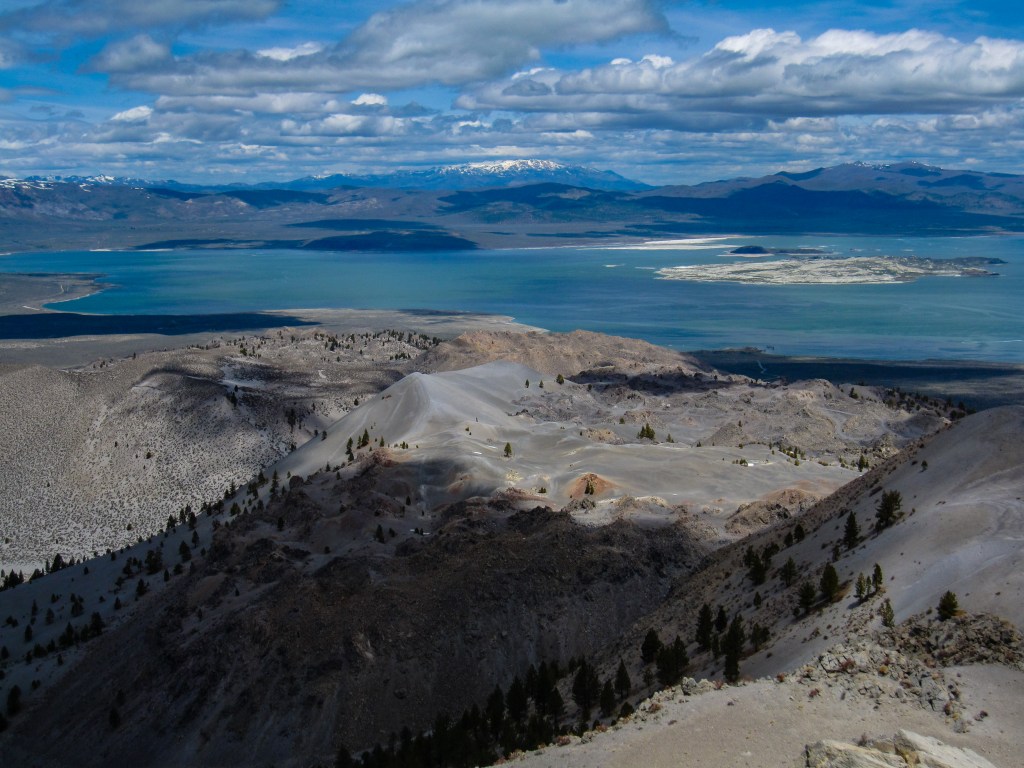
Below are photos of Mono Lake, where thousands of Phalaropes gather every summer. The first photo was taken from the Mono Craters, a group of volcanos south of the lake. In the foreground is volcanic ash and rubble. In the middle distance on the right is an island called Paoha. Most California Gulls migrate from the coast to this island in the summer, nest, and raise their chicks. In the far distance are the snowy summits of the Sweetwater Mountains, which straddle the California-Nevada border.
The winter view below, looking south, shows the Lake from near Conway Summit. The large road is Highway 395. The town of Lee Vining is in the distance on the right. Rain and snow are coming down from the clouds.

Sunrise from the Lake’s south shore.

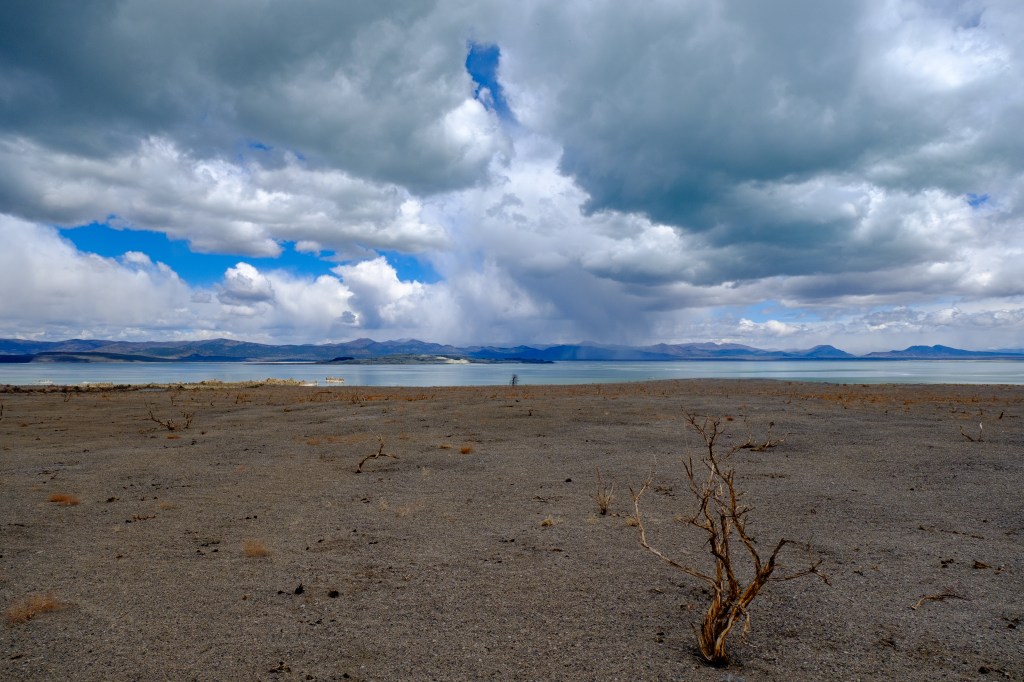
Lightning started a fire just a few years ago. It burned off sagebrush and rabbitbrush from a large area on the Lake’s south shore.
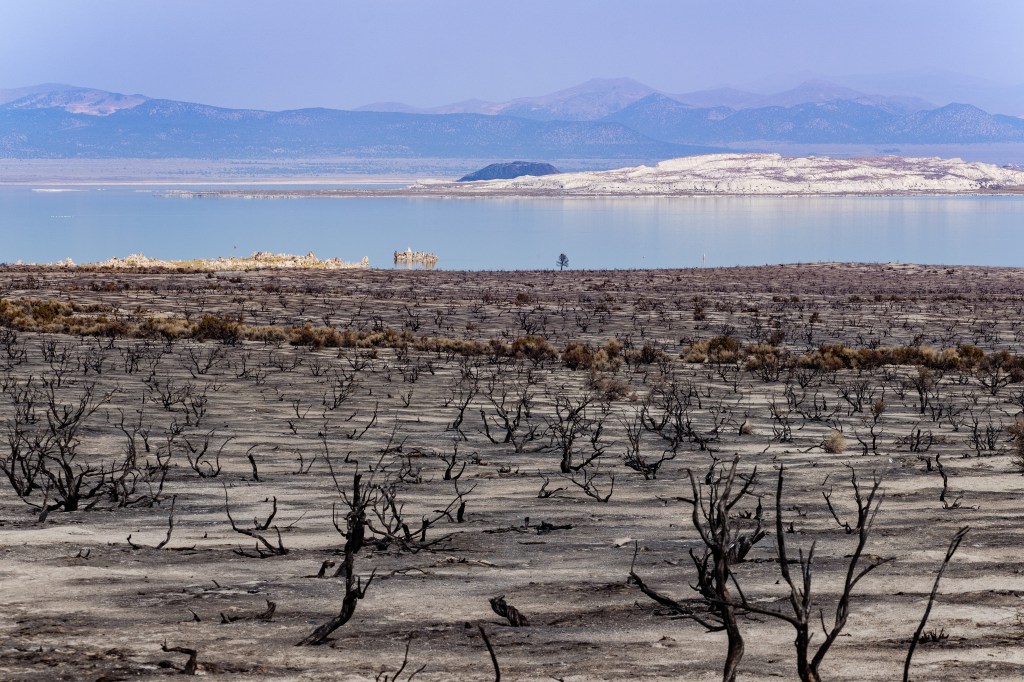
Another view of the burned area.
Below are pictures of Wilson’s Phalaropes floating, preening, and feeding. These images were taken from the South Tufa area of Mono Lake, which has easy road access and a boardwalk that leads to the water. The female birds have a black facial stripe that morphs into a cinnamon color on the back of the neck; very elegant. Colors for the males and juveniles are muted; a blah look.

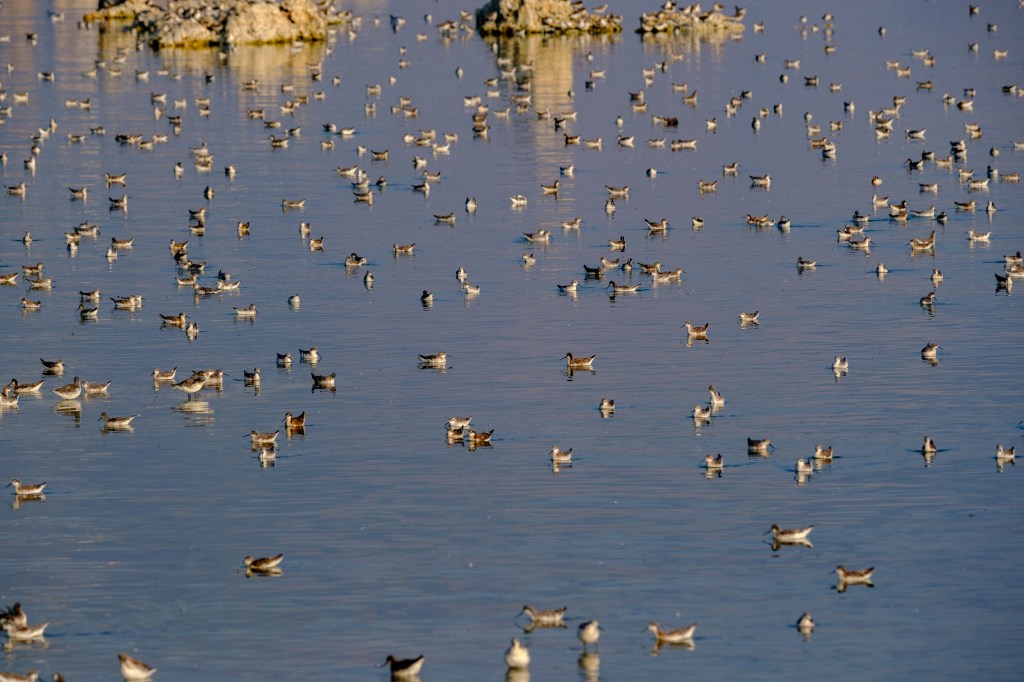
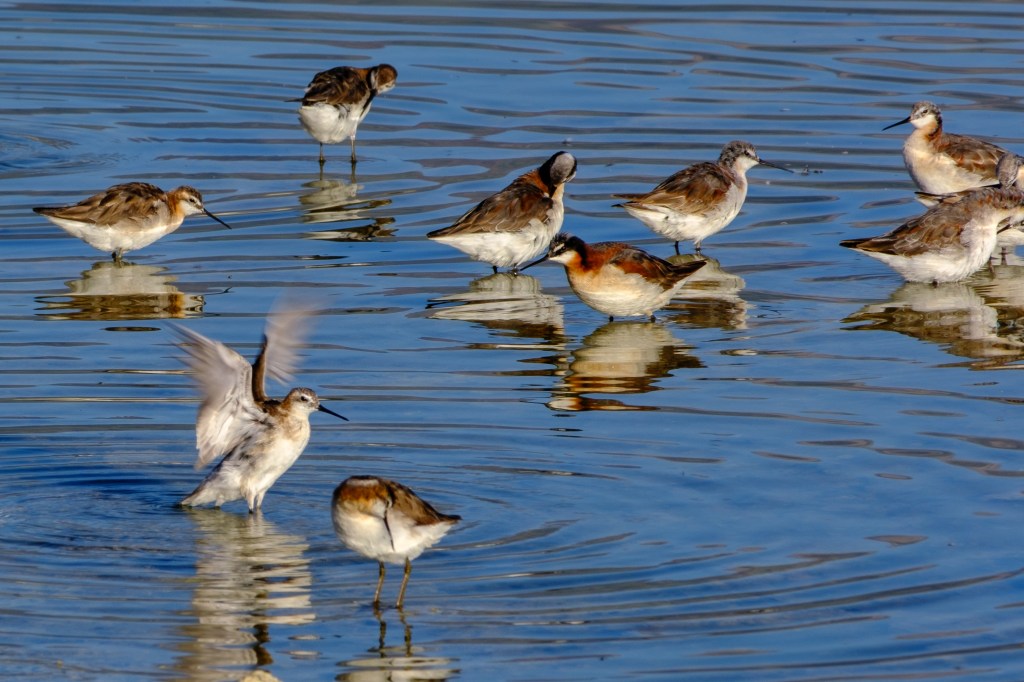
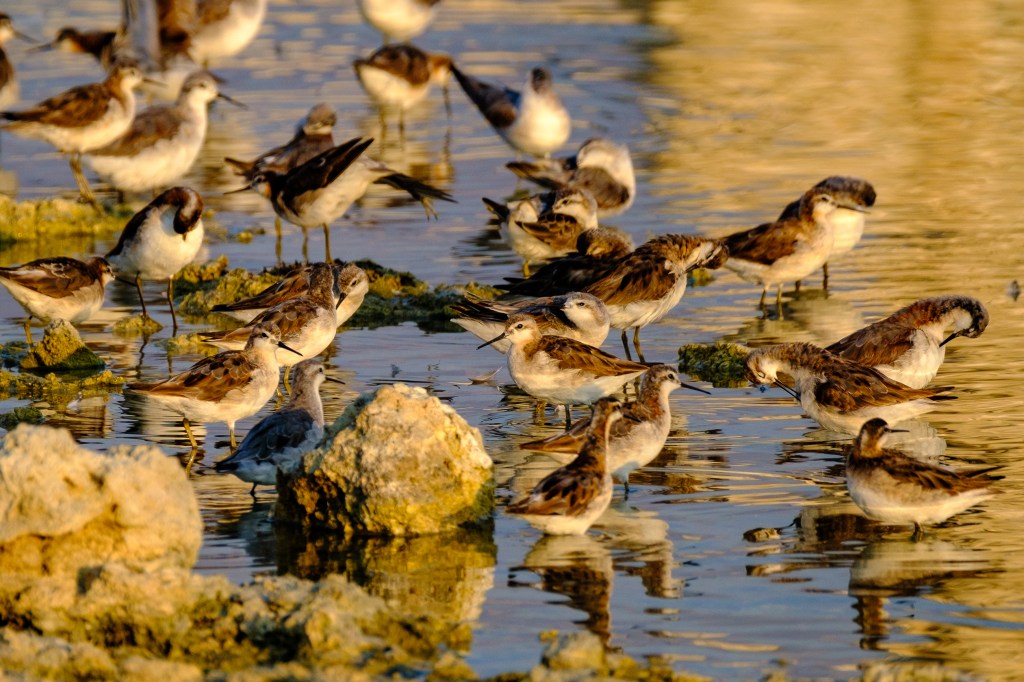

The image above shows some birds feeding. All they have to eat here are brine shrimp, which are less than a half-inch long, and small alkali flies. They grasp brine shrimp or flies with the tip of their bills, then open the bill so that a water droplet containing the food moves up to the mouth using surface-tension. Two California biologists studied this with high-speed cameras and their article shows photos of water droplets moving up a bird’s bill from tip to mouth in 0.01 seconds. (Rubega MA, Obst BS. Surface Tension Feeding in Phalaropes: Discovery of a Novel Feeding Mechanism. The Auk: A Quarterly Journal of Ornithology. 1993;110(2):169-173.)
Until 2021, I knew nothing about this bird. Roberta and I visited Mono Lake’s South Tufa beach early on July 2 and found thousands of them at the shore, floating on the water, and flying about in flocks of hundreds, even thousands. We came back on July 6 and 13 to get more photos. The birds made little noise; just faint gurgling sounds. At the shore they seemed restless, either eating or preening themselves. The scene was one of the most exciting wildlife events I’ve ever seen, comparable to seeing animal herds on the Serengeti.
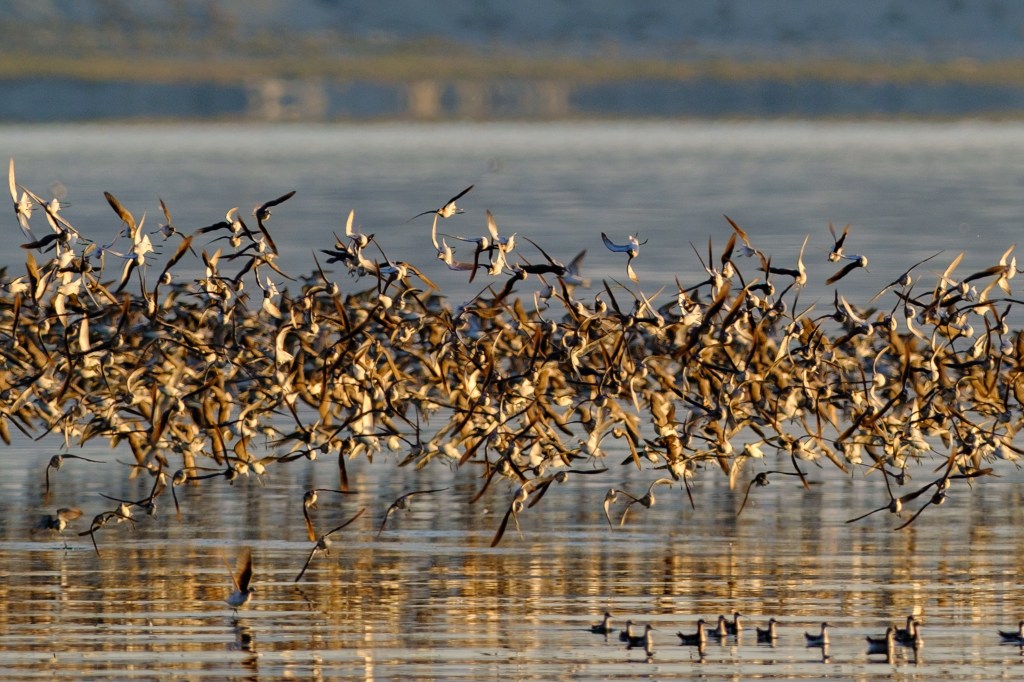
Below are two images of Phalaropes landing.
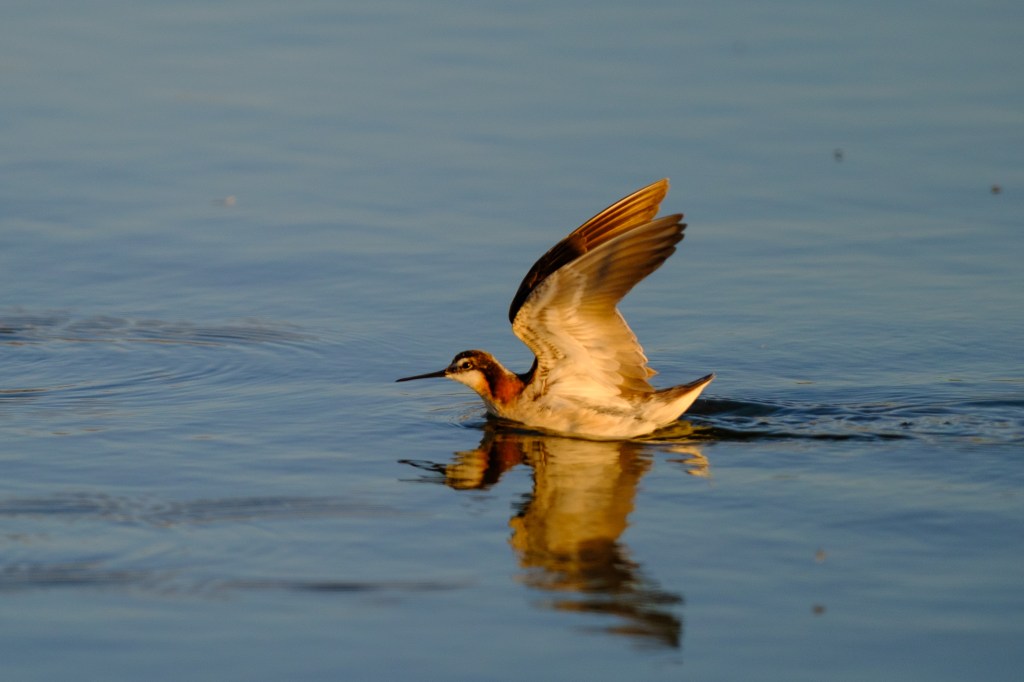

Every few minutes a flock of hundreds or thousands took off, zoomed about (at speeds up to 50 mph) near the water surface or high above the water, and then landed on the water. Large flocks made a “whooshing” sound as they went past. The landings looked like a controlled crash; the birds spread their wings, put out their feet, and take several steps on the water before flopping down. Their bellies are white, backs are a mix of browns. So depending on their angle in flight, they make look white, brown, grey, or black. As they change direction, the color of the flock changes — a fast moving plume of black smoke seems to turn white. Sometimes a dark-appearing flock crosses the path of another flock that looks white.
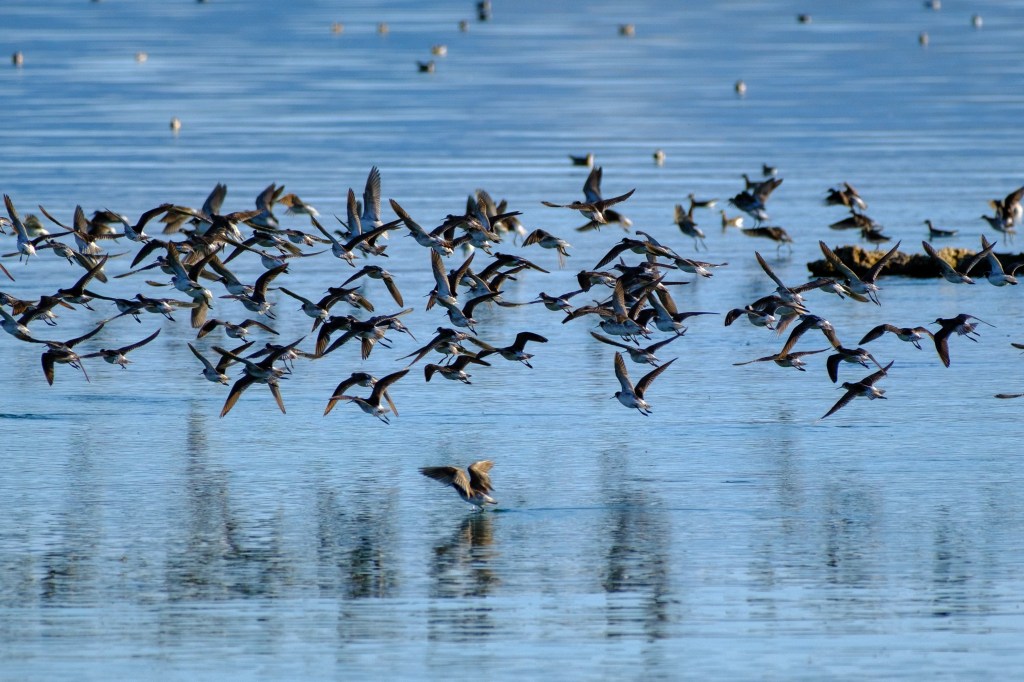
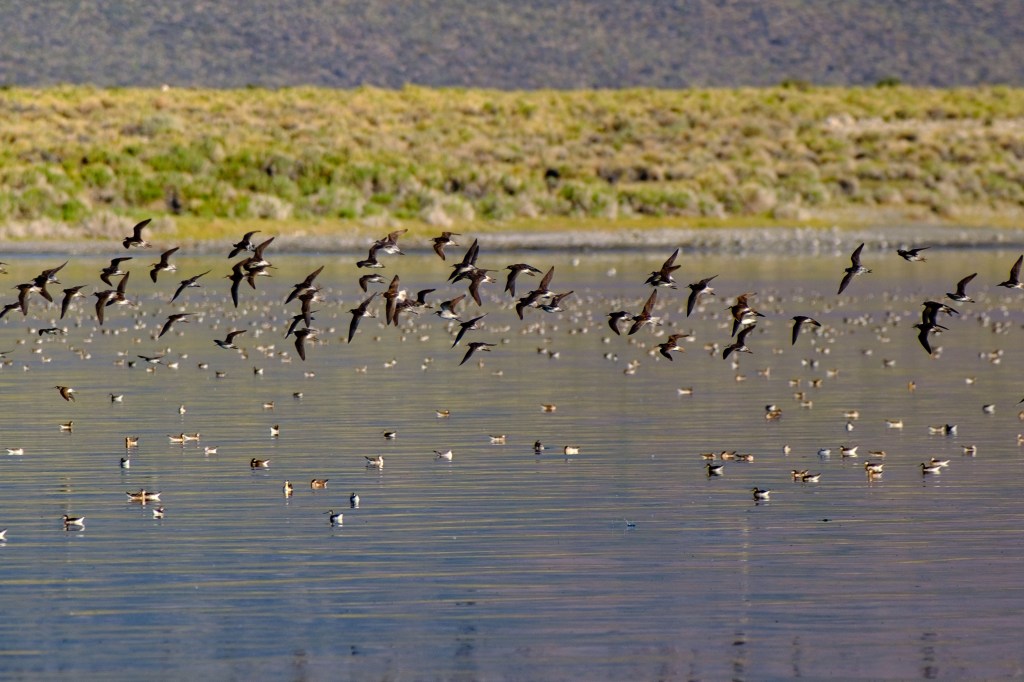

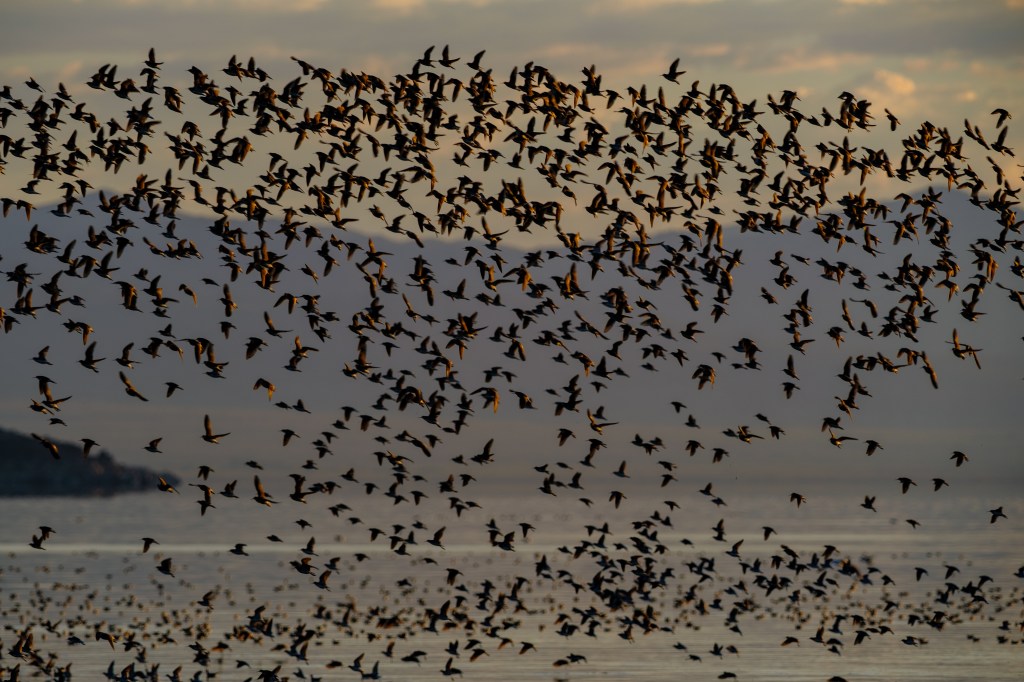
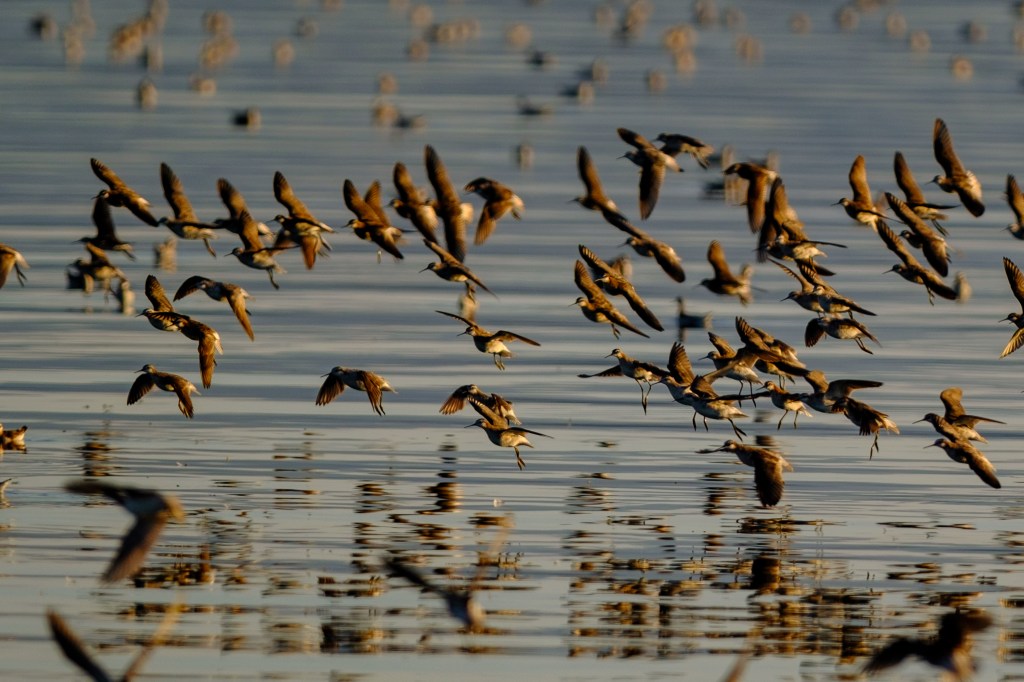
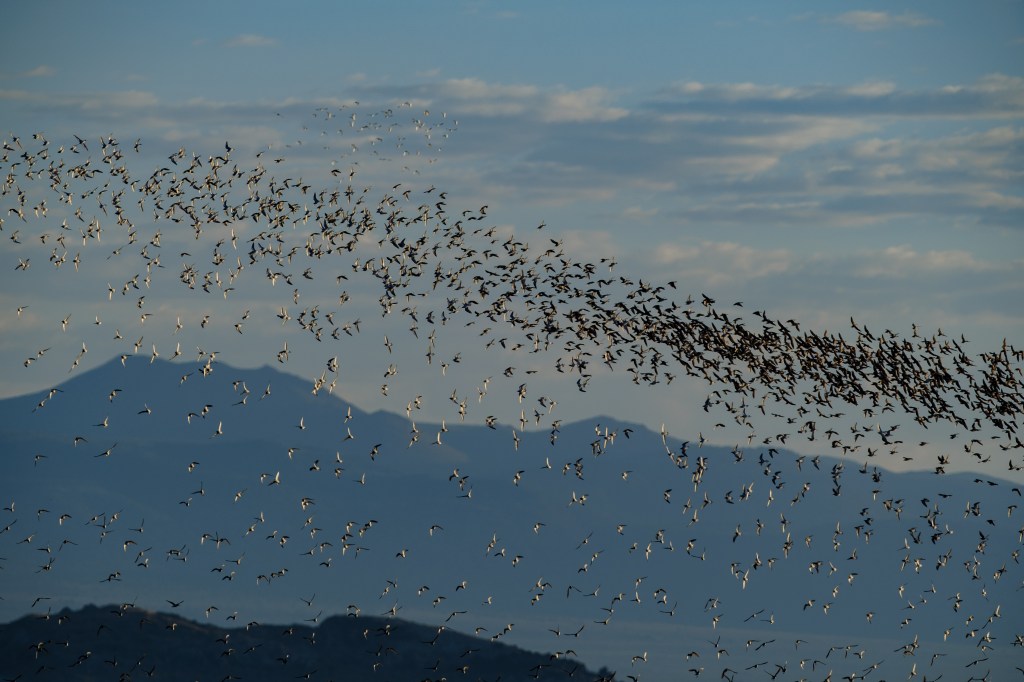
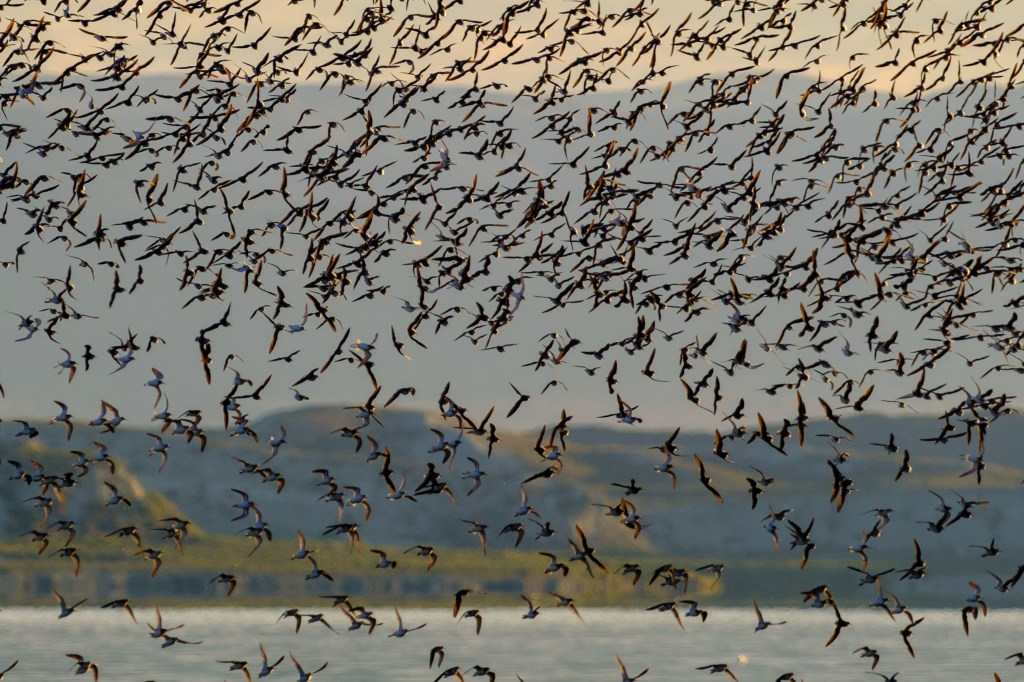
In some photos, individual birds are upside down! Does air turbulence from the flock tip them over? Or are they just banking a turn very hard? How do they avoid crashing into each other? As they land, they seem to touch at times.
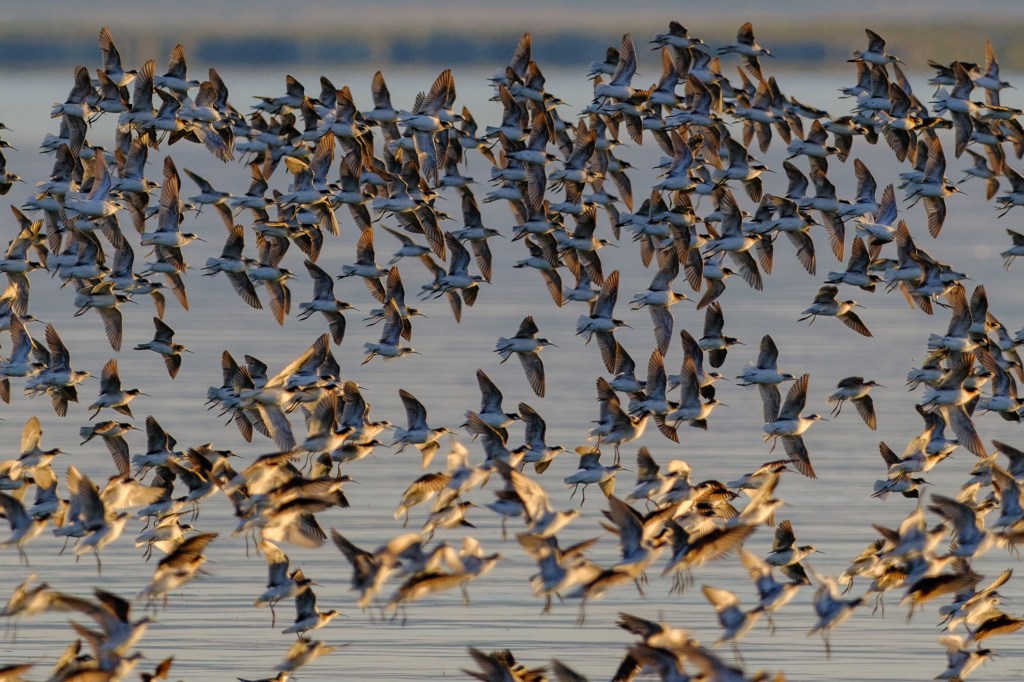
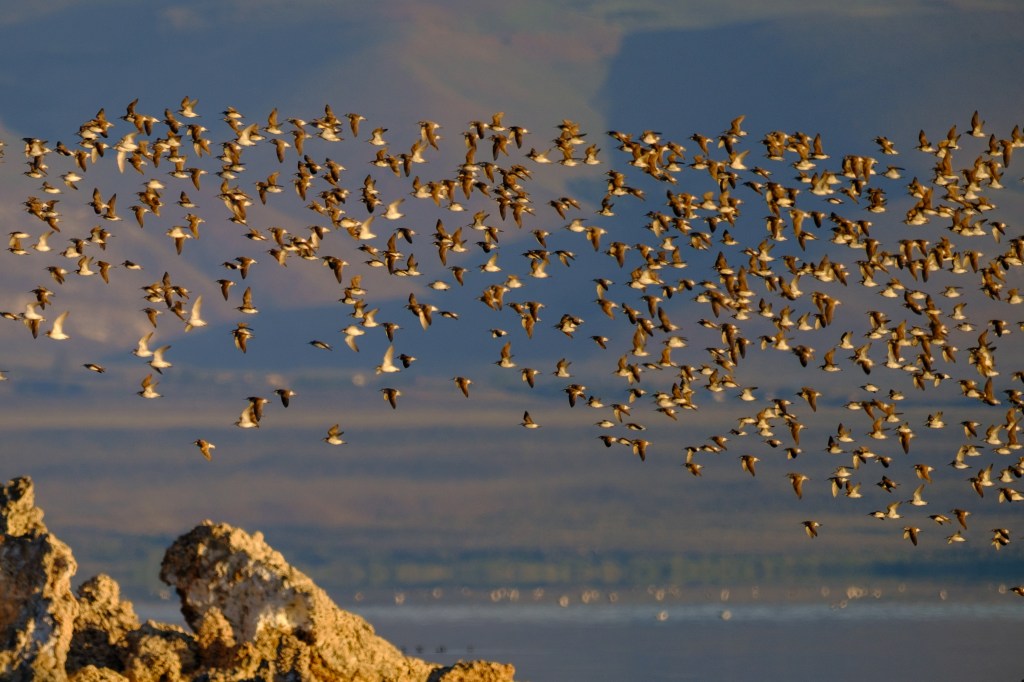
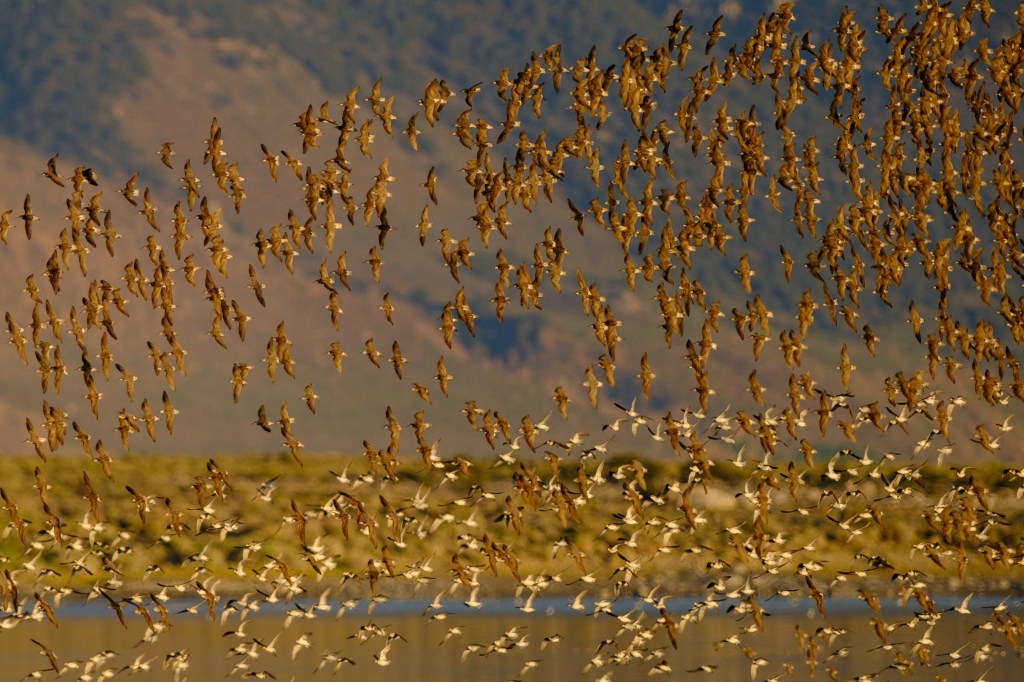
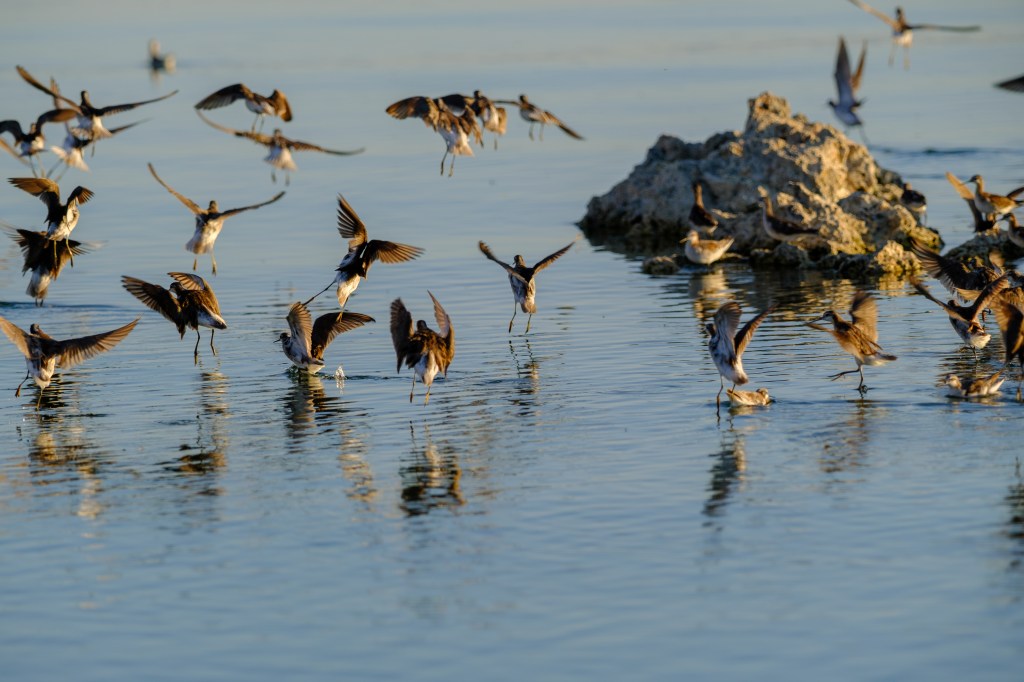
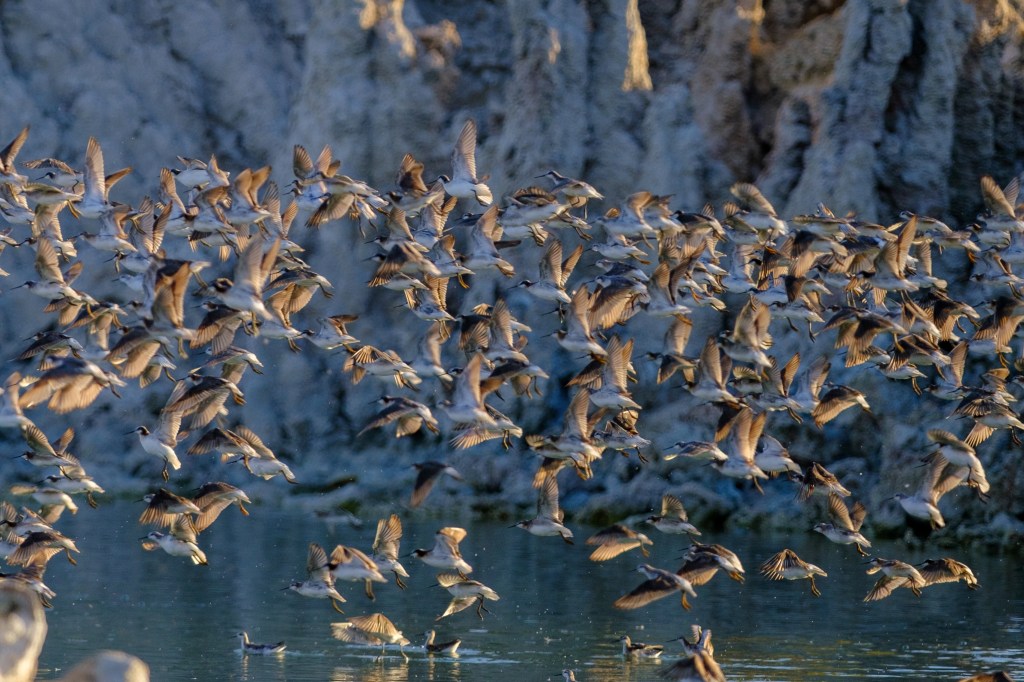
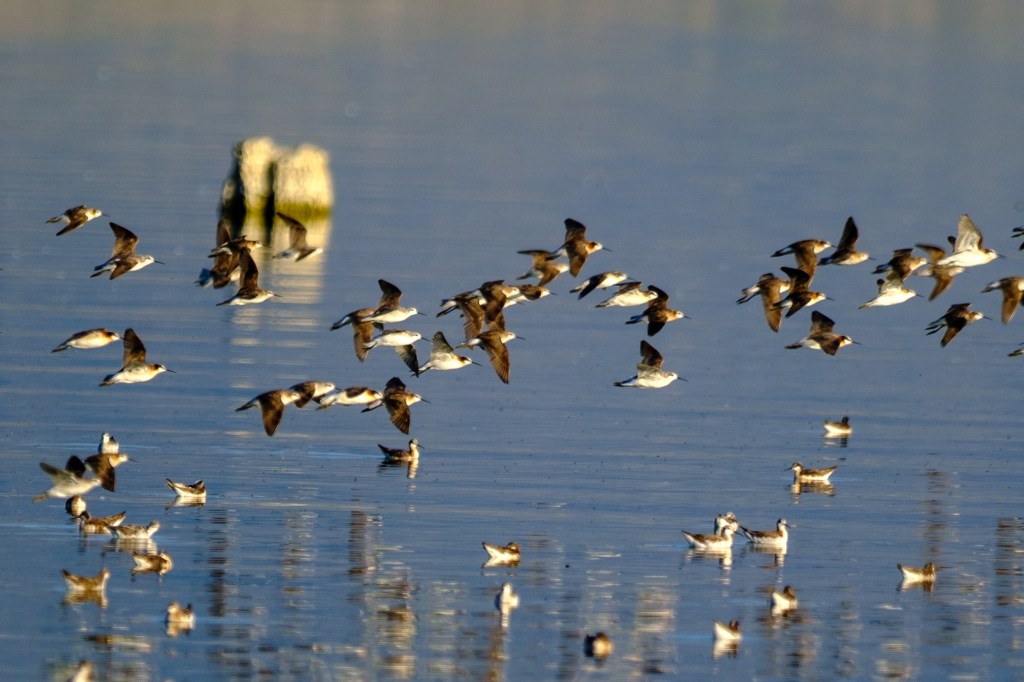
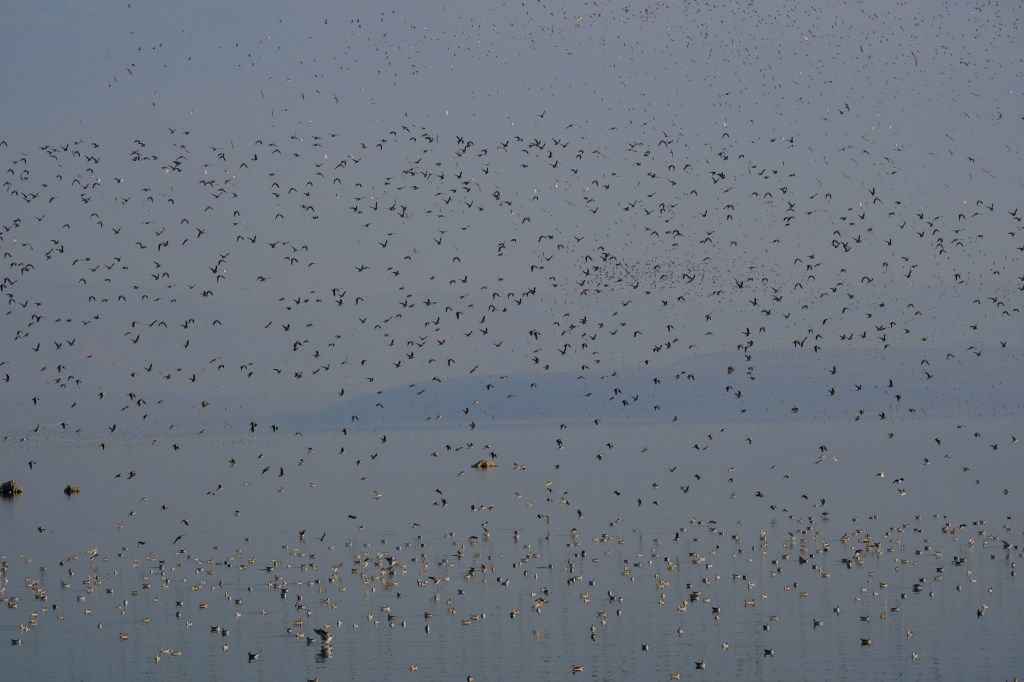
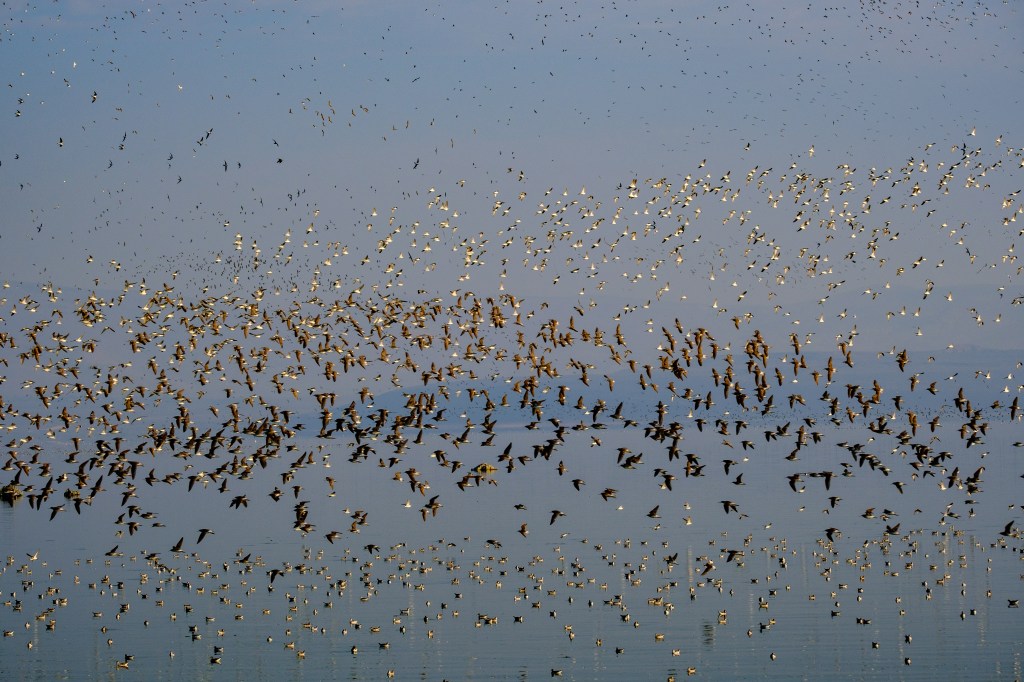
Why do they fly about so much? I assume they are getting their muscles in shape for the 3000-mile trip to South America. They are training, just as a human trains for a marathon. Are they also practicing how to fly as a group? When they head south, they usually lift off at night, head for the coast, and fly over the ocean. I wonder what it would look like to see a flock pass overhead against the stars or the moon?
Who was Wilson?
Alexander Wilson (1766 to 1813) was born in Scotland. He moved to America in 1794 (age 27) in the hope of escaping poverty. He lived in Pennsylvania. Before his death at age 47, he published 9 books of bird illustrations; American Ornithology (1808-1814). His name is attached to Wilson’s Storm-Petrel, Wilson’s Plover, Wilson’s Snipe, Wilson’s Phalarope, and Wilson’s Warbler.
In 2023, the American Ornithological Society announced a plan to revise North American bird names. Instead of naming birds for people (all white males of European heritage), names will be revised to describe the birds. They plan to revise 10 names in 2024, including Wilson’s Warbler and Snipe. Europeans did not discover these birds; they were known to indigenous people for thousands of years.
A couple of additional photos remind us that Phalaropes are not the only creatures at Mono Lake. Roberta spotted this Desert Cottontail on April 2, 2024.


 Birds of Bishop