
In their book about Sierra Nevada birds, Beedy and Pandolfino wrote: “Eagles may get all the press, but Great Horned Owls are really the top predator of the North American bird world. They feed primarily on rodents and rabbits but will kill almost any animal they can carry, including birds, snakes, fish, and even animals other predators avoid completely, like porcupines and skunks. They can fly away with prey as much as three times their own weight and are known to kill house cats, small dogs, geese, and Great Blue Herons on occasion.”
Roberta and I have seen Great Horned Owls near Bishop at the Bishop Creek Canal, Airport Road, and the Buckley Ponds. One reliable location is a dirt road that branches off Dixon Lane. The road is lined with cottonwoods and owls sometimes raise their young there. In January or February, a pair of owls will occupy a nest that was built by Red-tailed Hawks. Eggs arrive in March and babies appear in April. Two months later the fledglings are learning to fly. We have seen from 1 to 4 baby owls in the spring. Dozens of people walk this road every day, often with dogs, but the owls still like the location. This year there were 4 fledglings and I was able to collect some photos.
An adult Great Horned Owl is almost 2 feet long, has a wing-span of 3.5 feet, and weighs 3 pounds; a little bigger than a Red-tailed Hawk. In daytime, the owls sit on the ground or branches and blend in with surrounding trees. At night they use incredible hearing and eye-sight to hunt.
When a bird flies through the air, the feathers create turbulence that produces sound. You can sometimes hear a whooshing noise when a large flock of Phalaropes or Blackbirds flies past. When a Common Raven flies nearby, up to 100 feet away, I often hear the sound of each wing-beat. The bird is constantly surrounded by this noise when flying. Most owls, however, use their ears to locate prey in the dark. These night hunters have evolved special feathers that smooth the airflow and muffle the sound of the wing slicing the air. Silent flight enables an owl to locate faint sounds that give away the victim’s position. The other night creatures do not hear the danger until it is too late.
Adult Owl Portraits
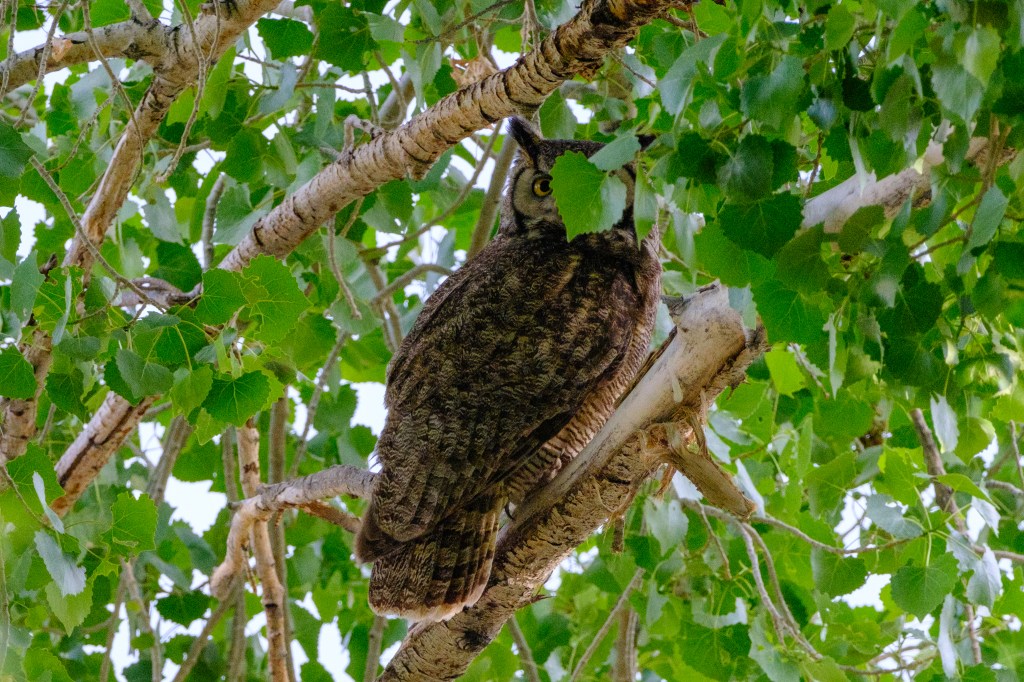
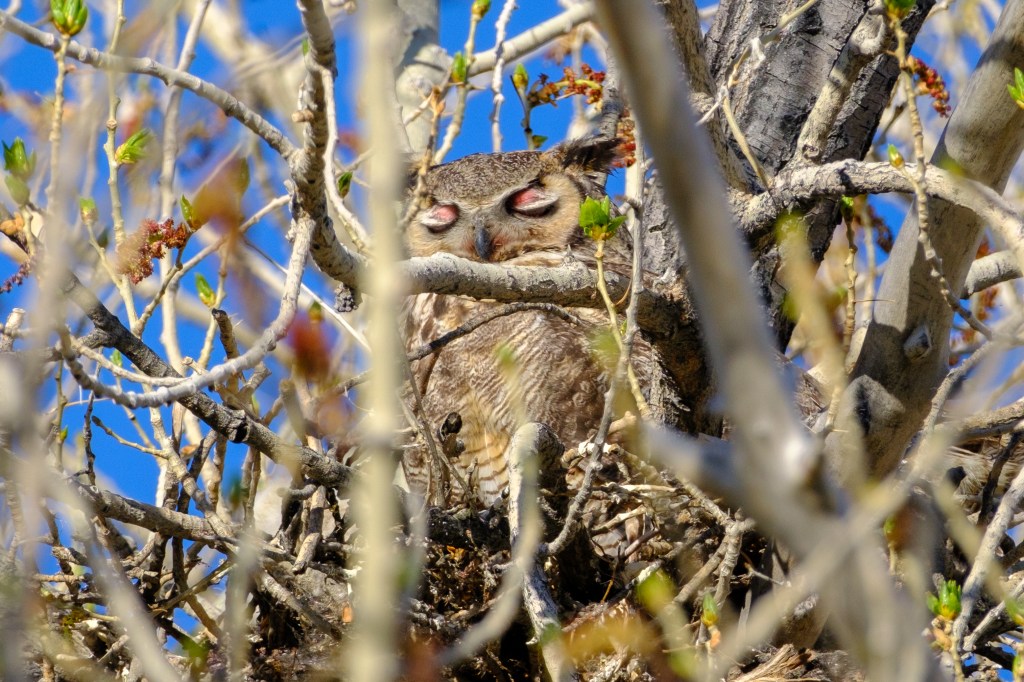
Below are photos of a typical owl, hiding in shadow behind branches. This is frustrating; it makes me want to carry hedge clippers so I can get a good photo. To find an owl, Roberta and I use camera or binoculars to study shaded areas. Often we spot an “owl” that turns out to be a stump or branch. One day we could not find an owl that we were sure was there; until we looked up and realized it was sitting on a branch just 4 feet above Roberta’s head.
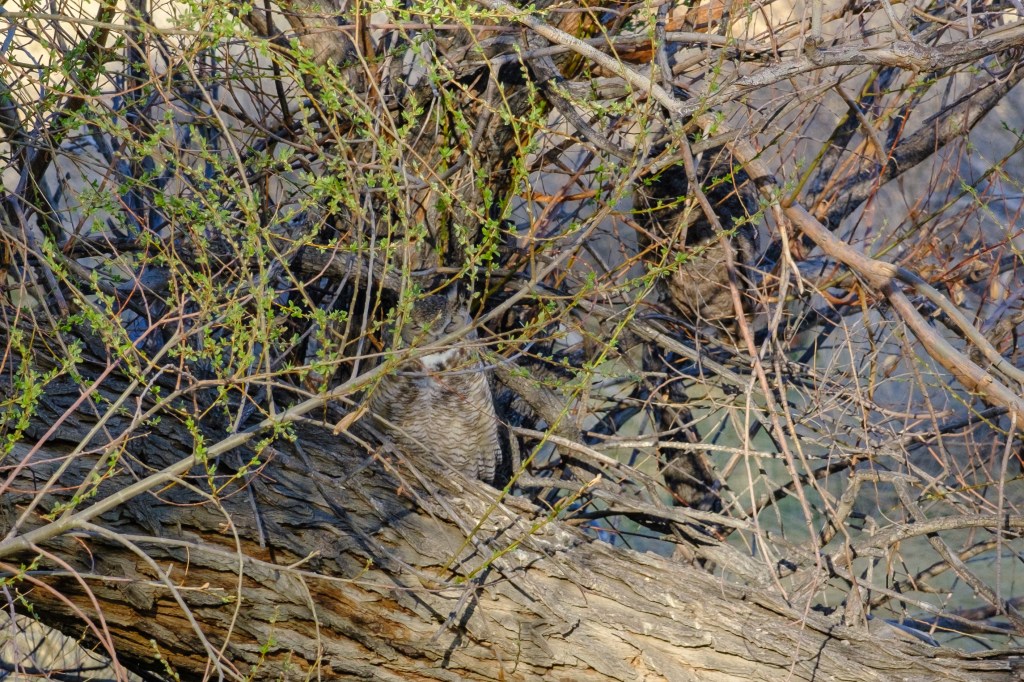
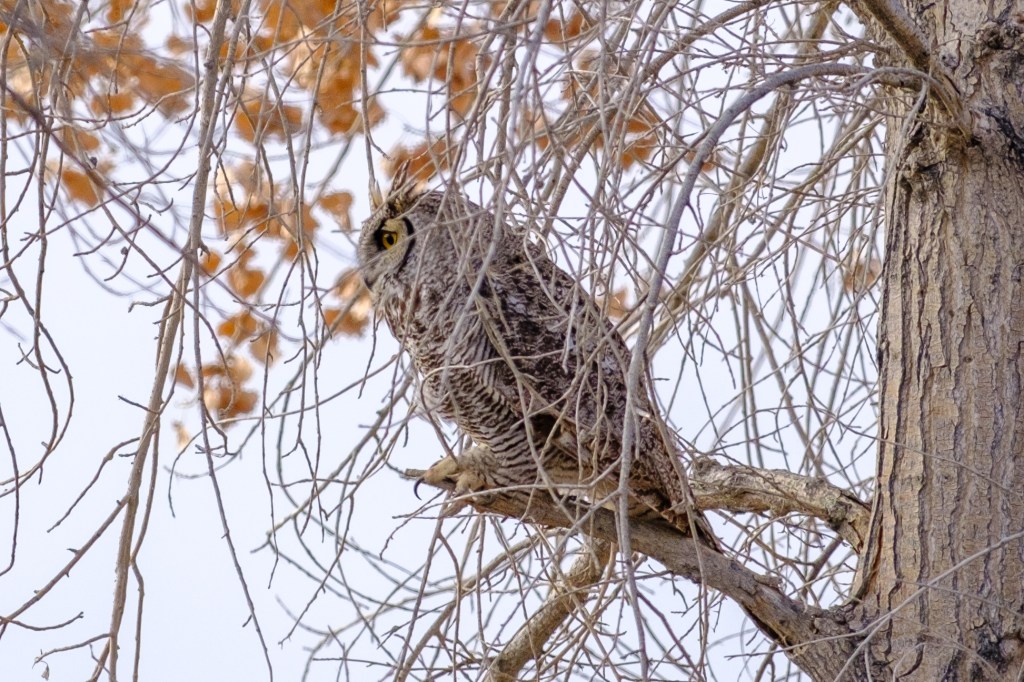
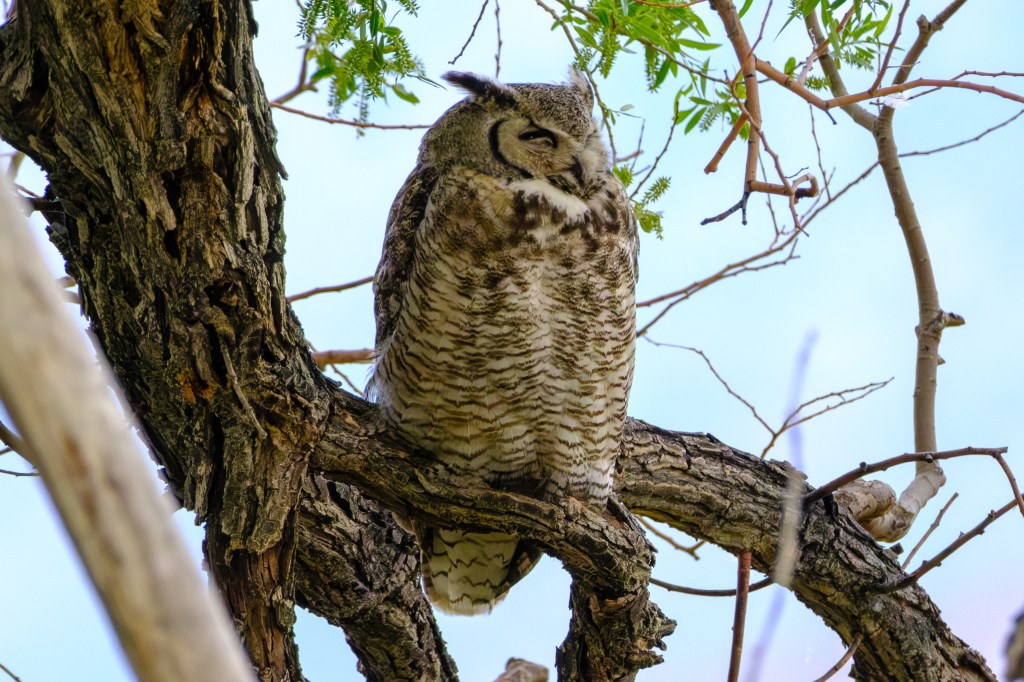
Sometimes adults are easy to spot. This seems to be especially true in early morning, when they are sitting with fledglings. Here are a few adult portraits.
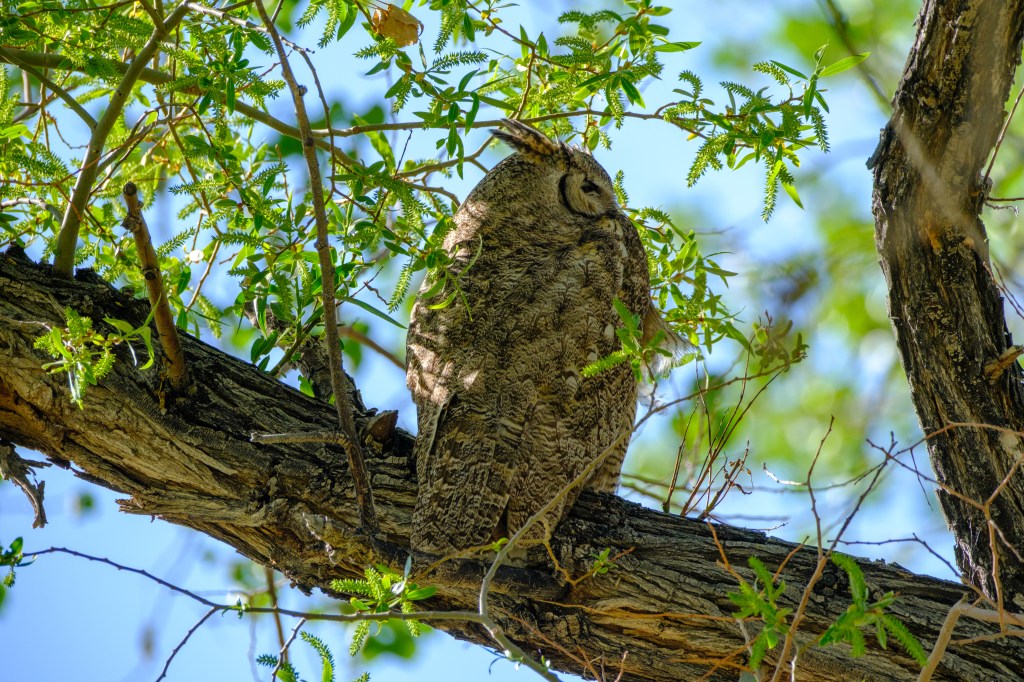
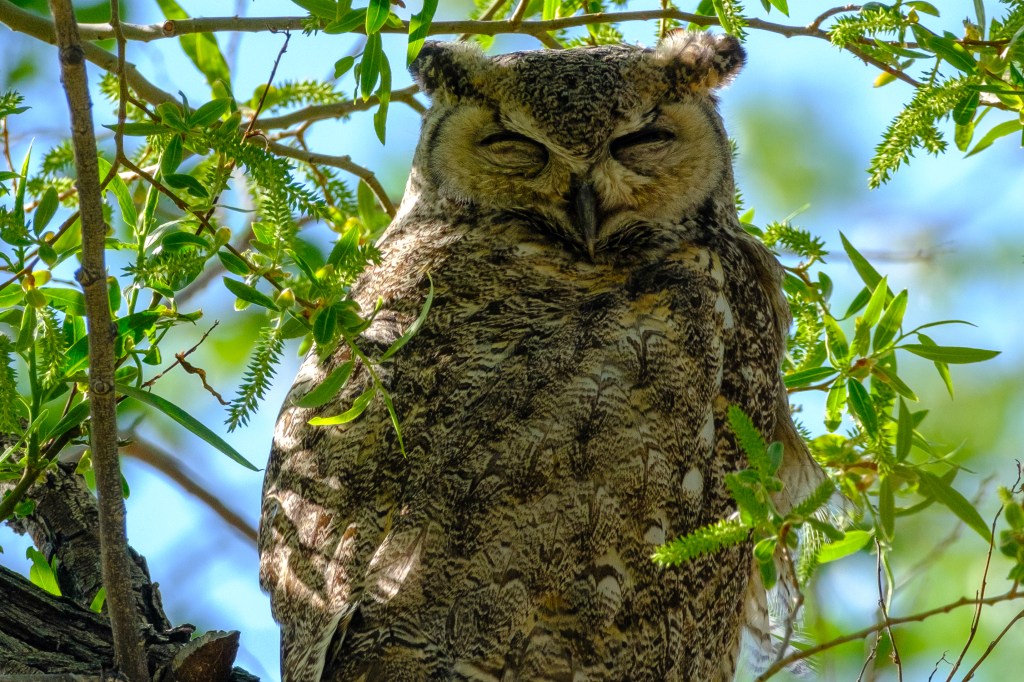
Look closely at the “horns” in the picture above. They are just feathers. They have nothing to do with hearing. Some authors suggest they help with camouflage.
Fledgling Owl Photos
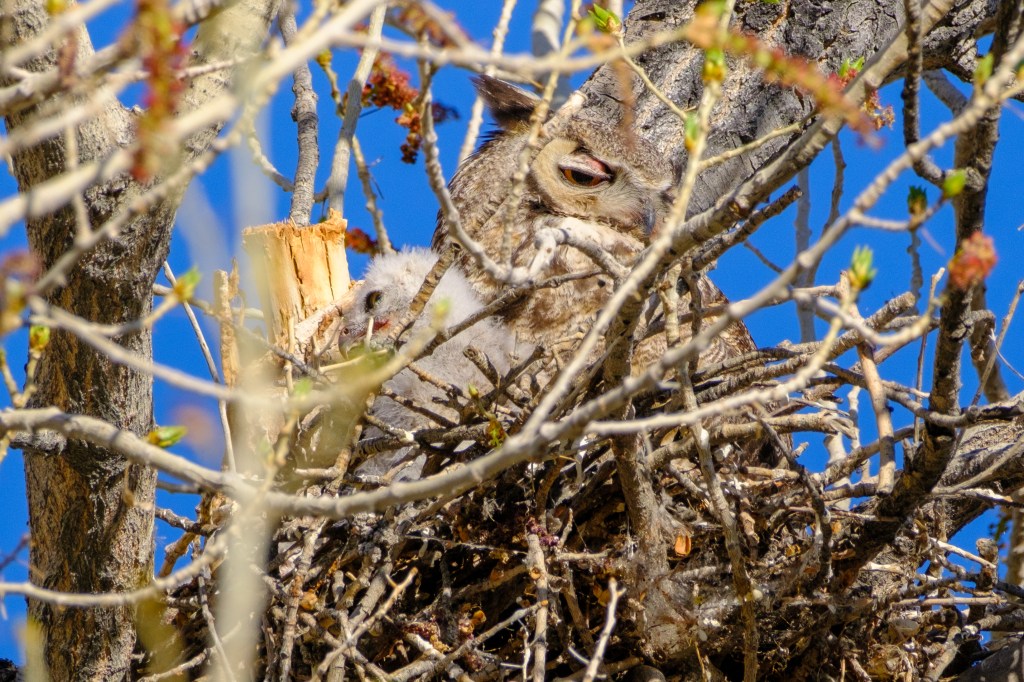
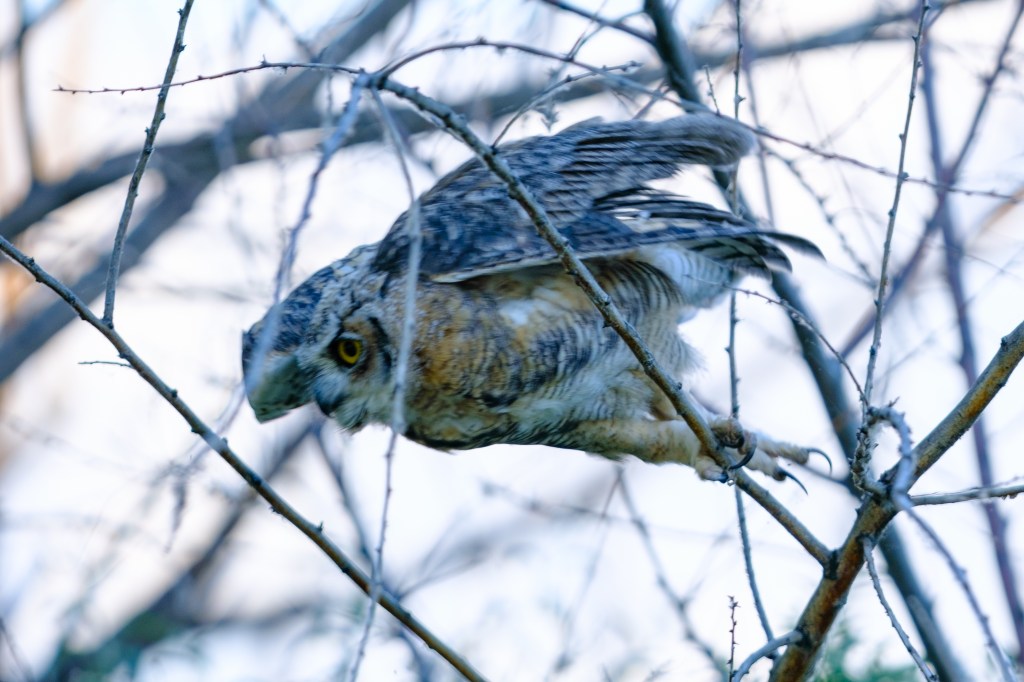
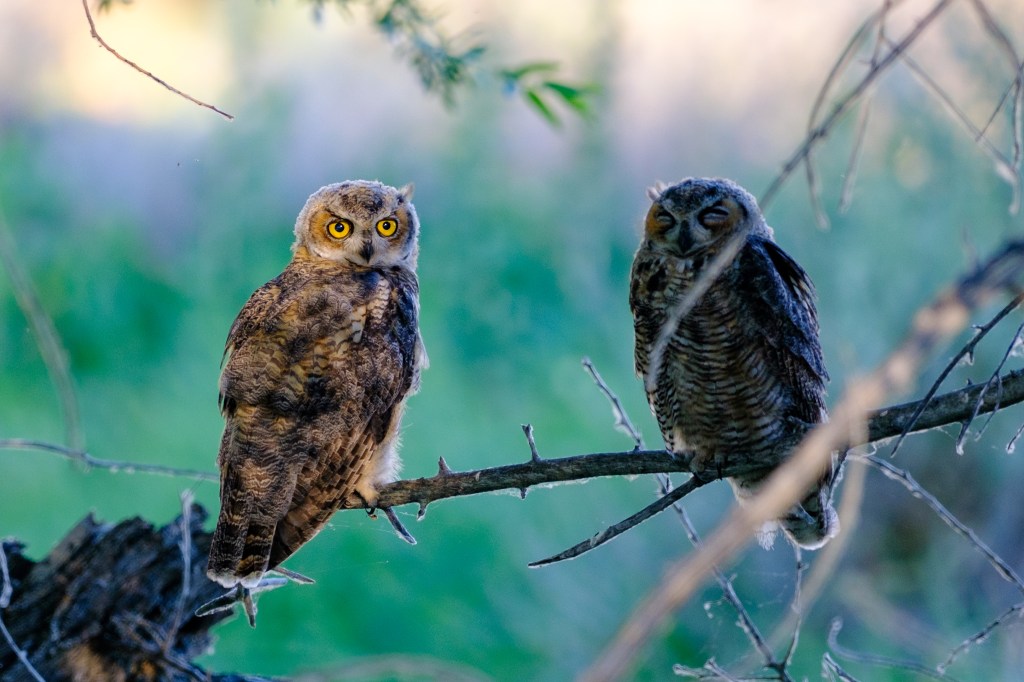
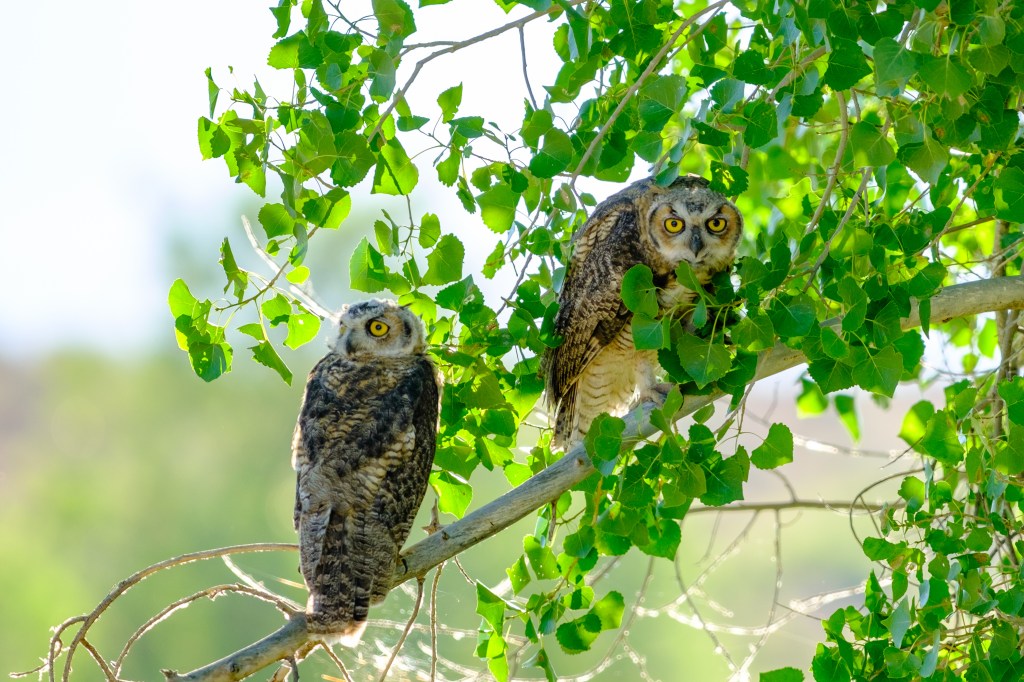
The youngest fledglings look ridiculous. They have white feathers and no “horns.” In just a few months they start to look like adults. By fall they go off to live on their own. Here are pictures of babies, starting with the youngest:

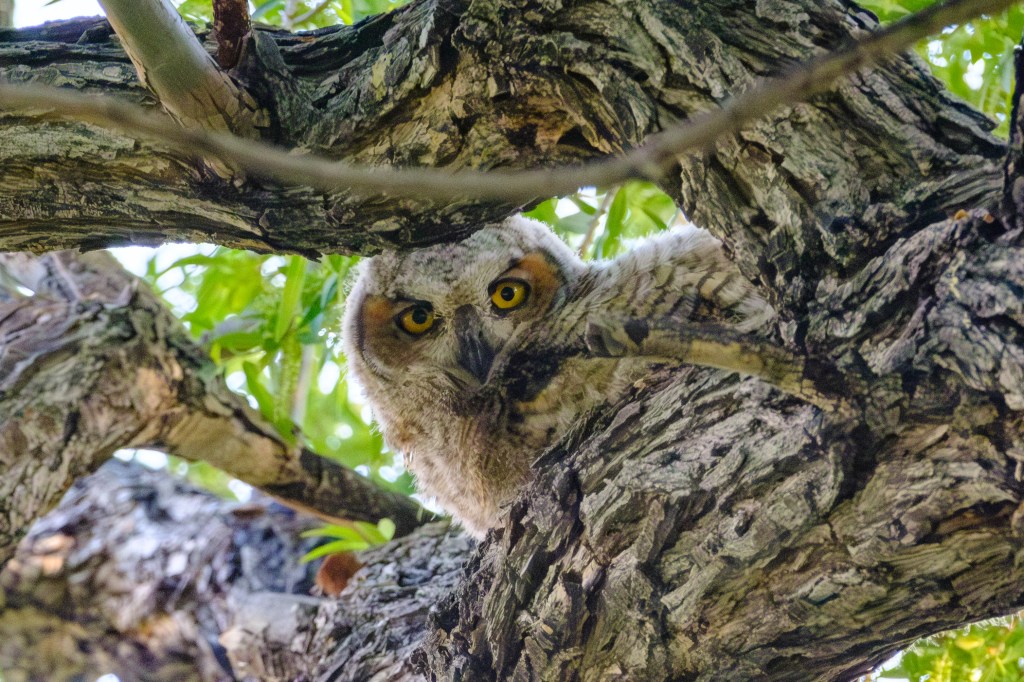
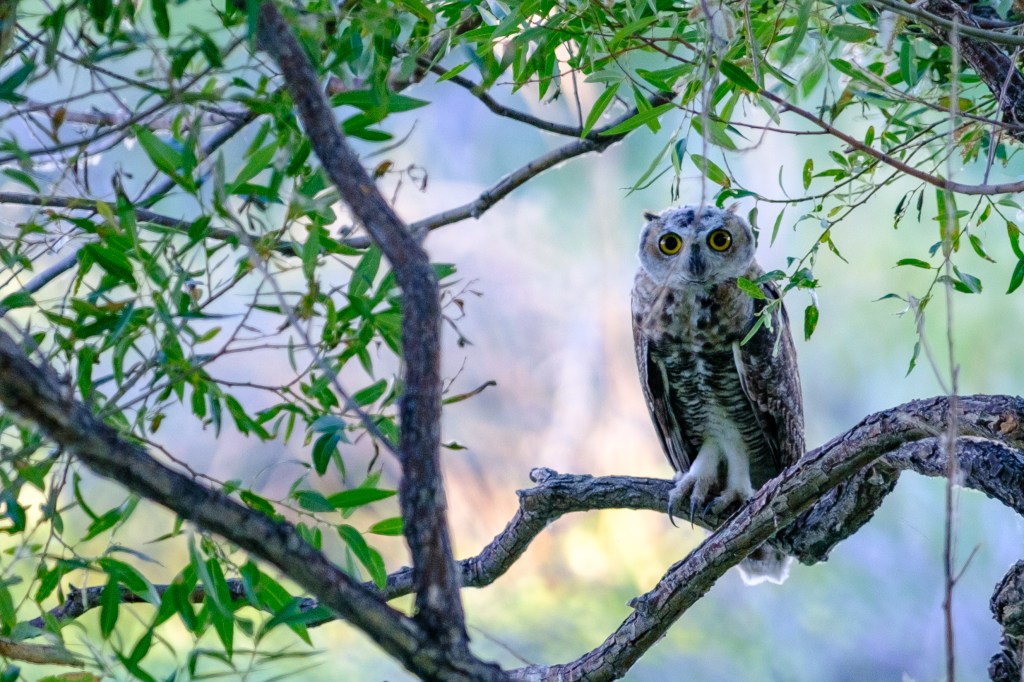
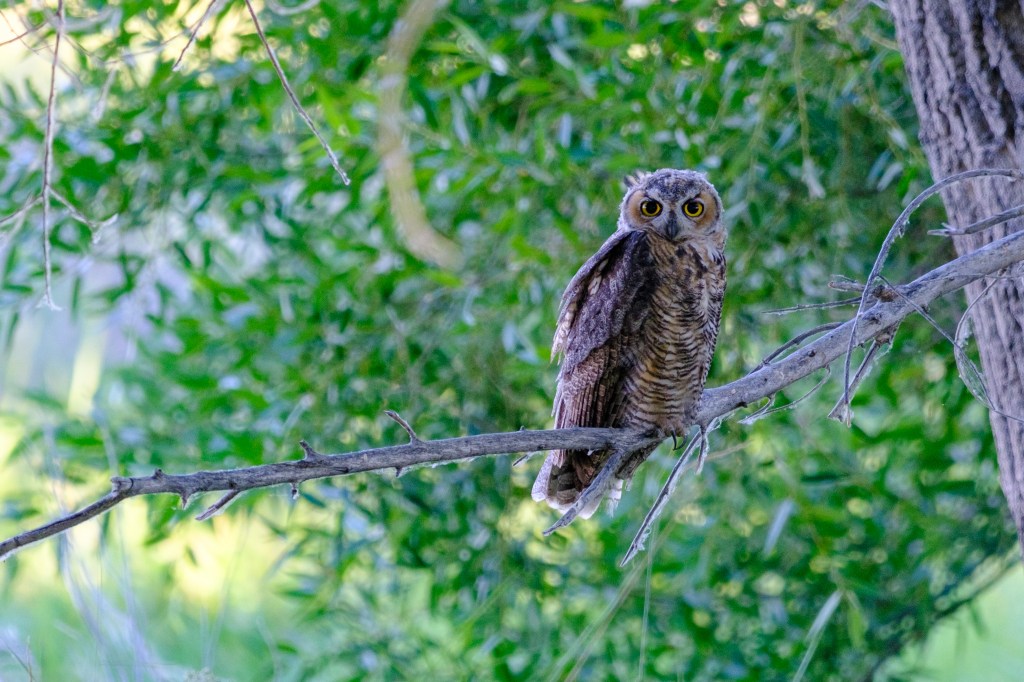
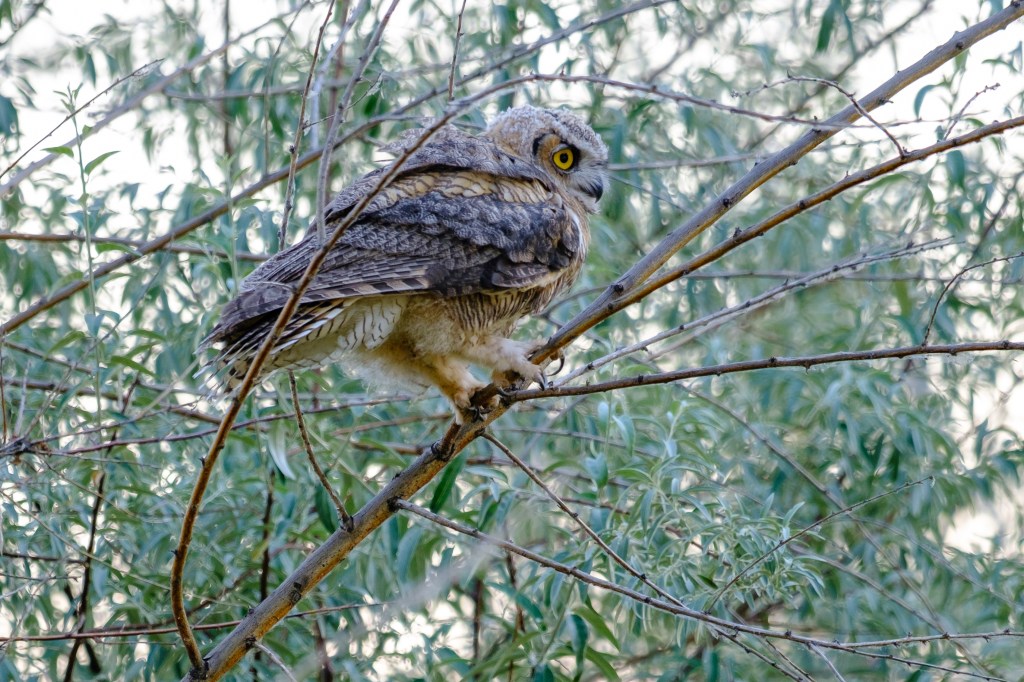



The “X” feet
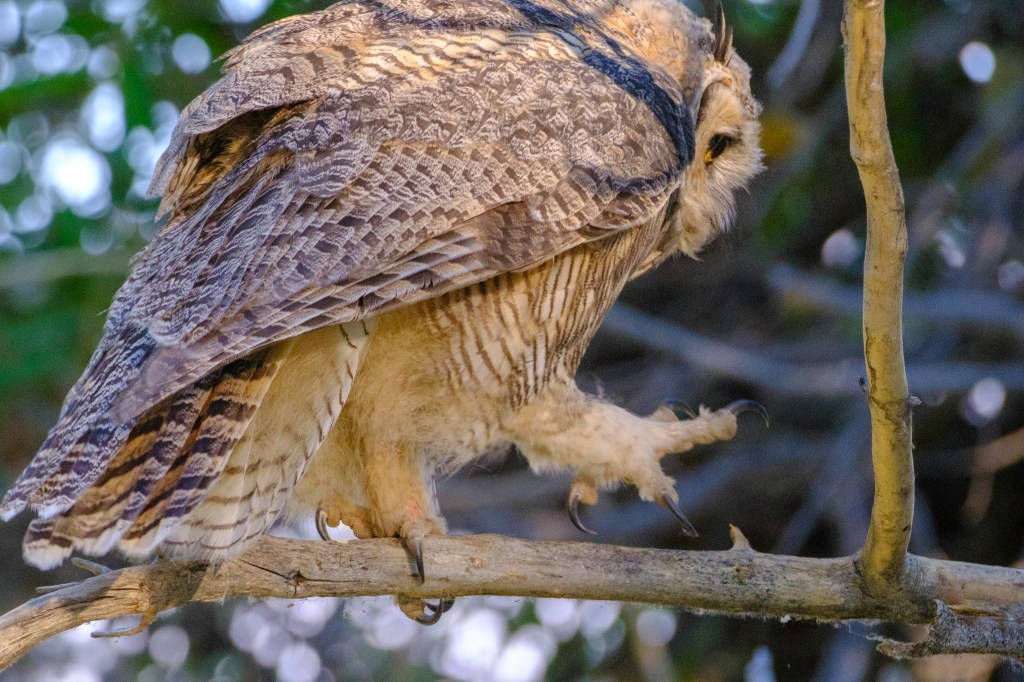
Most birds have 4 toes; 3 point forwards, 1 points back. This is true of hawks, herons, sparrows, etc. But owls have one toe that can point forwards or backwards. When that toe points to the rear, their feet look like a large “X.” See the photos below. Having a powerful grip and sharp talons is useful for grabbing squirming prey. But other predator birds do not have this “X” formation; birds with this kind of “X” foot include cuckoos, woodpeckers, and parrots.
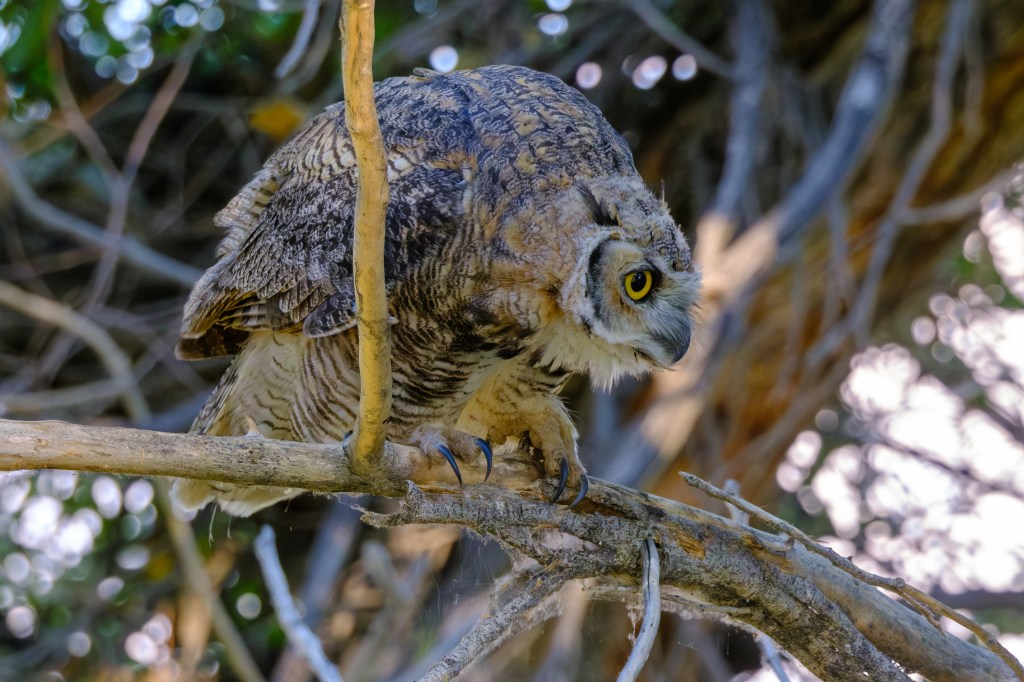
Outdoor dining
The next section is R rated for violence, blood, and atrocious table manners. When owls catch prey, they carry it back to their daytime hiding area, so they can eat in peace. They dismember the body, often decapitating the victim. Next they choke down large chunks. Photos below show a fledgling that cuts a mouse in half and swallows the headless body. You can see the feet and tail sticking out of owl’s mouth. The faint-of-heart should skip these photos.
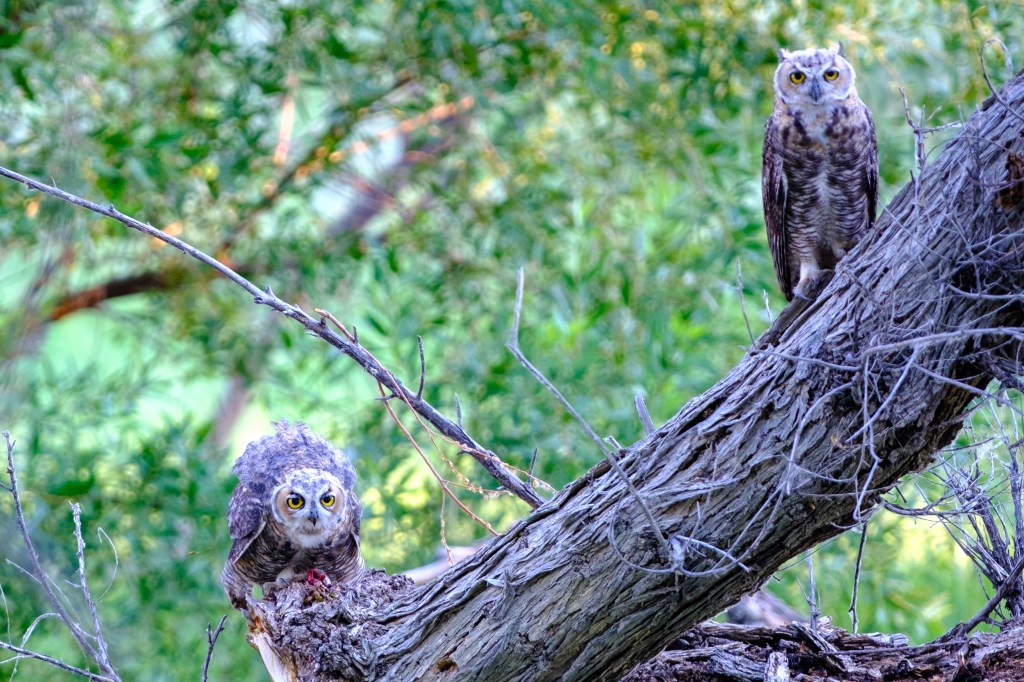

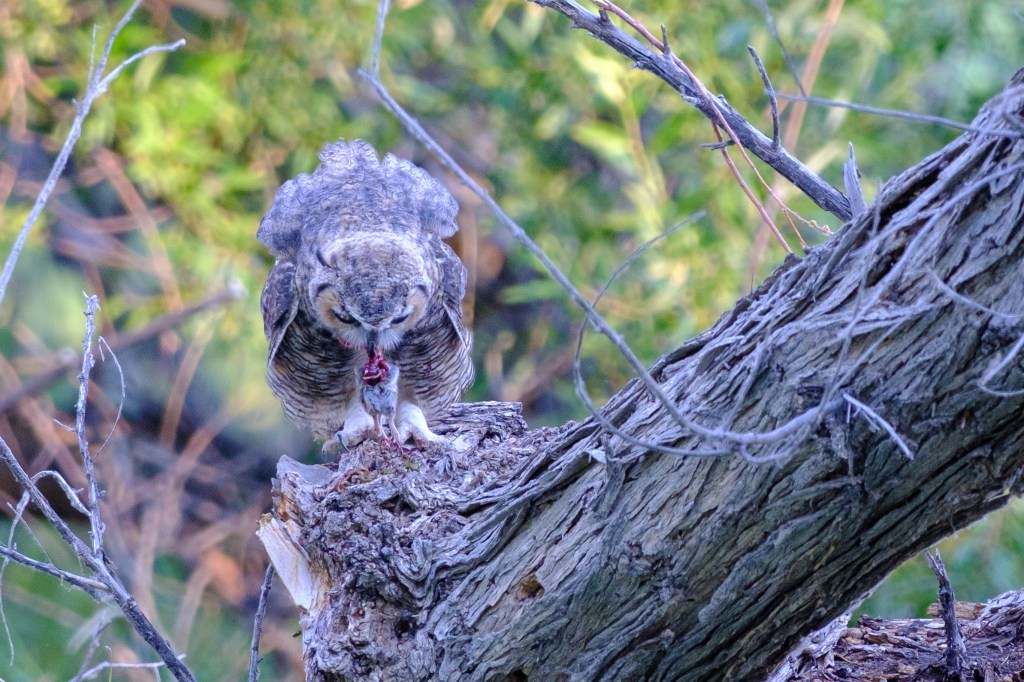
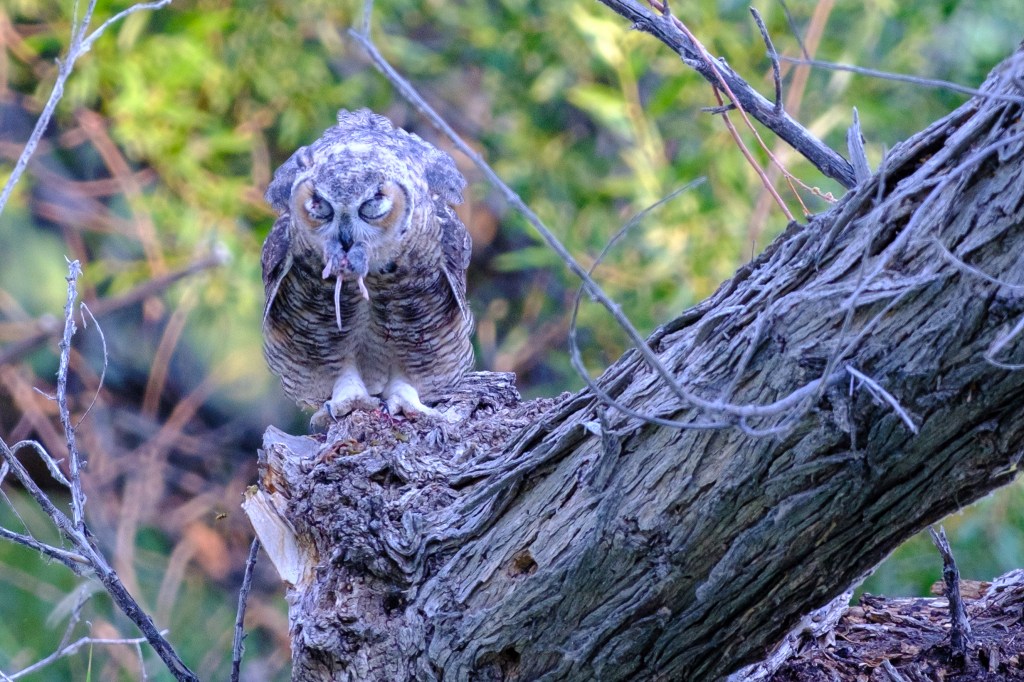
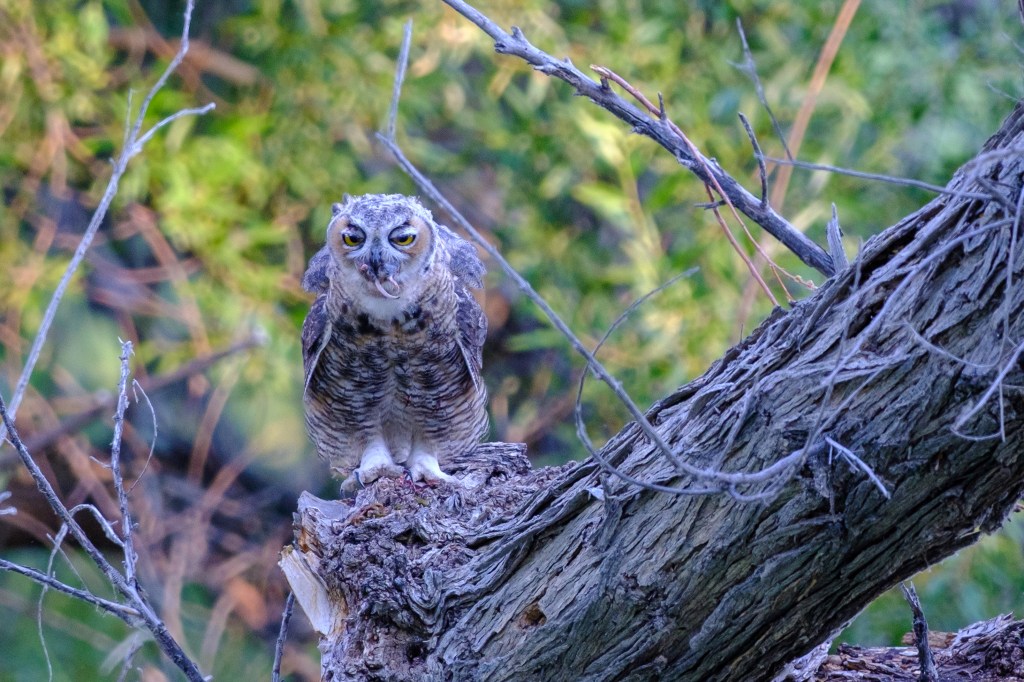
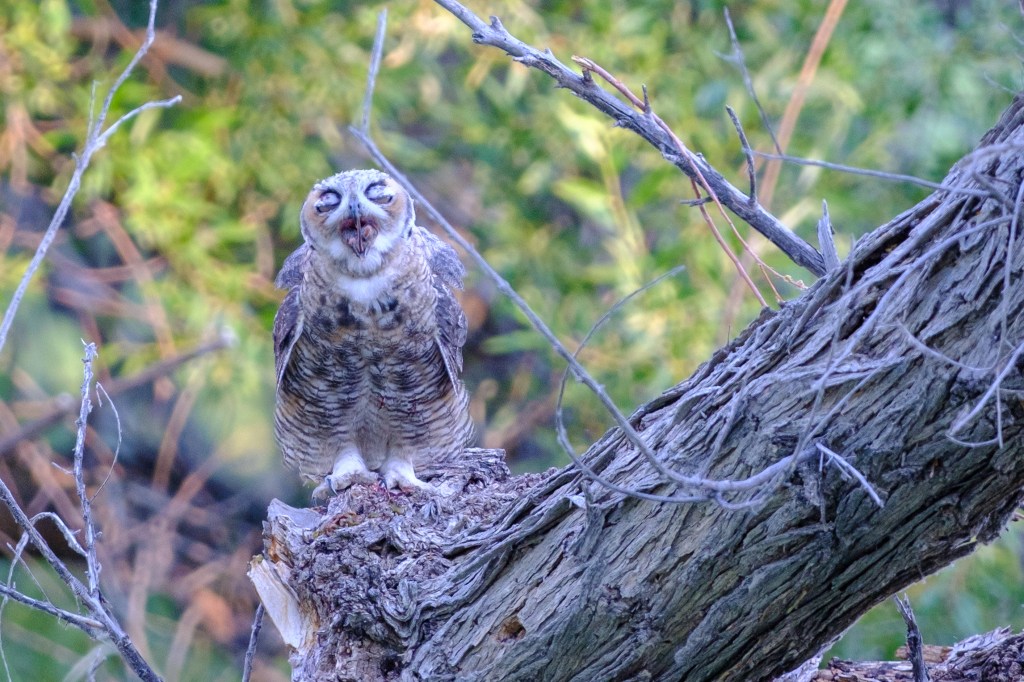
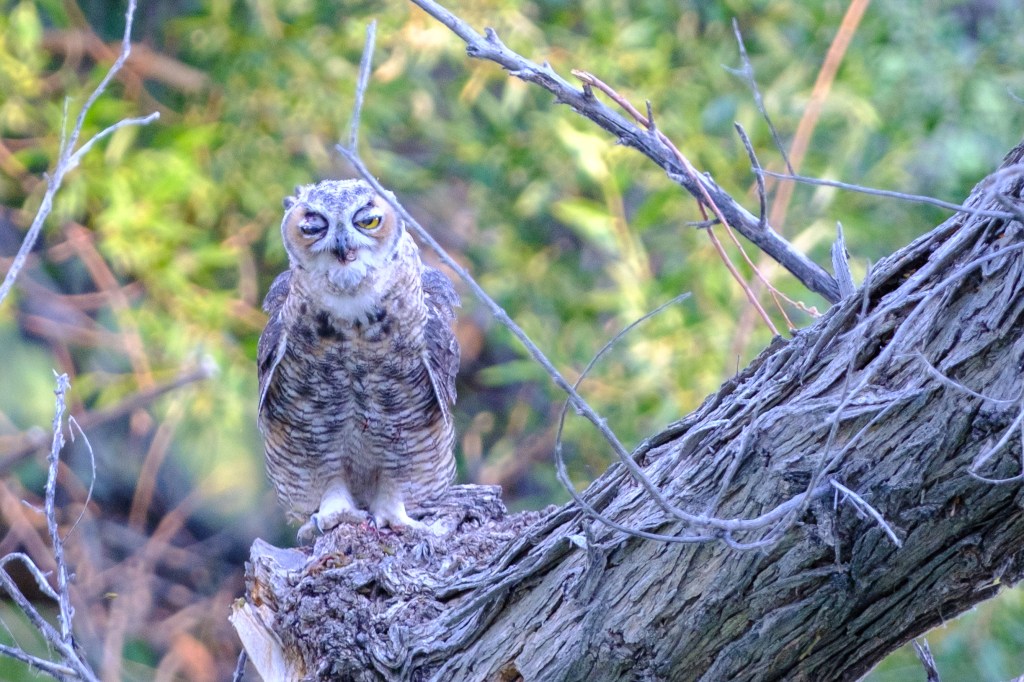
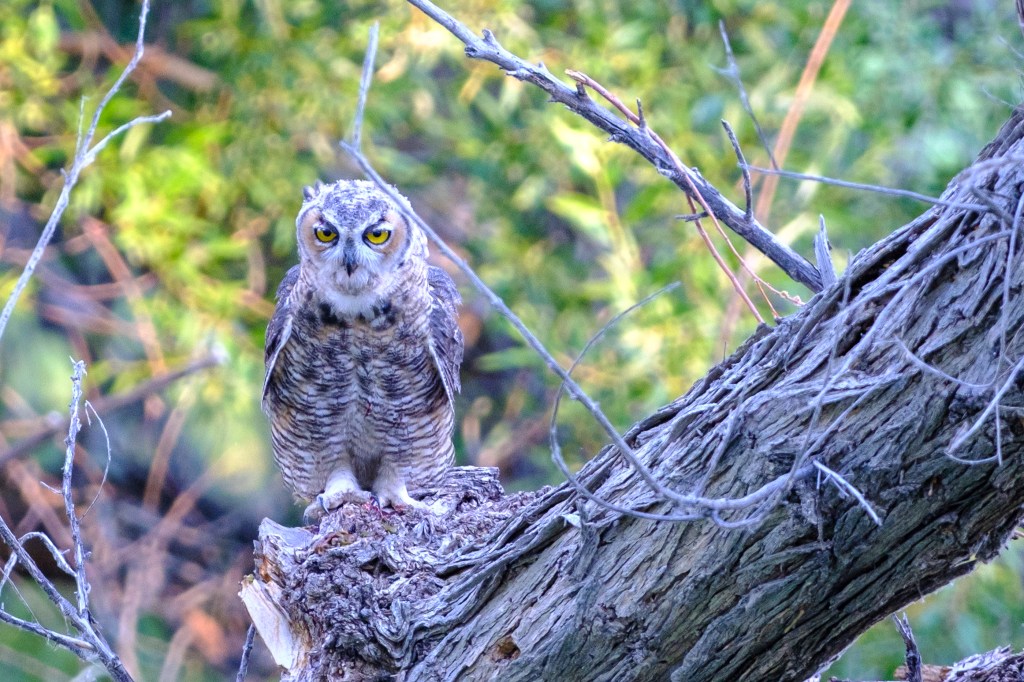
Sometimes I like to daydream about being born-again as a bird and having the power of flight. Photos like those above just kill those dreams.
Three short owl anecdotes:
1. Just after Christmas 2009, I did a loop hike in Death Valley with three friends. One morning we were walking on a dirt road which had a few inches of snow. Dan Ward, who sees things that I miss, pointed out that every 100 feet or so, there were rodent tracks and nearby feather marks. An owl had been hunting mice and it probably missed a few kills. Then Dan found a spot with similar markings and drops of blood in the snow; a mouse did not live to see the sunrise.
2. In 1985 I was leaving Kings Canyon National Park to get home to Visalia. It was late, the narrow paved road was pitch black. As my headlights came around a curve, the beams illuminated a Great Horned Owl descending over a mouse. The mouse changed direction at the last moment and the owl missed. This was a 2-second Nature Channel moment. The only thing missing was David Attenborough saying “The owl went hungry, but the mouse lived to see another day.”
3. Roberta and I like to walk; I carry a camera and often she spots a bird. We still haven’t learned to communicate well, partly because we both get too excited. We are not yet a well-oiled machine. In February of 2024, we were walking on the grassy headlands above the ocean near Fort Bragg, California. Roberta spotted a small owl in the grass just a dozen feet in front of us and she started yelling: “Owl! Owl!” I started yelling “What? Where?” The photo below was the result. We need to step up our game.

 Birds of Bishop