
In late December, 2024, Roberta and I were driving home after a bird walk. I was bemoaning how the Owens Valley had changed in ways that birds cannot control. Airports, canals, cars, cattle, highways, homes, and telephone lines have all appeared in the last two centuries. Birds, here for millennia, have no say in these changes.
But for the Red-shouldered Hawk (RSHA), my lament is mistaken. They are newcomers. These birds live east of the Great Plains. They are absent from the Plains, the Rockies, and the Intermountain West. But they reappear on the west side of the Sierra, inhabiting forests near rivers in California’s Central Valley. So there is a giant territory, from the Sierra crest almost to the Mississippi, where you will not find these birds.
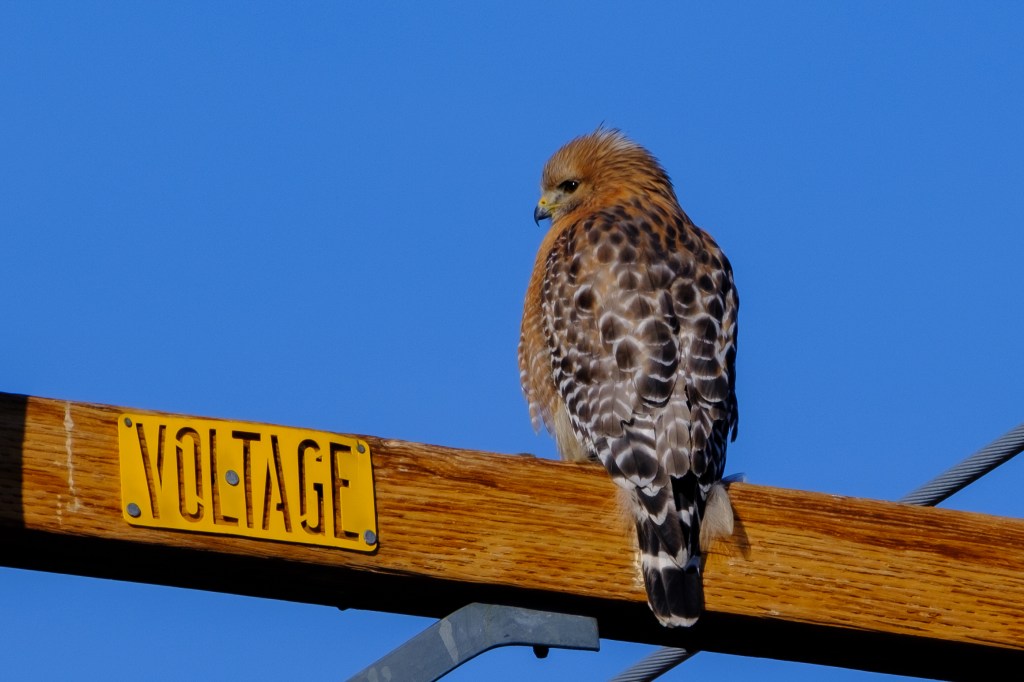
They were absent from Inyo County until 1968, when the dead body of a Red-shouldered Hawk was found in Death Valley. During the 1970s, they moved into the Bishop area. Now they live here year-round, nesting and raising their young. They are on tree branches and power lines all over Bishop and the surrounding fields. They control the land along West Line Street from downtown to Riata Road. One of these hawks hunts patiently from a Line Street telephone cable; I drive past this bird 50 times a year.
I graduated from medical school and moved to California in 1970 to start my internship at Stanford. In June I drove over Tioga Pass and down Highway 395 for the first time. In 2002, I settled in Bishop. So I feel some kinship with our local Red-shouldered Hawks; I imitated their move to this area.
Size
Red-shouldered Hawks are a medium-sized raptor. Smaller than a Red-tail, larger than a Cooper’s. Here is a table of size and weight (numbers from Sibley’s guide) for some local raptors:
Length (inches) Weight (pounds)
Bald Eagle 31 9.5
Ferruginous Hawk 23 3.5
Red-tailed Hawk 19 2.4
Swainson’s Hawk 19 1.9
Peregrine Falcon 16 1.6
Red-shouldered Hawk 17 1.4
Northern Harrier 18 1
Cooper’s Hawk 16.5 1
Prairie Falcon 16 1.6
Sharp-shinned Hawk 11 0.3
American Kestrel 9 0.3
Appearance
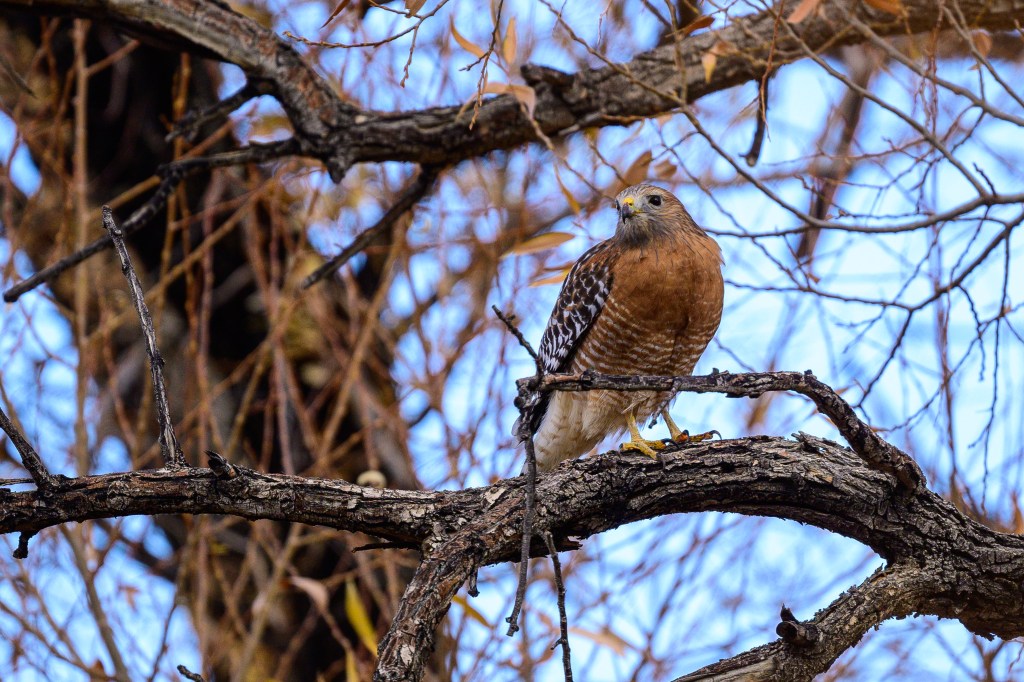
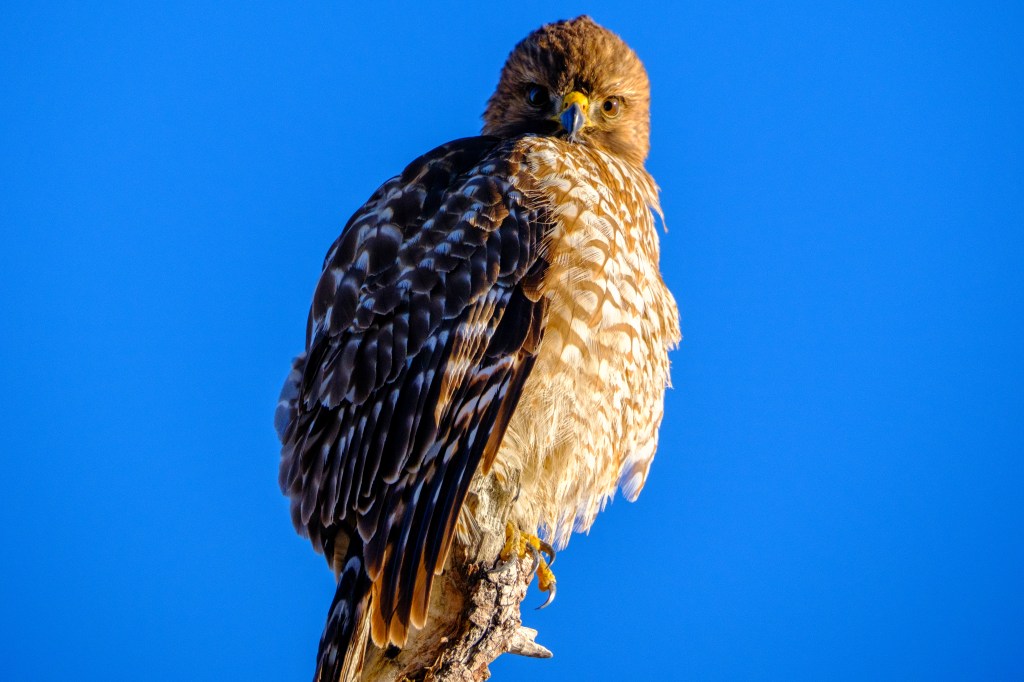
The first photo below shows a mature Red-shouldered Hawk near the Bishop Creek Canal. I had recently purchased a telephoto lens and was excited to find this bird. These hawks are not that skittish; I was able to approach within a 100 feet or so and the bird let me take a hundred pictures. The red color of the chest continues onto the wing, giving the bird its name. Lower on the body the red feathers form horizonal lines. The characteristic that stands out most to me are the white markings on the black feathers, visible on the side and back. These white spots contribute to the bird’s Latin name: Buteo lineatus = lined hawk. If it were up to me, this would be called the “Spotted Hawk,” for the white spots or blotches on the back.
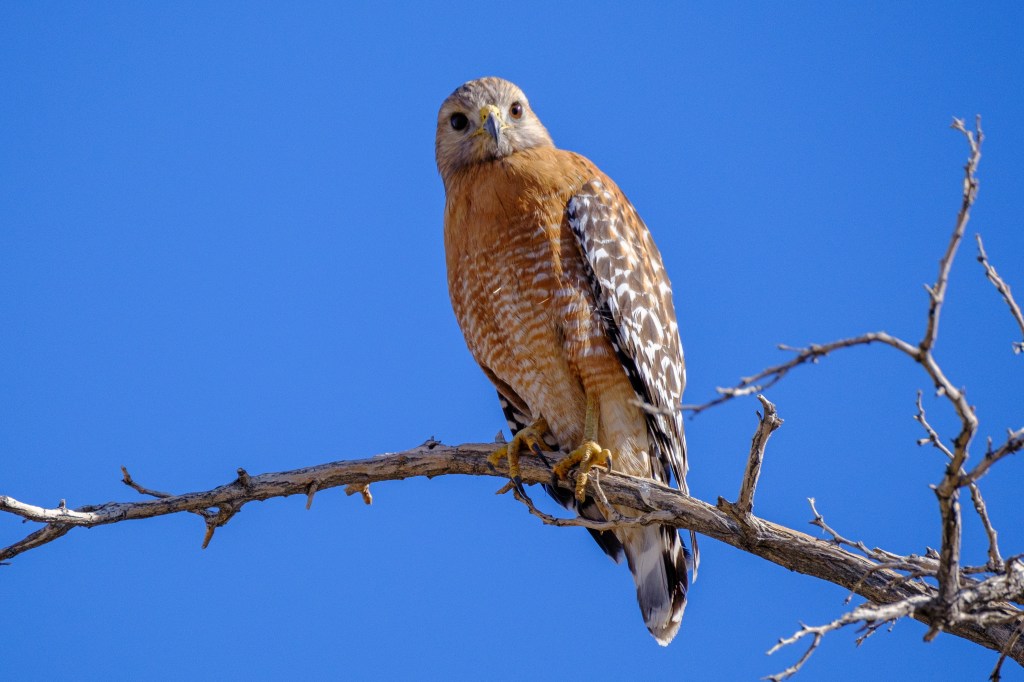
Above, the right eye looks like a black marble, while the left eye shows a brown iris around the black pupil. The eyes of many raptors look fierce, but the eyes of this hawk look like those of a harmless kitten.
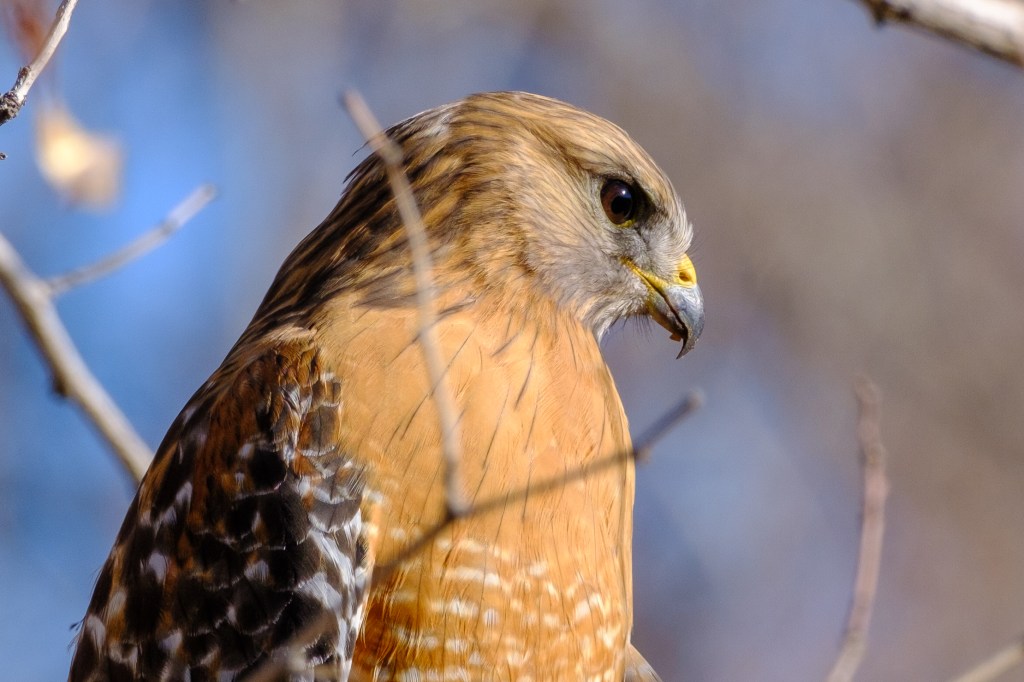
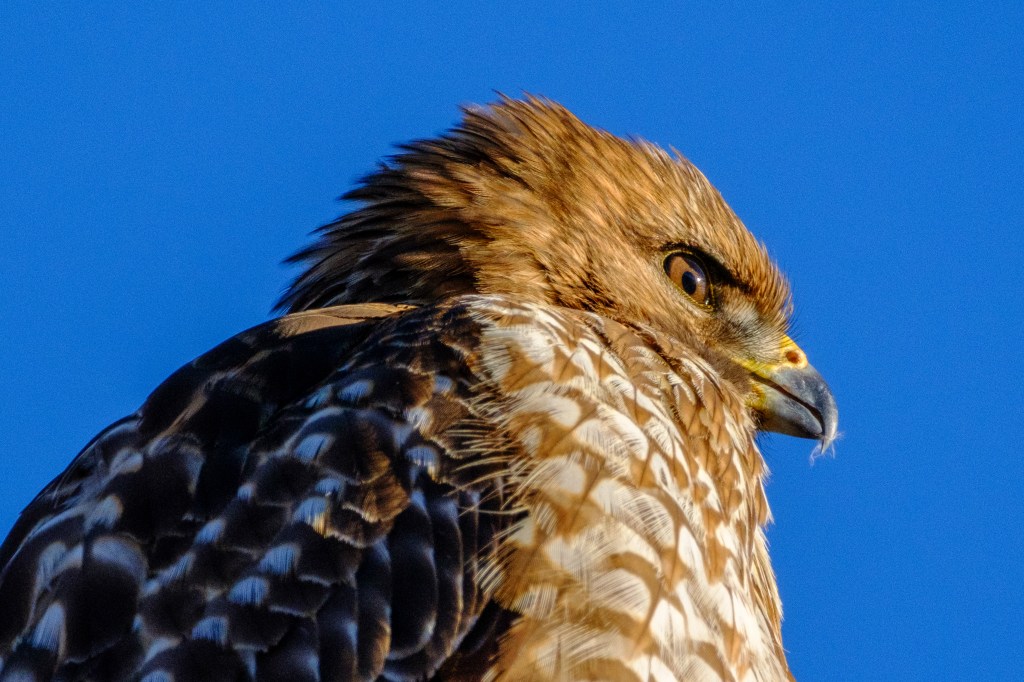
Birds have a nictitating membrane, a translucent “third eyelid” that arises near the nose and can be drawn across the eye to clean, moisten, and protect it. There are other creatures with this membrane, such as sharks, beavers, and cats. See photo below.

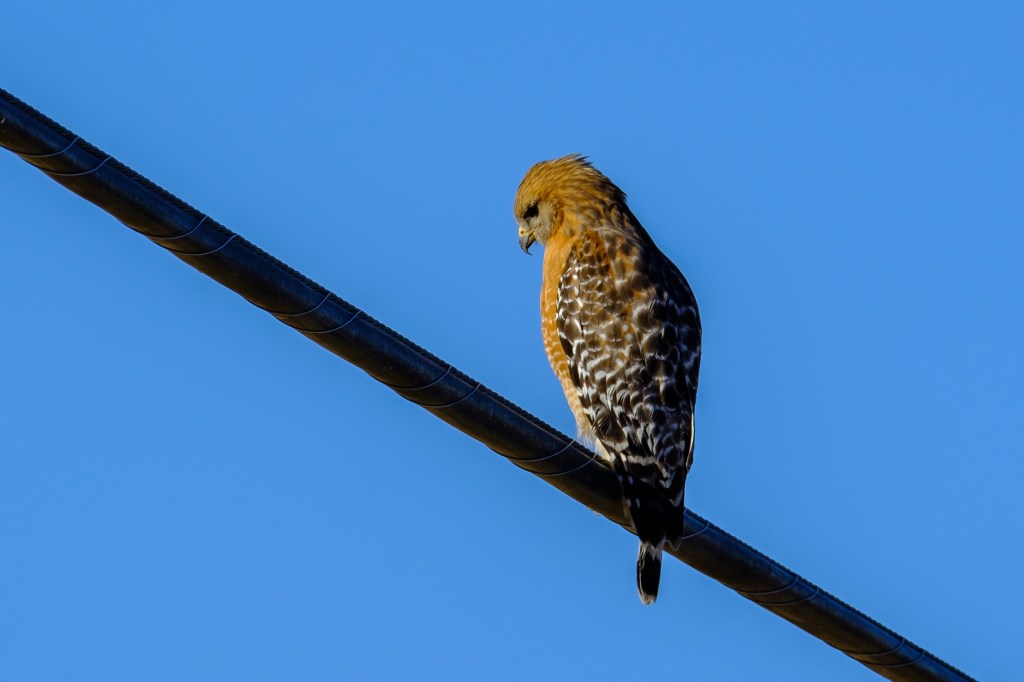
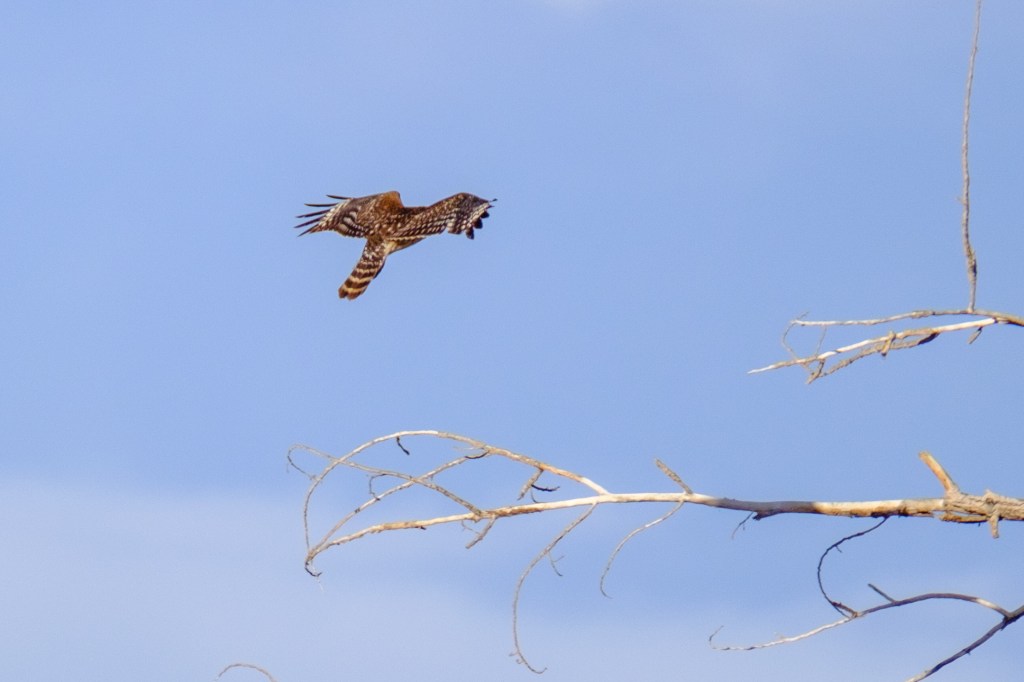
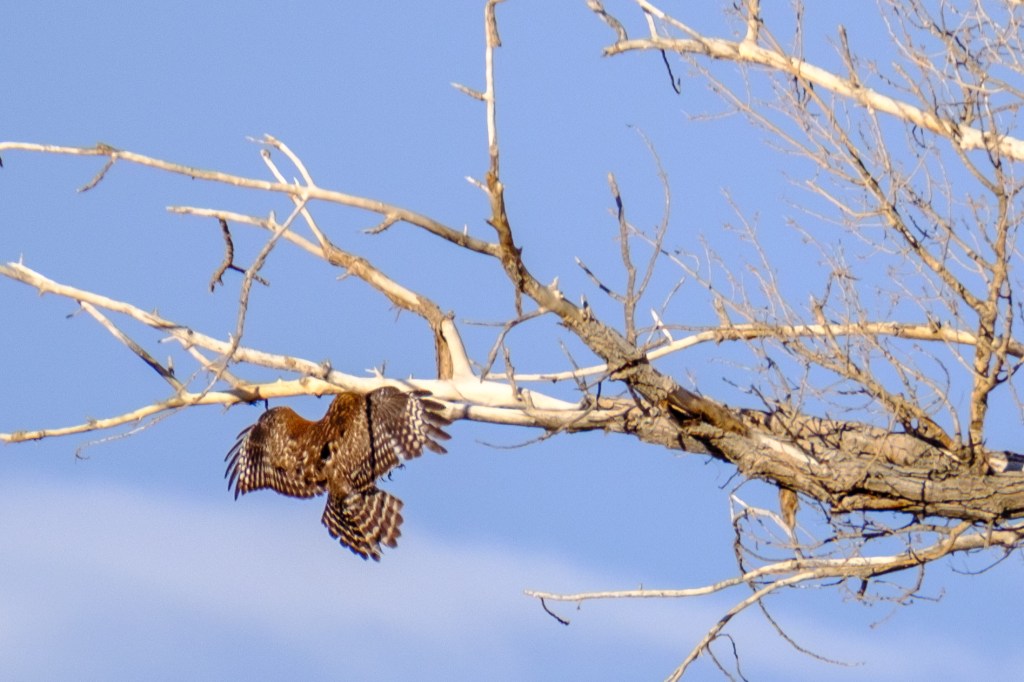
Red-shouldered Hawks are “still-hunters” or “perch-hunters.” They sit on a branch or wire and look down, patiently watching for prey. While they do this, they look hunched over; see photo below. When they spot a rodent or insect, they will swoop down and grab it. Instead of flying down, they may just topple forward (or backward) and drop, falling quickly with little movement. Their folded wings snap open just before they hit the ground. I’ve seen this twice; it looks as if the bird just fainted and fell off the wire. See the hunting posture below.
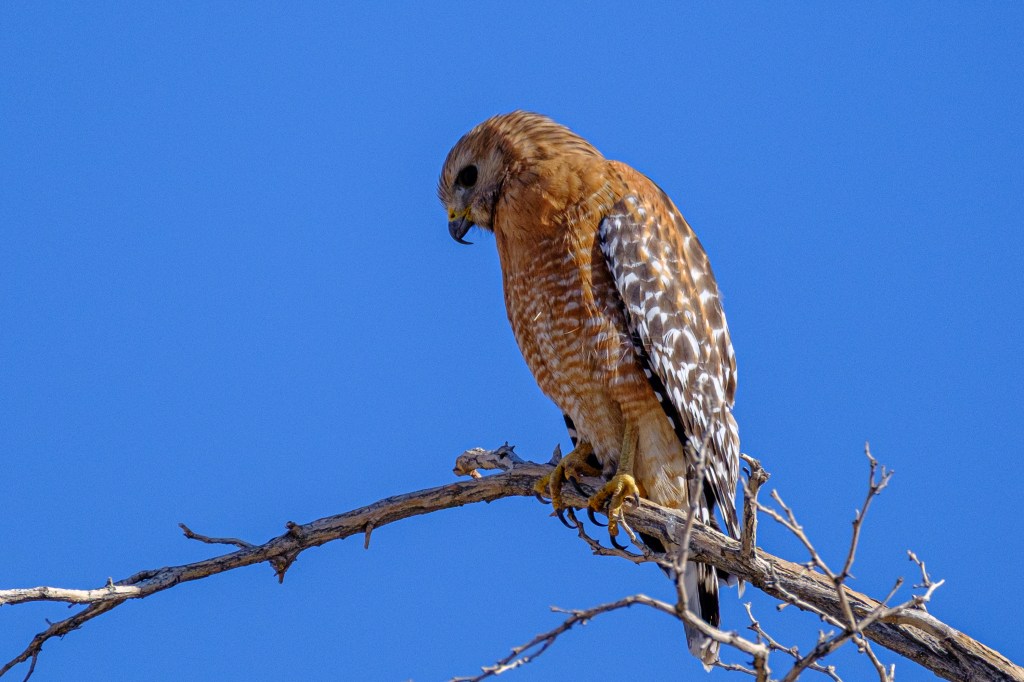
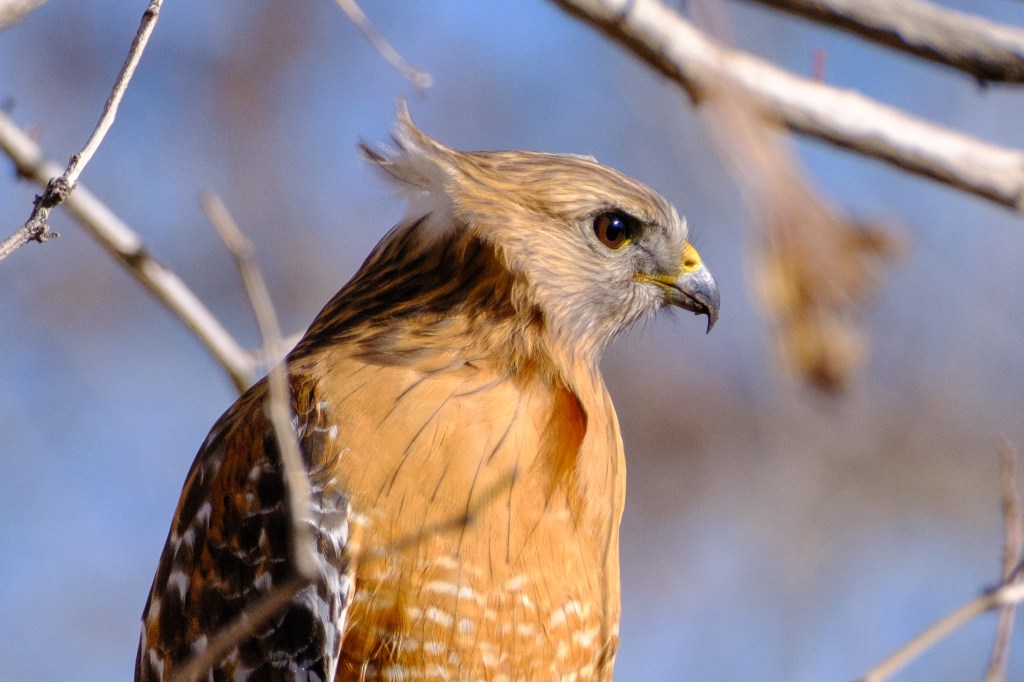
The next two pictures show a Hawk on Line Street near Barlow Lane. In the second photo a breeze lifted up the feathers on the neck.
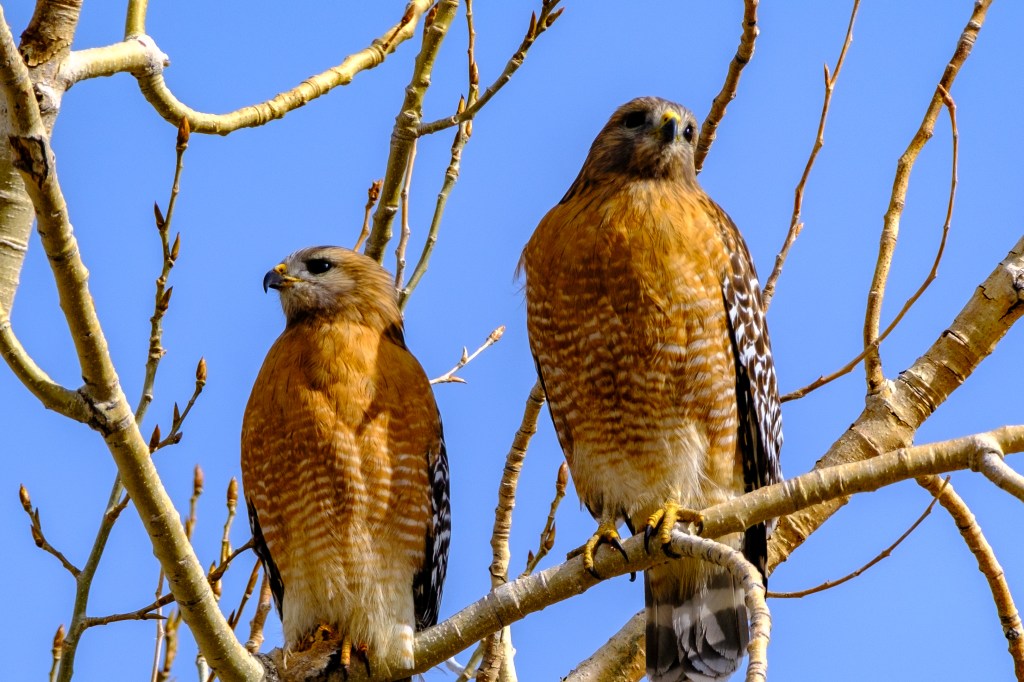
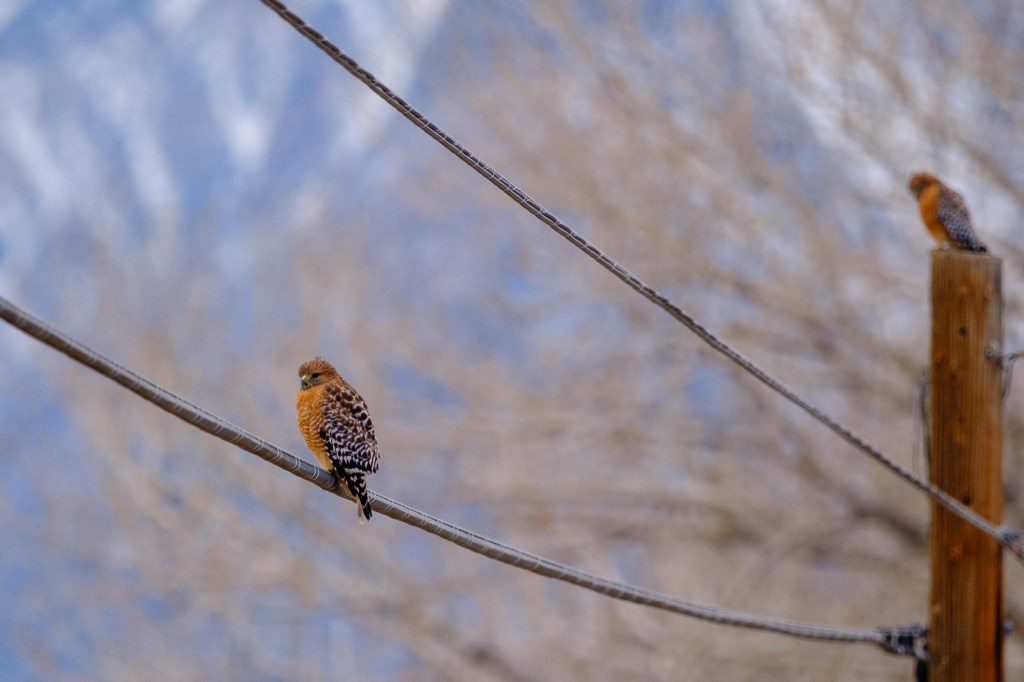
The photo below shows a pair of Red-shouldered Hawks on Barlow Lane, near Line Street.
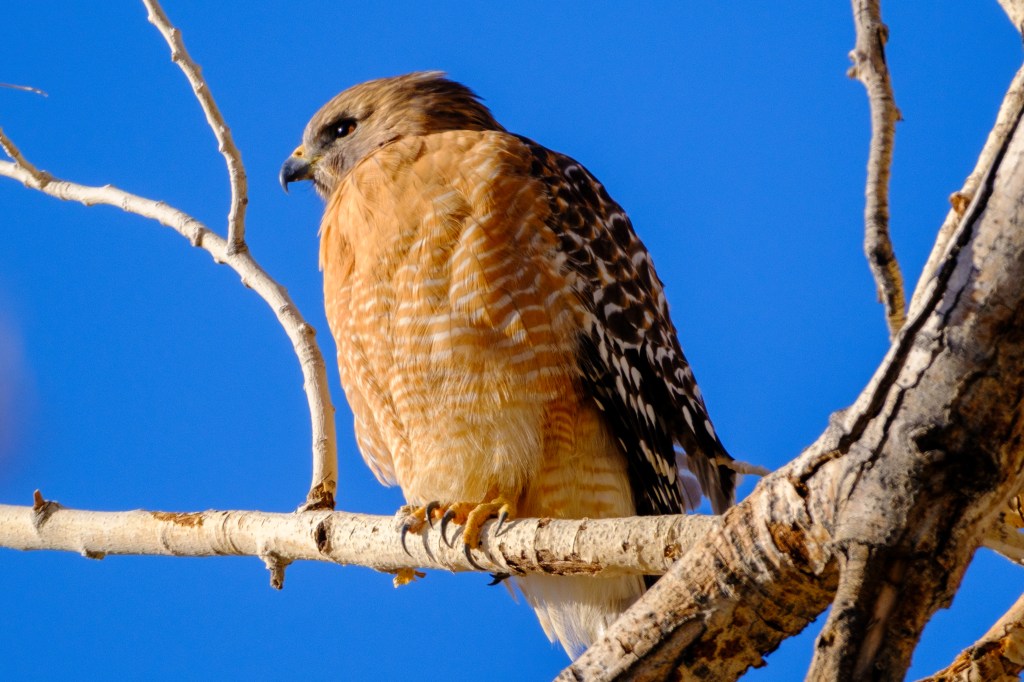
The bird in the next picture was on Dixon Lane near the Green Gate road; this is where Great Horned Owls raise their young.
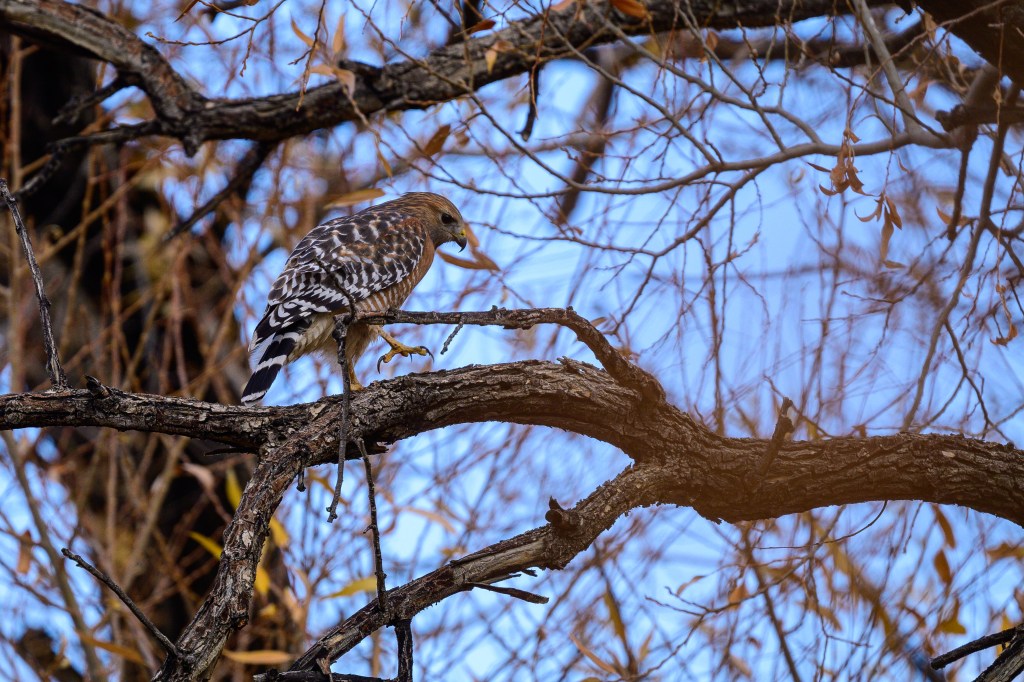
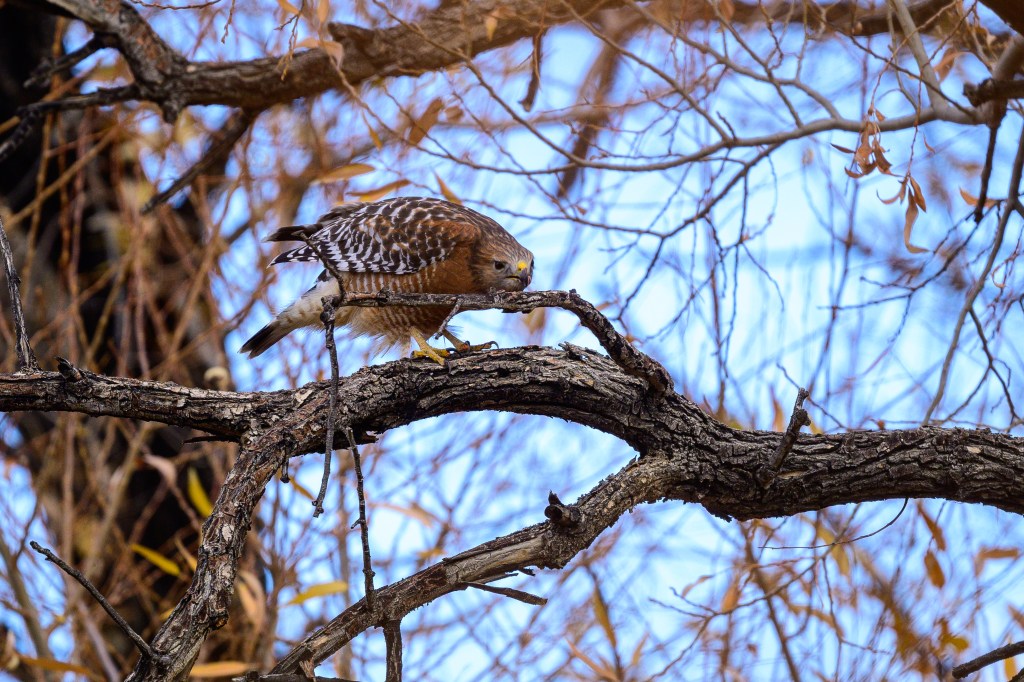
Just north of Line Street is the Conservation Open Space Area (COSA), run by the Bishop Paiute Tribe. The following 3 photos show a Red-shouldered Hawk that was present during the Christmas Bird Count. The first photo shows the spotted or linear pattern on the back. In the second and third pictures, look for a red spot on the left foot; blood from a recent victim.
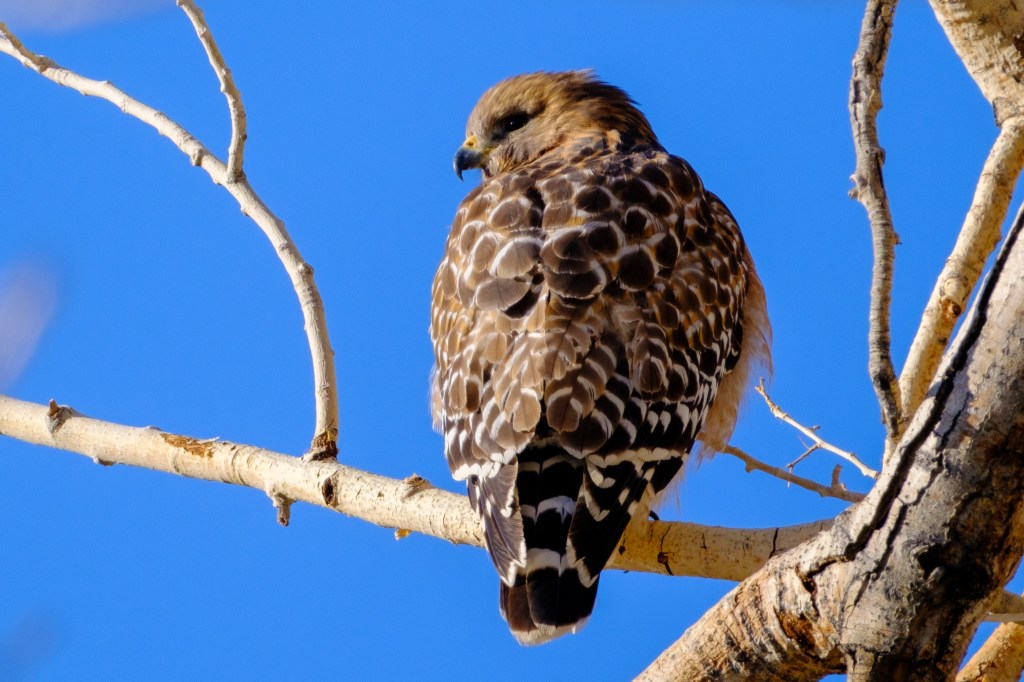
A few days later I returned to the COSA and again saw a Red-shouldered Hawk. Same one? First I show a frontal view. Then a view of the back. The tip of the tail is white, most of the tail is black with thin white bands. The primary feather tips lie on top of the tail, but fail to reach the tail-tip. A curtain of white feathers lies on top of the primaries. From the back, the red-shoulders and breast are often invisible, but the feather pattern I’ve just described helps identify this bird.


The next photo shows the back of a bird at the Buckley Ponds. I can make out 4, possibly 5, white bands on the tail. The long primary feathers overlap the tail and above them is a horizontal “skirt” of feathers.

Another view of a bird on Dixon Lane. You cannot see the red shoulders, but the white-black patterns are a giveaway.
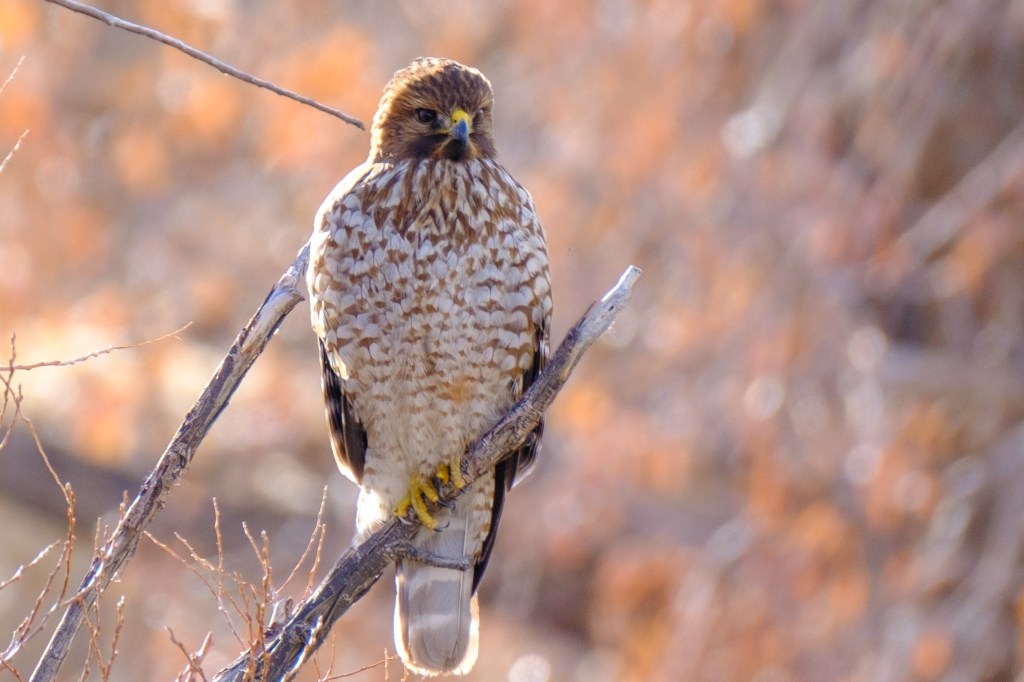
Juvenile Red-shouldered Hawks look rougher, the upper chest has red streaks, the lines across the body are less distinct. The next four photos show birds that I think are juveniles.
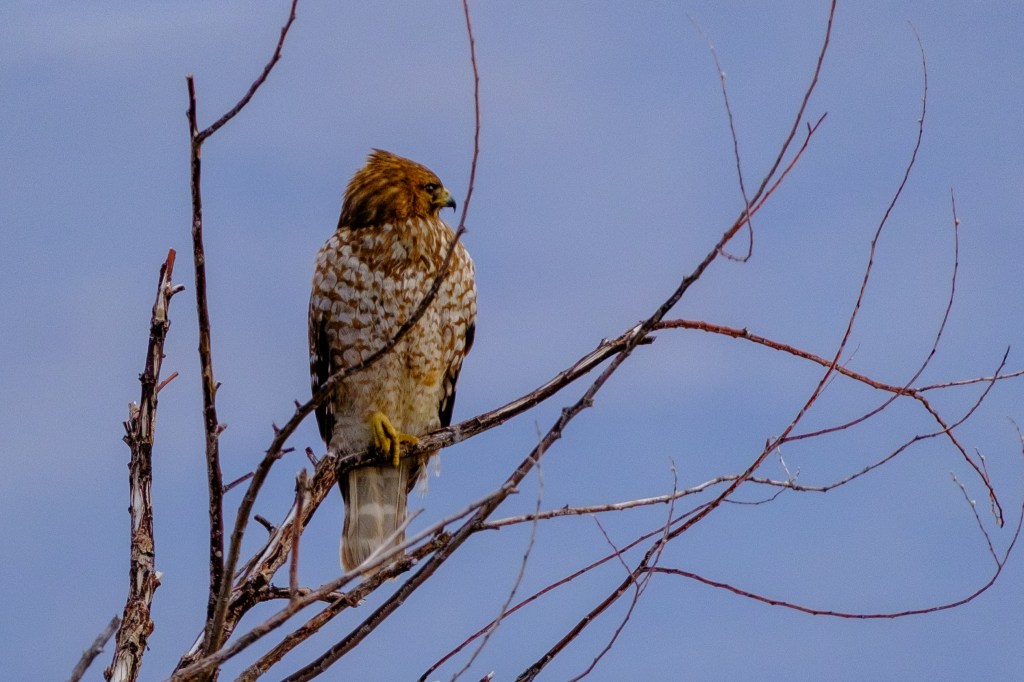
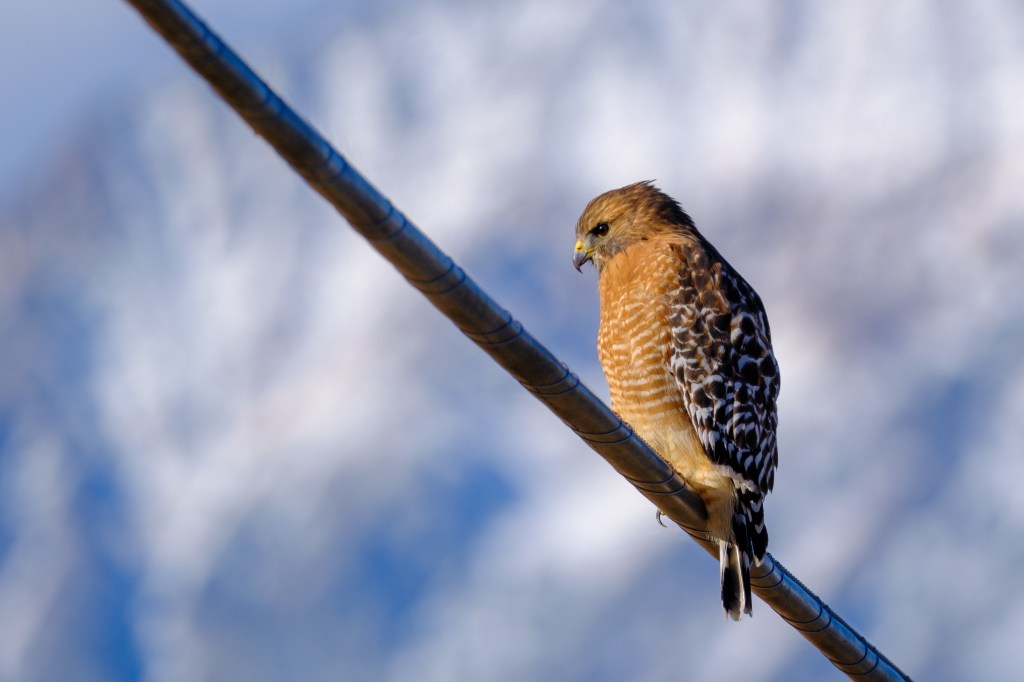
These hawks love telephone lines. If you see a raptor on a line, think of this bird first. The first photo below was taken near the Bishop dump, the next four pictures on Line Street near Barlow Lane. The bird in the last 3 photos is there almost every week, searching for food; if it is not the same bird, they must be related. The last picture shows two of these hawks.

Preening
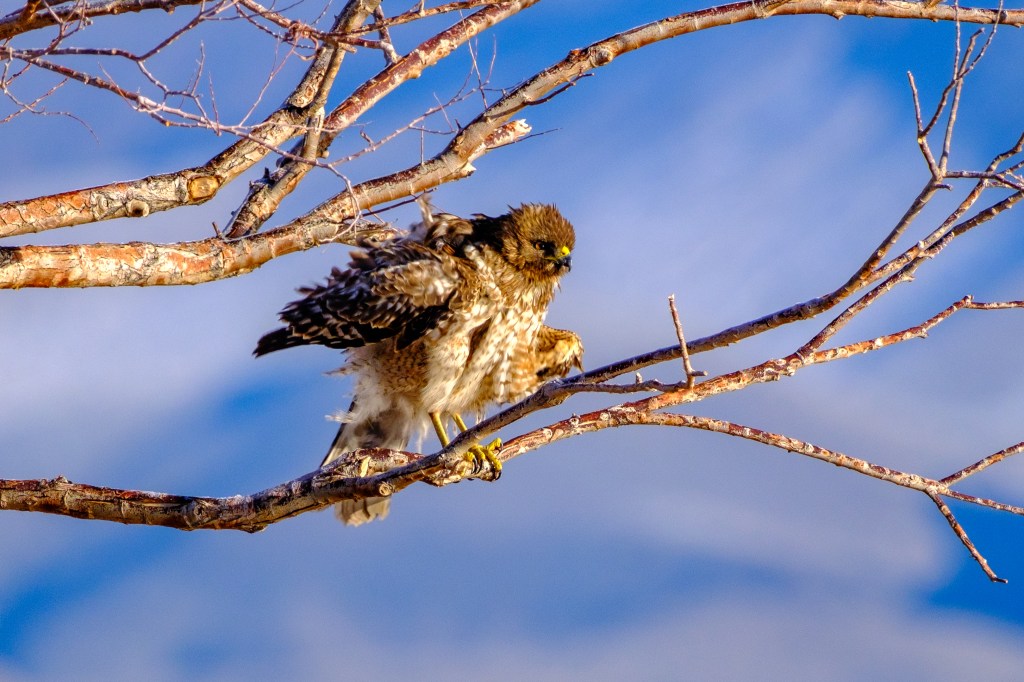
An immature Hawk at the Buckley Ponds was preening; It was licking feathers, trying to tear them out, and generally contorting itself. Why is the lower eyelid so swollen in some images?
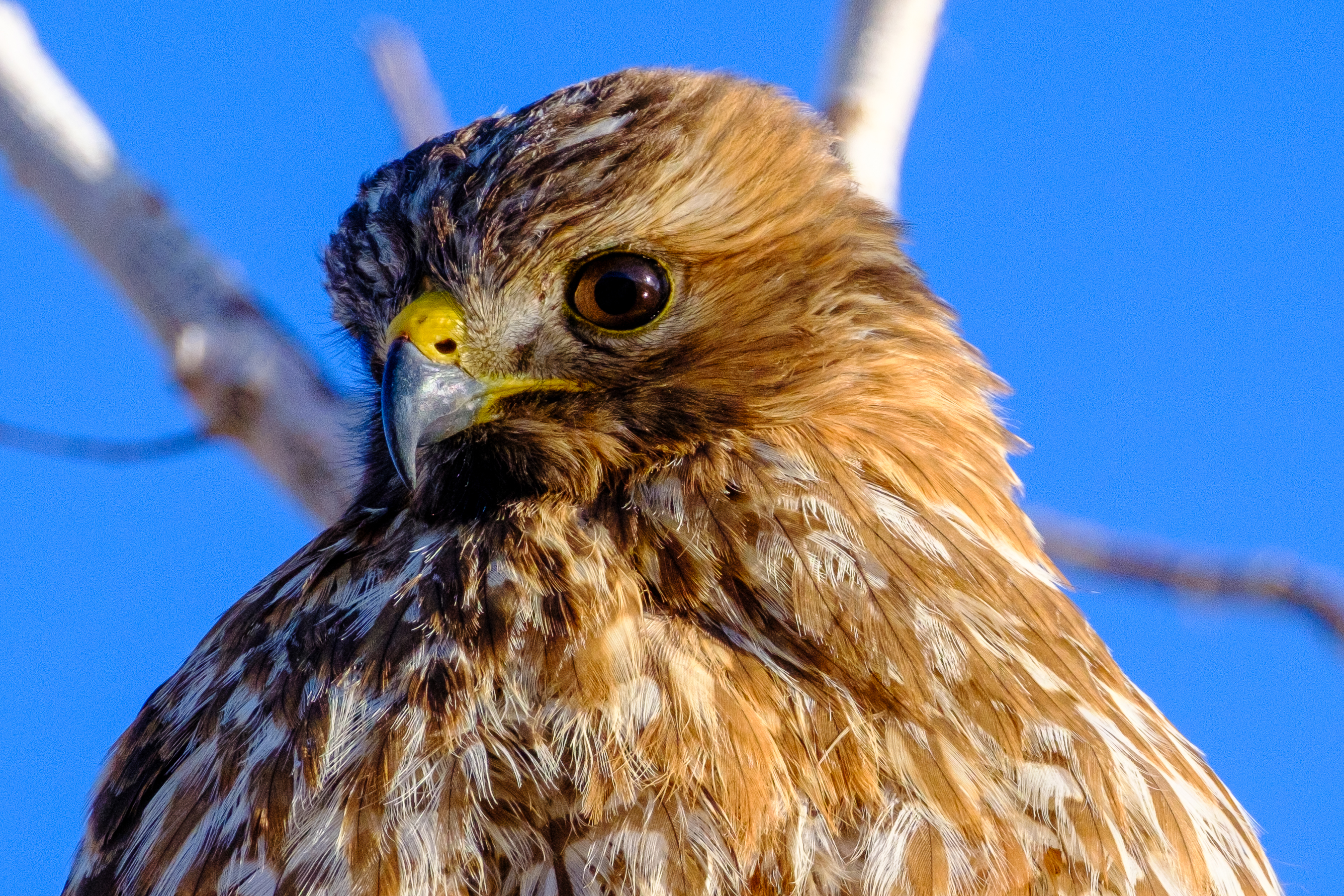
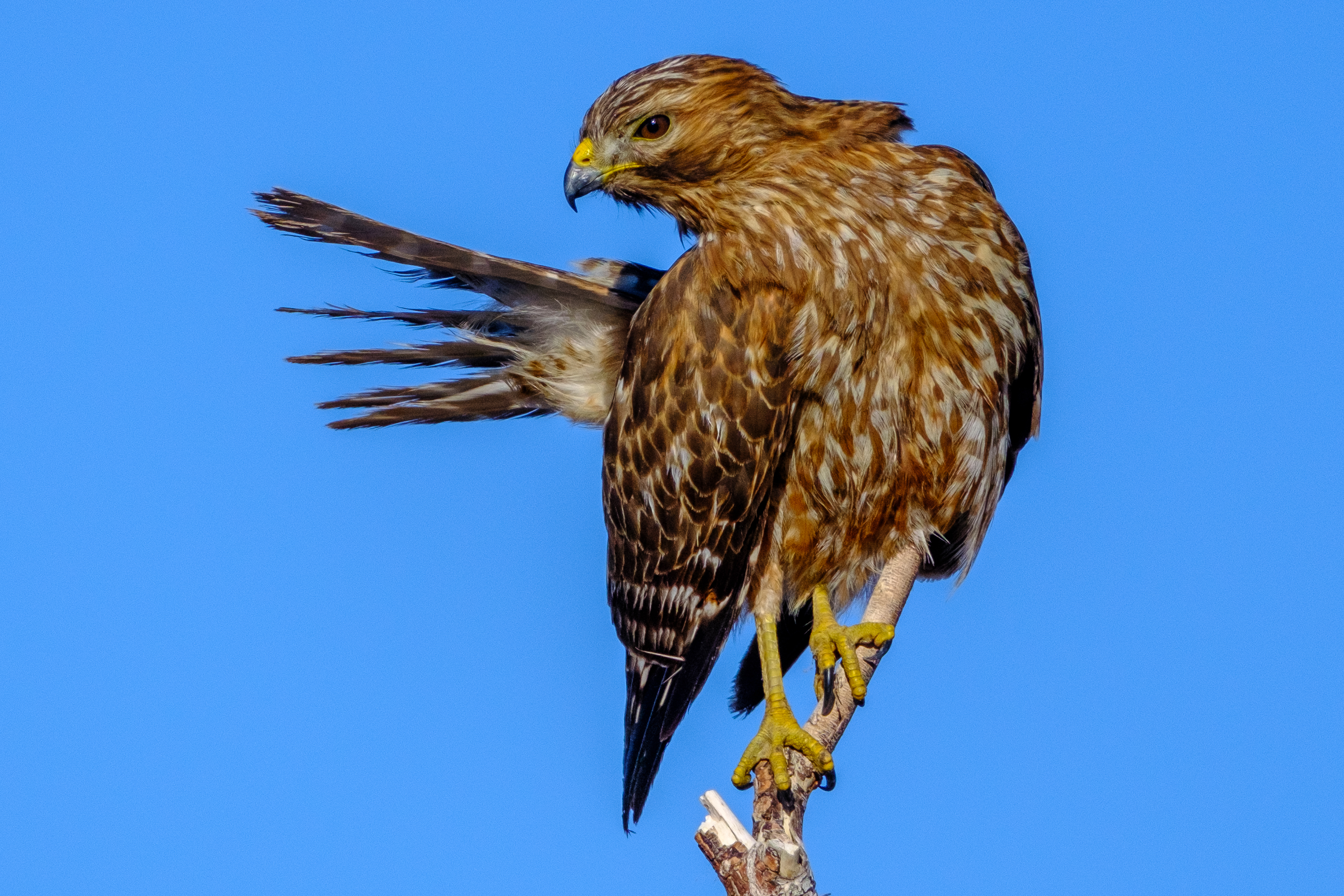
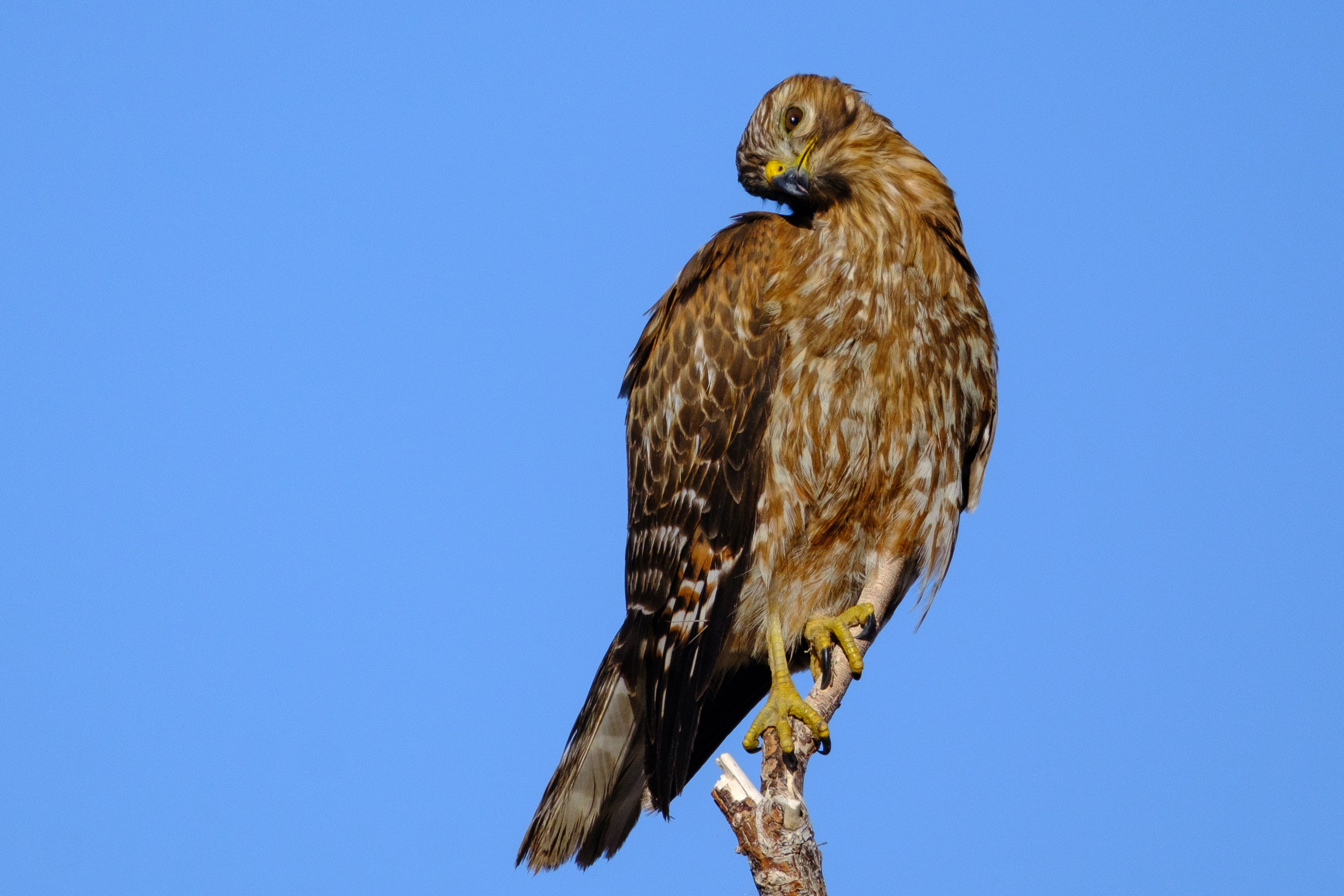
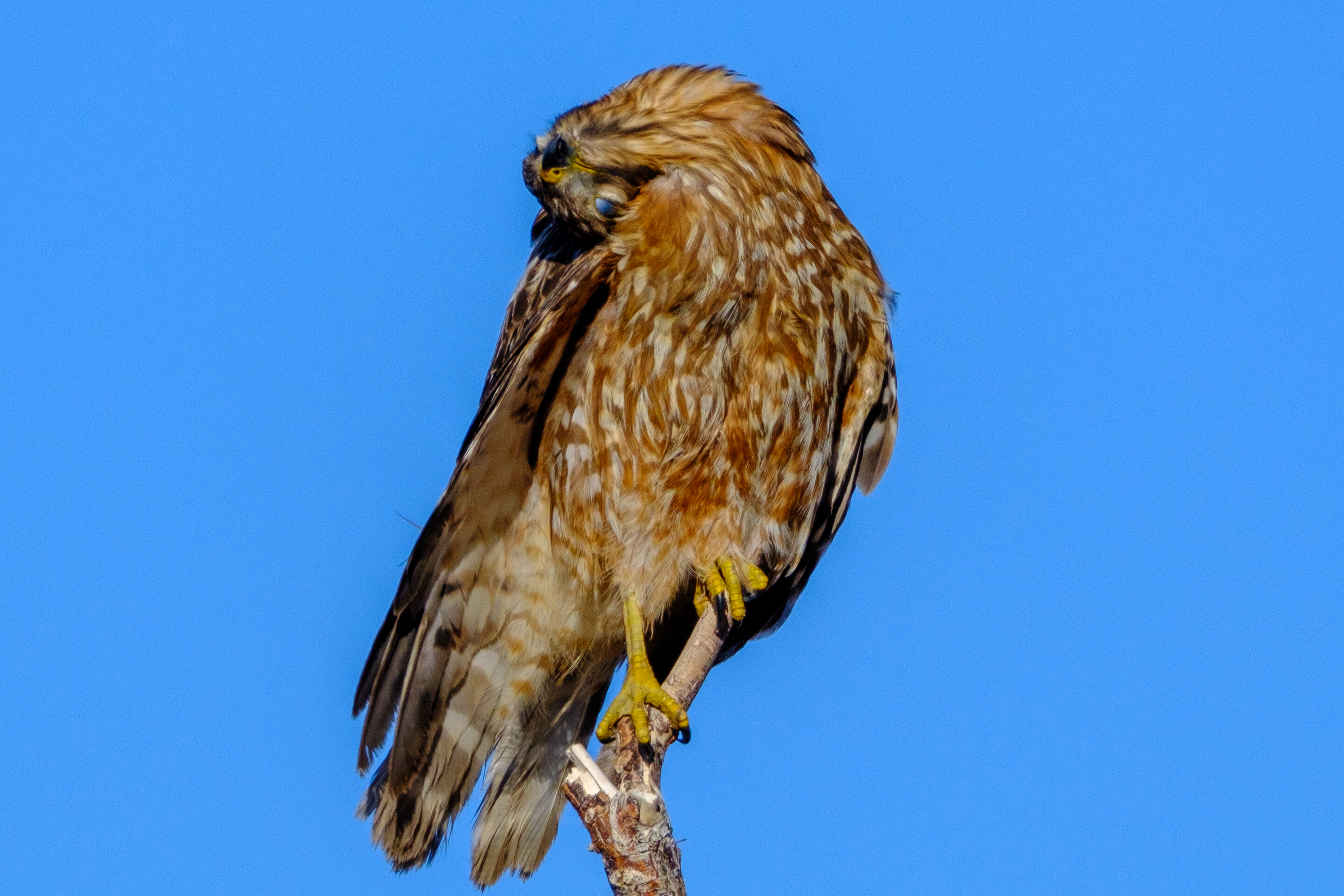
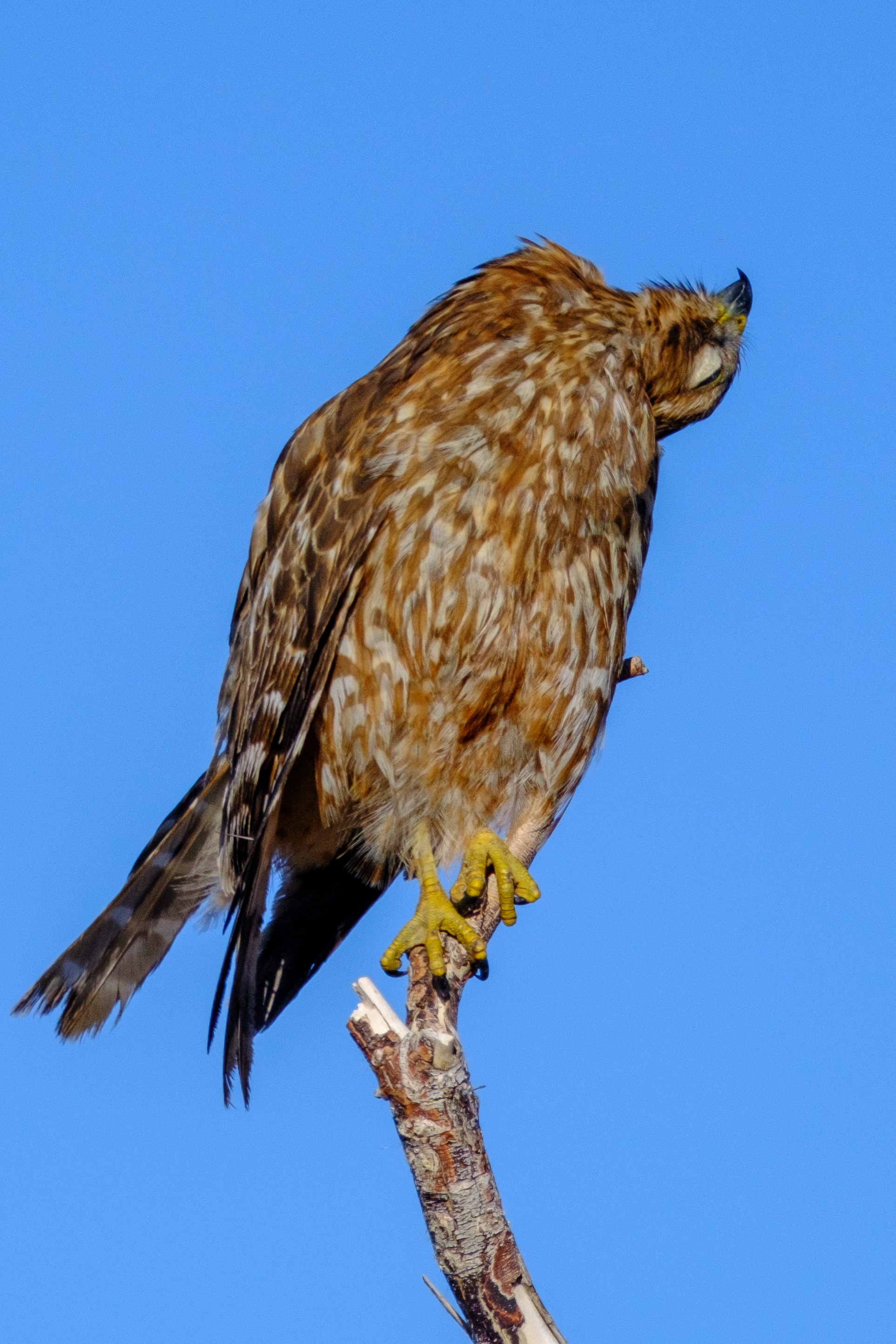
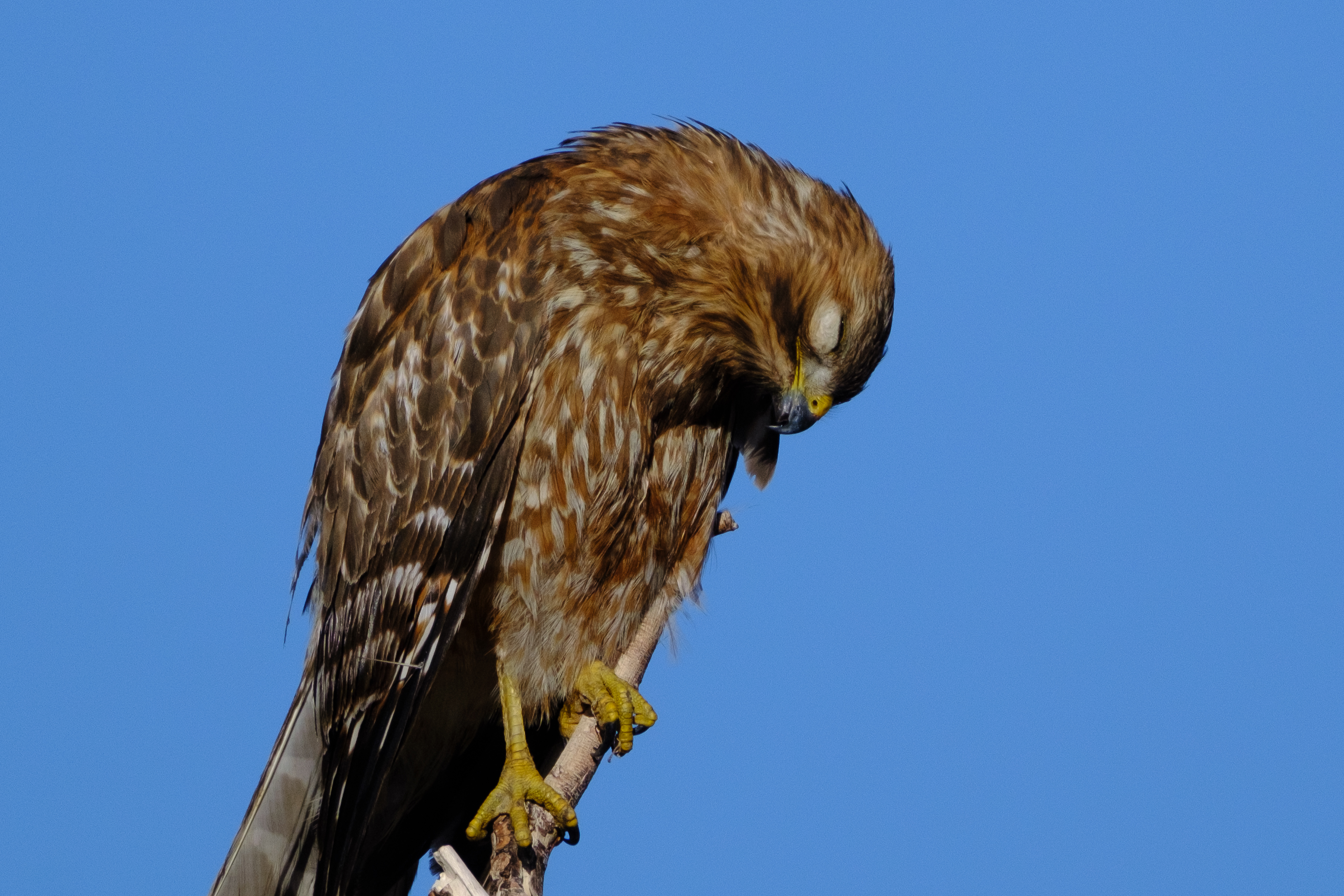
A week later I saw another immature Hawk, or perhaps the same one, imitating Linda Blair in the Exorcist.

Flight
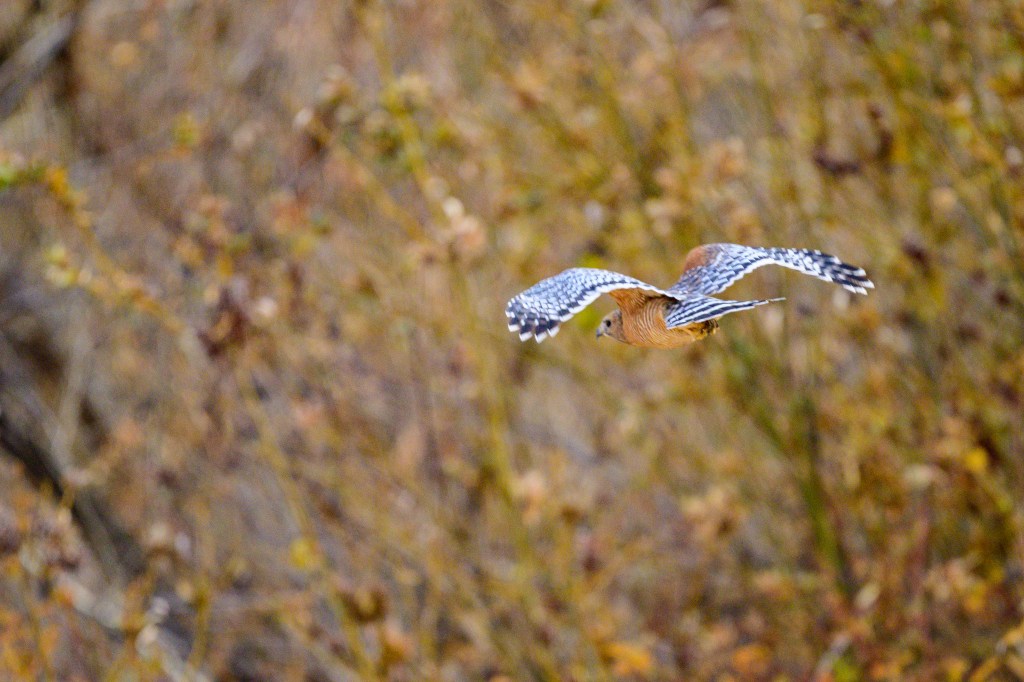
Unlike some raptors, these birds do not usually engage in long flights. I have photographed them covering short distances, moving from one perch to another.
In courtship displays, the male bird is willing to soar upwards for hundreds of feet, then plunge to earth with wings folded, pulling up just before cratering. I hope to see this someday.
The picture below shows a RSHA landing on a post near the Bishop Creek Canal. At the end of each wing are long, dark, primary feathers. At the base of the primary feathers is a band of white; this is sometimes described as a translucent window, crescent, or comma. This feature can help identify the bird in flight. This translucent band can be seen below.

The following two photos show a RSHA taking off on Warm Springs Road. Both photos show the band of whiter feathers near the ends of the wings.
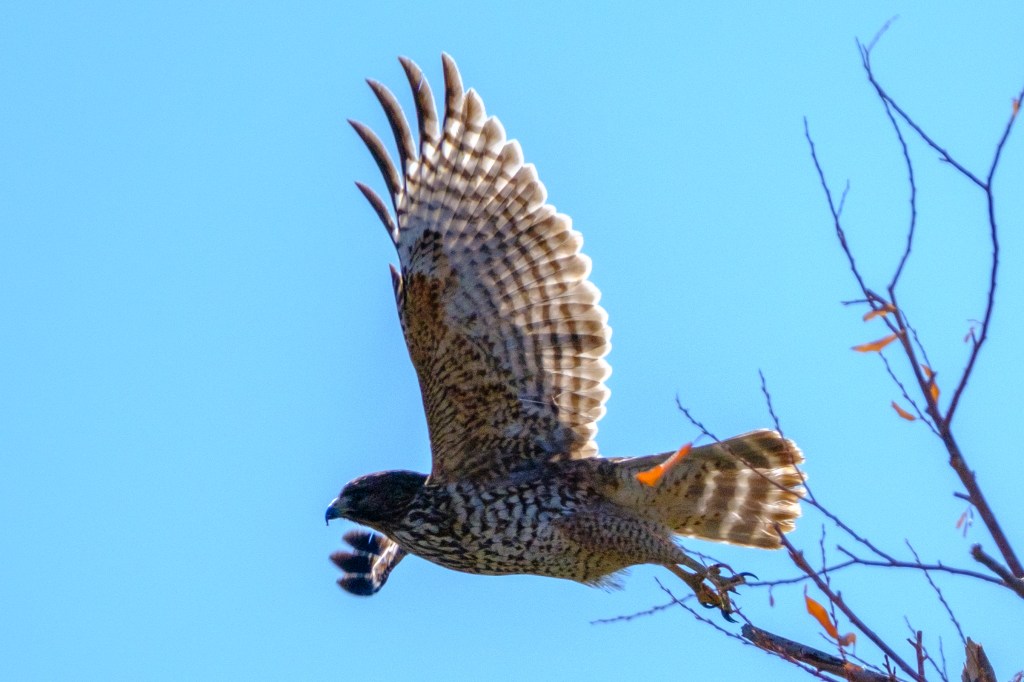
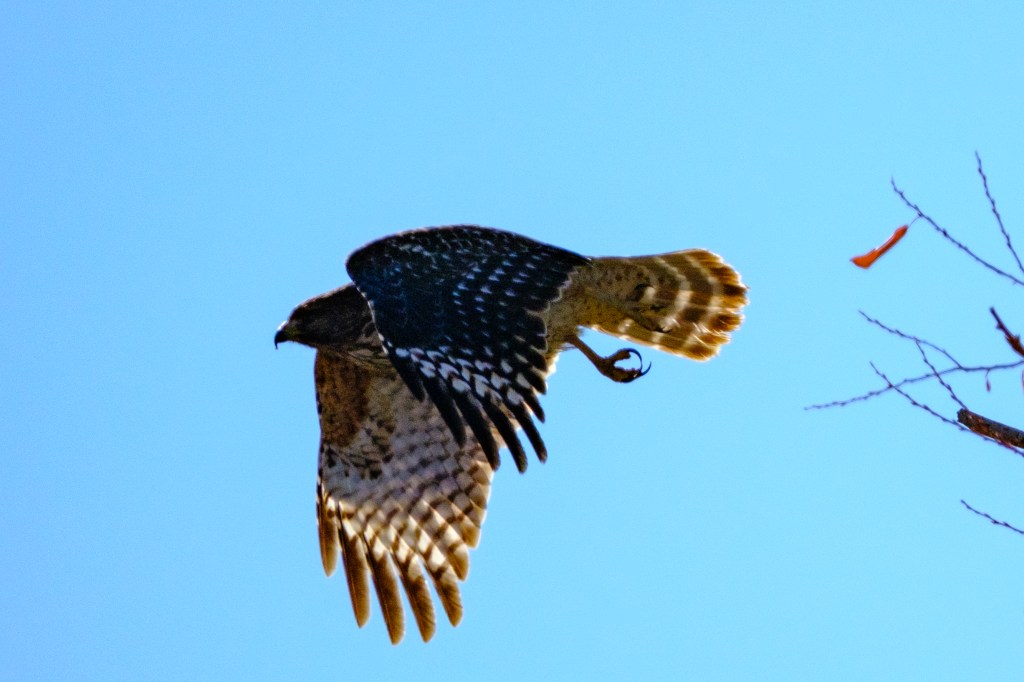
A Red-shouldered Hawk takes off on the Bishop Creek Canal. Left wing shows the band of light color.
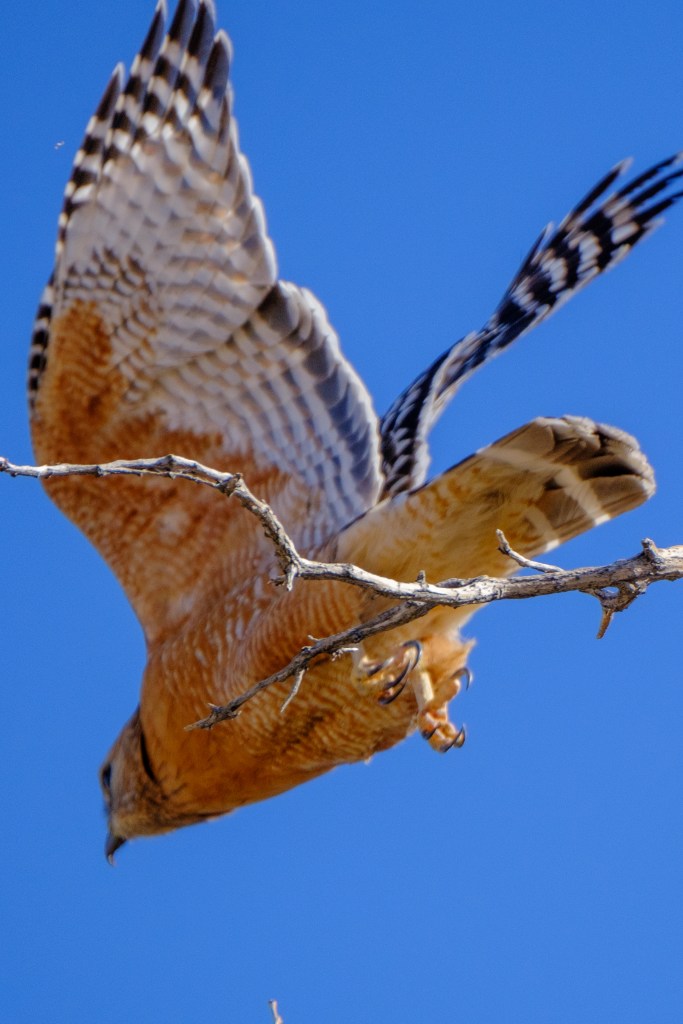
Two more pictures show a RSHA landing at the Buckley Ponds.
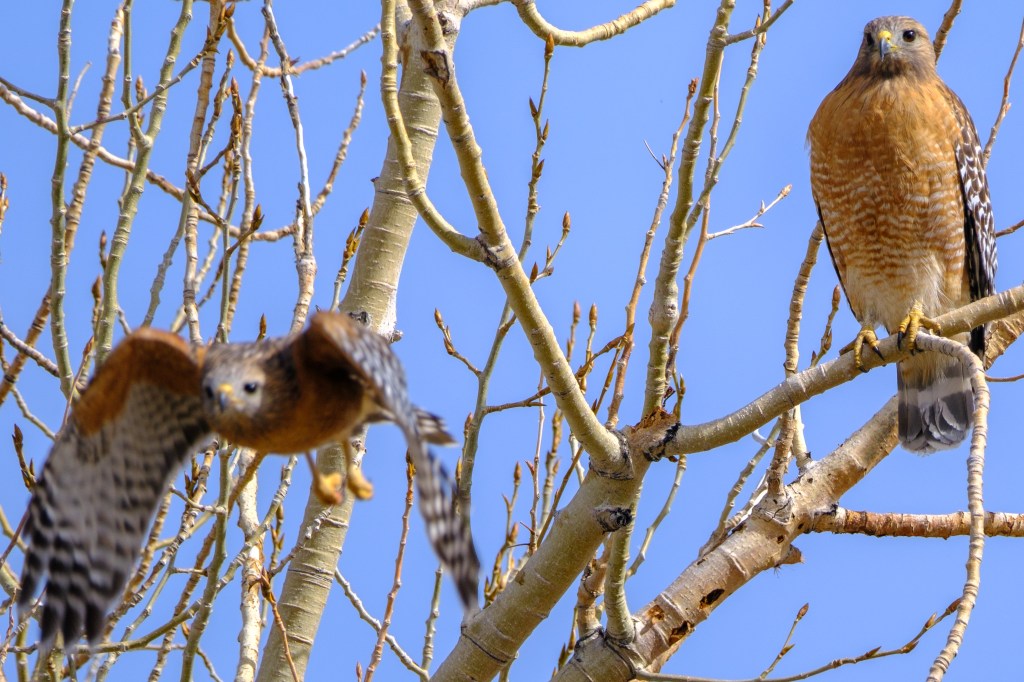
On Barlow Lane, one Hawk takes off while its mate looks on.
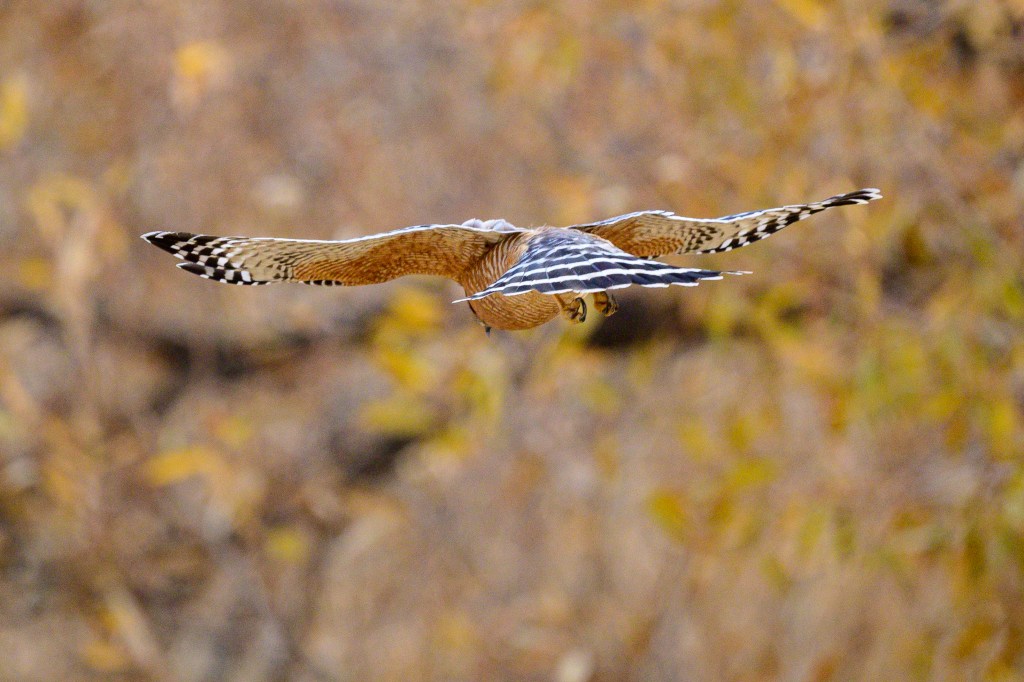
The next two photos show a bird flying away in the forest of the Conservation Open Space Area.
Feeding
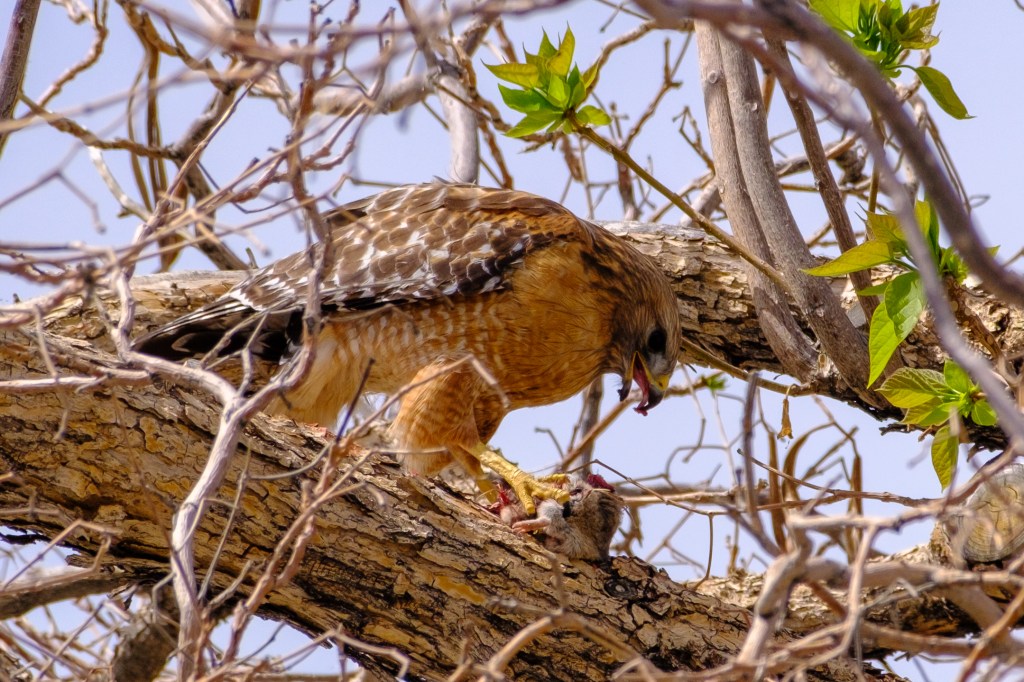
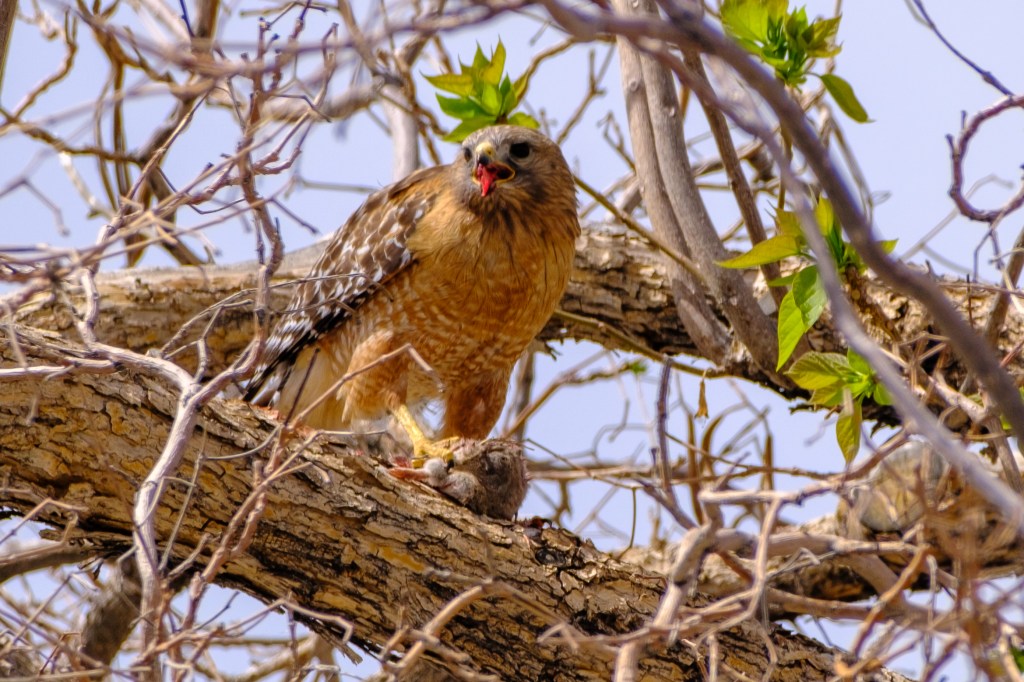
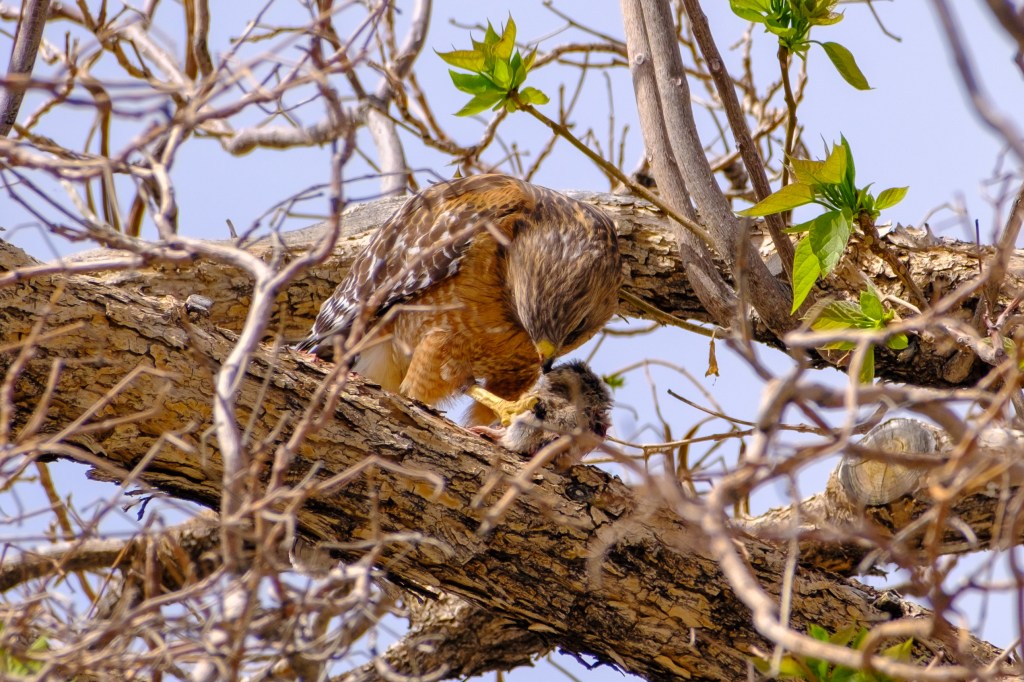
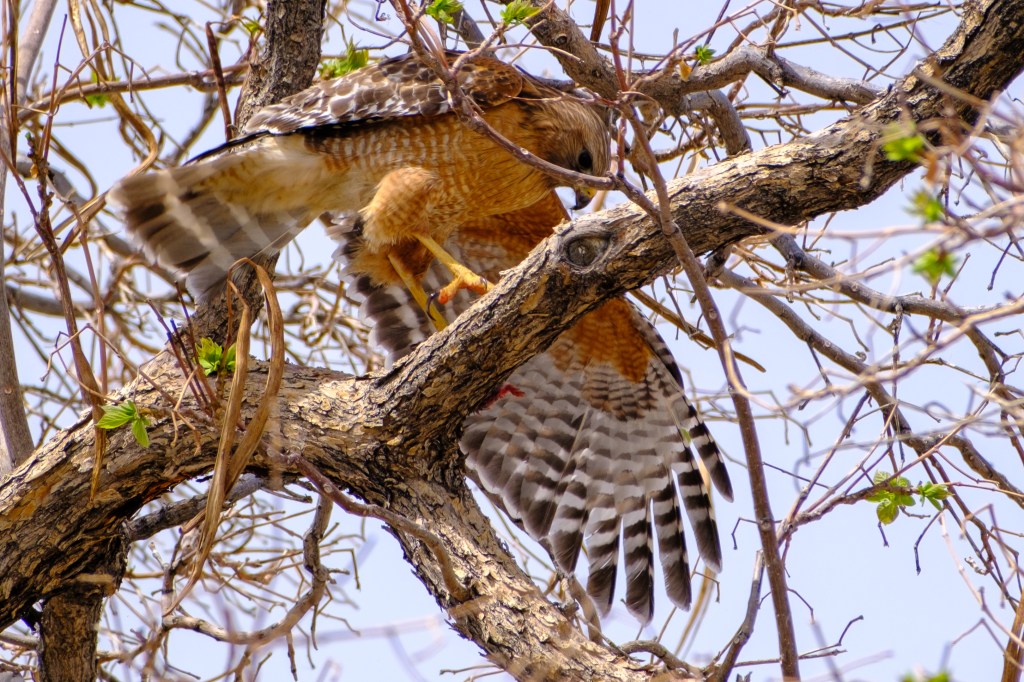
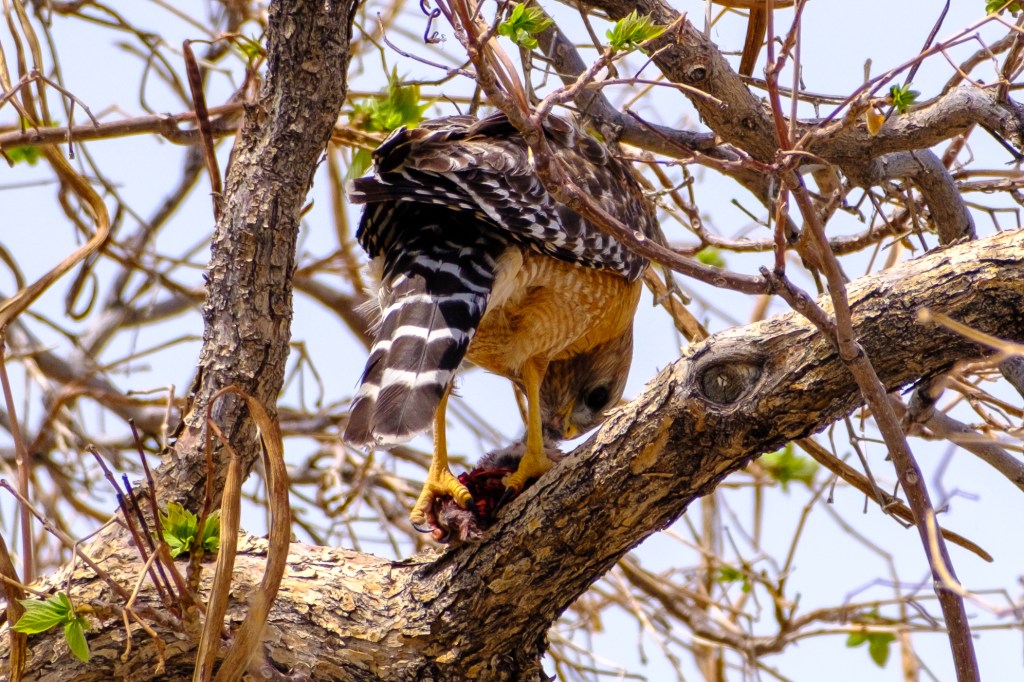
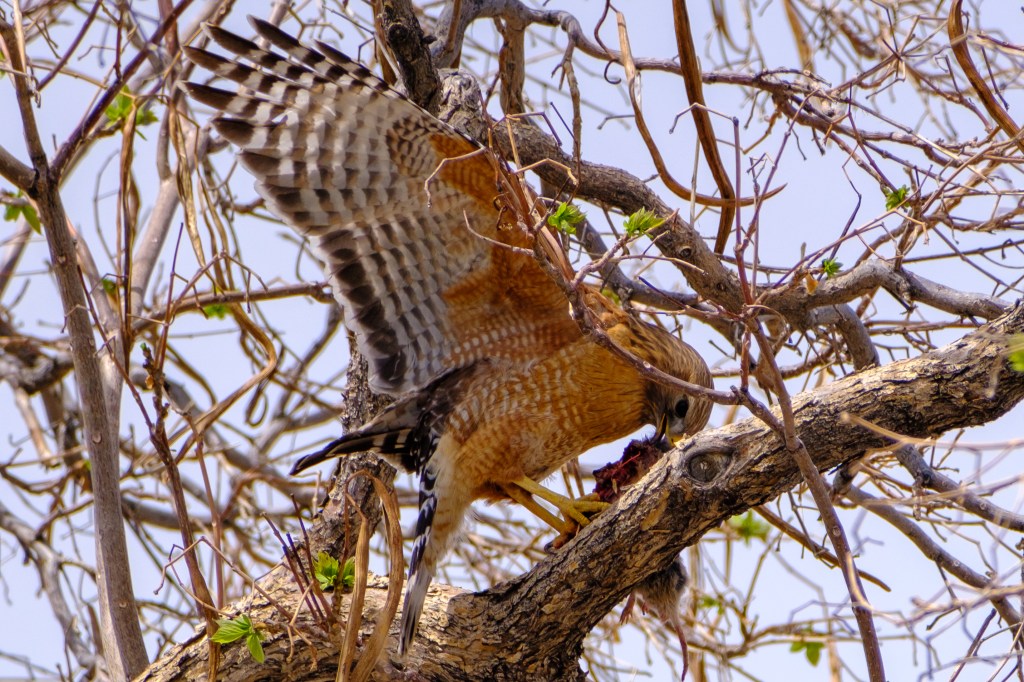
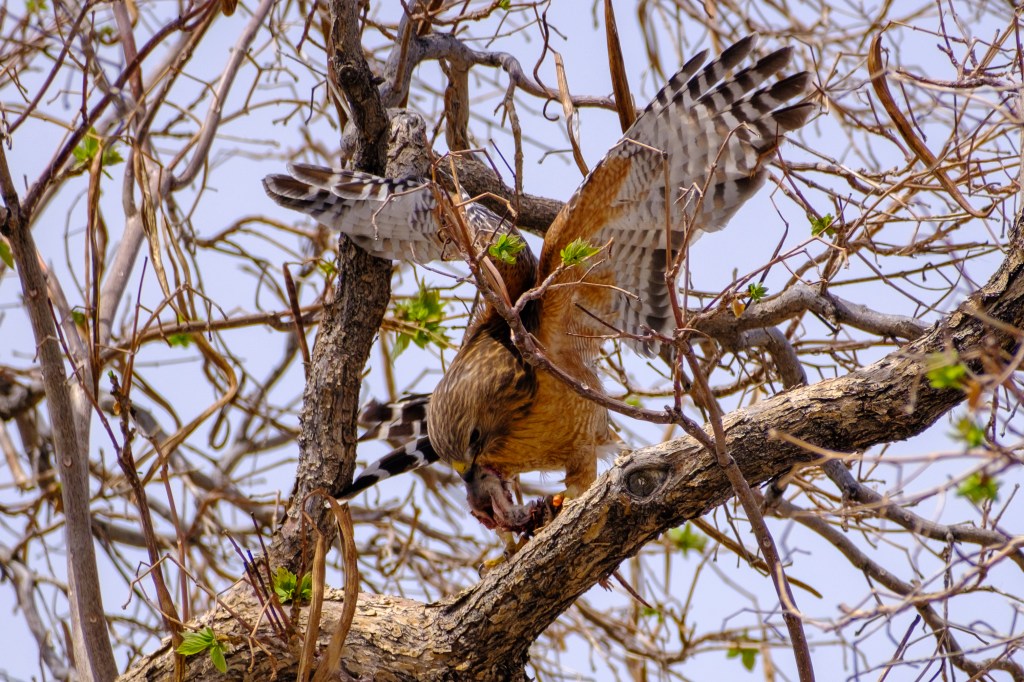
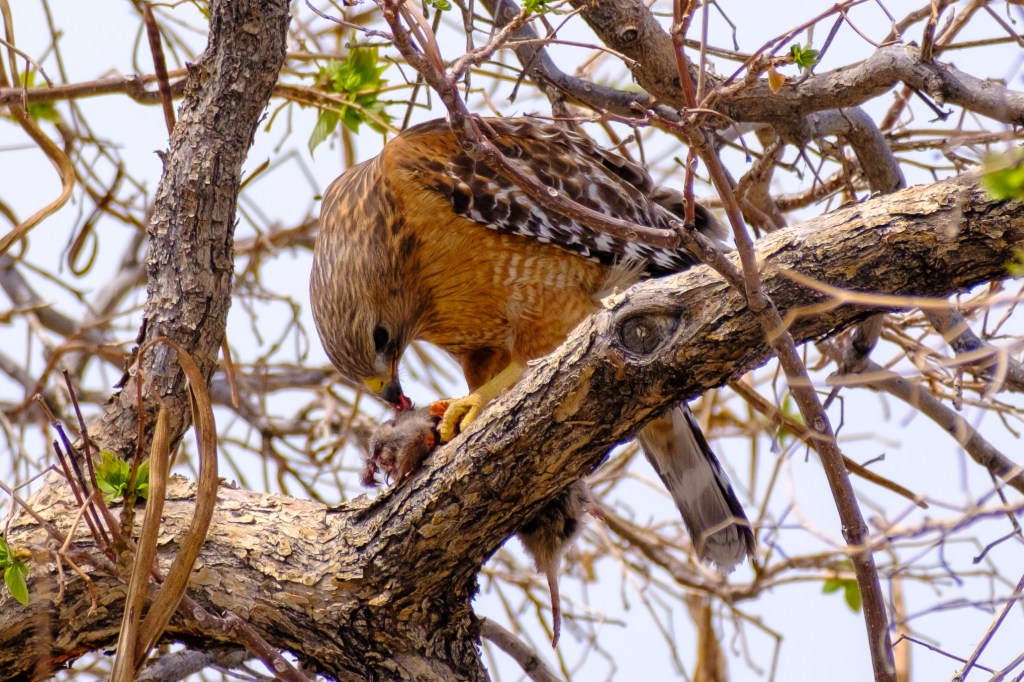
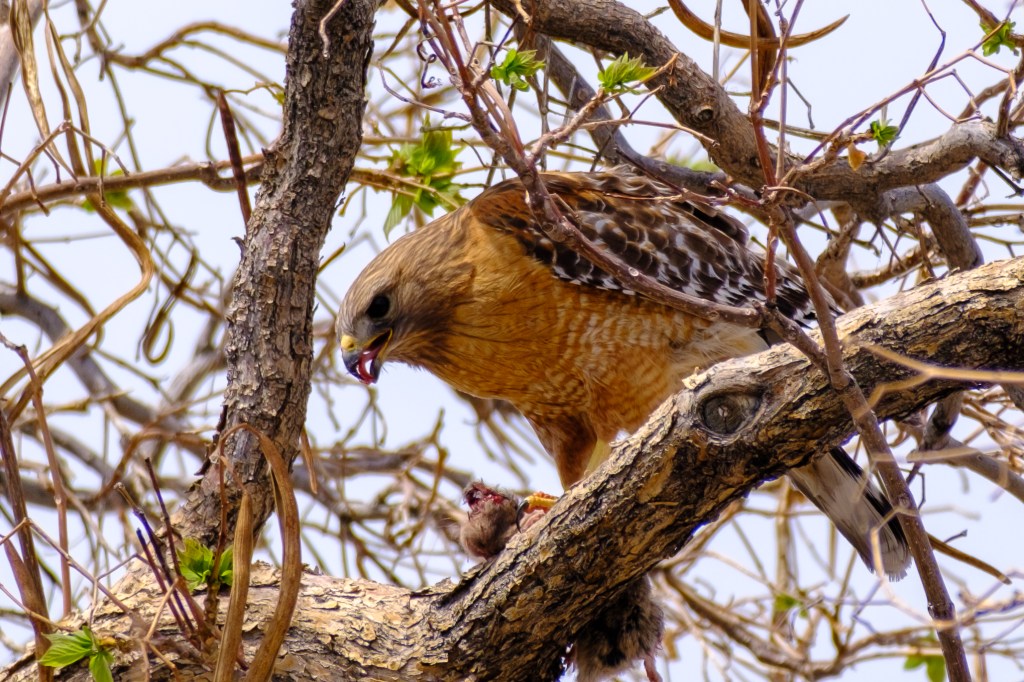
The United Methodist Church is in downtown Bishop. Roberta was finishing up a chore in the Soup Kitchen and I was waiting in the car. I noticed a hawk in a nearby tree and stepped out to get some pictures. It was a RSHA tearing apart a rodent; perhaps a Norway Rat? Birds have no teeth. Raptors rip their food apart, choking down the pieces. They have no manners. The bird looks like a fierce gargoyle in some images. These pictures were taken within a 7 minute interval; no leisurely dining for this bird. The bird kept thrashing the rodent about, changing position, and flying short distances. If you ever wished to be reincarnated as a bird, consider having to eat like this.

Fun fact
Red-shouldered Hawks are not the only raptors new to Inyo County. Bald Eagles were not recorded in the County until 1967. Now we see them every winter at the Buckley Ponds, Pleasant Valley Reservoir, and other locations. So Red-shouldered Hawks, Bald Eagles, and Peter are all fairly new to Inyo County. Other new arrivals are Great-tailed Grackles (1970) and Eurasian Collared Doves (2002).
Two seconds of action
Roberta and I walked north on Barlow, then turned west onto Line Street. Across the road, I saw a Red-shouldered Hawk fall backwards off a telephone pole. Just before it smashed on the ground, the wings popped out. This converted the falling momentum to horizontal flight and the bird shot across Line Street, a foot above the pavement. There was a mouse in grass near the road edge; it saw the Hawk, but too late. All over in two seconds.
 Birds of Bishop