
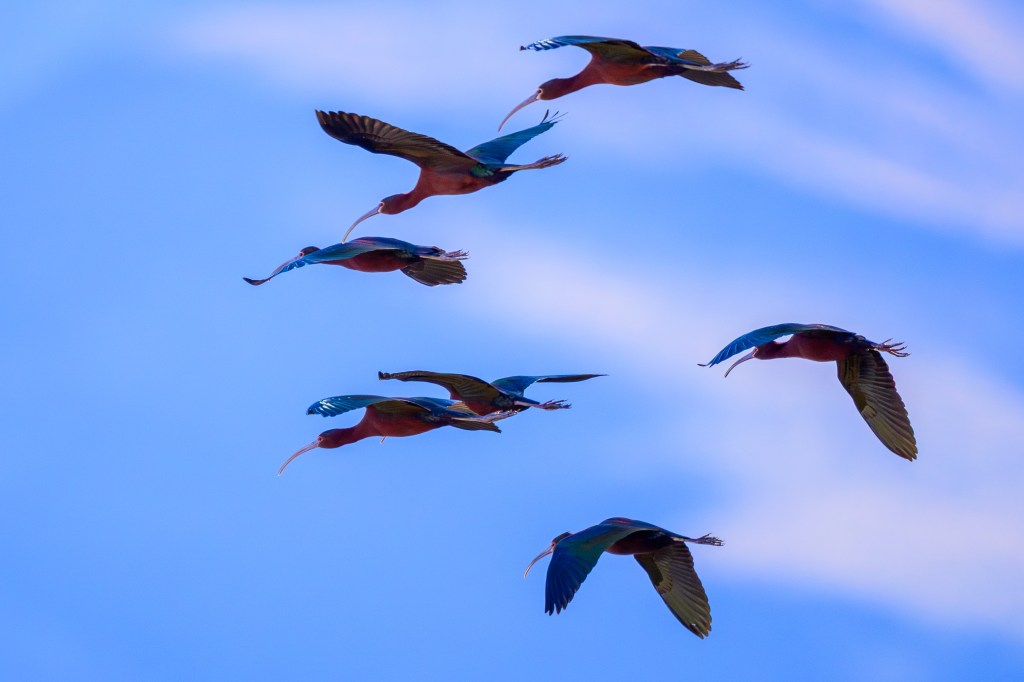
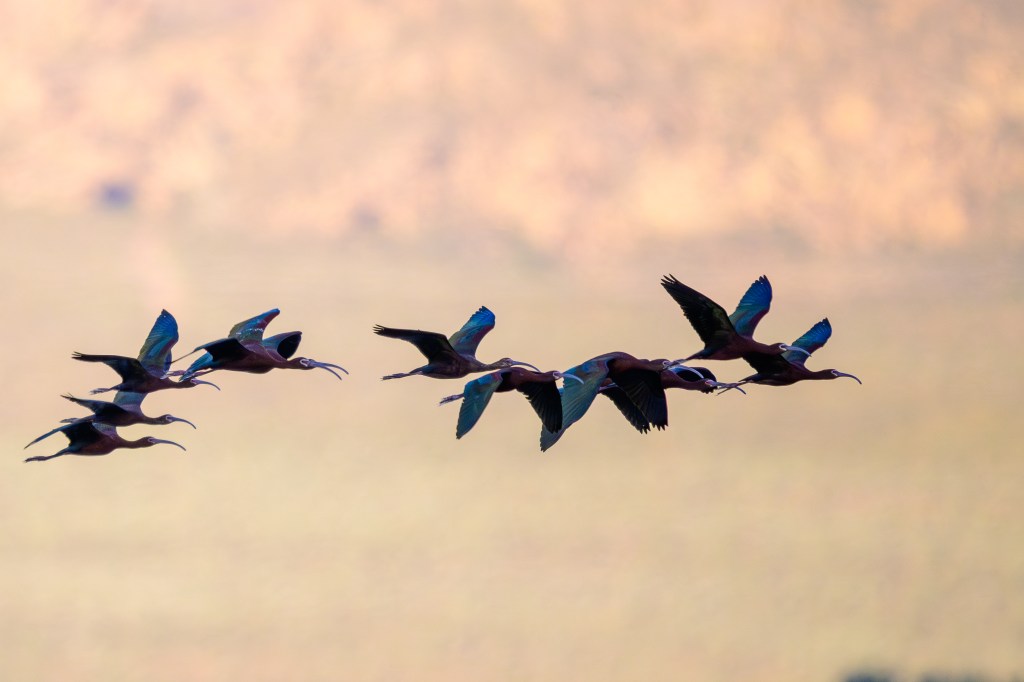
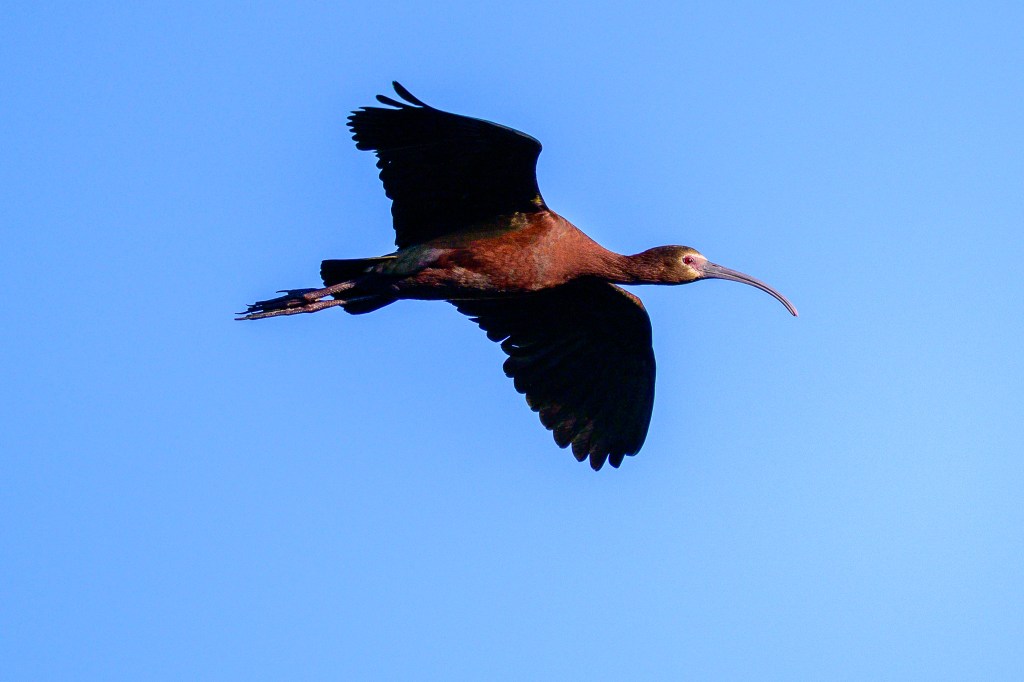
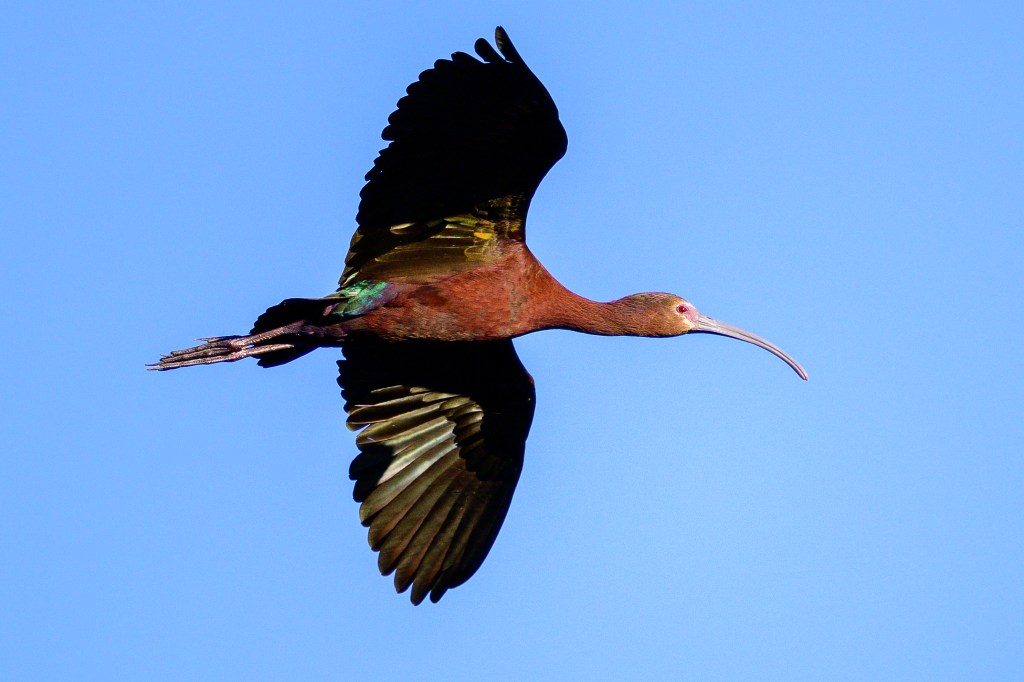
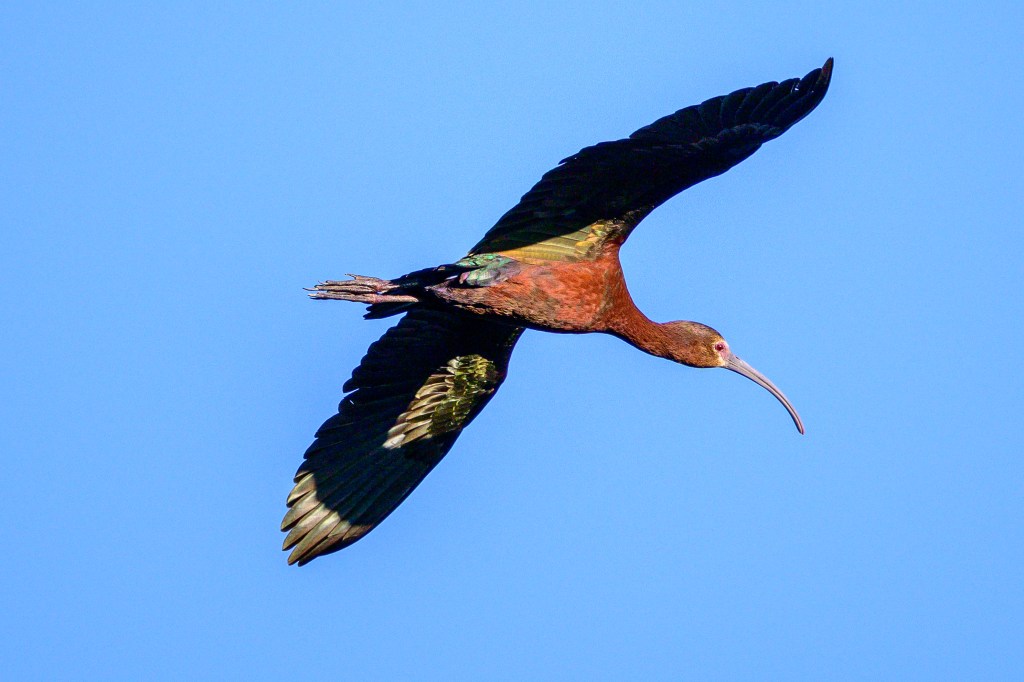
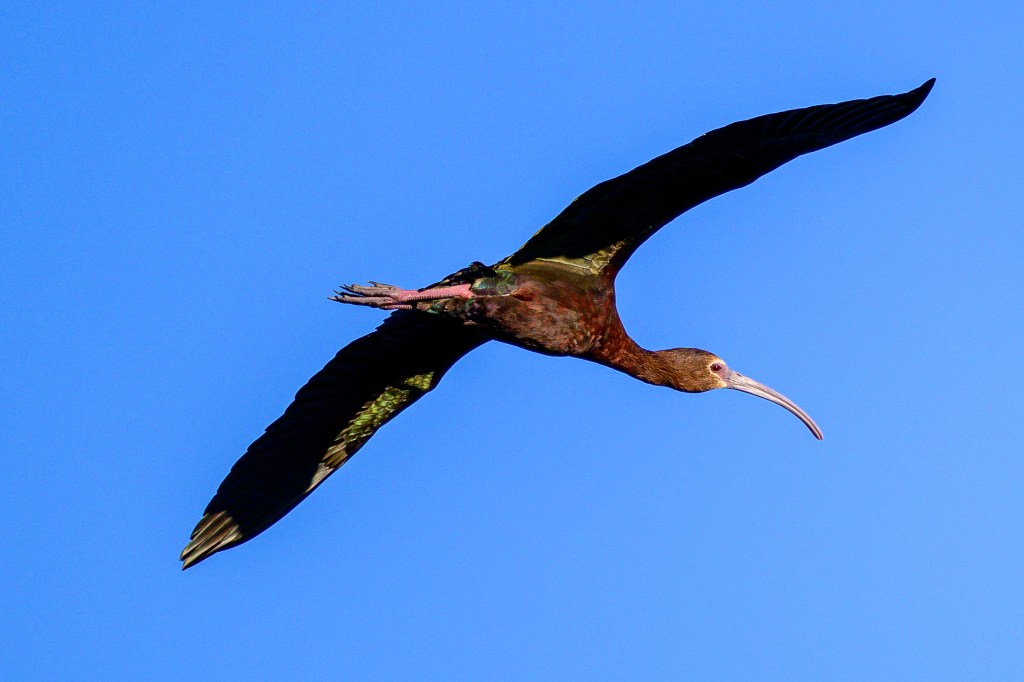
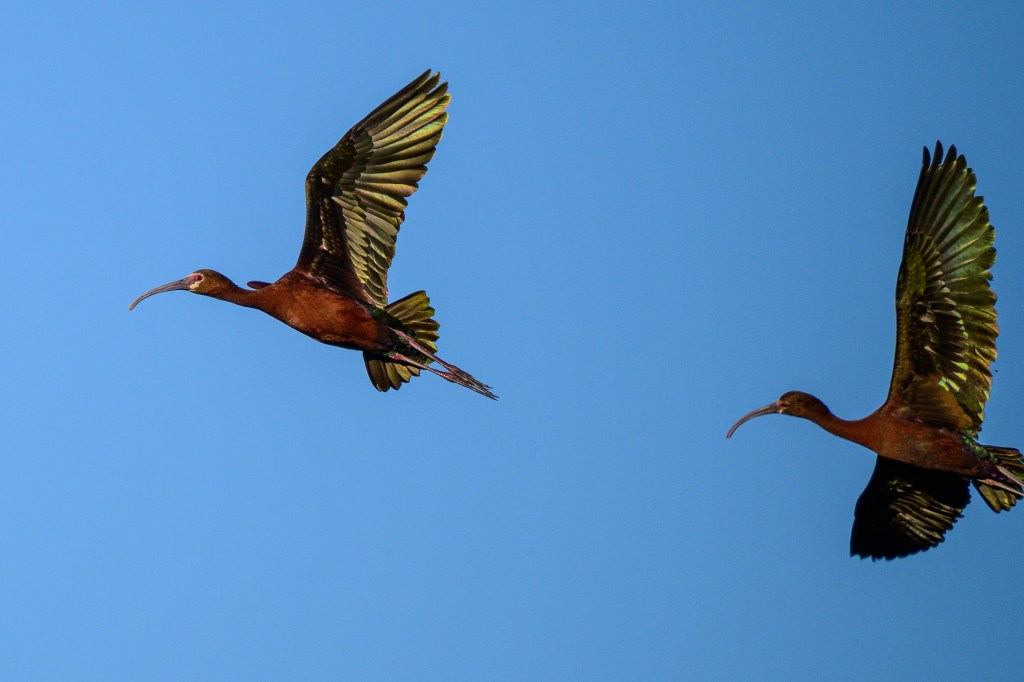
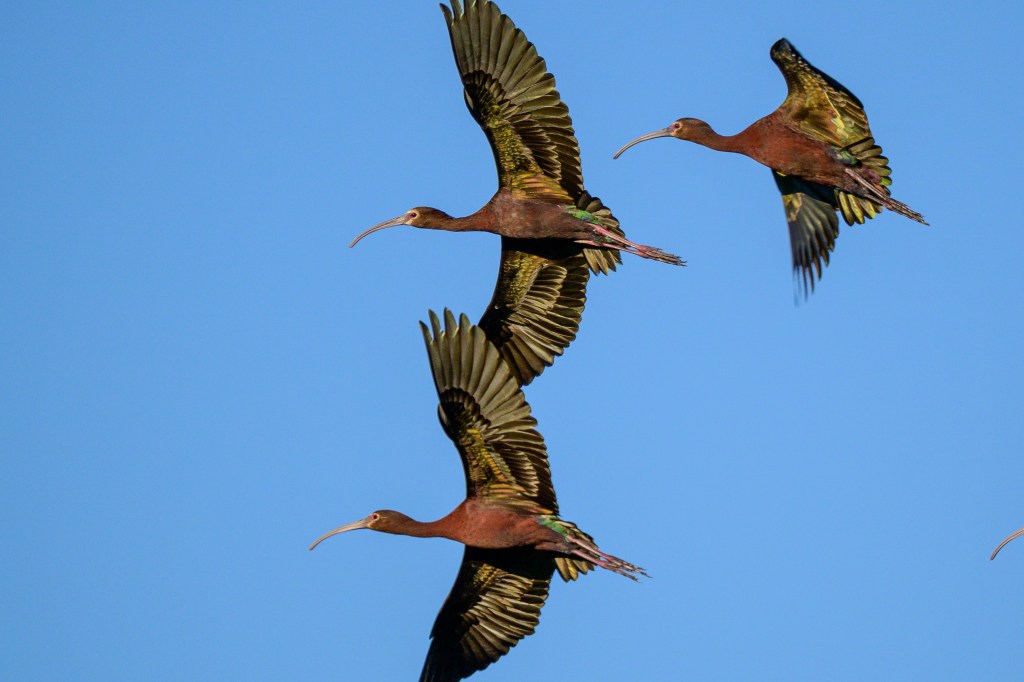
Did a child invent this bird? The birds below were circling the Buckley Ponds on June 29, 2025. The iridescent green feathers, maroon body, decurved bill, red eye, and pink legs are suitable for Alice in Wonderland. Or a Florida theme park.
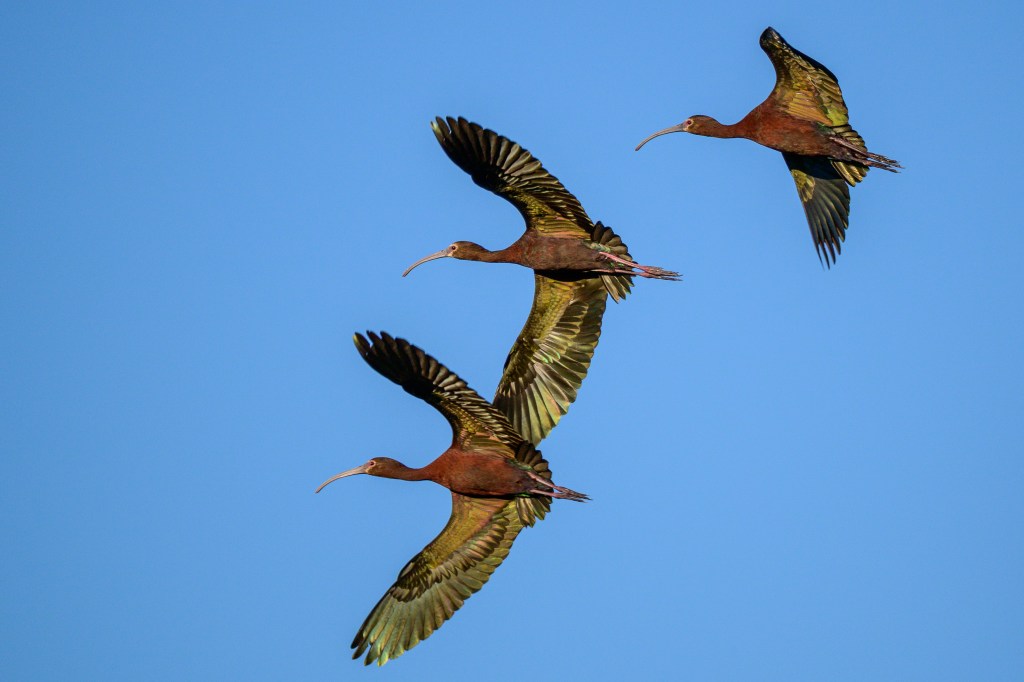
The name “white-faced” refers to the rim of white feathers that surrounds the eyes and base of the bill. This area is white in breeding season. After molting in the fall, the white border disappears and the bird looks grayer. Strange that the name describes a feature that is usually absent.
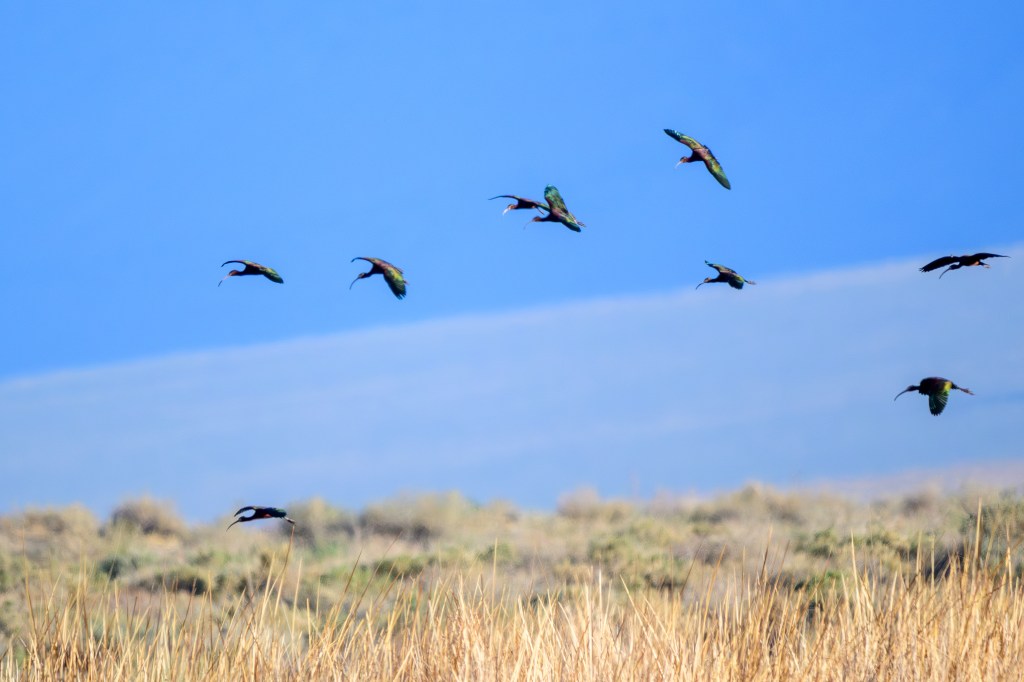
This bird is found throughout the US, except for a few regions in the east. I was clueless about its existence until Aug 13, 2022. An Ibis flock passed over the Buckley Ponds and I captured the three images below.
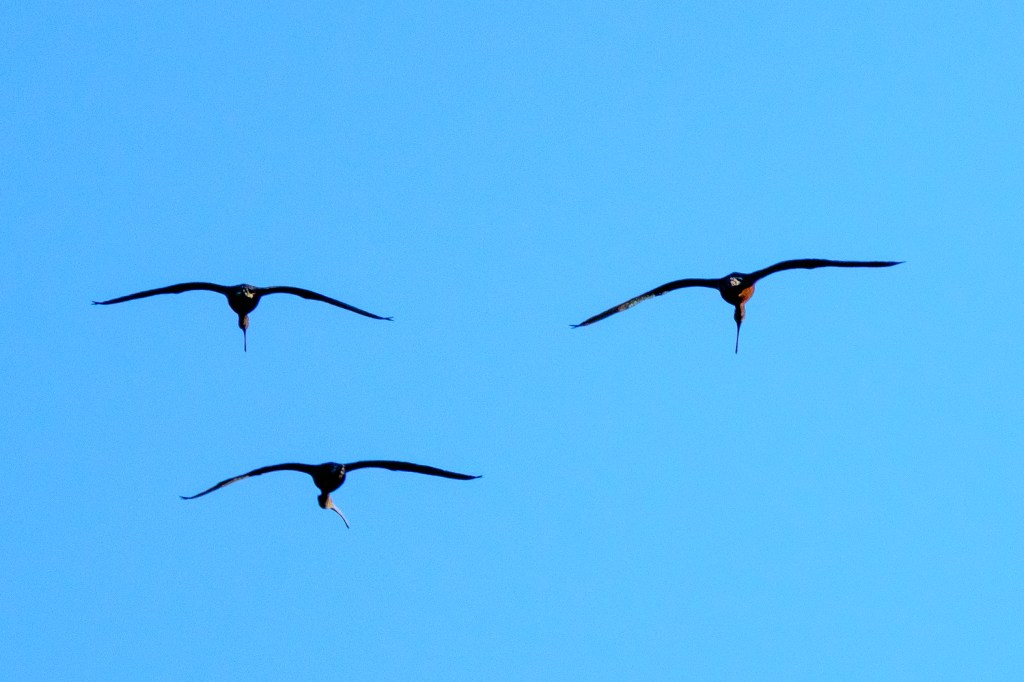
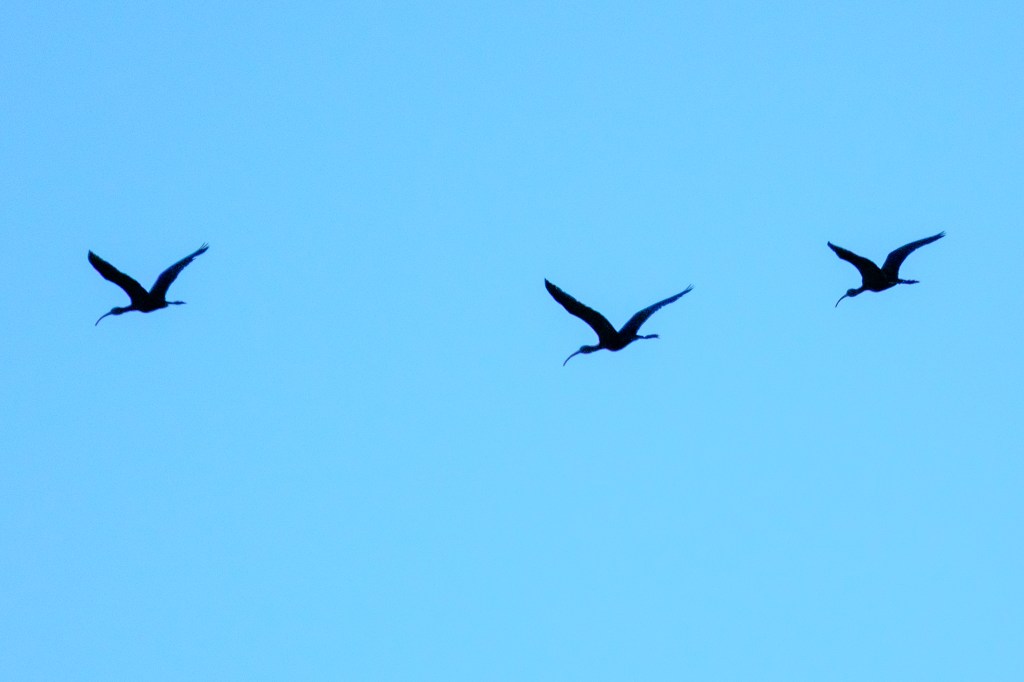

The three pictures above illustrate the difficulties of photographing this bird. They appear mostly as black silhouettes or blurry shapes. They move fast, they are far away, and they appear without warning (unlike Canada Geese and some ducks, who announce their approach with honking or quacking). The distinctive beaks give away their identity; I was able to search my bird guides and quickly figure out what I had photographed.
August, 2022
During August, 2022, I collected more Ibis photos as they migrated through the Owens Valley. The flocks often made large circles, so in some images the birds are moving south, but in others they are moving north. All these pictures were taken at the Buckley Ponds.
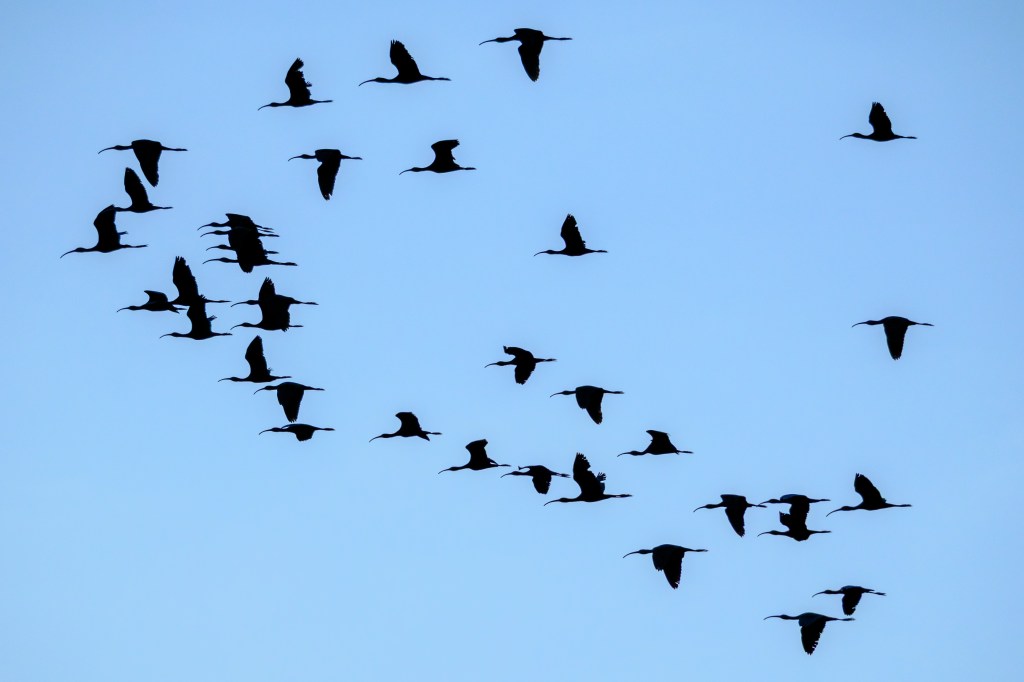
In the next two photos, the birds are flying south with the White Mountains in the background.
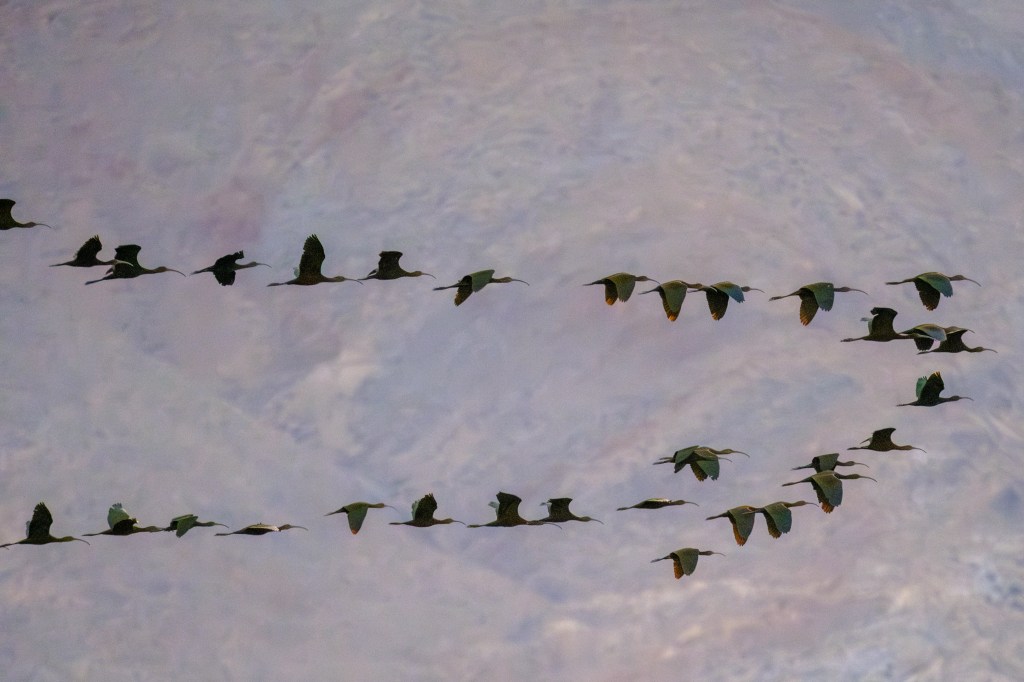
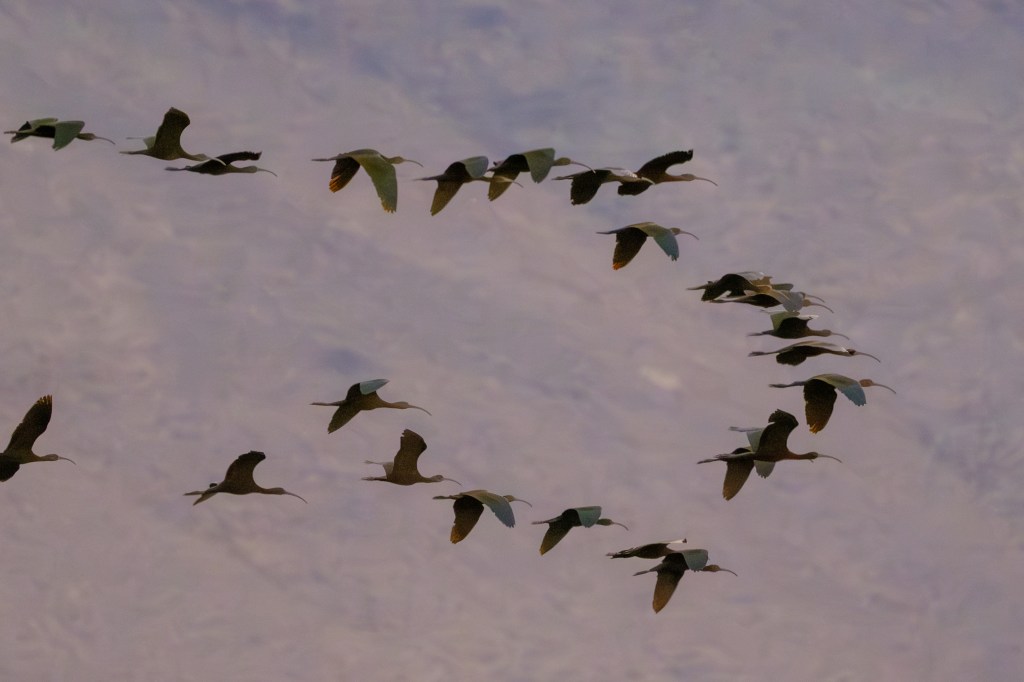
In the next two images, they are flying north. The first photo shows Mt Humphreys in the background.
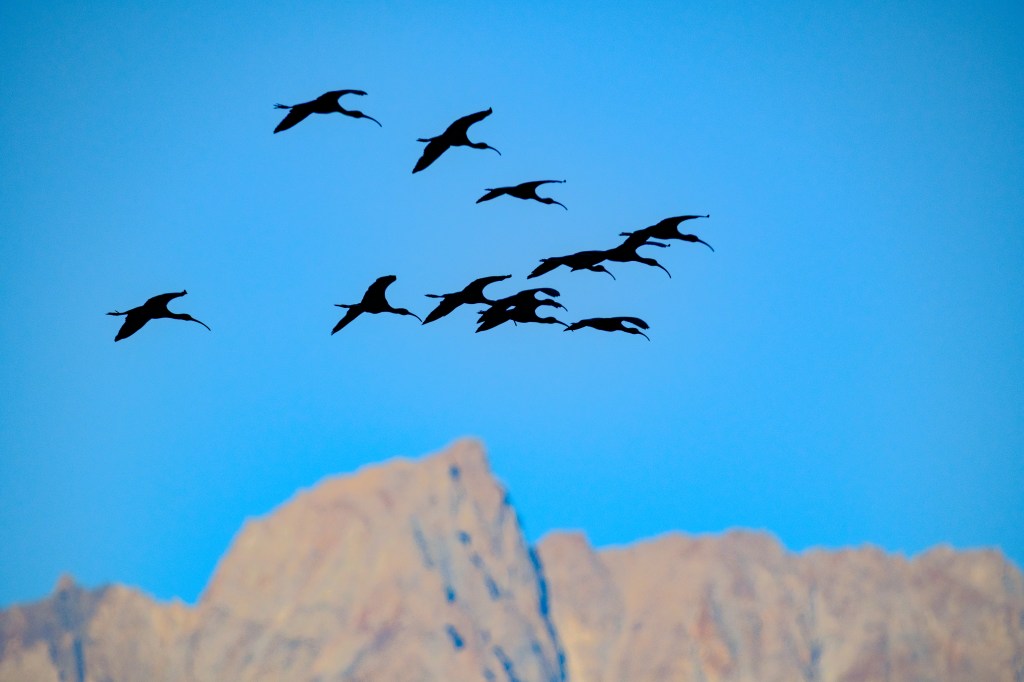
In the next photo, part of Mt Tom and the Wheeler Crest are in the background.

Ibis weigh 1.3 lb, have a 3-foot wingspan, and the bills are five inches long. They winter in Mexico. They migrate north to breed in marshy areas of California, Nevada, and elsewhere. They like shallow fresh water, including wet agricultural fields, such as alfalfa fields and rice paddies.
To forage, they wade about, using their long bills to sweep the water or probe muck for insects, crayfish, and worms. In videos, their heads rapidly bob up and down like a feathered sewing machine, while their beaks probe for chow in muddy gunk. Imagine that you put on a blindfold, then stuck your head into a dumpster and tried to locate edible treats with your lips. Fortunately, for Ibis, my dumpster analogy is not quite right. The tips of Ibis bills have sensitive nerves and they have a reflex that makes the bill snap shut on food. So they are not wasting much thought about their culinary choices. Whereas you, in a dumpster, might pause before swallowing what might, or might not, be a hot-dog bun.
Spring 2023
The winter of 2022-23 brought record snow to the Sierra, so many Bishop fields were water-logged in spring. Ponds and marshes sprang up in the sagebrush. Ibis appeared along Airport Road in March. The birds were in breeding plumage, with maroon coloring, white faces, and pink lores. (The lore is the area between the eye and the base on the bill.)
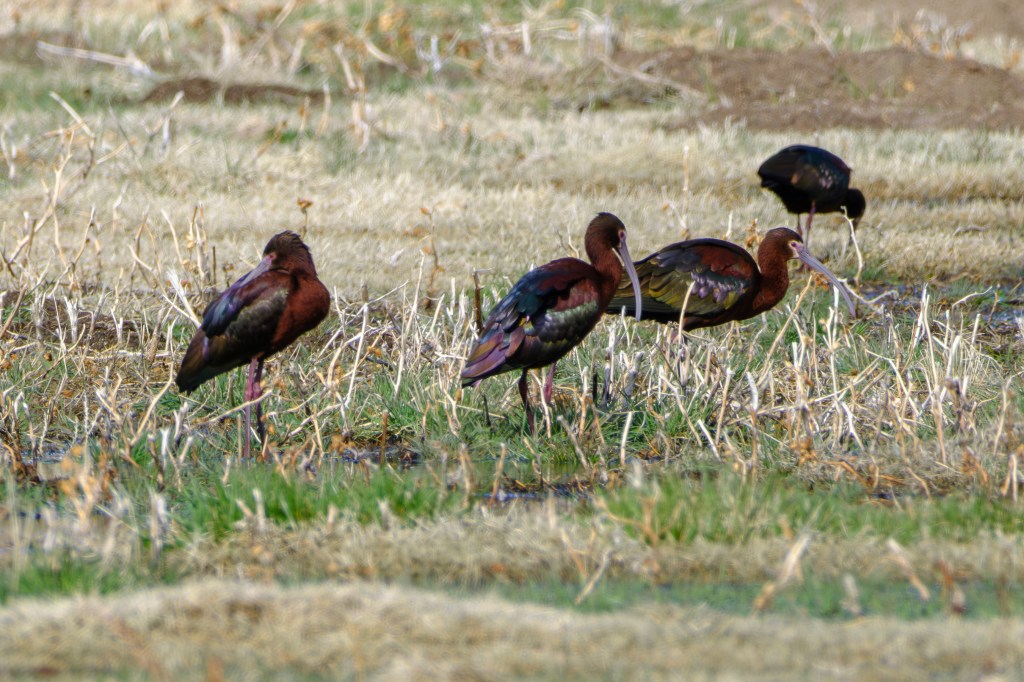
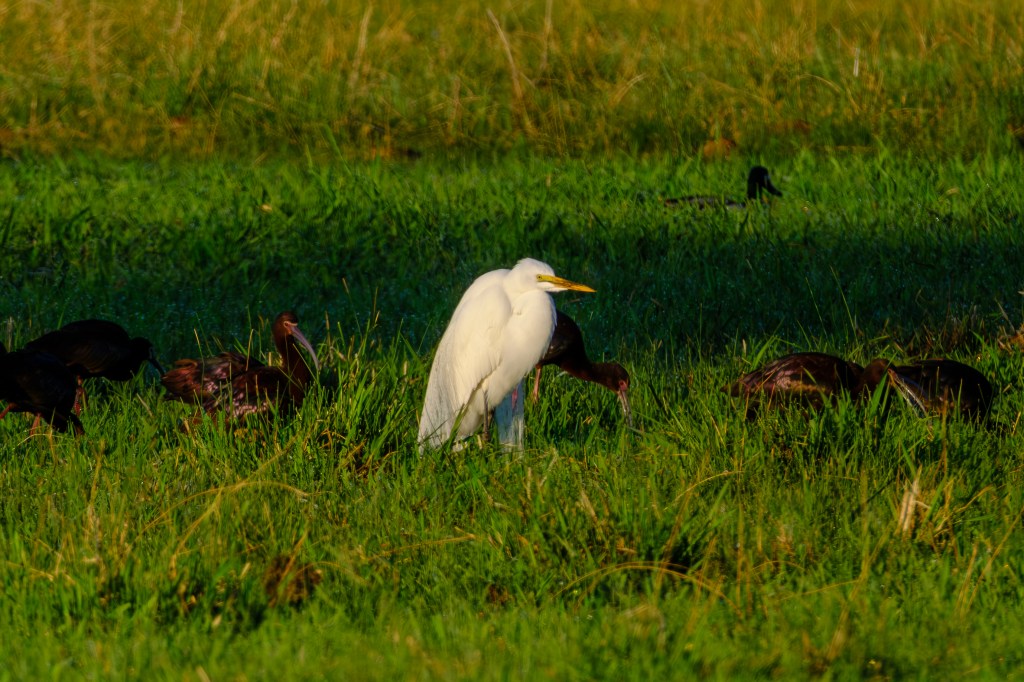
In April, Ibis were in a field bordering Line Street in Bishop, along with a Great Egret and a Mallard.
Fall 2023
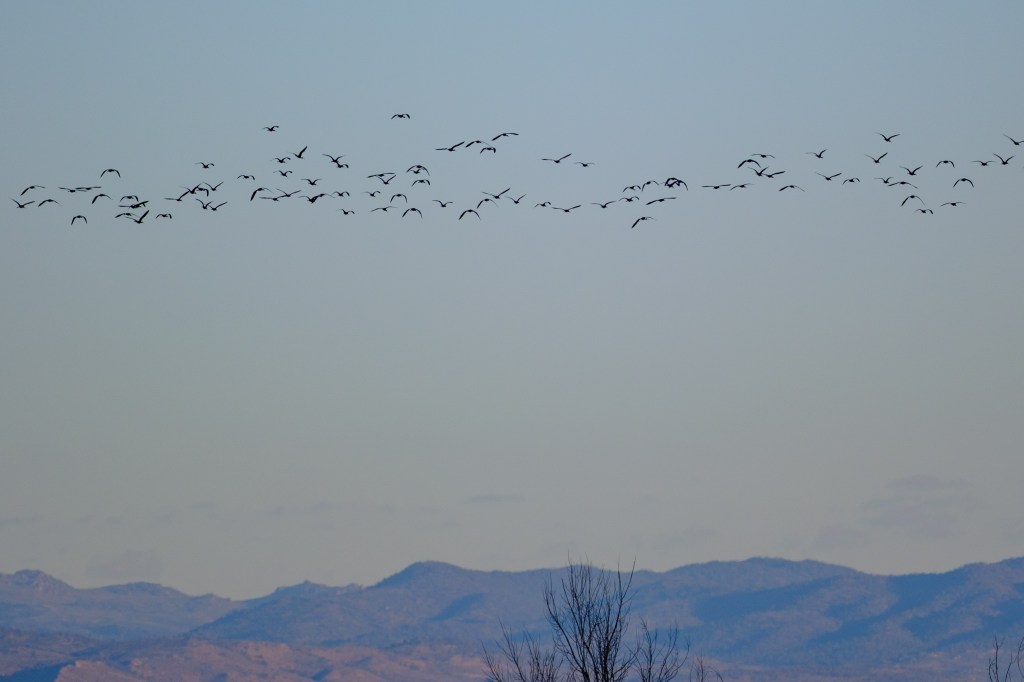
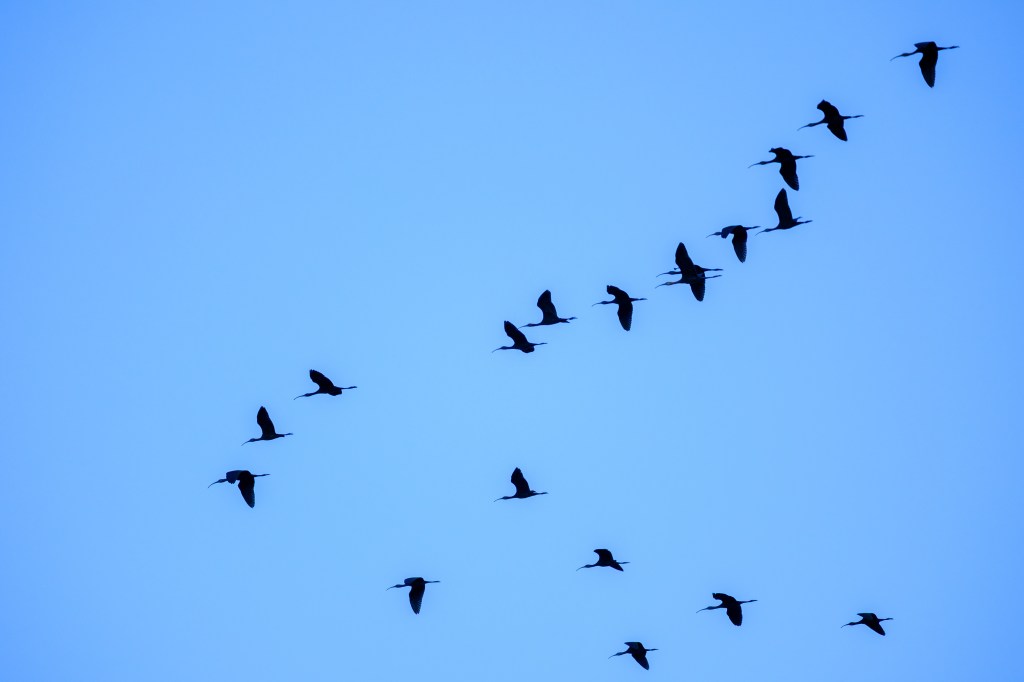
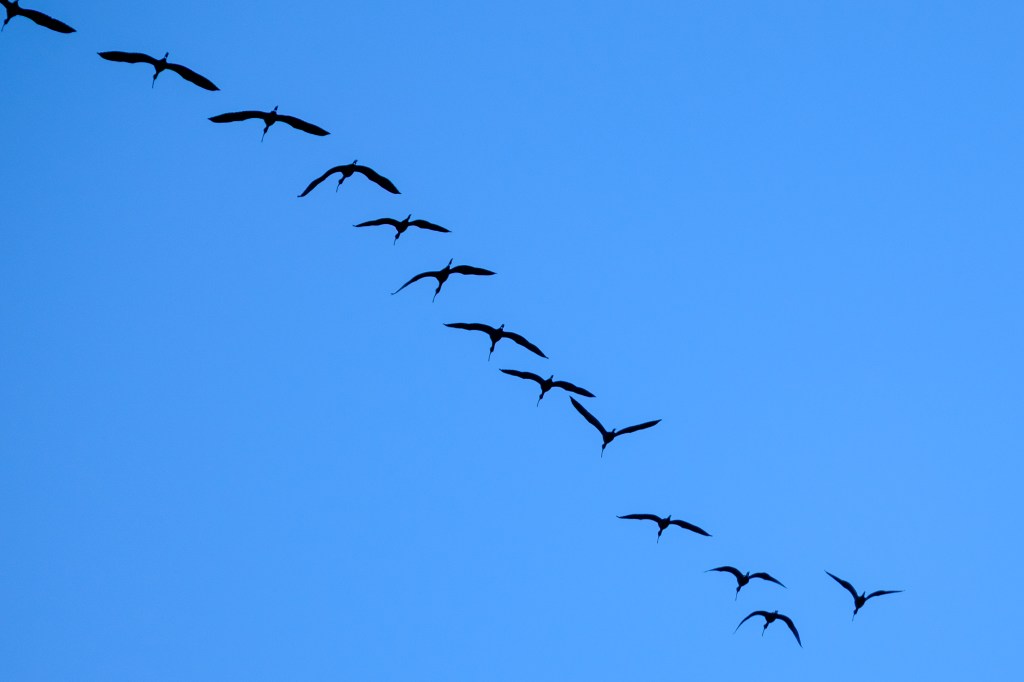
In the fall of 2023, large Ibis flocks passed overhead at the Buckley Ponds. Without a camera, or binoculars, I would mistake them for geese or ducks.
Owens Lake
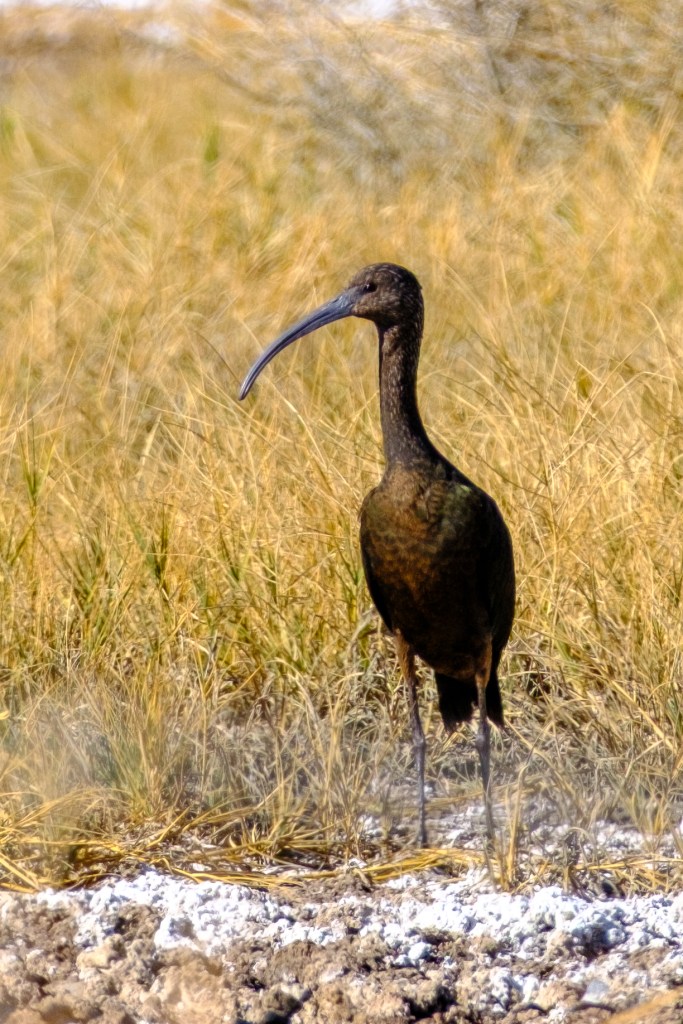
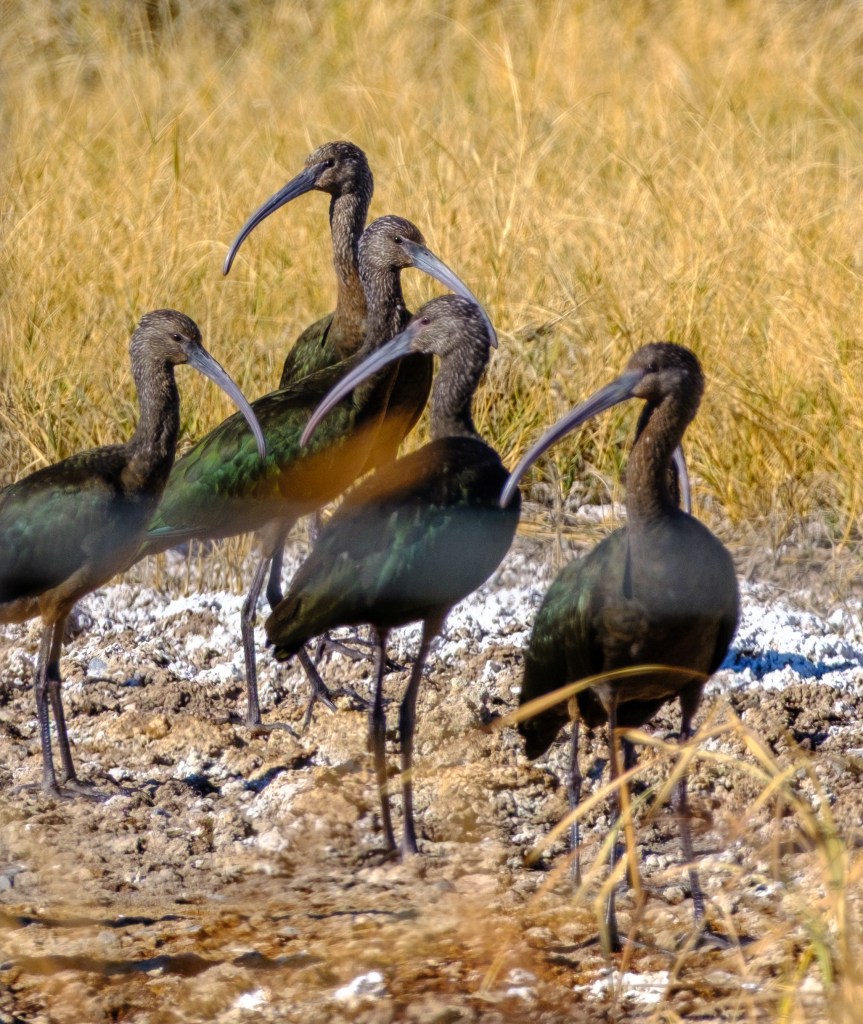
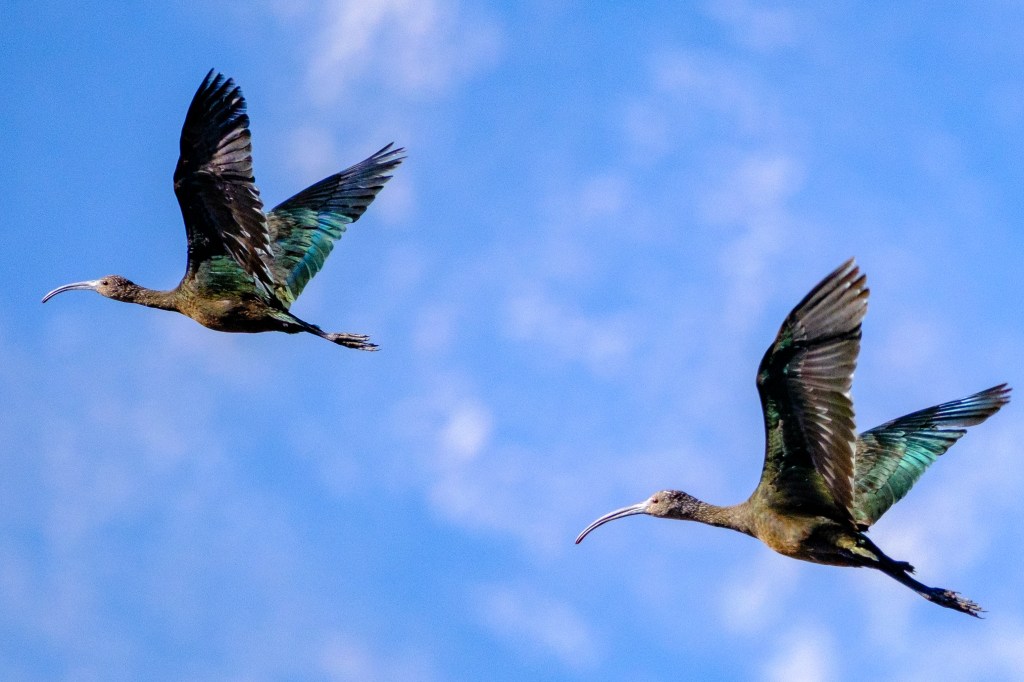
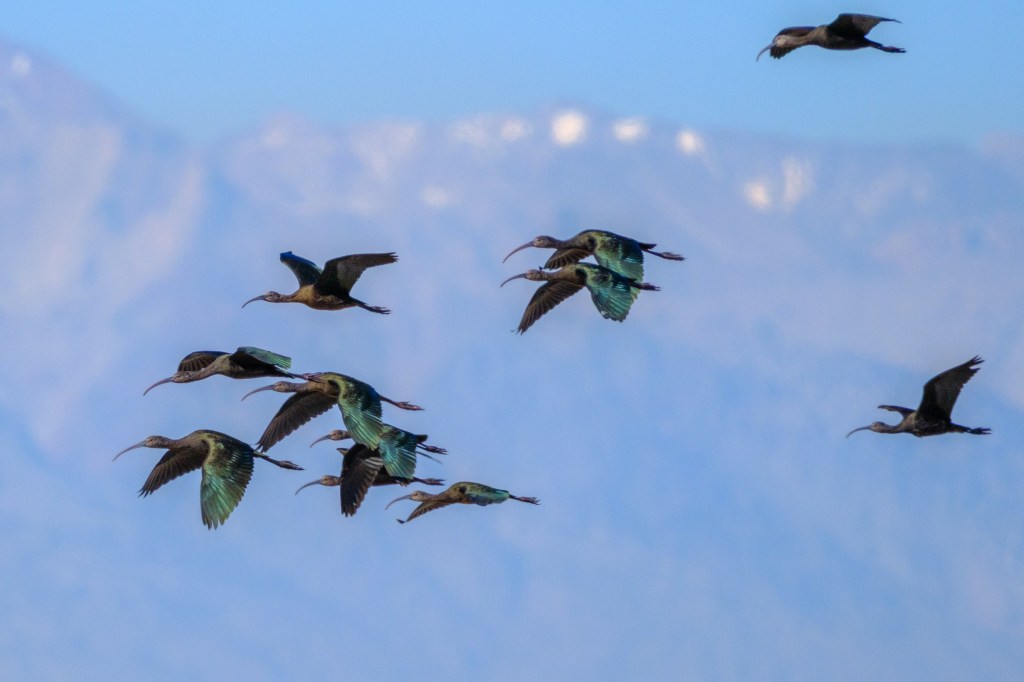
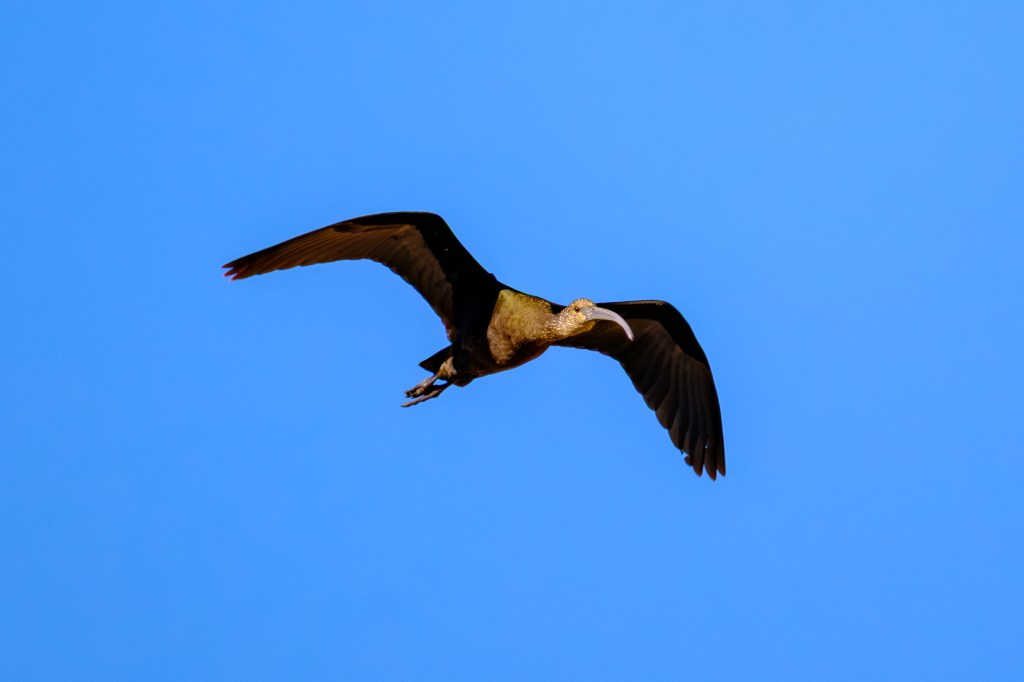
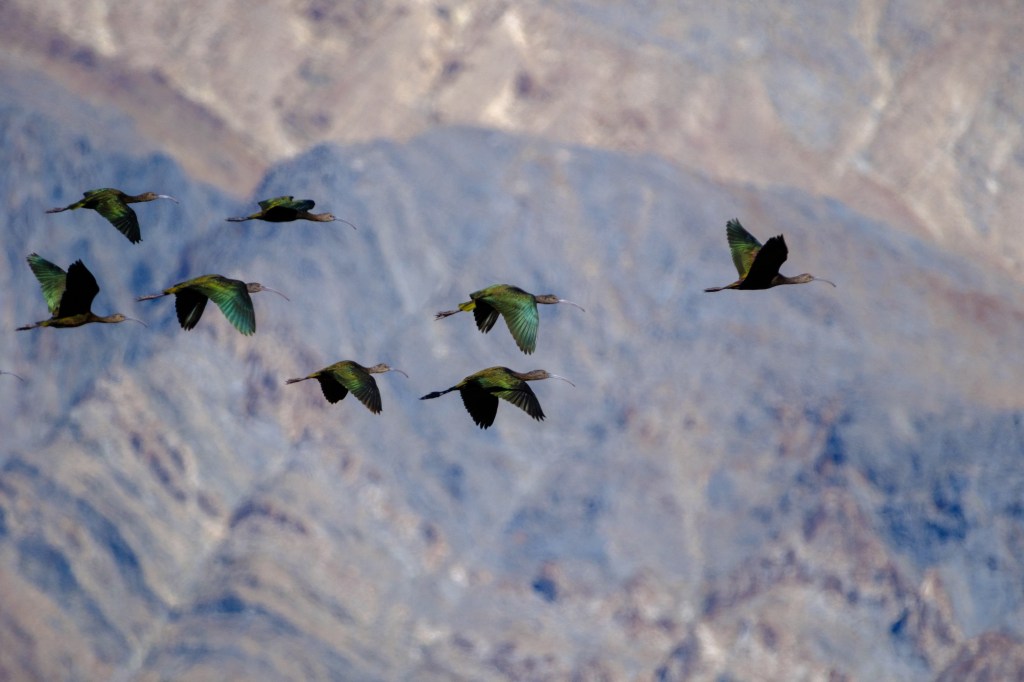
On November 29, 2023, Roberta and I were prowling Owens Lake for birds. Where the Owens River joins Owens Lake, we found Ibis having lunch in casual non-breeding outfits; white faces absent, color grayer, green feathers, less maroon, legs now black. An annoying fence made it hard for me to get clear photos of the birds on the ground. Then the birds took off and circled; the Inyo Range and the Sierra appear in the backgrounds:
Summer 2024
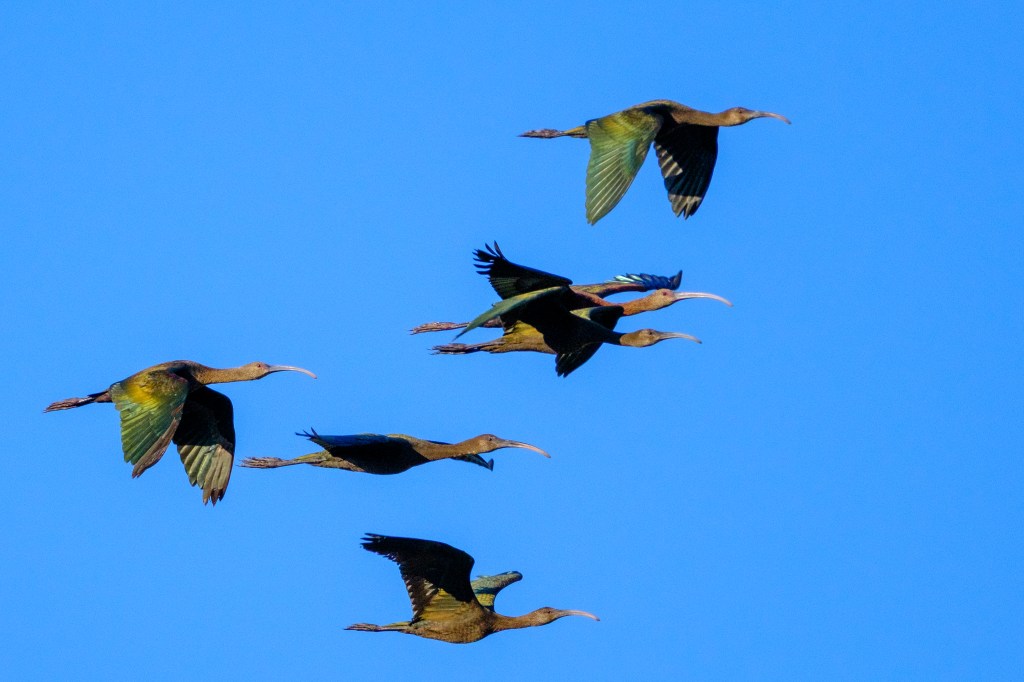
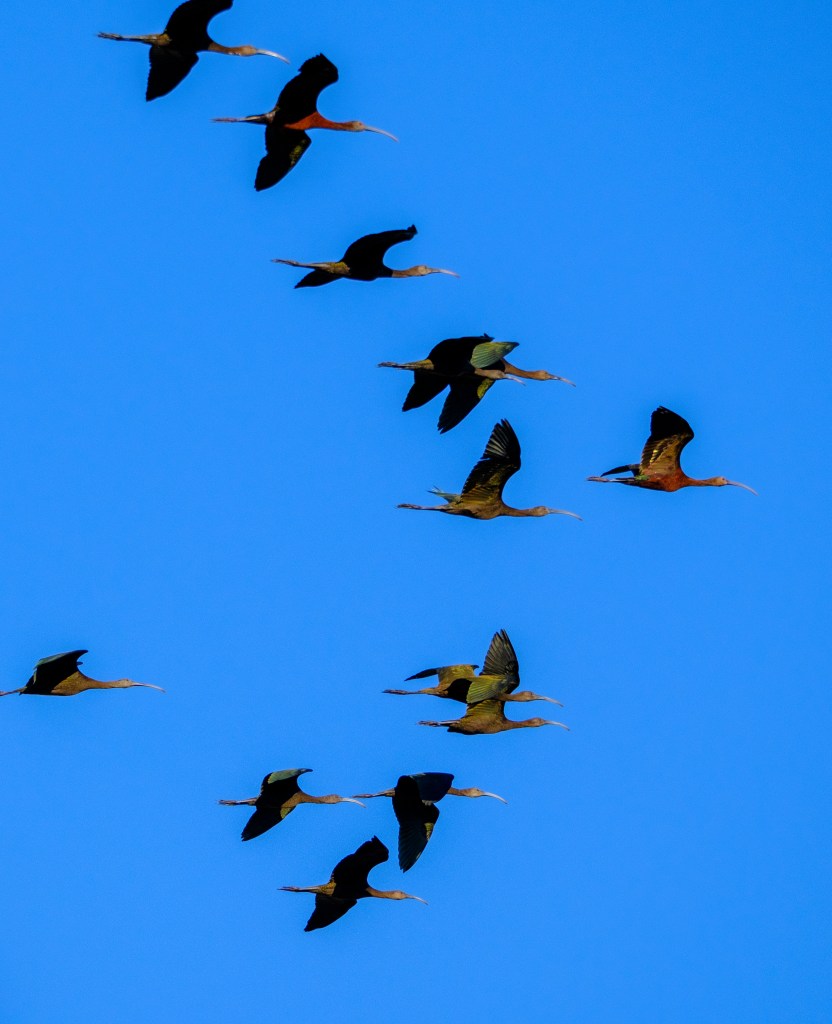
In summer of 2024, a flock of Ibis flew over Airport Road. Some were still in breeding colors:
Spring 2025
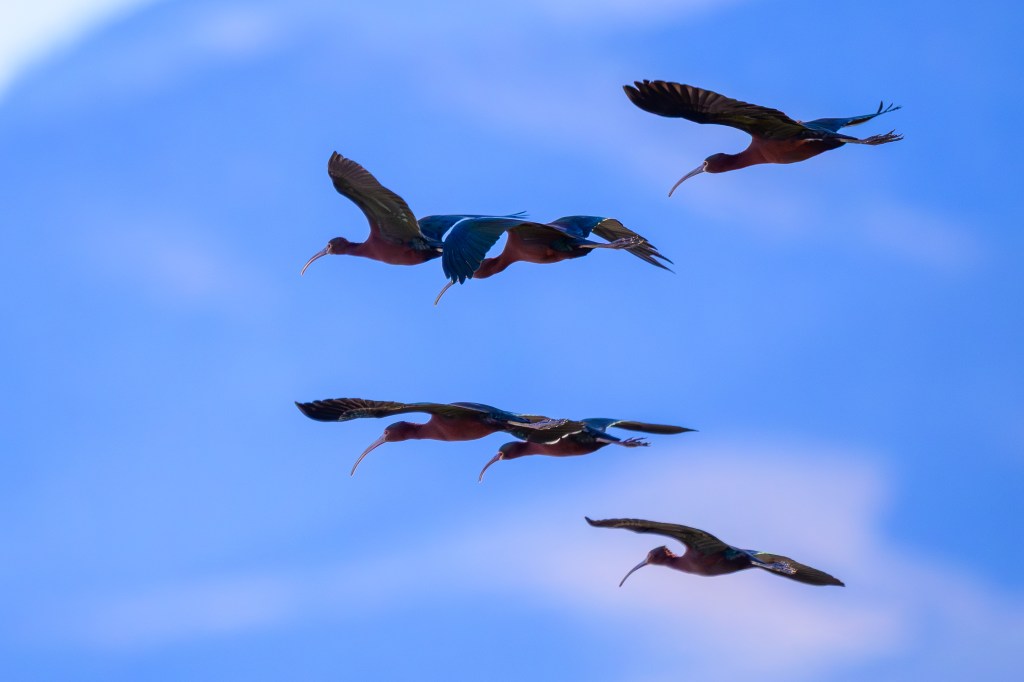
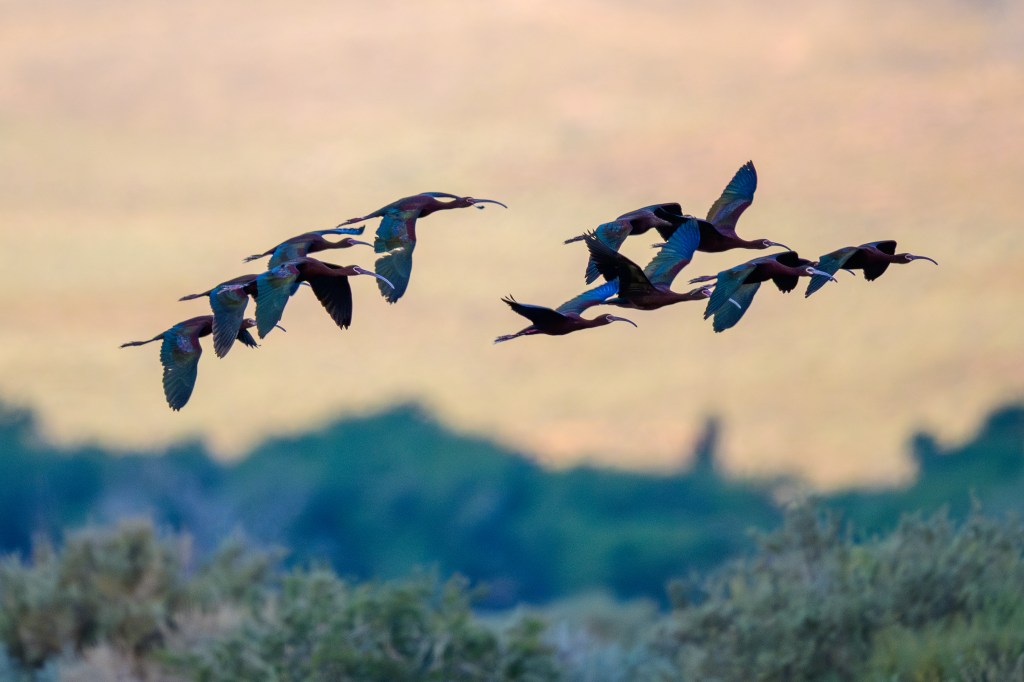
In April and May of 2025, Ibis were at the Buckley Ponds. I now had a full-frame camera (Nikon Z8) and the quality of these images is better than the previous ones.
Summer 2025
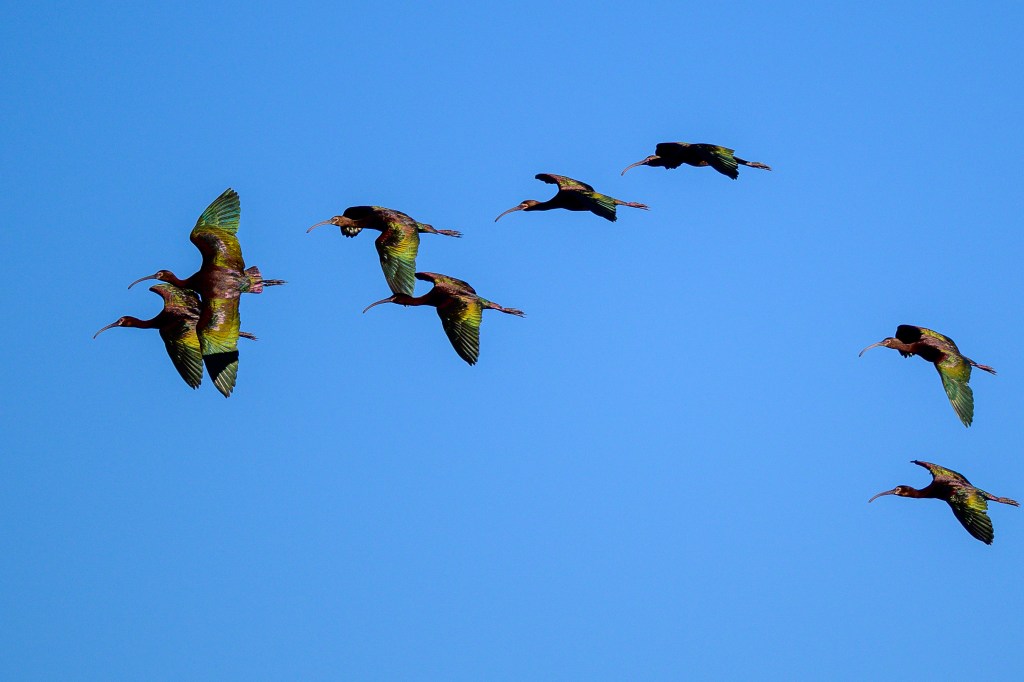
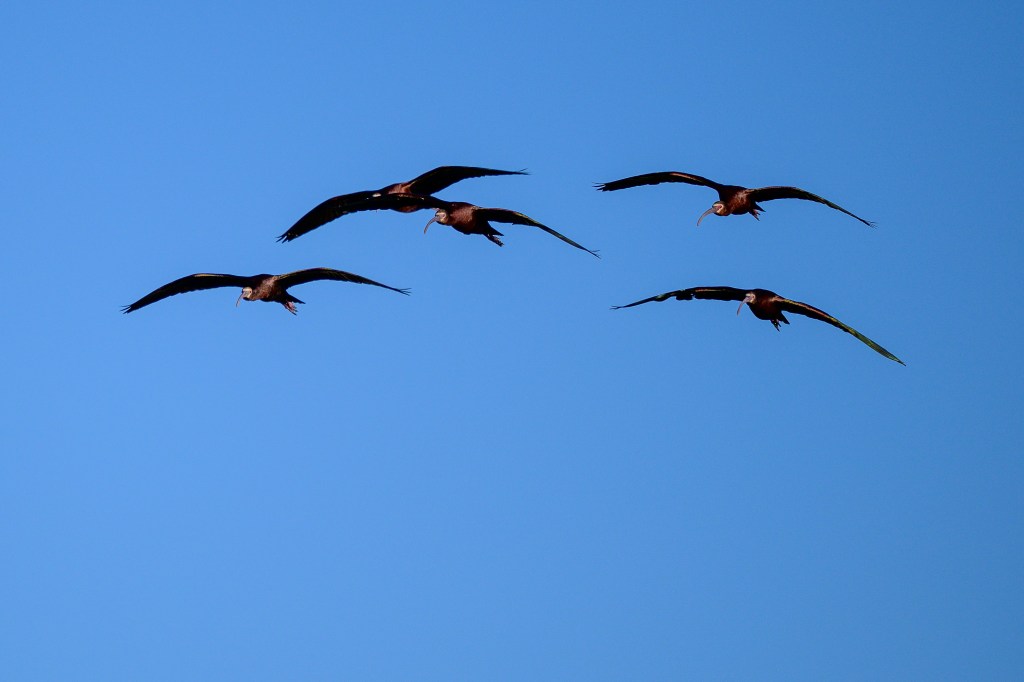
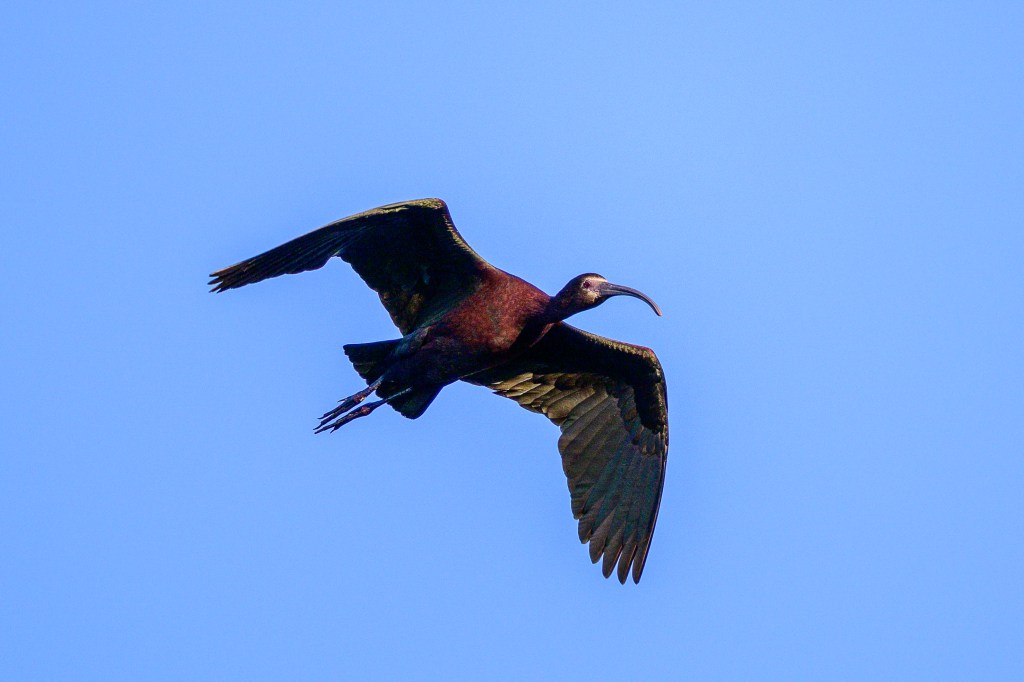
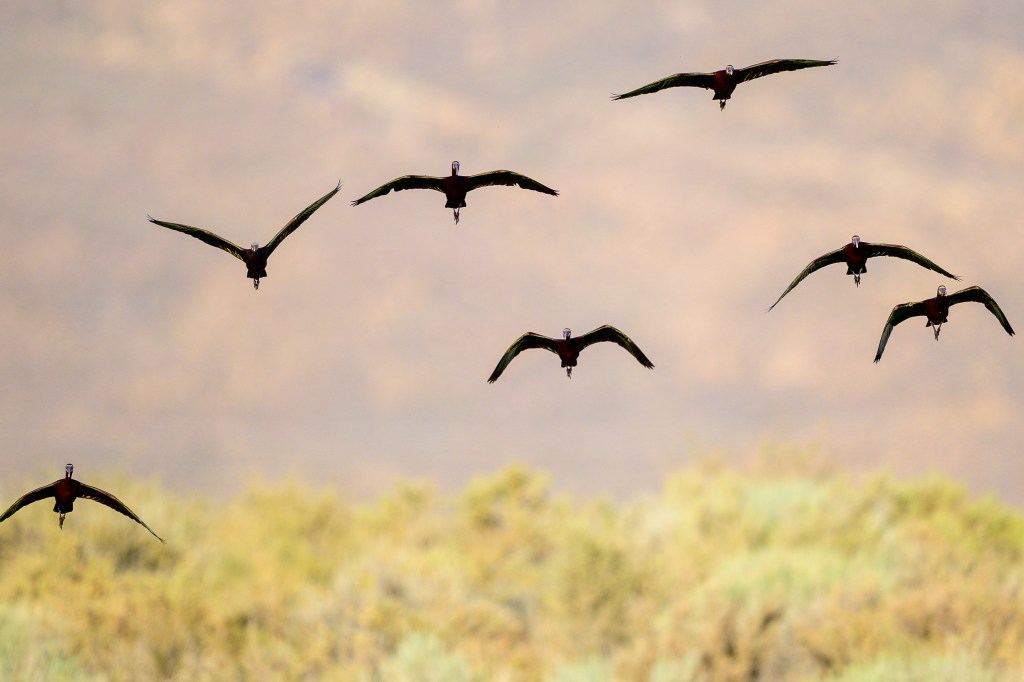
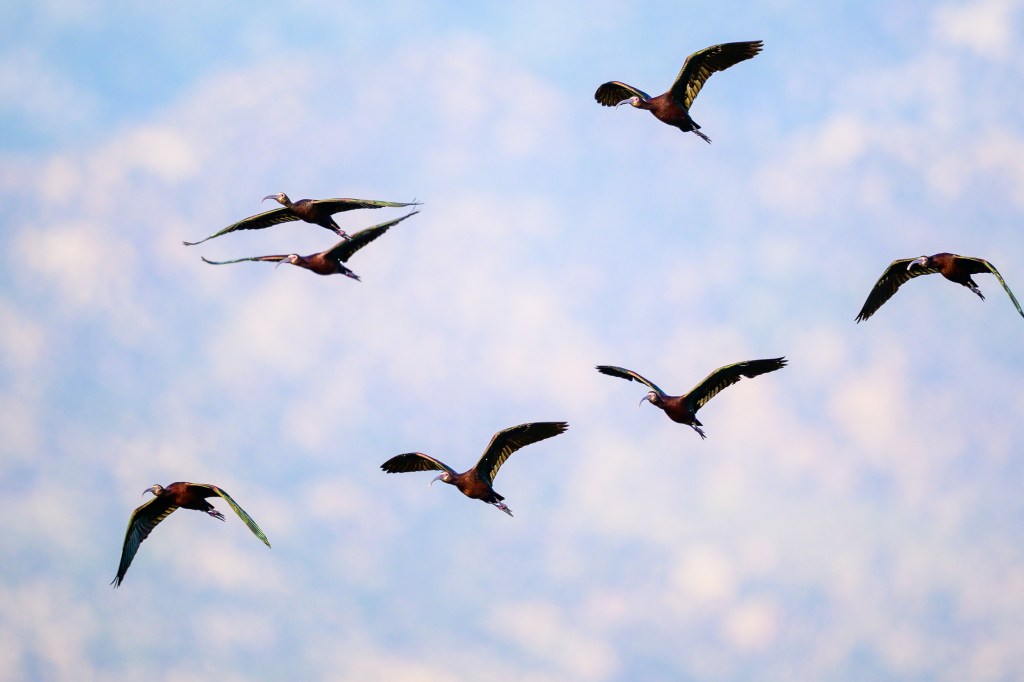
On June 29, at 7am, Ibis circled us at the Ponds. Thanks to their flight path, I was able to shoot with the sun behind me. I had my Nikon Z8 with a Nikkor Z 600mm f4 lens, gear that proved itself that morning. Images are sharp and well-lit. The garish colors are obvious. In the future, I hope to get better photos of this bird on the ground.


Death Comes for the Agave
This little story has nothing to do with birds. It describes, with photos, the spectacular death of a Harvard agave in my backyard.
Valery Harvard (1846 to 1927) was born in France. He emigrated to the US as a young man and finished medical school at NYU in Manhattan in 1869. He served for decades in the US military, mostly in the American West, but also in Cuba and Manchuria. In 1906 he became faculty President of the Army Medical School. In addition, he was a botanist and studied plants in western Texas. In the 1880s he described the agaves in the Chisos Mountains along the Rio Grande. This plant was later named for him. The beautiful leaves and spines of a Harvard Agave appear in the two photos below, taken in the Chisos Range of what is now Big Bend National Park.
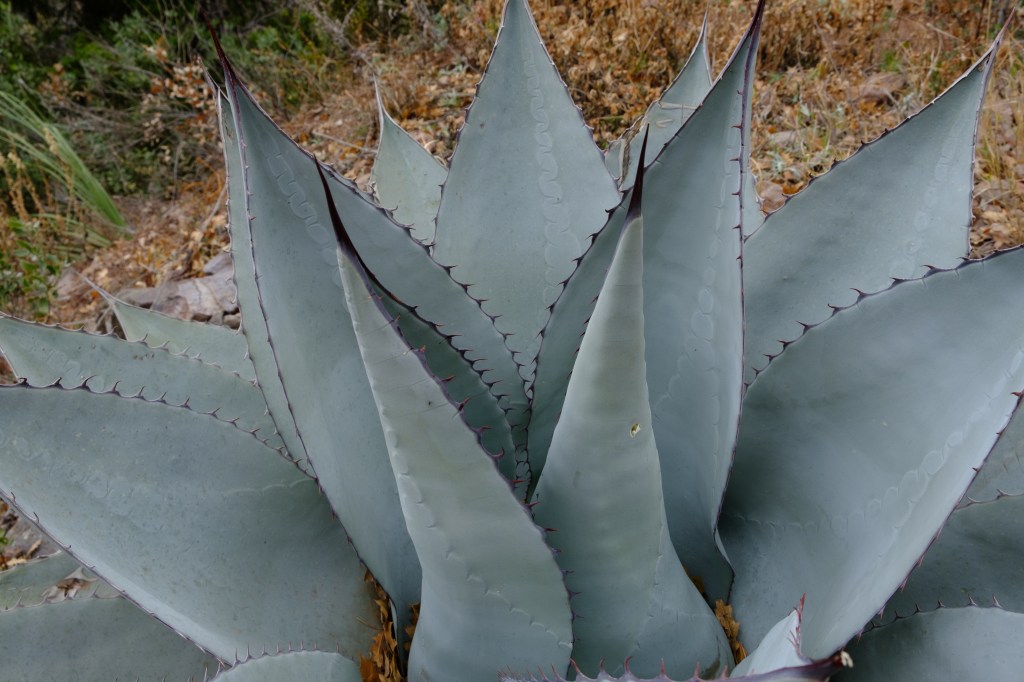
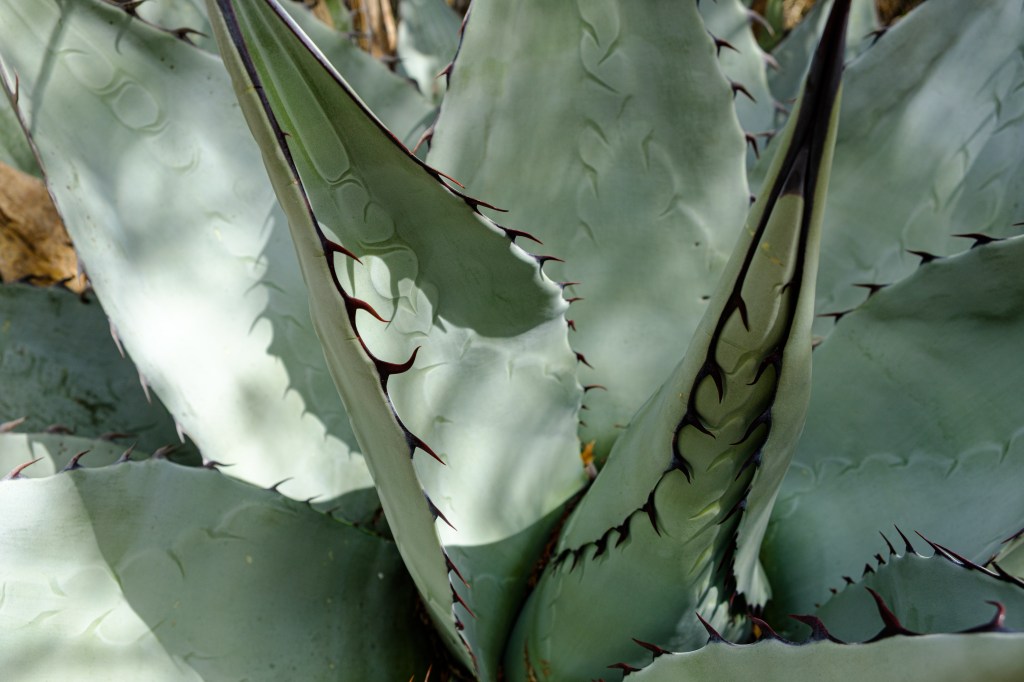
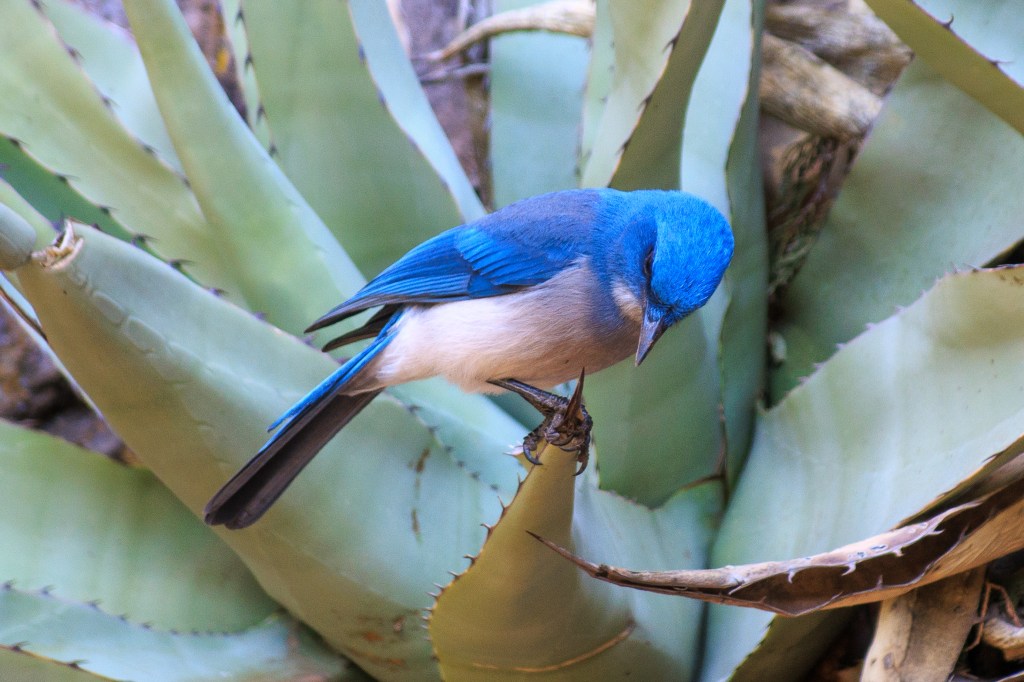
Mexican Jays, a gaudy bird, are common in Big Bend. Below, one perches on sharp agave spines.
I bought a Harvard Agave from the Bishop Nursery and planted it in our raised backyard beds in April of 2014. It survived summer heat and winter snow for years.
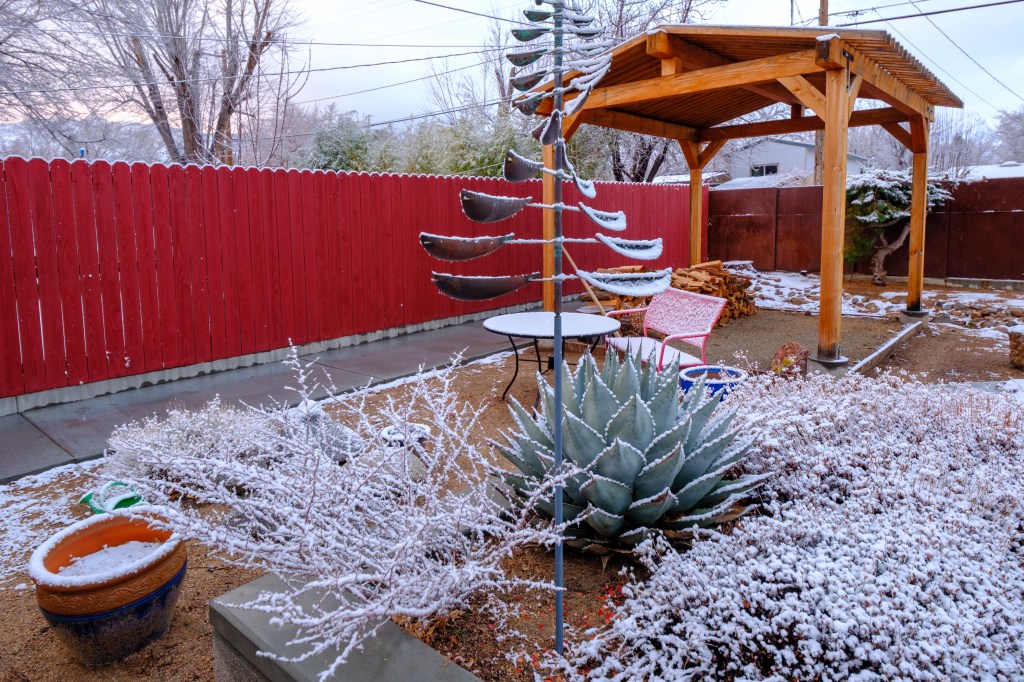
On May 5, of 2025, I noticed my Agave was putting out a new central stalk.
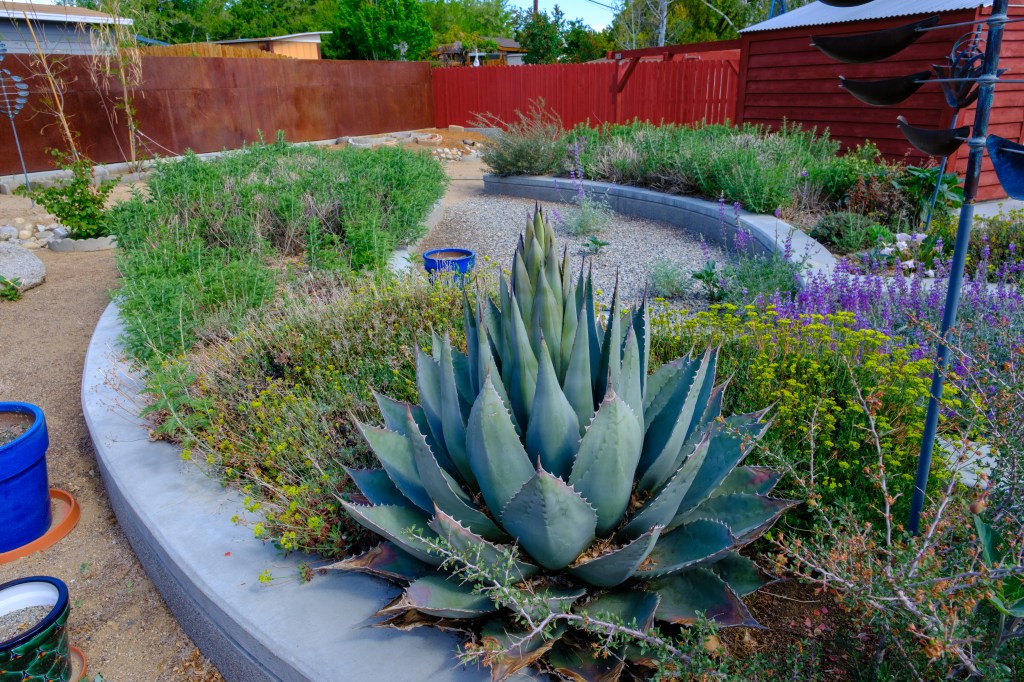
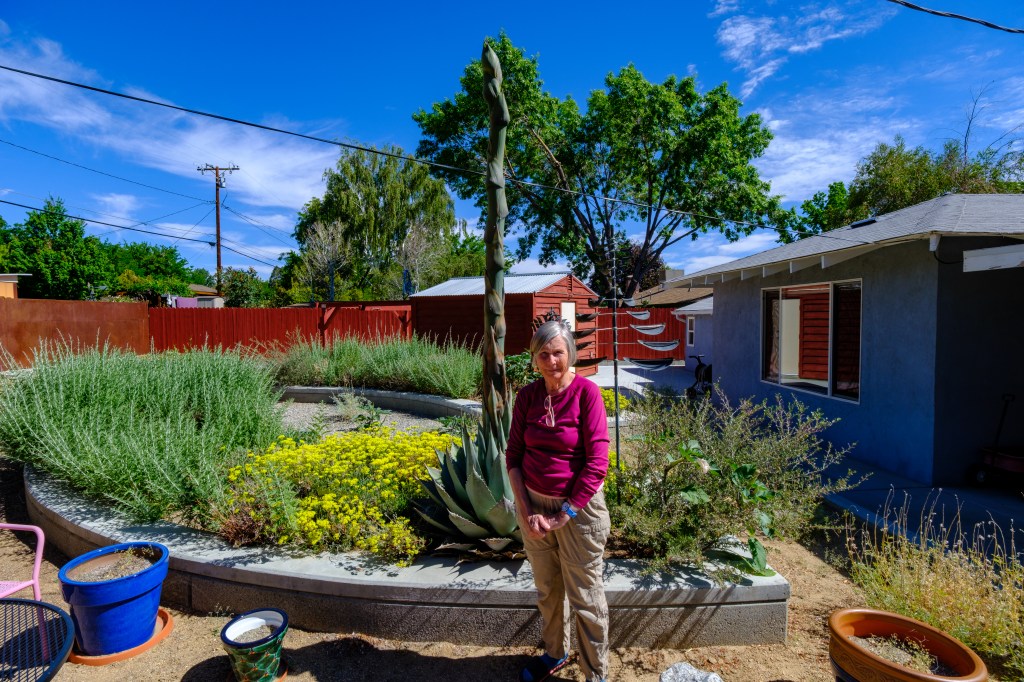
In less than 3 weeks the stalk looked like a ten foot spear of asparagus. Below, I posed a professional model in front of the plant, so you can judge the height. The model is 5’2”. She looks worried, probably thinking the stalk will topple over and clobber her.
During June and July, the stalk grew to over 15 feet and put out masses of flowers that were visited by bees.
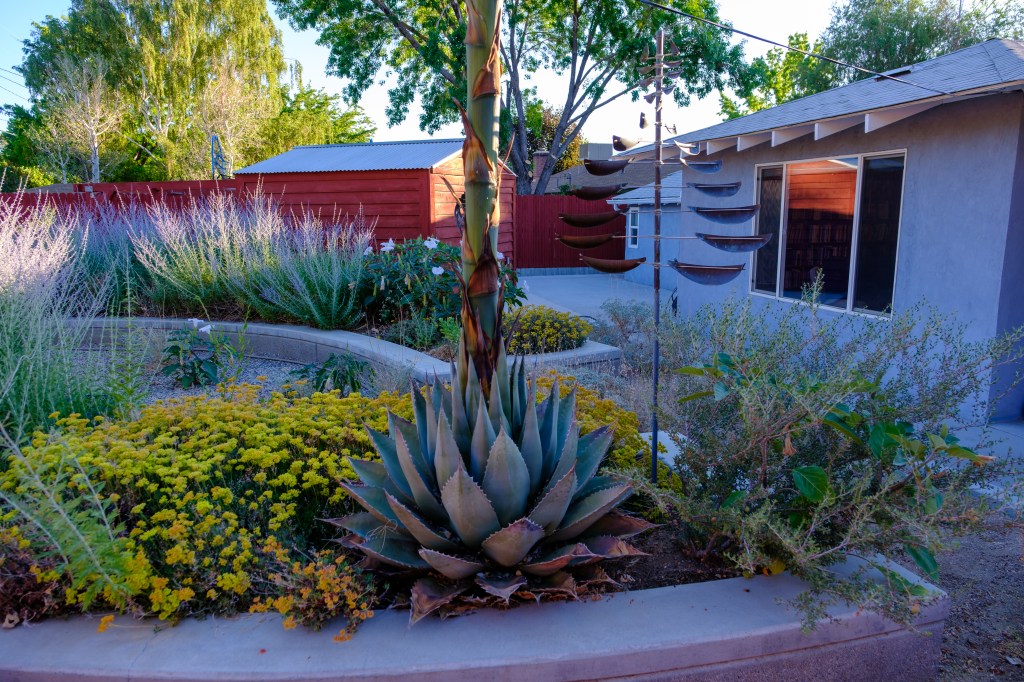
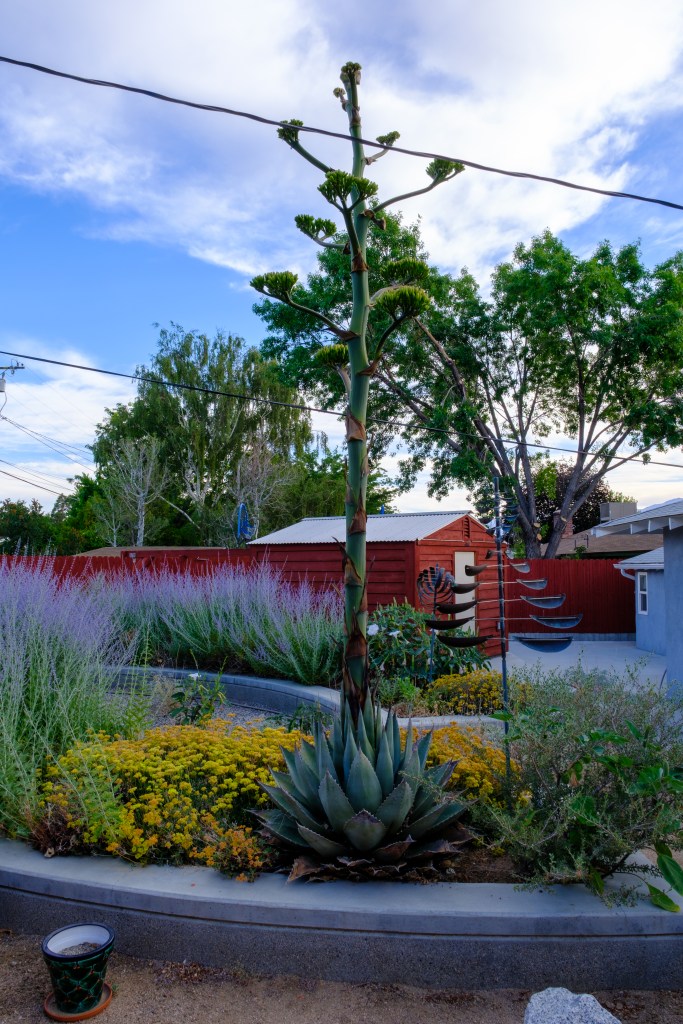
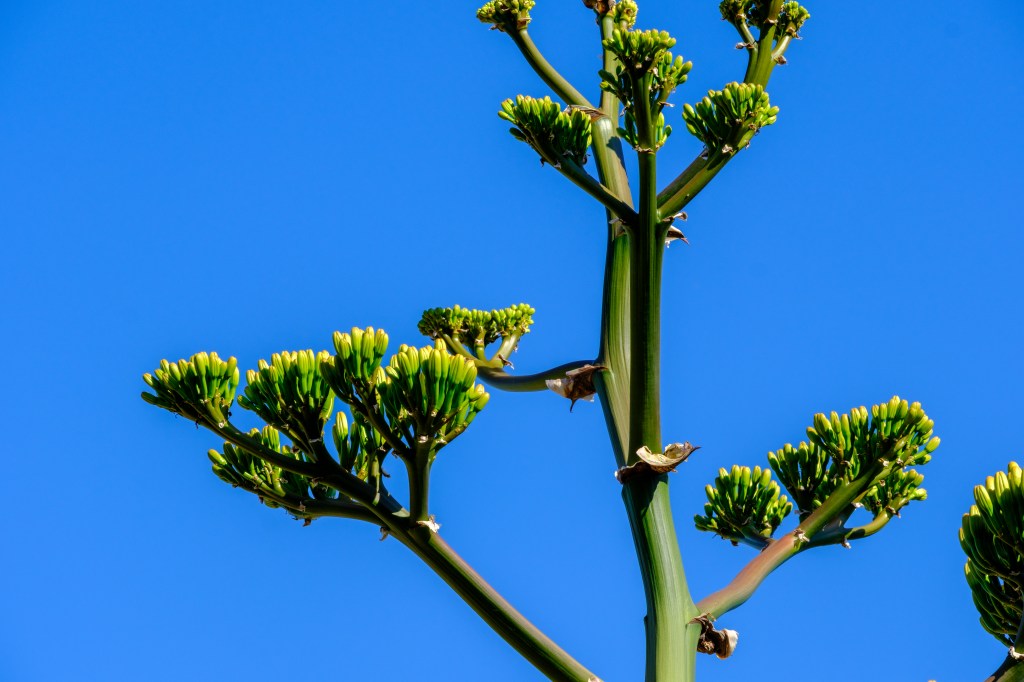
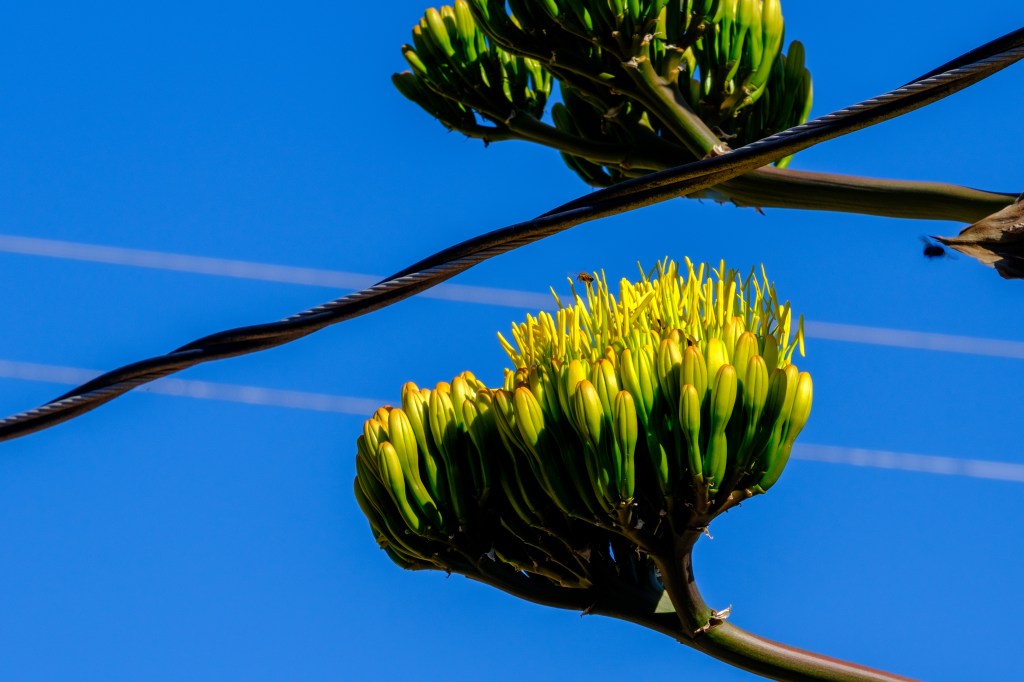
The last photo, taken July 28, shows that the plant is dying at its base; all the nutrition in the big leaves was used to grow the stalk. The stalk was now between our power line and cable line. It weighed about 40 pounds.
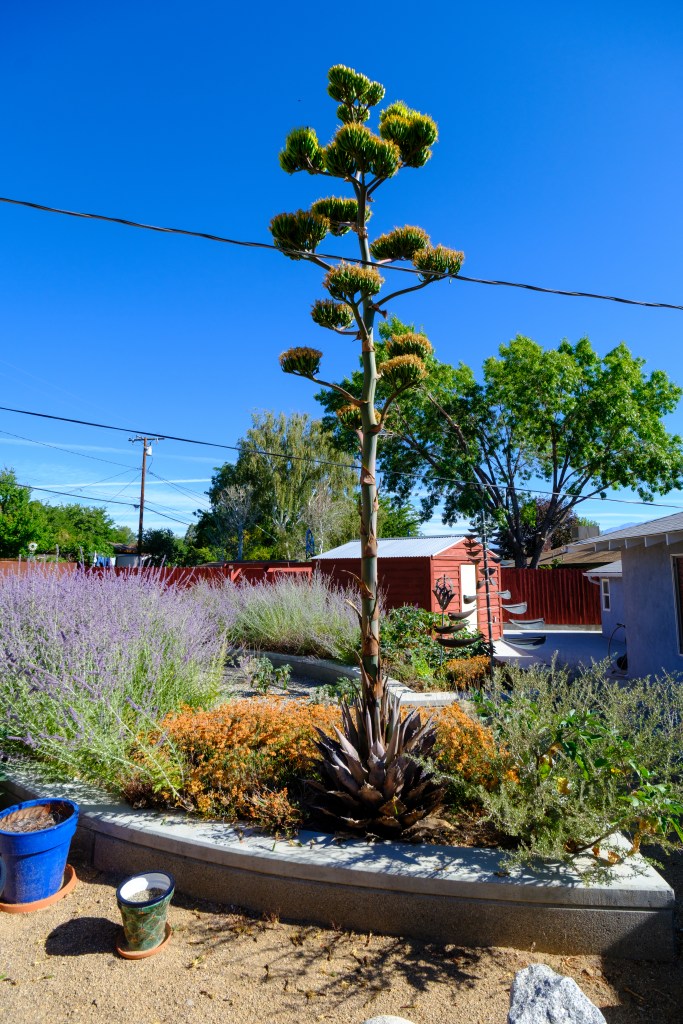
With help from a friend I finally cut it down. I will miss that plant; it was a privilege to watch its spectacular death. I have seen thousands of dead, desiccated agave stalks on hikes in the Southwest. But I’ve never seen the entire cycle from robust health, to sudden growth, and suicidal blooming.
 Birds of Bishop