
In my essay about “Modern Cameras for Bird Photography,” I claimed that the best bird-photography cameras are made by Canon, Nikon, and Sony (CNS). But I don’t use those cameras. I use Fujifilm cameras, models X-H2S and X-T5.
A dedicated bird photographer will usually use CNS gear. A digital camera collects light photons on a rectangular device called a sensor. Millions of electronic pixels are mounted on the sensor to collect data about light intensity and color. The number of pixels is expressed as megapixels; one megapixel = one million pixels. The collected data is processed into a photo image. The sensor in the leading CNS cameras is “full-frame” in size: 24mm x 36mm. The sensors in my Fujifilm cameras are smaller, “cropped sensors,” 15.6mm x 23.6mm.
A bigger (full-frame) sensor is better because:
1. Bigger sensors have better performance in dim light. A full-frame sensor and a cropped sensor might both have the same number of megapixels. But the pixels can be larger on a full-frame sensor, and larger pixels collect more data from light. With more data, a better image can be produced.
2. Bigger sensors handle a wider range of light intensity. The human eye can see detail in both the light and dark areas of a scene. But a camera has trouble doing this; it may produce white areas that are pure white or turn dark areas into uniform blackness. Full-frame sensors are better at capturing detail in both light and dark areas.
3. Bigger sensors yield more detail. A bigger sensor can hold more pixels. Other things being equal, more pixels means more detail. My Fujifilm X-H2S has 26 megapixels. The Nikon Z9 has 46 and the Sony a1 has 50. So full-frame is better, right? Not so fast. My Fujifilm X-T5 has 40 megapixels. The superb Canon R3 has only 24 and the new Sony a9iii has only 25. Fujifilm has put a lot of megapixels on smaller sensors.
4. Habit, custom, history. No committee sat down and picked the 35mm full-frame size as “best.” Historical accident and tradition played a big role in making 24mm x 36mm the size of a film negative. 35mm film had a uniform size, so a roll of film could fit into hundreds of camera models. As digital cameras developed, 35mm remained the standard, partly out of custom or habit. As a result, this is the go-to product to buy. Companies such as Canon, Nikon, and Sony have developed a giant array of lenses for full-frame sensors. Most camera advances come first for this sensor size. If you adopt the full-frame size, your choice will be supported by many lens choices and engineering advances.
One additional feature in favor of CNS cameras is the autofocus algorithms they use. As of early 2024, I think the CNS cameras do a better job of focusing on birds in flight. For perched birds, Fujifilm’s autofocus is very capable. But Fujifilm needs to up its game for flying birds. (For details see blog posts by Mathieu Gasquet at https://mirrorlesscomparisons.com.)
Smaller cropped sensors are better because:
1. A smaller sensor means a smaller camera. My small Fuji cameras are easy to grip, point, and carry.
2 A smaller sensor means a lighter camera. With batteries and memory cards, the Fujifilm X-H2S weighs 23 oz and the X-T5 weighs 20 oz. The full-frame Sony a9iii is 22 oz, the Sony a1 26oz, the Canon R3 36 oz, and the Nikon z9 47 oz. The telephoto lenses used for bird photography are heavy. The two Fujifilm lenses I use most weigh 3.6 and 5 lb. Full-frame lenses weigh more. It is easier for an old guy (me) to walk about with lighter gear.
3. A smaller sensor means cheaper cameras and lenses. If I can get 90% of the best performance for 25% of the price, 90% works for me. The last 10% for best performance is not worth a four-fold cost increase. Whatever camera you buy, you are somewhat committed to the lenses of that camera company. Many telephoto lenses cost more than camera bodies. Overall, the Fujifilm system is a less expensive investment.
So I made a rational choice that you should follow, right? Of course not. Other factors, preferences, and prejudices influenced my choice. If our buying decisions were rational, then we would all drive the same model car and use the same model washing machine. Some factors that influenced my choices were:
1. I loved the Sony RX100 camera for hiking. But I disliked the Sony menus. The first Fujifilm camera I bought was the X100F, a fixed-lens camera. I preferred the Fuji menus.
2. Fujifilm cameras such as the X-T5 use a retro design with external dials for shutter speed, ISO, aperture, and exposure compensation. I prefer those mechanical controls because they are similar to cameras I used in the past.
3. Fujifilm is known for making, well, film. Years ago I gave up Kodachrome film for Fuji Velvia. Fujifilm cameras offer film simulations which I can use in Lightroom to process images. I like these simulations and feel they make it easier to get the look I desire.
4. Irrational preferences. Perhaps I just want to be different. If most bird photographers use Canon and Nikon, I looked for alternatives.
In early 2024 I use two different lenses for bird photos:
1. Fujifilm’s 150-600mmF4.6-8. (Full-frame equivalent 229-914). 57 oz. This lens has terrific reach; it magnifies a bird roughly 18-fold. It’s main drawback is the f8 aperture, which means I need a lot of light. On a sunny day, this lens is on my X-H2S camera.
2. Fujifilm’s 200mmF2 prime lens. 80 oz. With a dedicated 1.4 teleconverter, this is equivalent to a full-frame 426mm lens. This lens is an optical wonder, always sharp. And fast focusing.
I think the cameras I own can produce beautiful photos. While there are rational reasons for picking other models, I feel the differences between models is not of critical importance. All the models I’ve discussed can do a fine job.
Once you have a one of these superb cameras, your ability to produce good pictures depends on going out and finding birds. Roberta and I try to find birds on over 100 days each year. Many days produce nothing. The next day may be a bird bonanza. You have to get out.
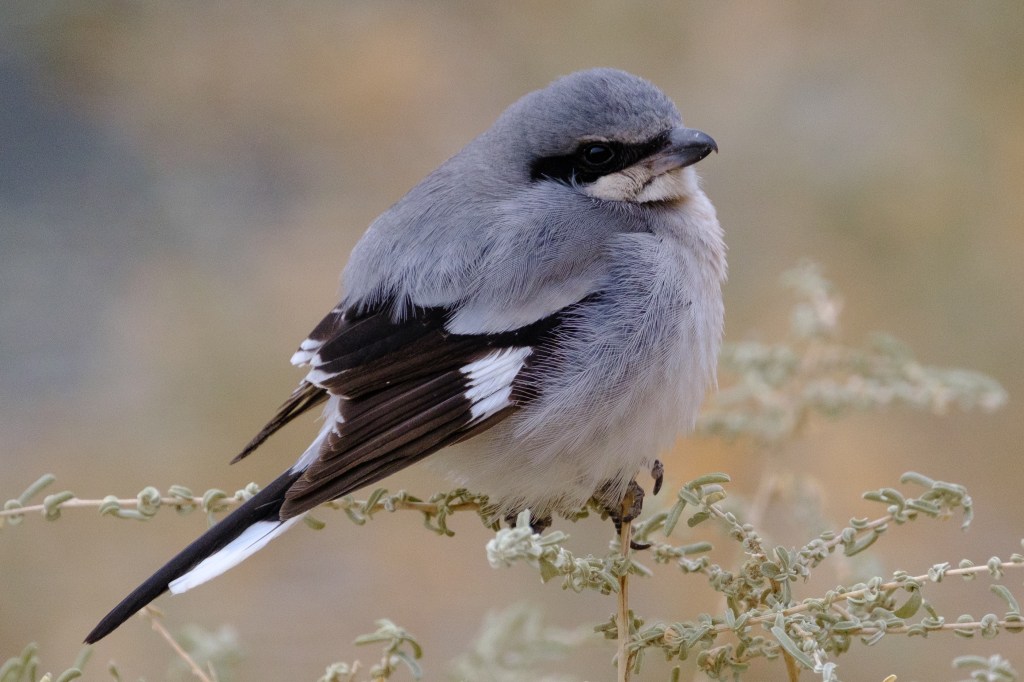
Let me illustrate what my cameras can do with one of my favorite photos, a Loggerhead Shrike at the Pleasant Valley Reservoir in January 2021. The day was cloudy. Due to a fast shutter speed (1/2000) and dim light, the camera bumped the ISO up to 2000. Despite the poor light, the detail in the feathers looks great. The black eye is obvious amid equally black feathers around it. The camera did all that I desired.
Breaking News:
In late 2024 I finally bought a full-frame camera, the Nikon Z8. That is now my preferred tool for photographing birds near Bishop. For details about this choice, see my essay called “Moving to Full-frame – Nikon Z8.”
[A little technical section for those who are interested. You should probably skip this.
The sensors in my Fujifilm cameras are called “cropped” sensors. That word comes from a term that photographers use to describing trimming away (cropping) the unwanted edges of a photo. When a lens for a full-frame camera is used with a smaller than full-frame sensor, the sensor only records part of the light image the lens creates. The rest of the light is “cropped.” Another name for these sensors is APS-C, meaning “Advanced Photo System – type C.”
Relationships between lens focal length and sensor size are often reviewed in discussions of sensor size. I skipped that topic as it is not terribly relevant to camera choice.
Full-frame size is 24mm x 36mm, but the film that produced this size negative was called 35mm. Why? 35mm film was sold as a long strip of film rolled up inside a metal container (a cassette). You put the container into the camera and the end of the film strip was threaded across projections (sprockets) on two wheels. Both edges of the film strip were perforated so the sprockets could grab the film and advance it. The width of the film strip was 35mm. Some of that width was taken up by the perforations at the edges and some was devoted to empty space, leaving 24mm for the negative. Each time you advanced the film a section 36mm long and 24mm across was advanced to a rectangular window behind the shutter, ready for the next shot.
See, I told you to skip this.]
Peter Cummings
Published February 5, 2024
 Birds of Bishop