Whitney Sunrise

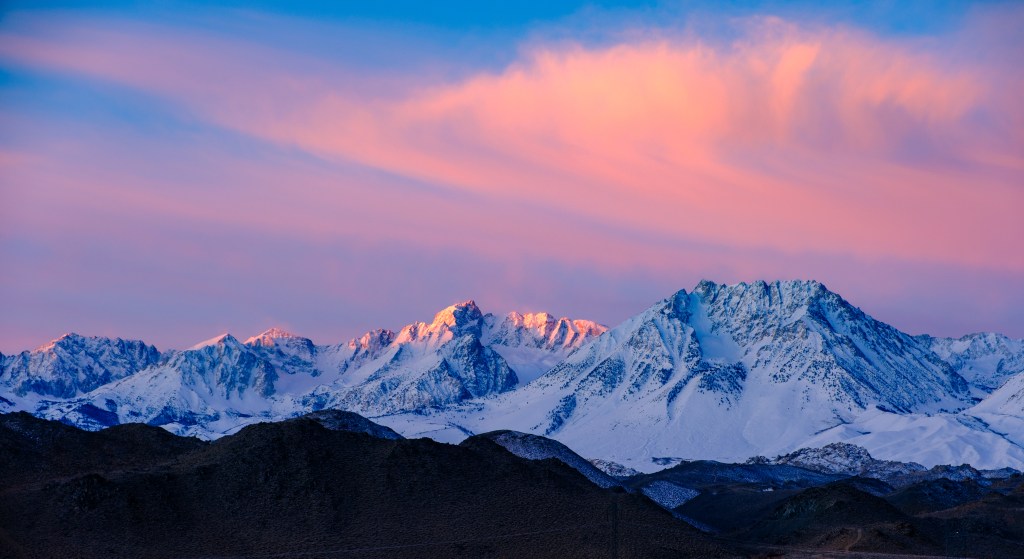
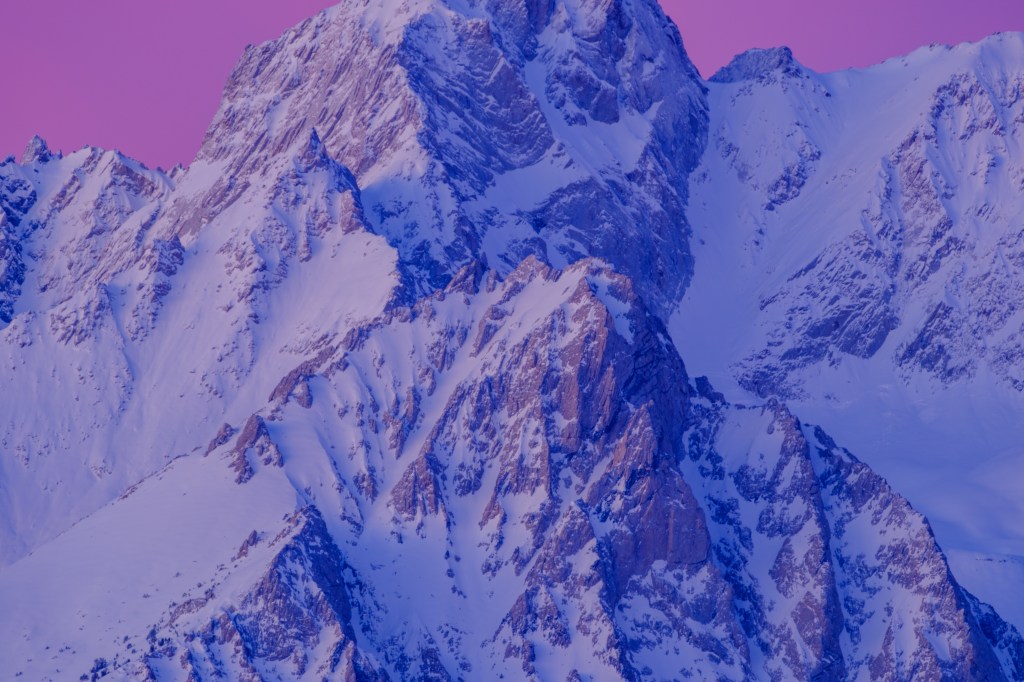
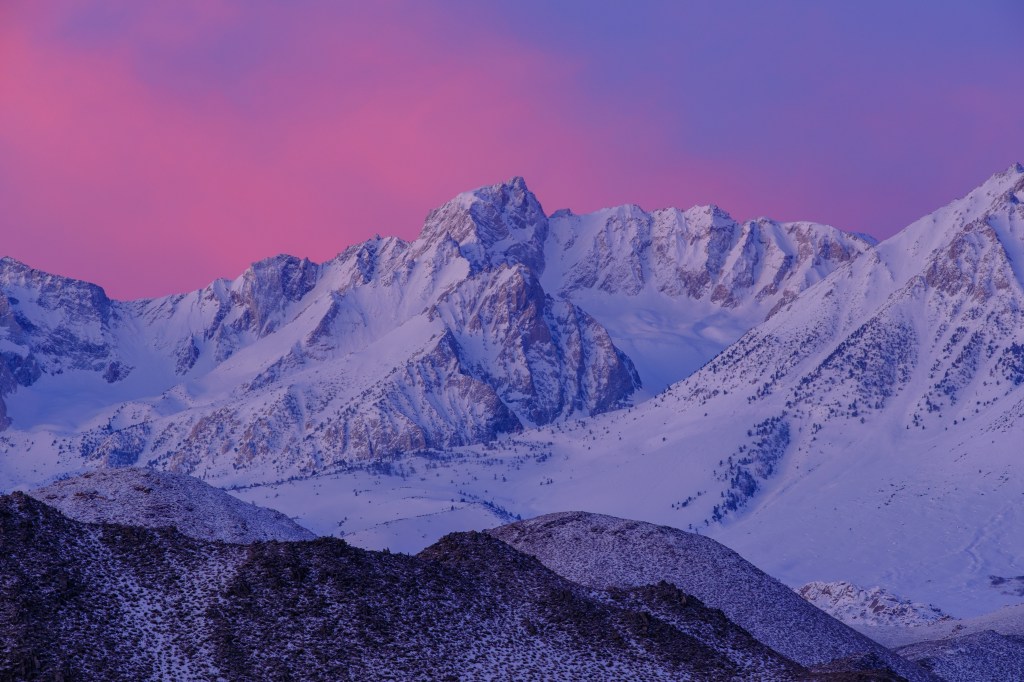
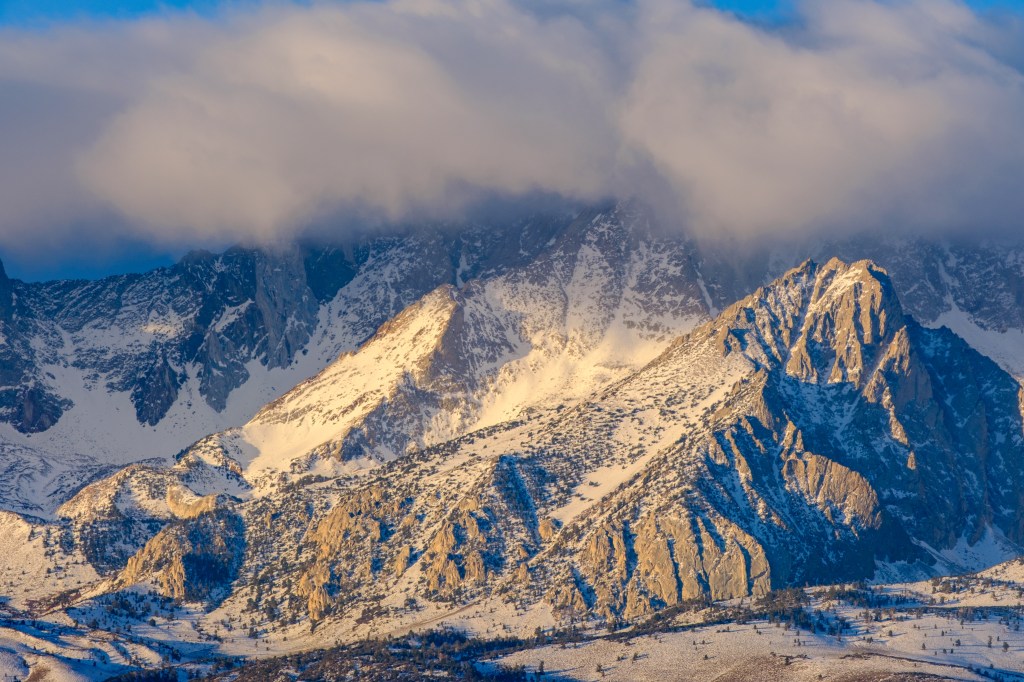
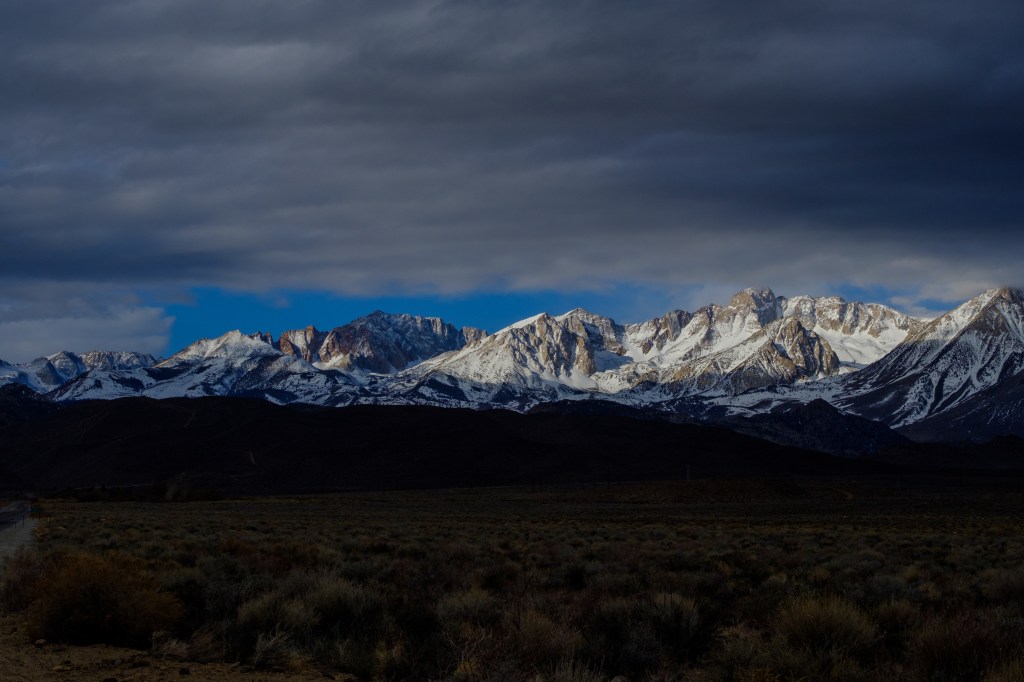
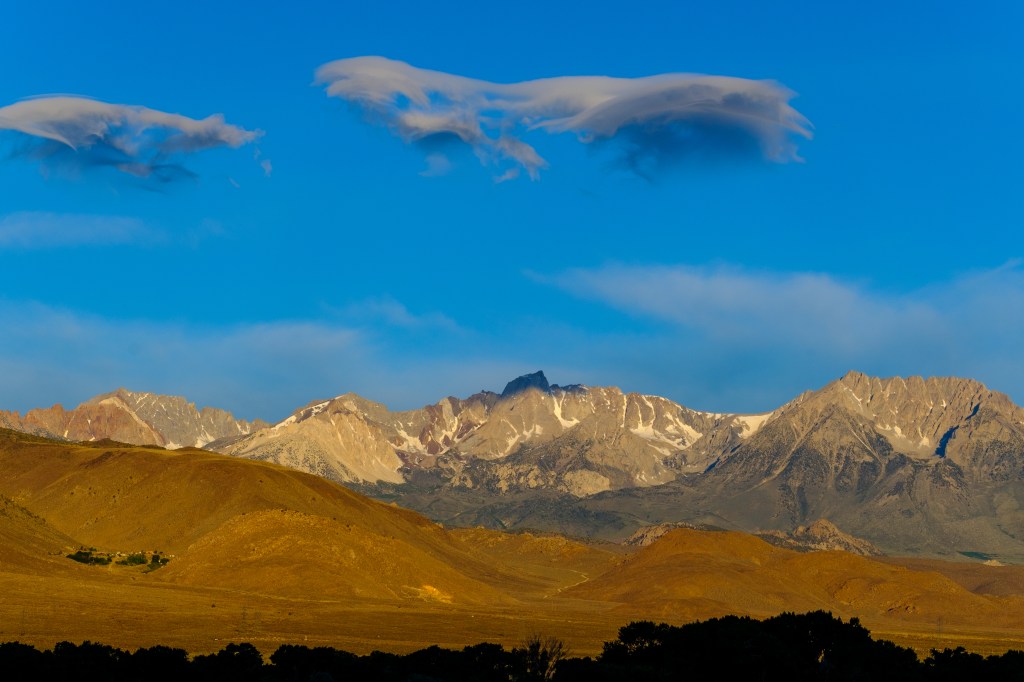
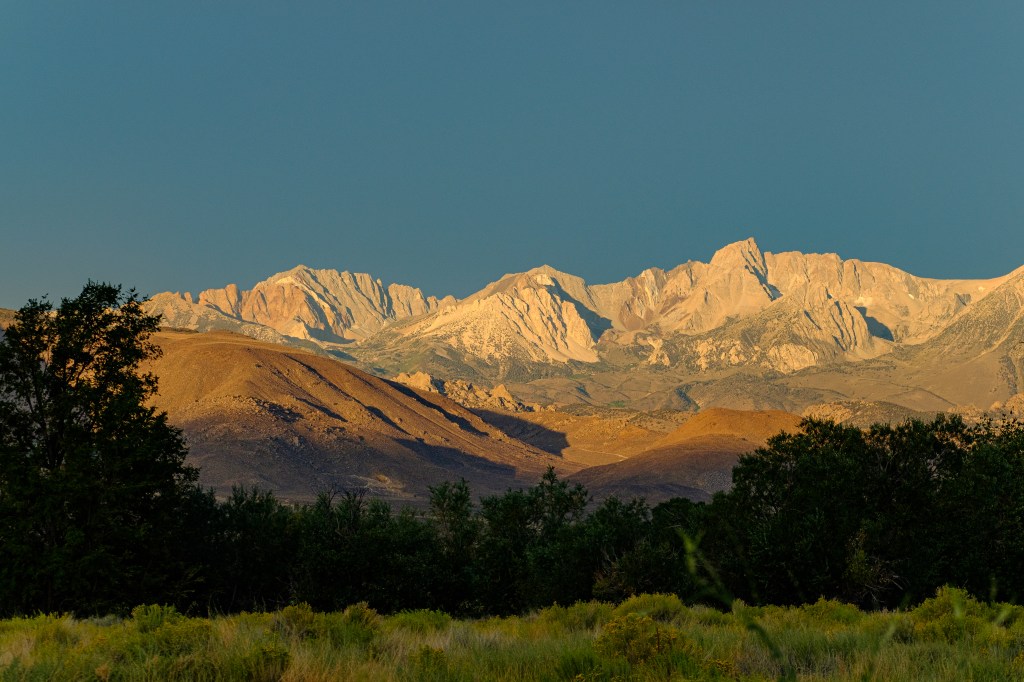
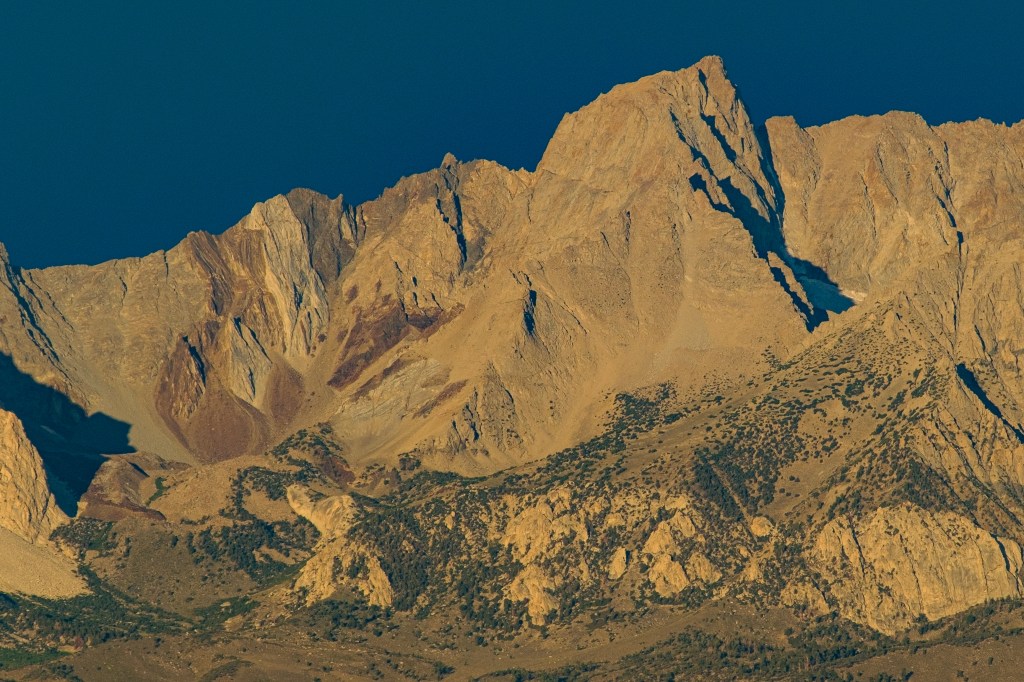
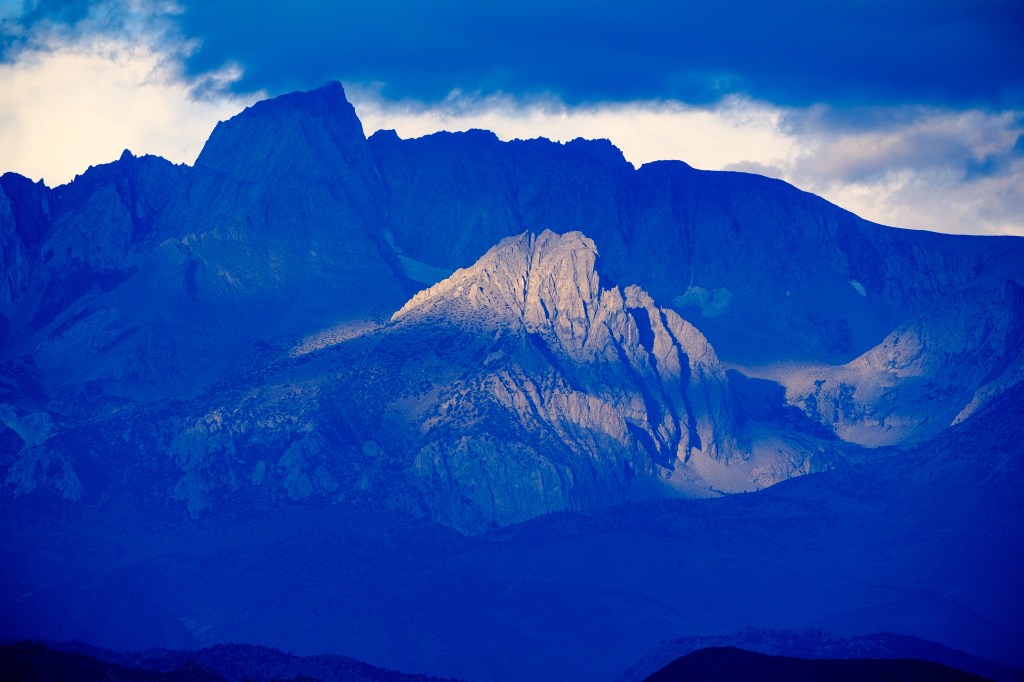
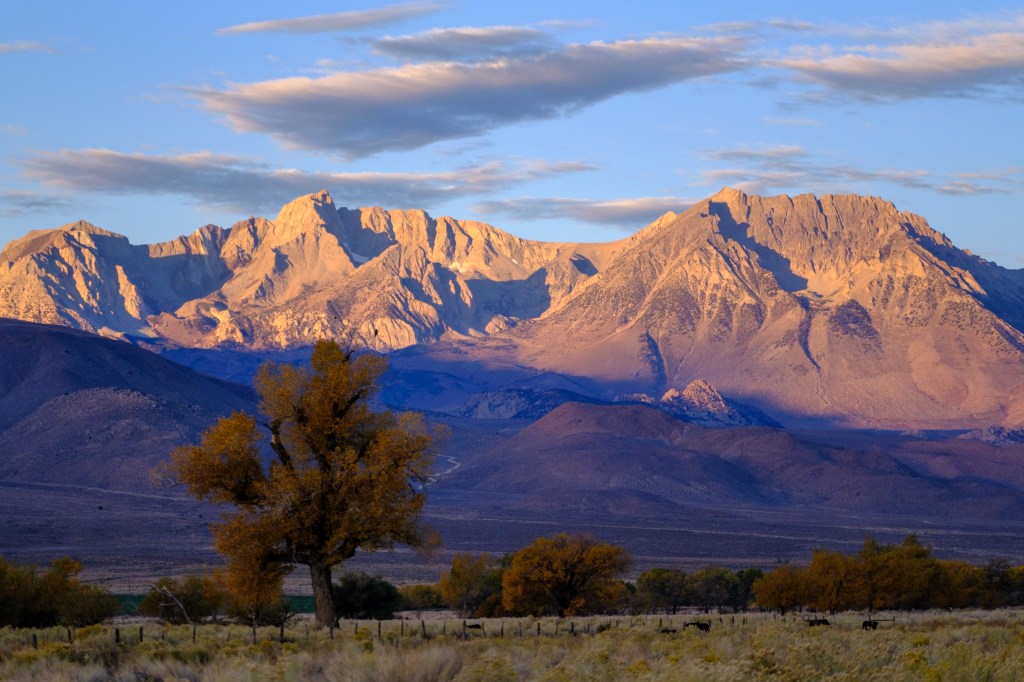
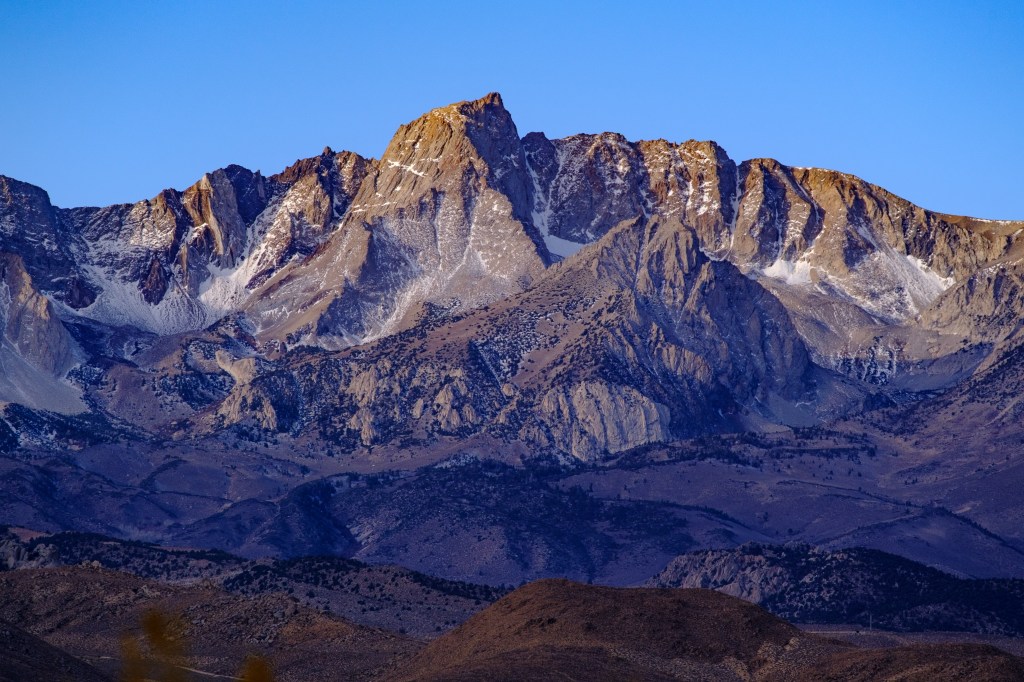
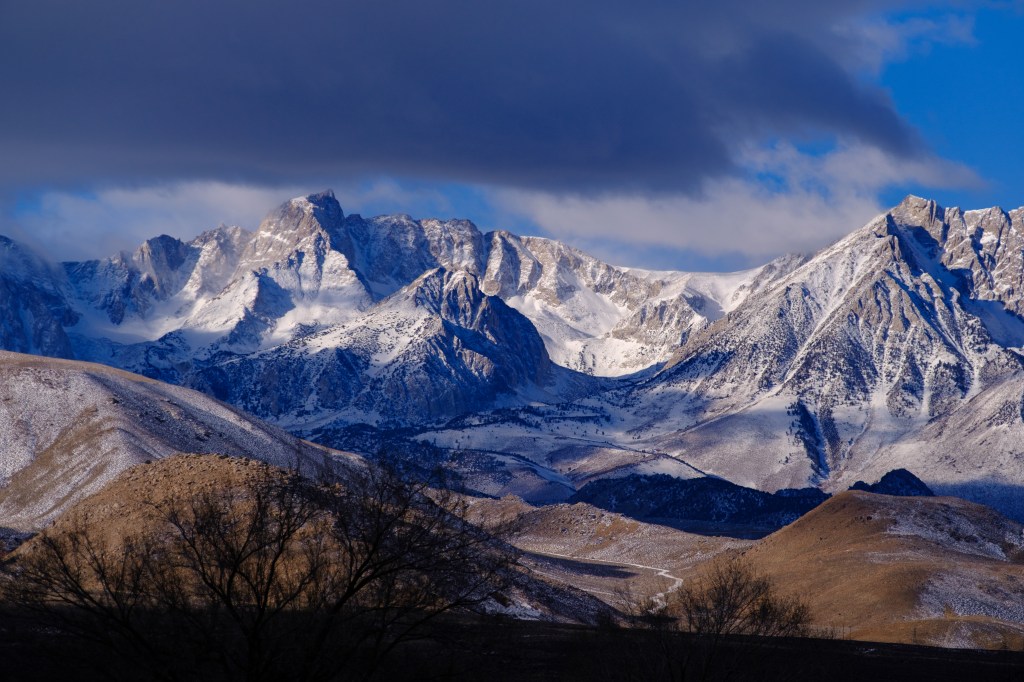
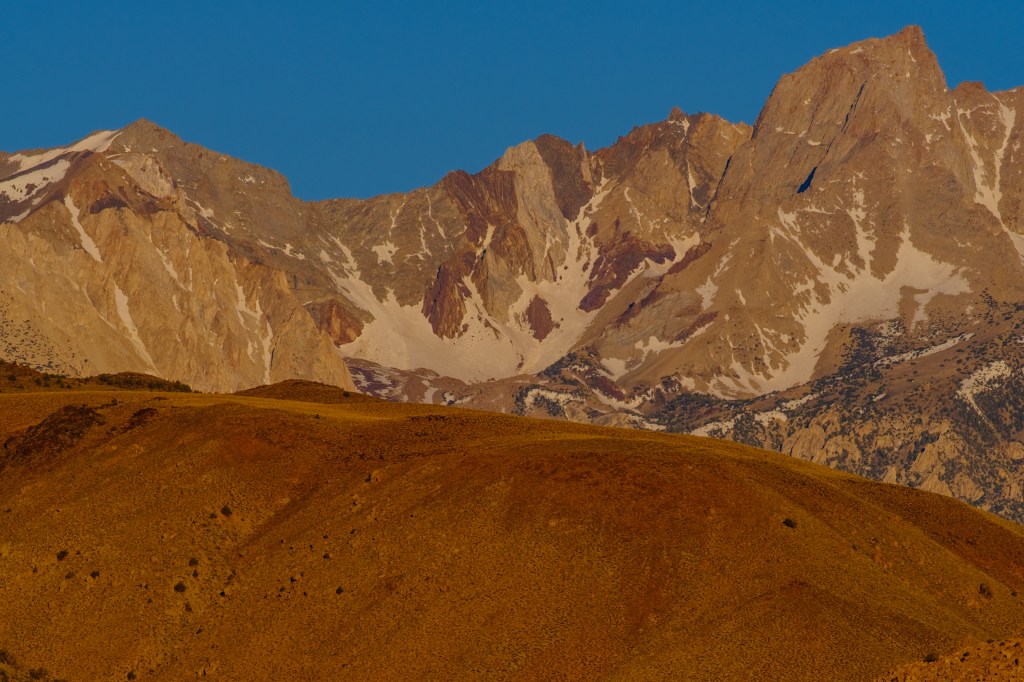
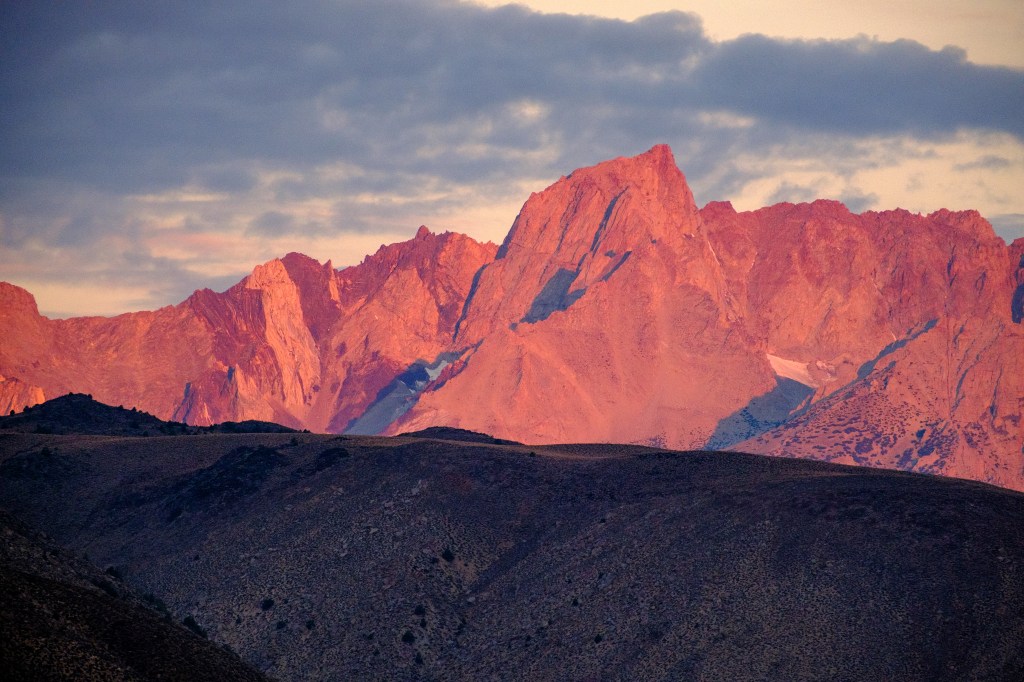
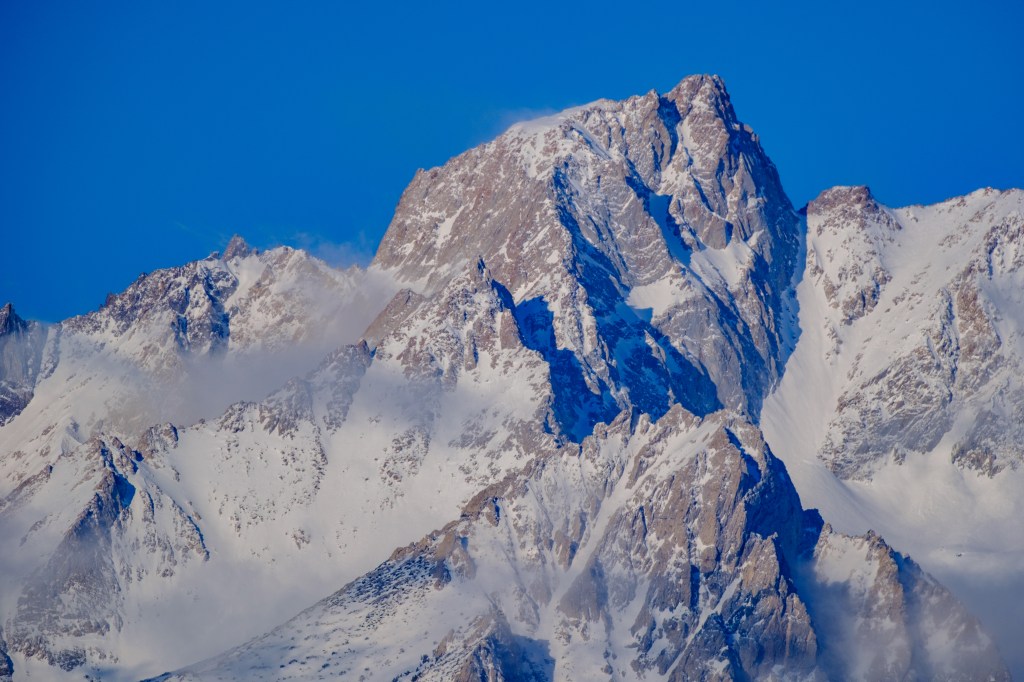
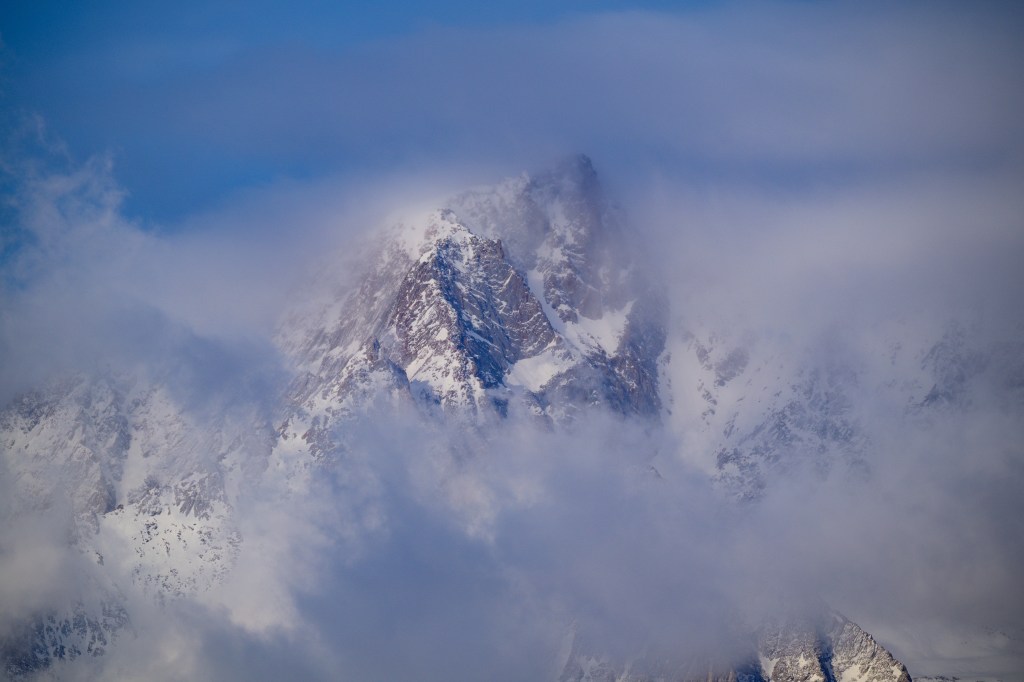
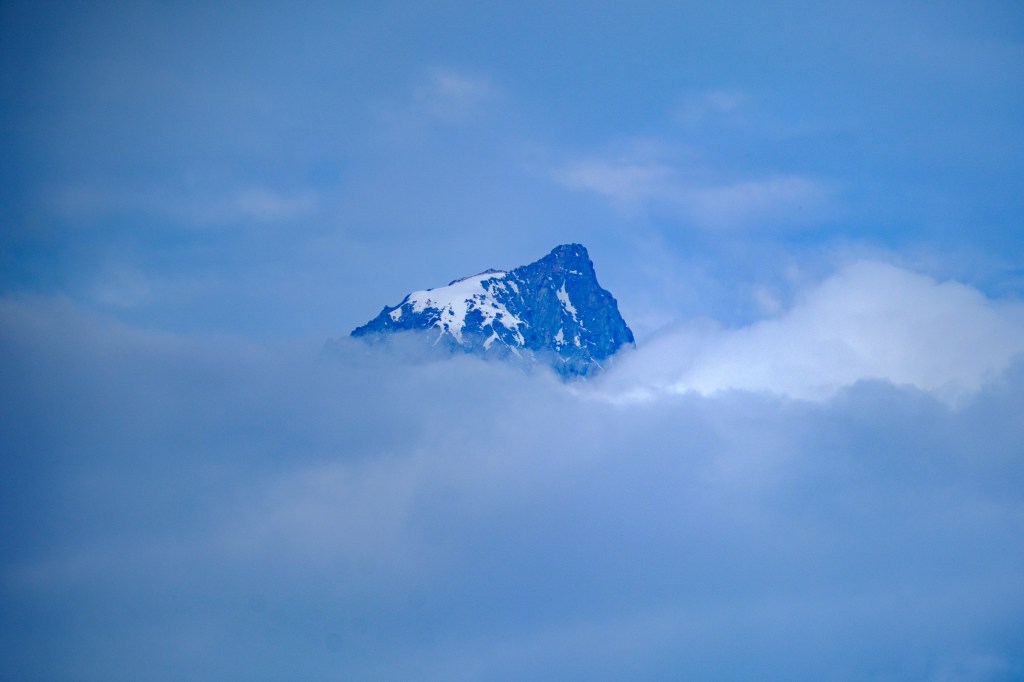
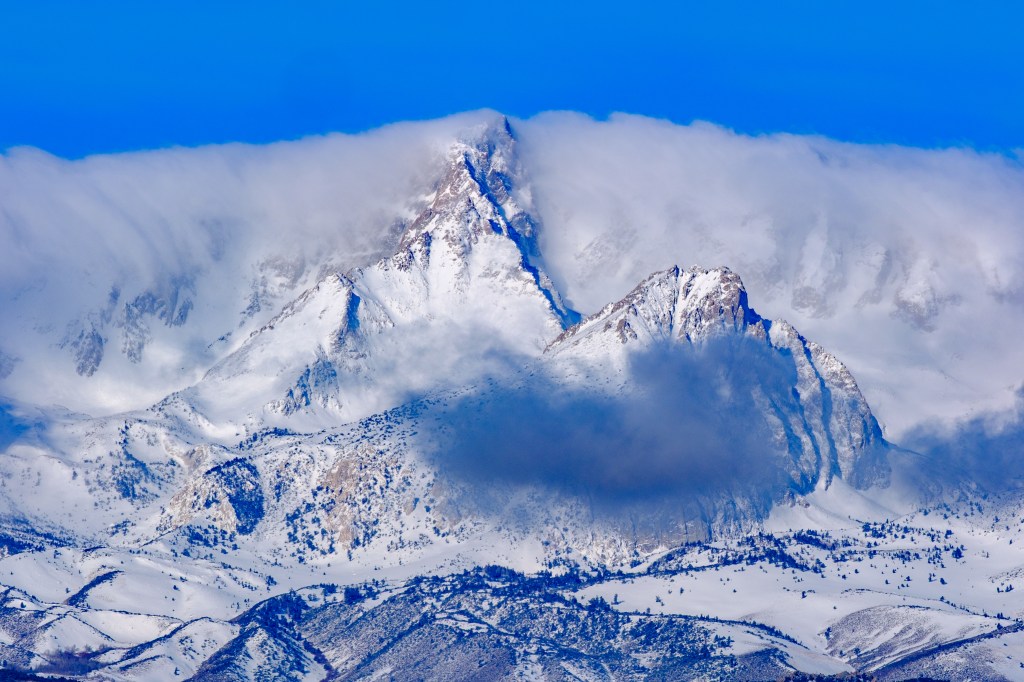
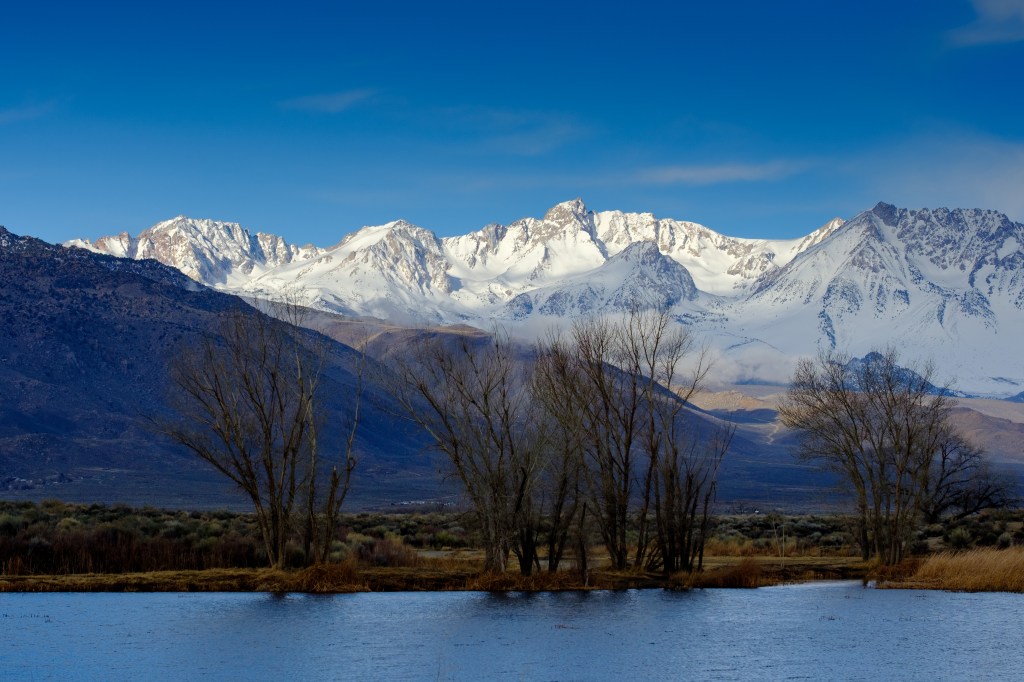
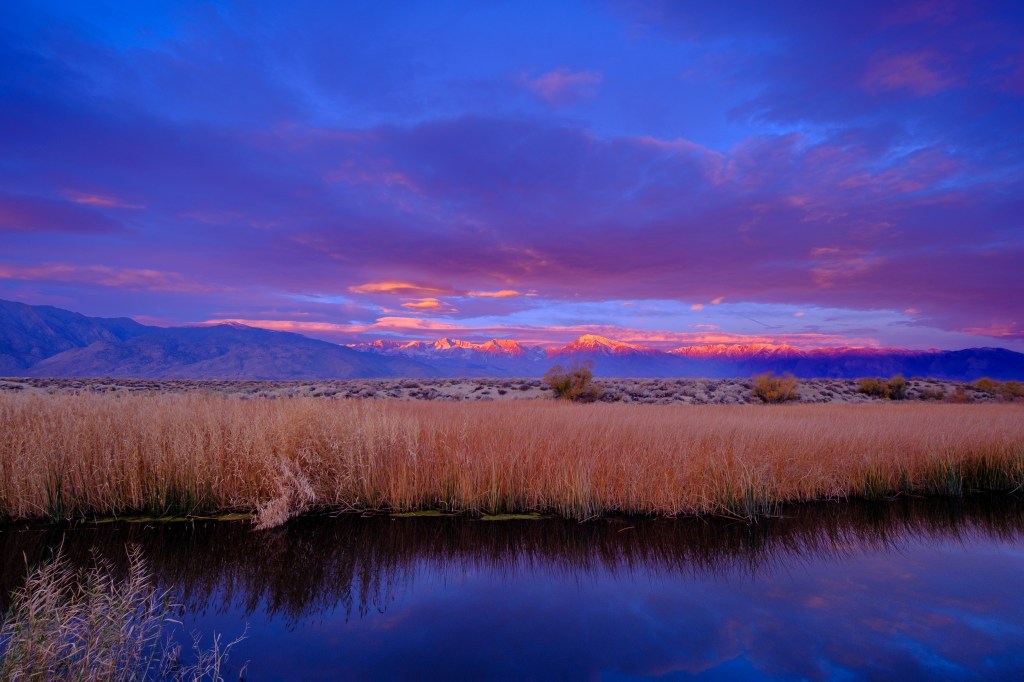
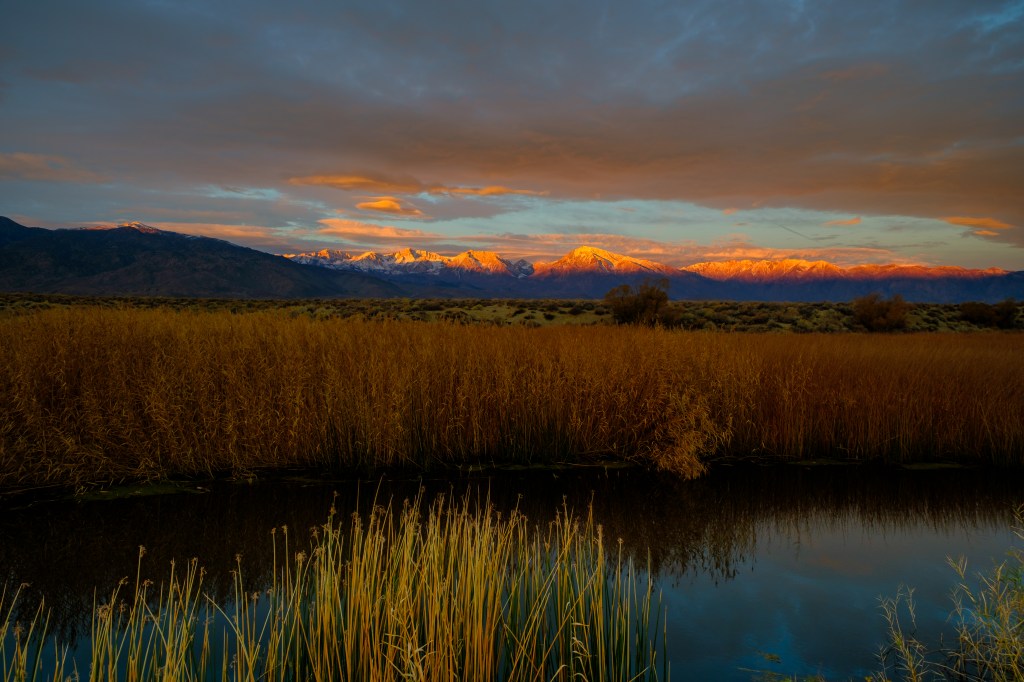
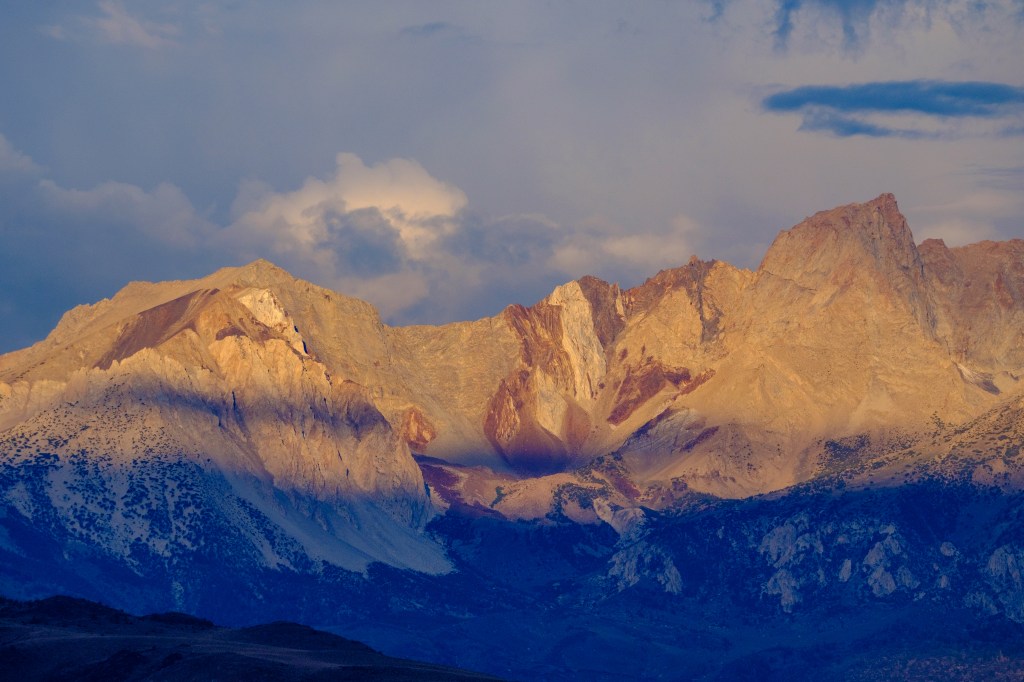
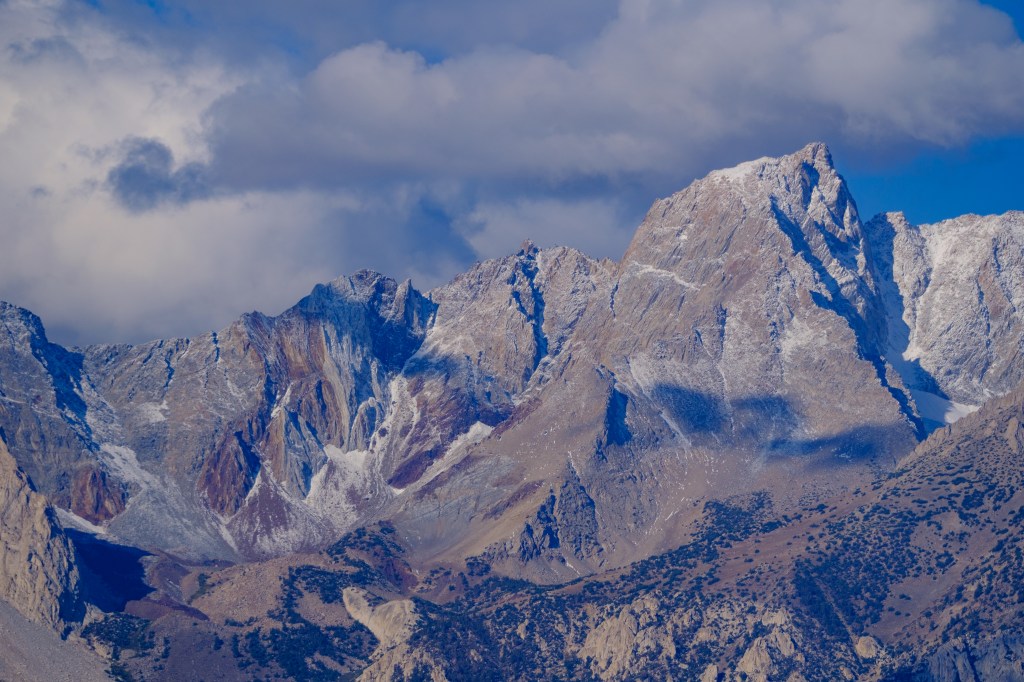
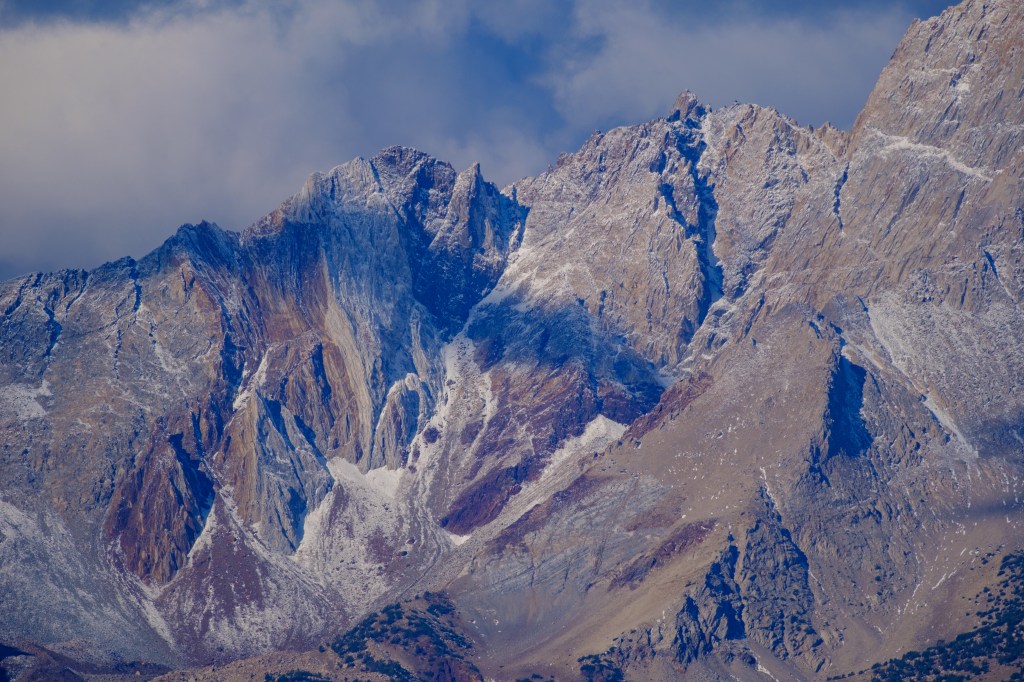
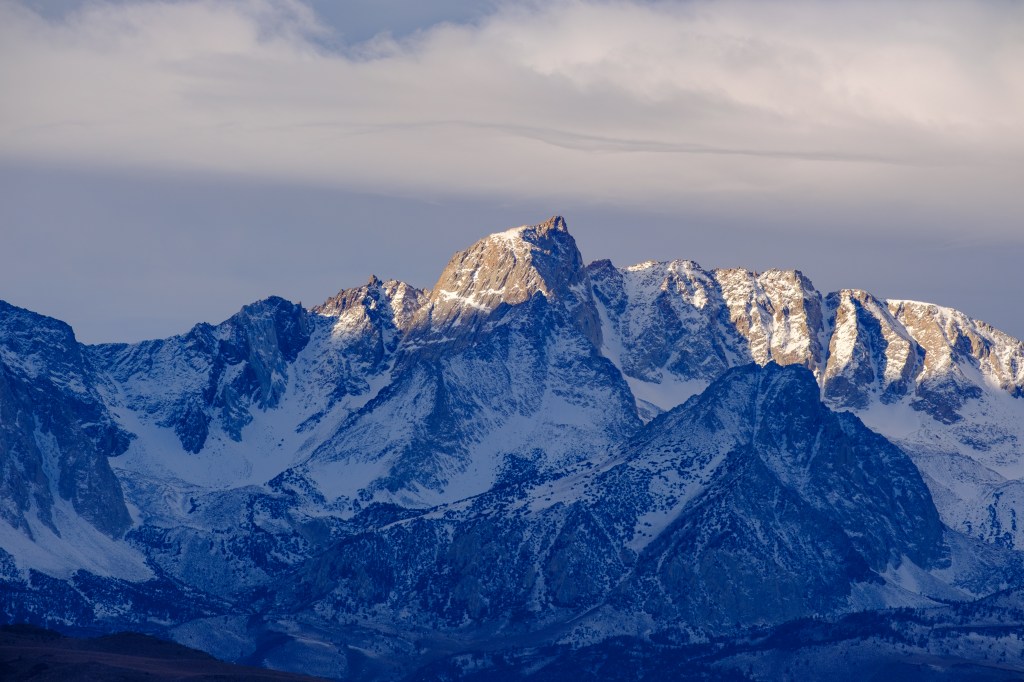
This blog shows photos of sunrise on the peaks near Mt Whitney (14,505 feet), the tallest US summit outside of Alaska. Some tourist spots offer “light shows” using electric lights on natural features. The eastern Sierra has a free light show every morning.

The Sierra Nevada extends north-south for 400 miles. It separates California’s Great Central Valley from the Great Basin. No road crosses the range from Sherman Pass Road in the south to Yosemite’s Highway 120 in the north; the Pacific Crest Trail between these roads is 240 miles long. Near my home, the Sierra crest is generally higher than 13,000 feet, a steep wall over 150 miles long.

Roberta and I sometimes photograph the sunrise on the Sierra. I pick locations on the east side of the Owens Valley, 8 to 15 miles from the nearest Sierra summits. We get up at 4 am, eat, fill a thermos with coffee, and head out. We arrive in the dark and sit in the car, letting our eyes adjust and getting caffeinated. Then I get out, bundled in warm cloths, and use a headlamp to set up two cameras on tripods in the sagebrush. I get back into the car to warm up.

In morning twilight the peaks become brighter for half an hour. The range has a subdued look as I start taking pictures. Then sunlight reaches the summits around 6:30 AM and for half an hour the light moves down the slopes to the Valley floor. This early light is often tinged with red. By 8 AM the best colors are gone. We pack up the cameras and head home.

The air is usually calm and clear in early morning, so photographs have a lot of detail despite distances up to 15 miles. I used telephoto lenses equivalent to full-frame (35mm) focal lengths of 75 to 600mm. Consequently the images are “magnified” about 2 to 12 times, compared with the view without a camera. Cropping on the computer doubles the magnification of some pictures. Camera exposure times range from 3 seconds during twilight to 1/1000 second when the sun is fully up. 

All photos in this post were taken from a spot on highway 136, south-east of the town of Lone Pine, at elevation 3600 ft. They were taken on March 1, 2023, February 24, 2024, and April 1, 2024. I’ve sorted them into groups from south to north, then ordered them by date and then by time, so you see images from twilight to full sun for each group of peaks on each day.

Panoramic Photographs

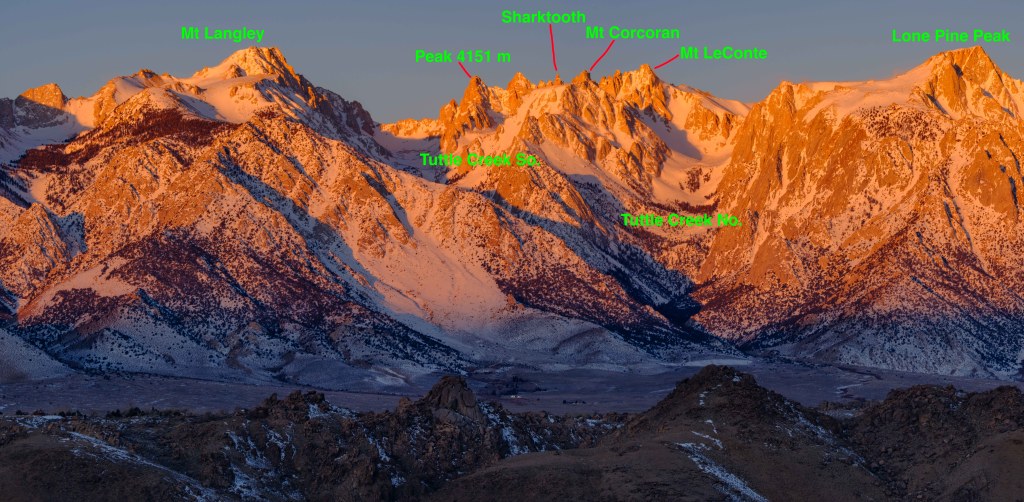
In the days of film, it was a big deal to take photos that could be stitched together into a wide panorama. This is easy with digital photos. You can move your camera from left to right and take multiple pictures that are joined into a single, wide shot, with lots of detail. This can be done within the camera or by taking several photos and combining them in software. To orient you to the peaks near Mt Whitney, below is a panoramic image that extends from Mt Langley (14,042 feet) on the left to Lone Pine Peak (12,944 feet) on the right. The smaller rocky summits in the foreground, still in shadow, are the Alabama Hills.

3/7/23. 6:18 AM.
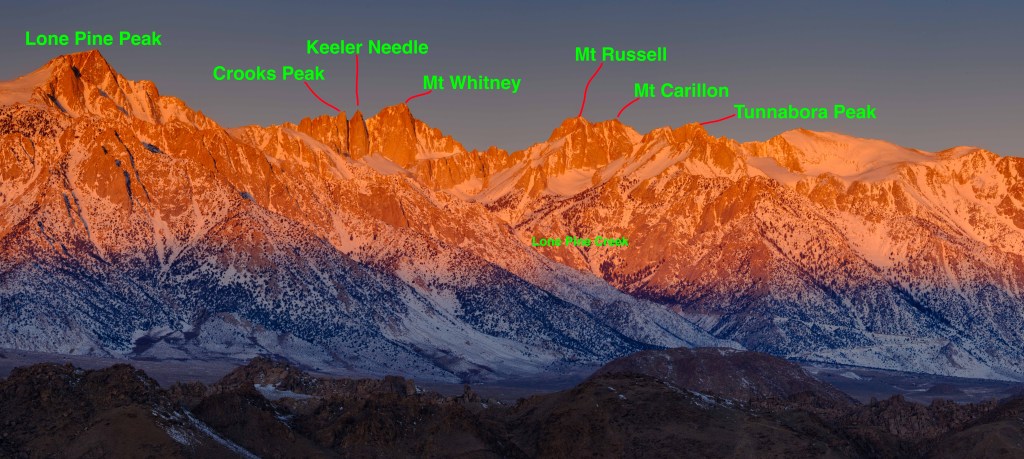
Next you can see summits from Lone Pine Peak to Tunnabora. Whitney is labeled; its enormous east face is in sunlight.

3/7/23. 6:17 AM.
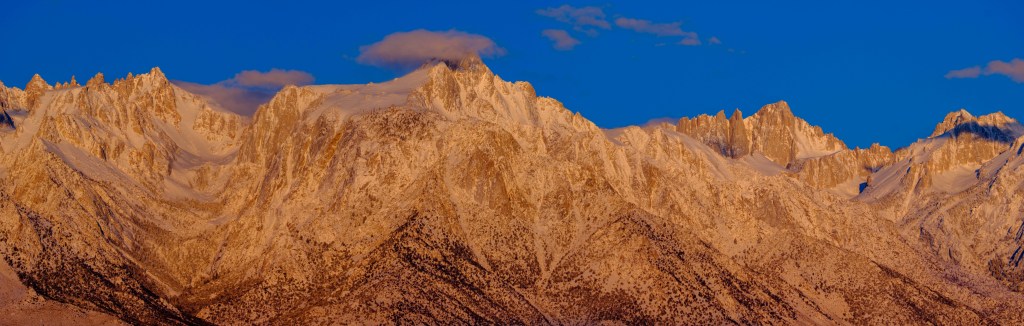
Next I show all these peaks, from the Corcoran group to Carillon.

4/1/24. 6:48 AM
Mt Langley

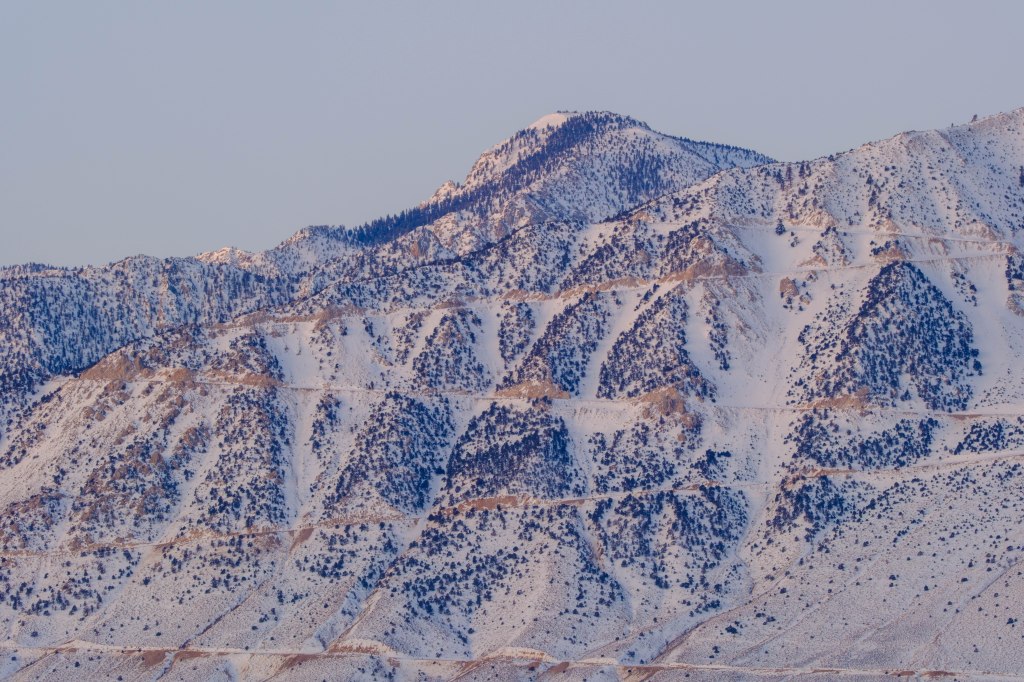
I’ll start at the southern end of this group. To the south of the peaks I’ve already shown, is the road to Cottonwood Lakes. It switchbacks up from 3500 feet to over 10,000 feet. After big rain storms, parts this road may be covered in rocks and sand; sometimes sections of the road are washed away. 

3/7/23. 6:09 AM
Next is Mt Langley (14,042 ft).

3/7/23. 6:04 AM
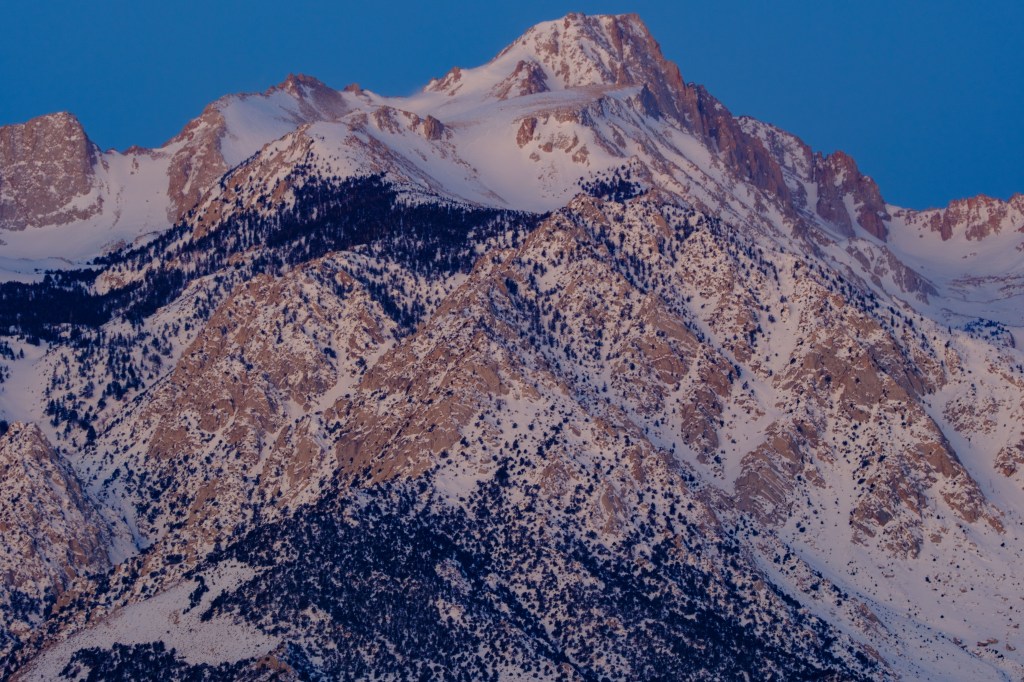
3/7/23. 6:12 AM
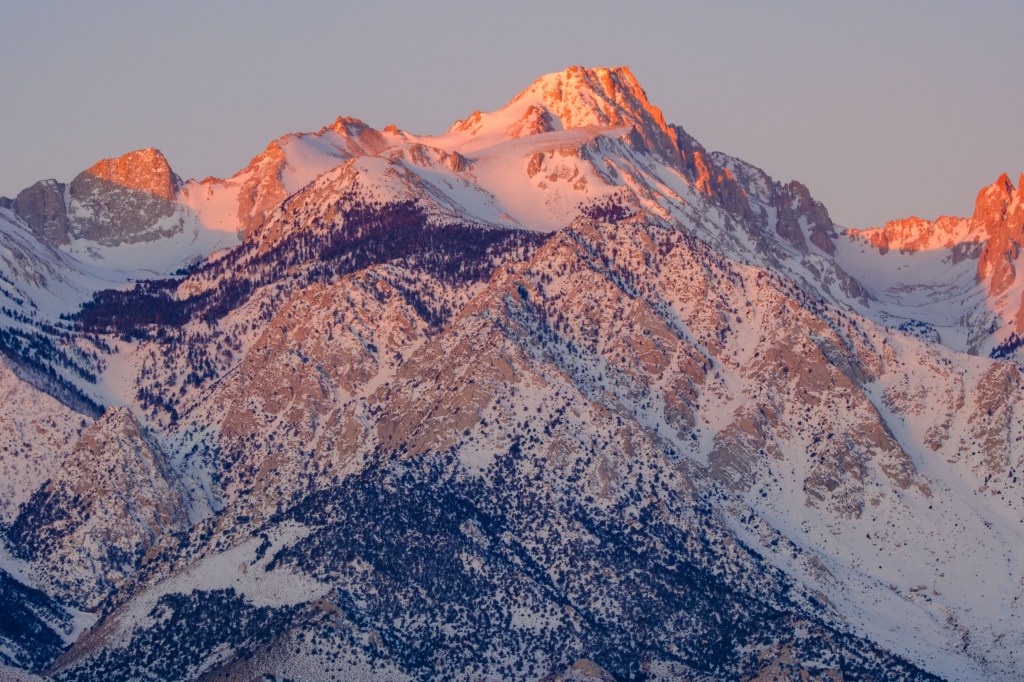
3/7/23. 6:32 AM
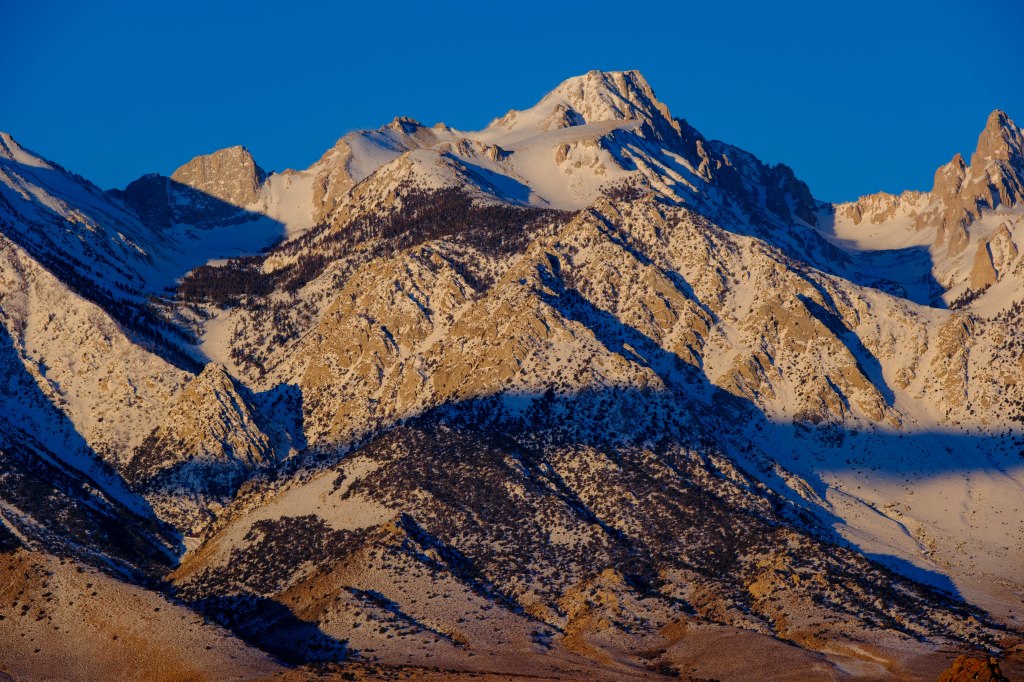
Looking a bit further north, the next photo shows Langley and the summits near Corcoran.

3/7/23. 6:32 AM

Mt Corcoran and Nearby Peaks

Mt Corcoran is a long ridge with several summits. The branches of Tuttle Creek bracket this collection of peaks.

3/7/23. 5:51 AM
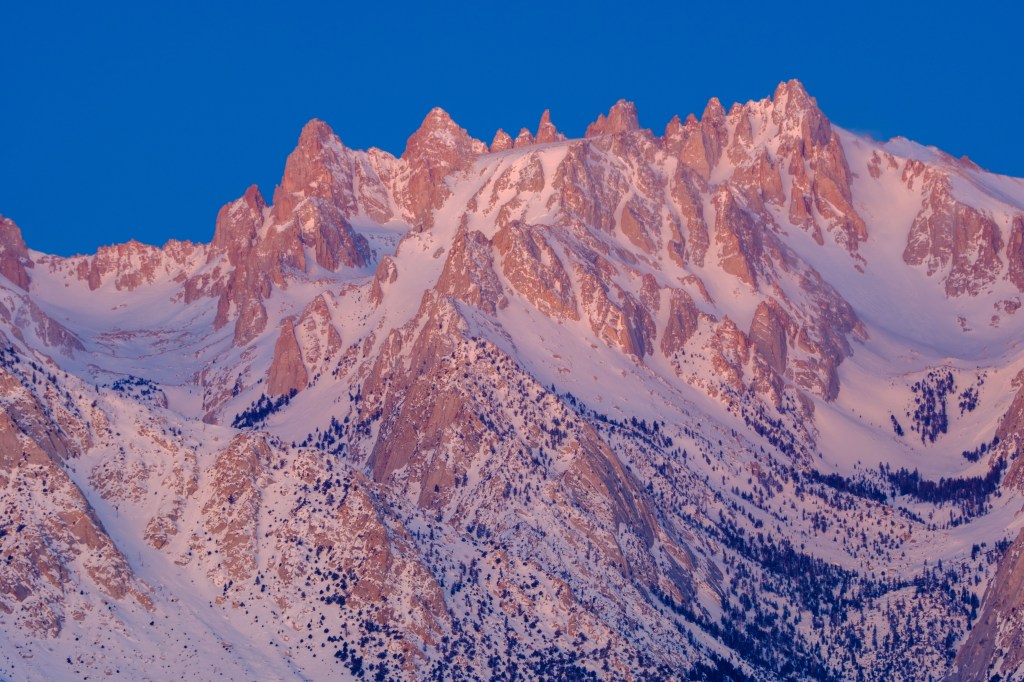
3/7/23. 6:04 AM
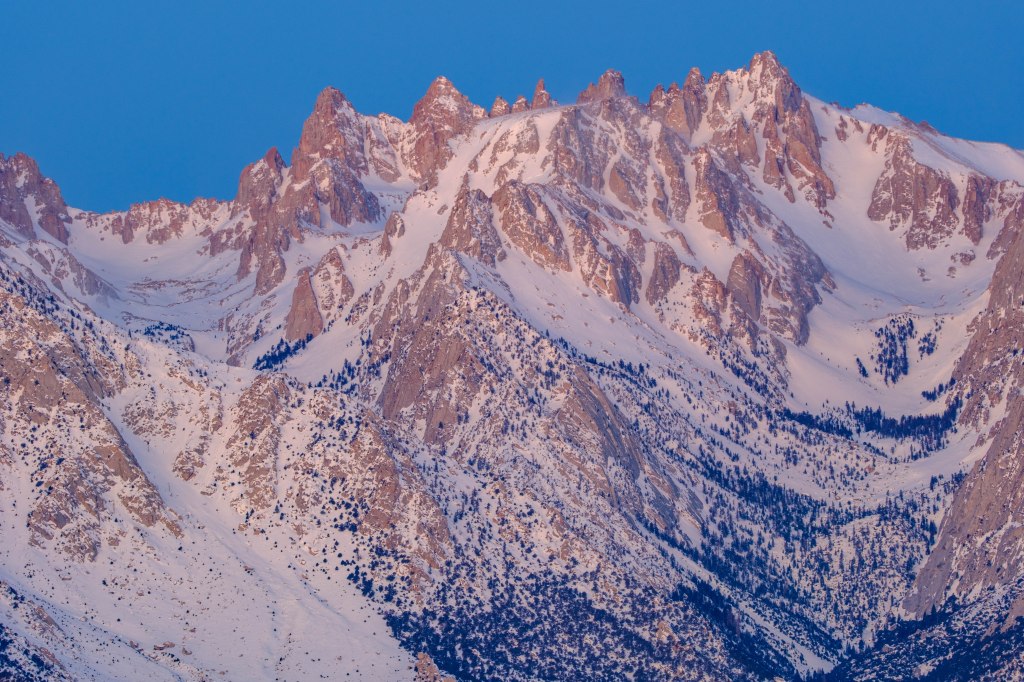
3/7/23. 6:12 AM

3/7/23. 6:14 AM
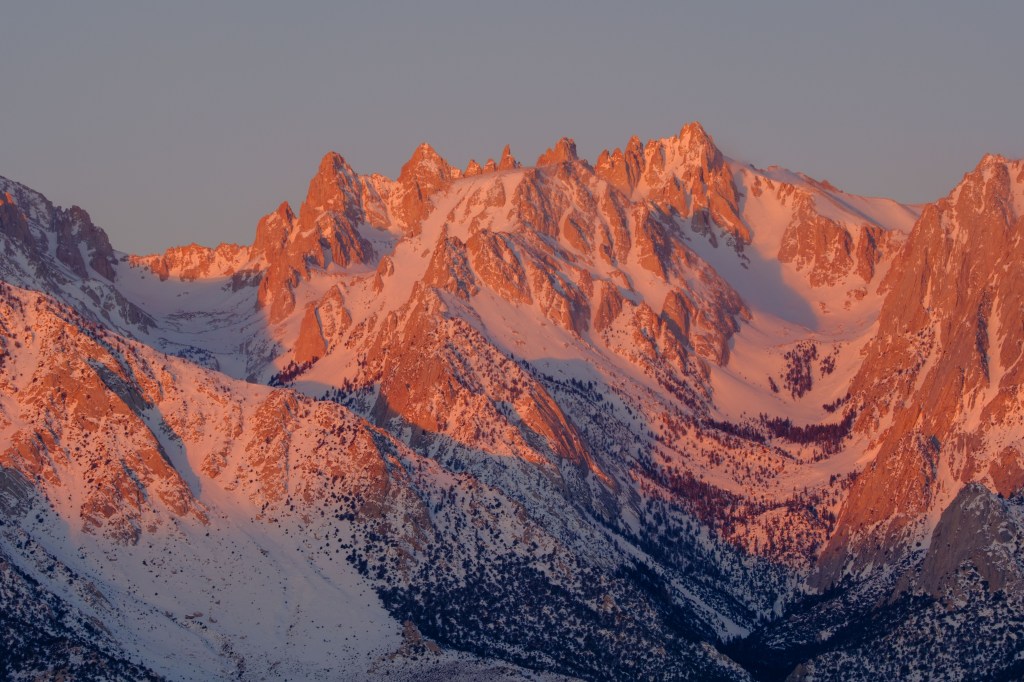
3/7/23. 6:24 AM
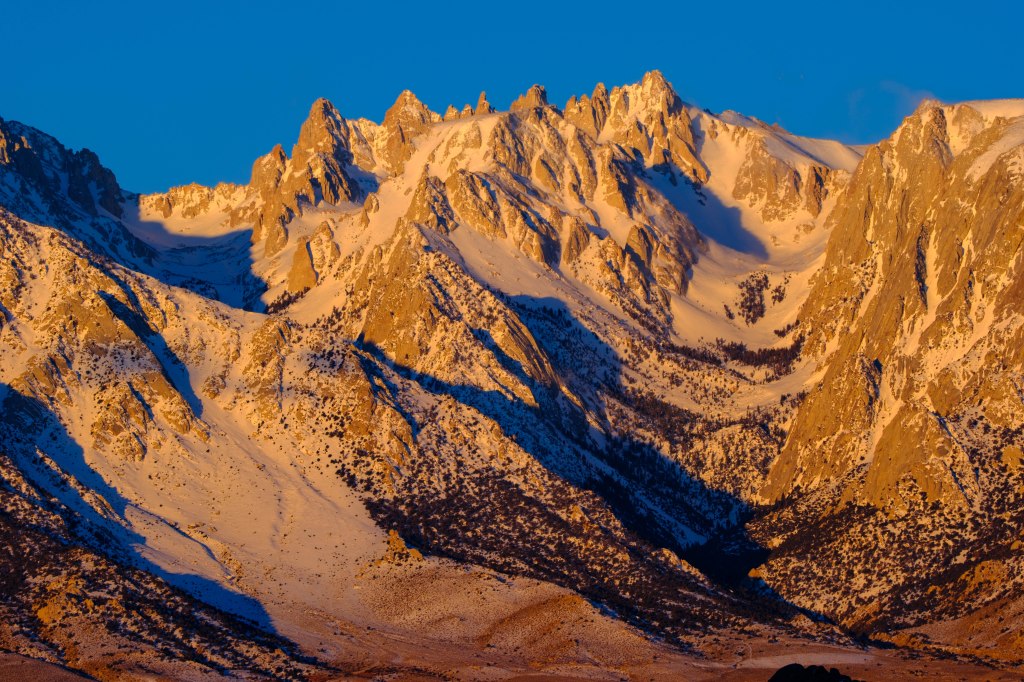
A closer look at Peak 4151 meters.

3/7/23. 6:25 AM
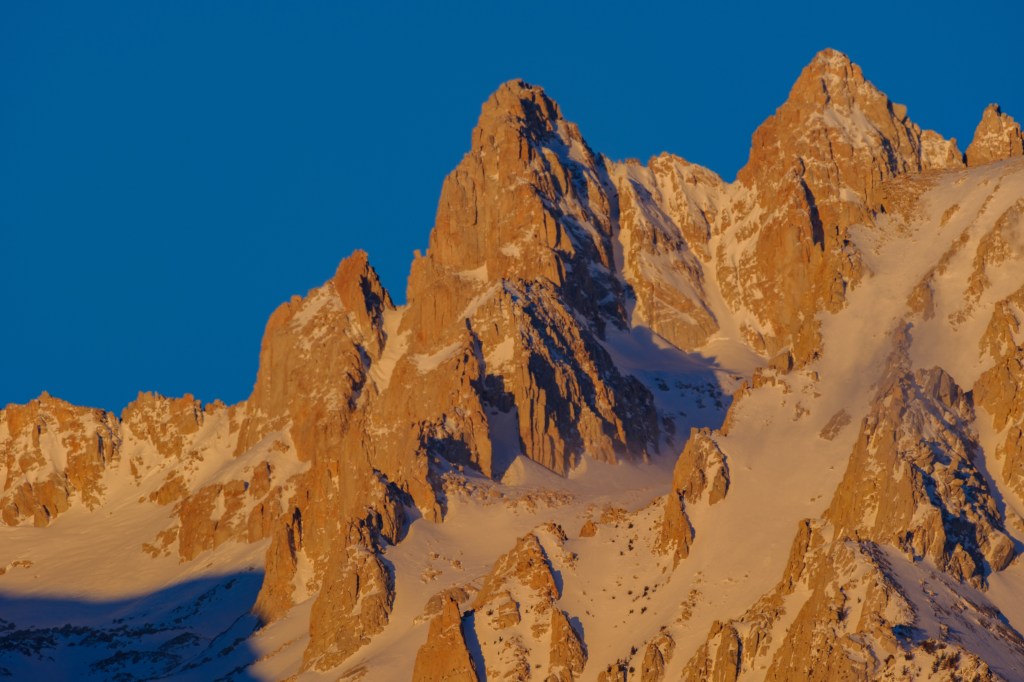
Details of Sharktooth, Corcoran, and LeConte (13,960 feet)

3/7/23. 6:28 AM
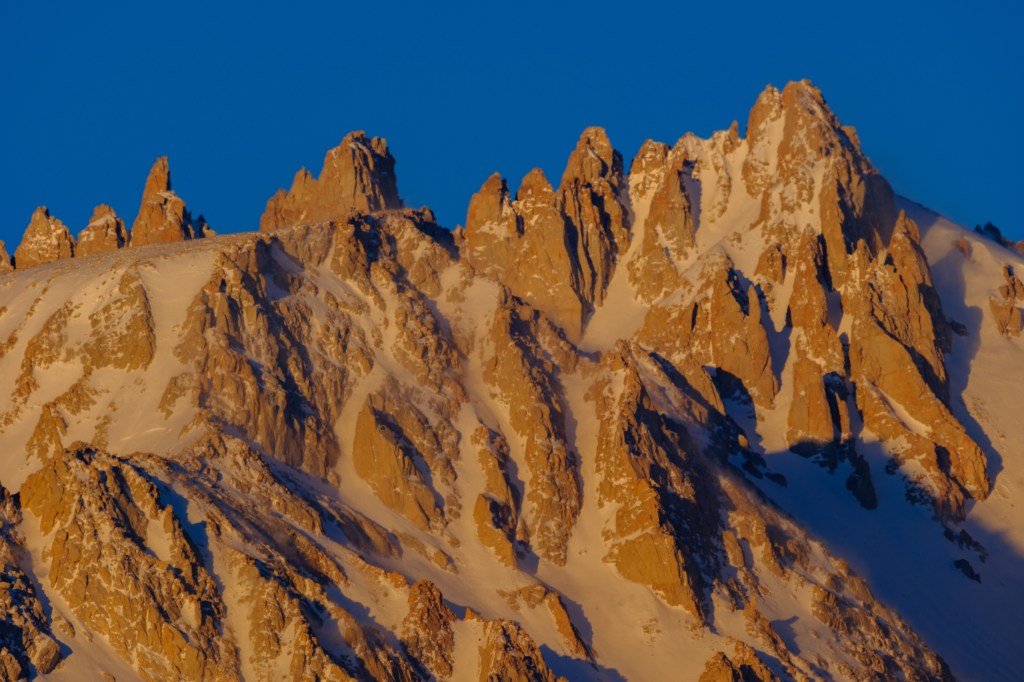
3/7/23. 6:32 AM
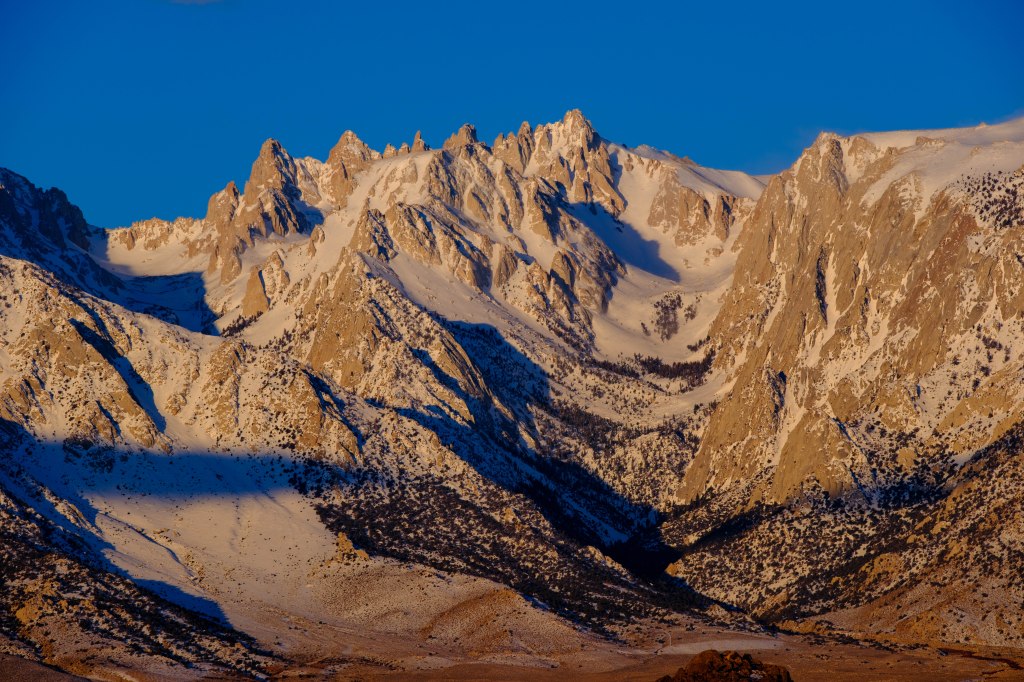
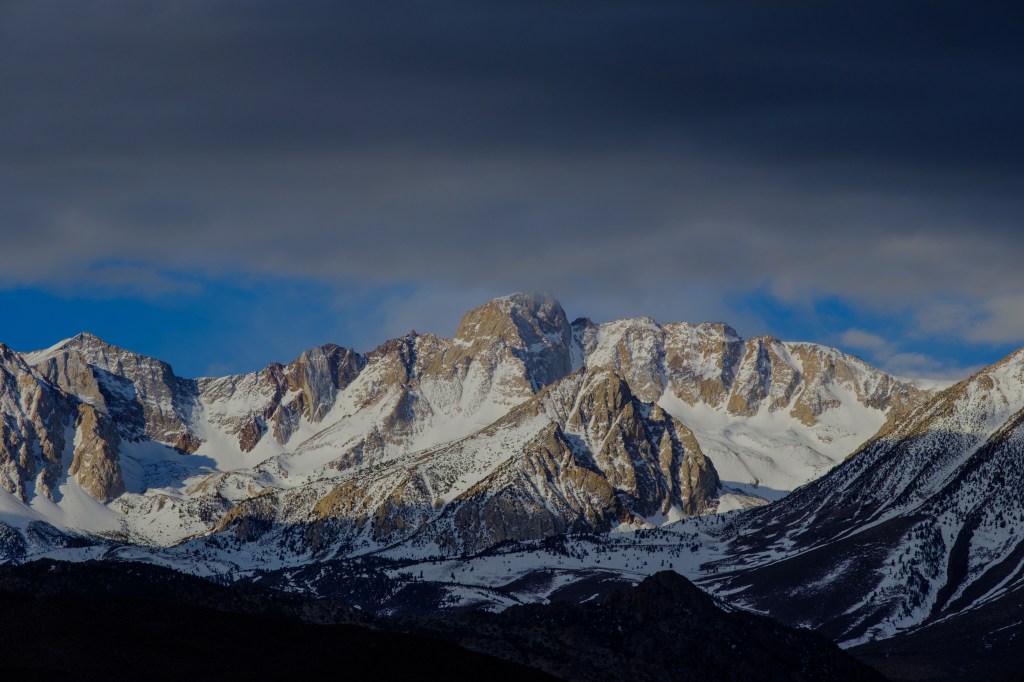
In the next photo, Langley and the Corcoran group have subdued colors due to clouds.

2/24/24. 6:46 AM

Next we see sunrise on April 1, 2024. The colors change quickly as the sun comes up.

4/1/24. 6:34 AM
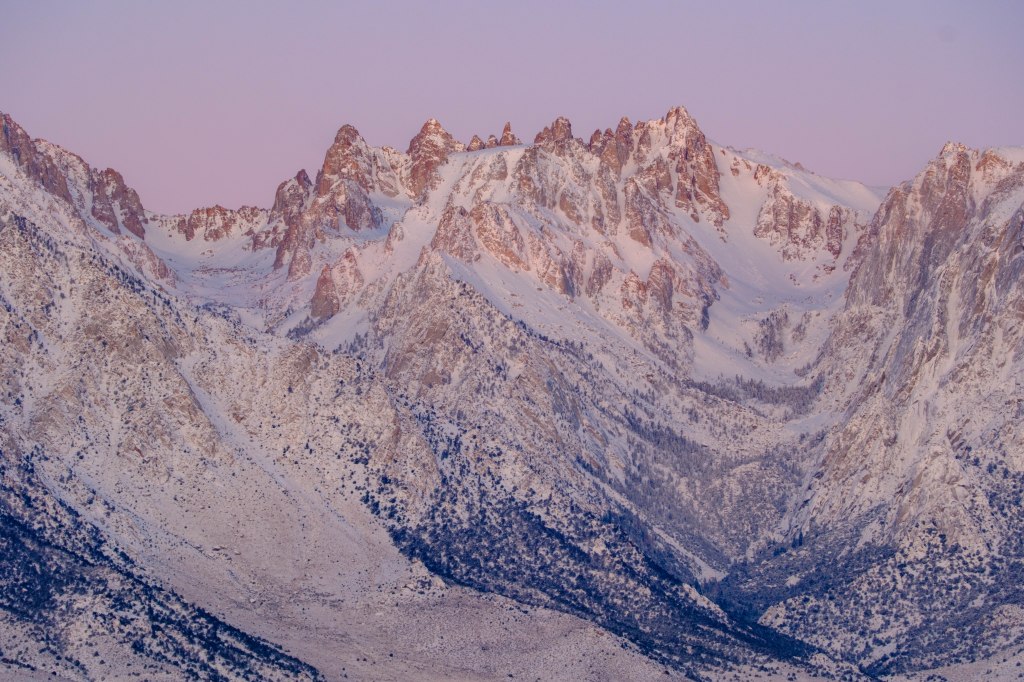
4/1/24. 6:39 AM.

4/1/24. 6:47 AM.
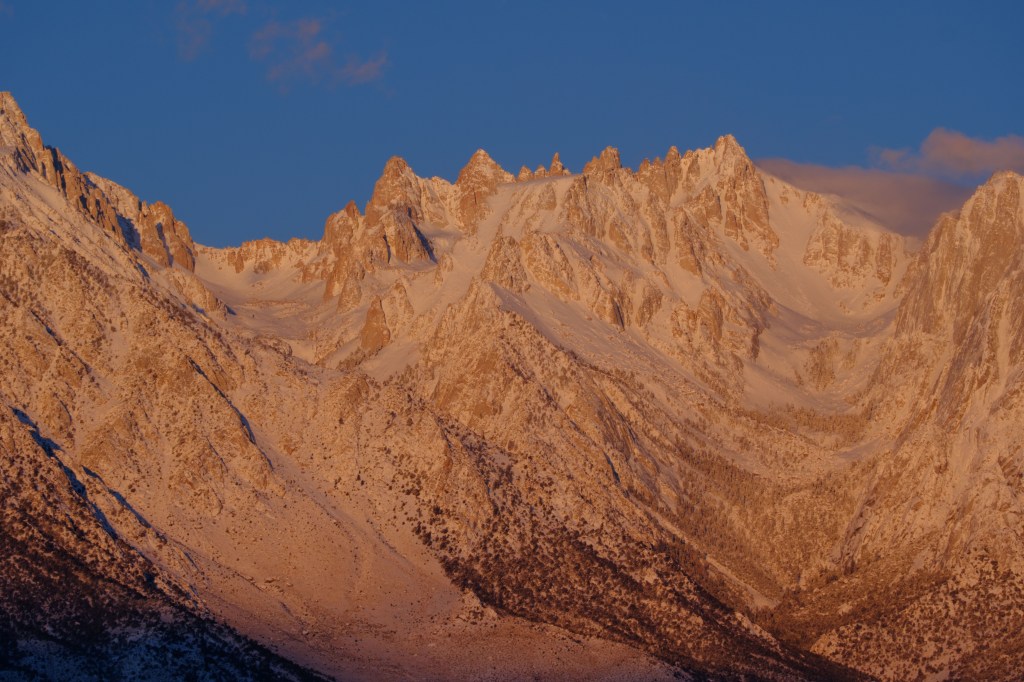
4/1/24. 6:55 AM.
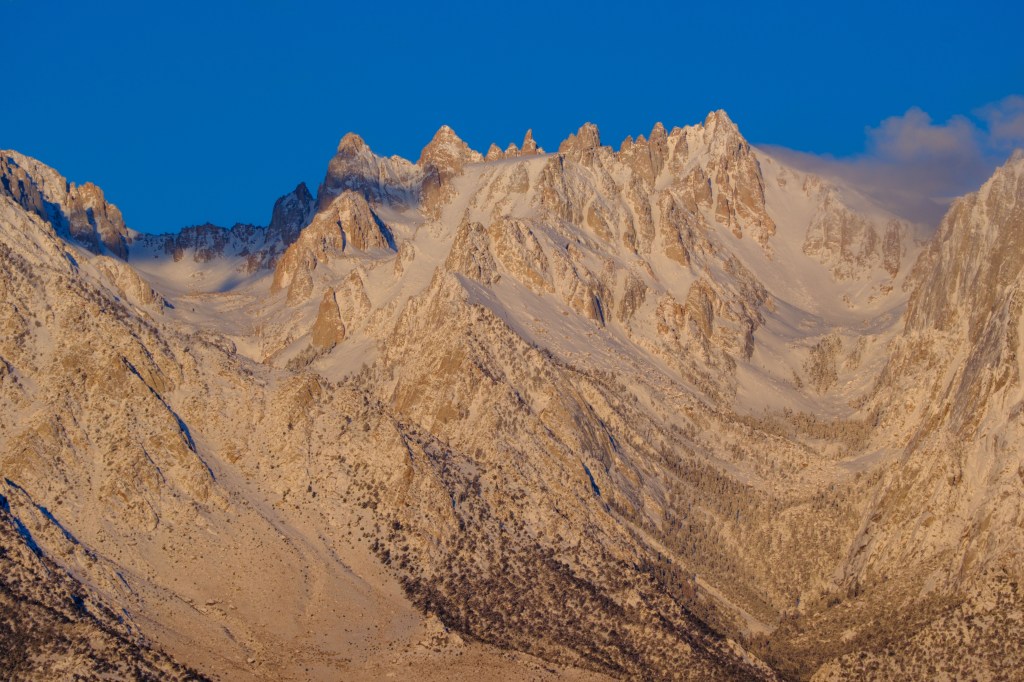
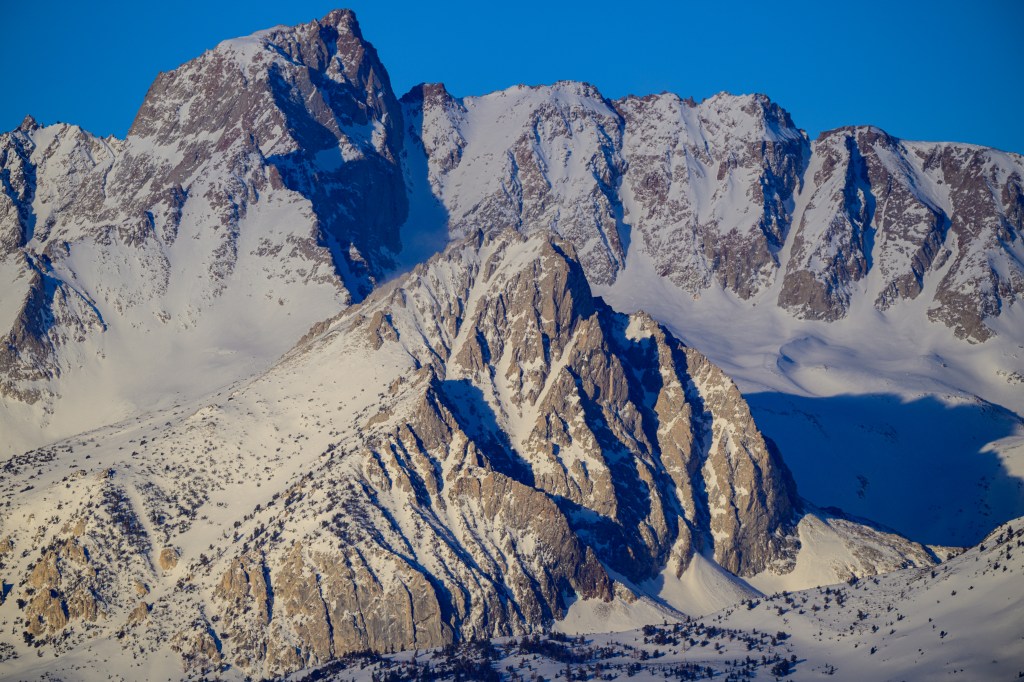
A close-up of Sharktooth, Corcoran, and LeConte.

4/1/24. 7:04 AM.
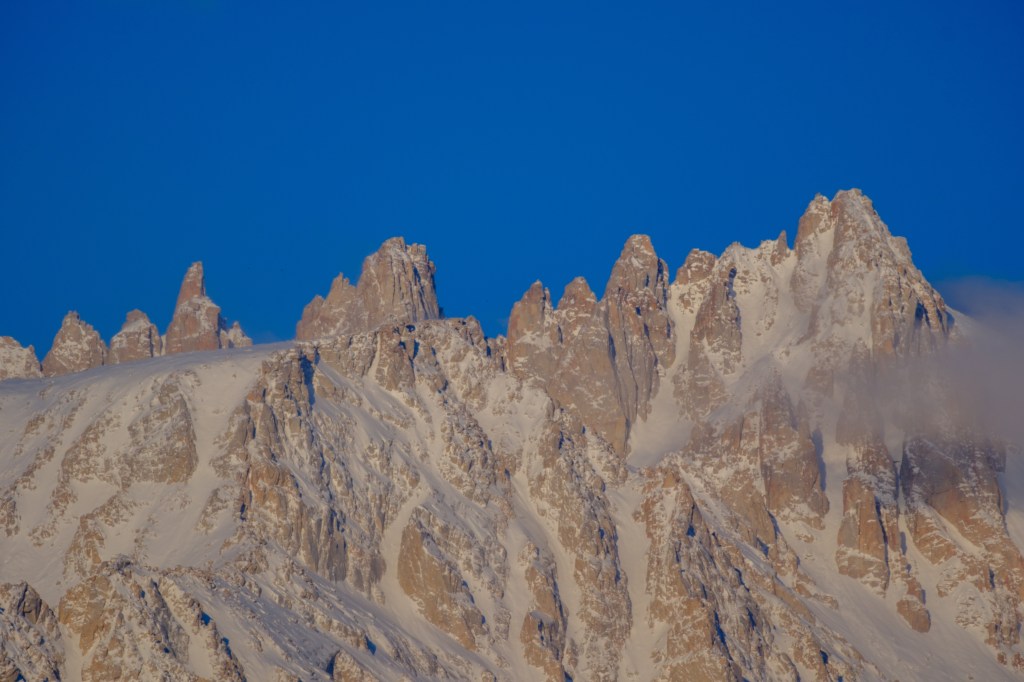
Peak 4151 meters (left) and Sharktooth (right)

4/1/24. 7:04 AM.

4/1/24. 7:05 AM.
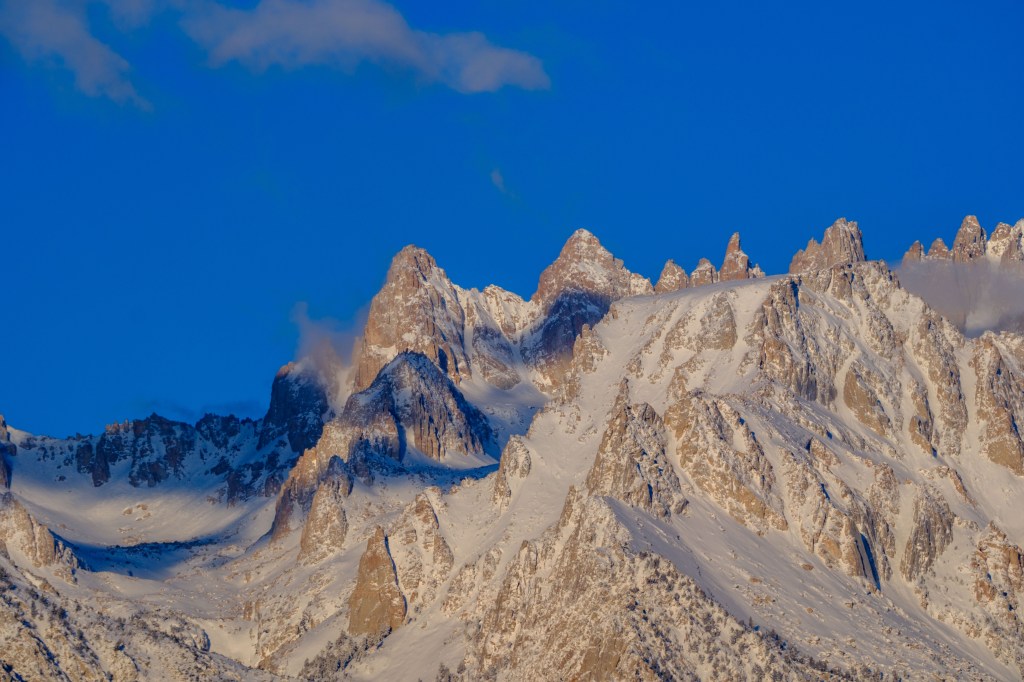
Lone Pine Peak

Because Lone Pine Peak is so much closer to the town of Lone Pine, it looks bigger than Whitney. It is slightly lower than 13,000 feet, lower than the other summits in this blog. Additional, higher summits (Mt Mallory and Mt Irvine) are blocked from view behind this peak.

3/7/23. 6:03 AM.
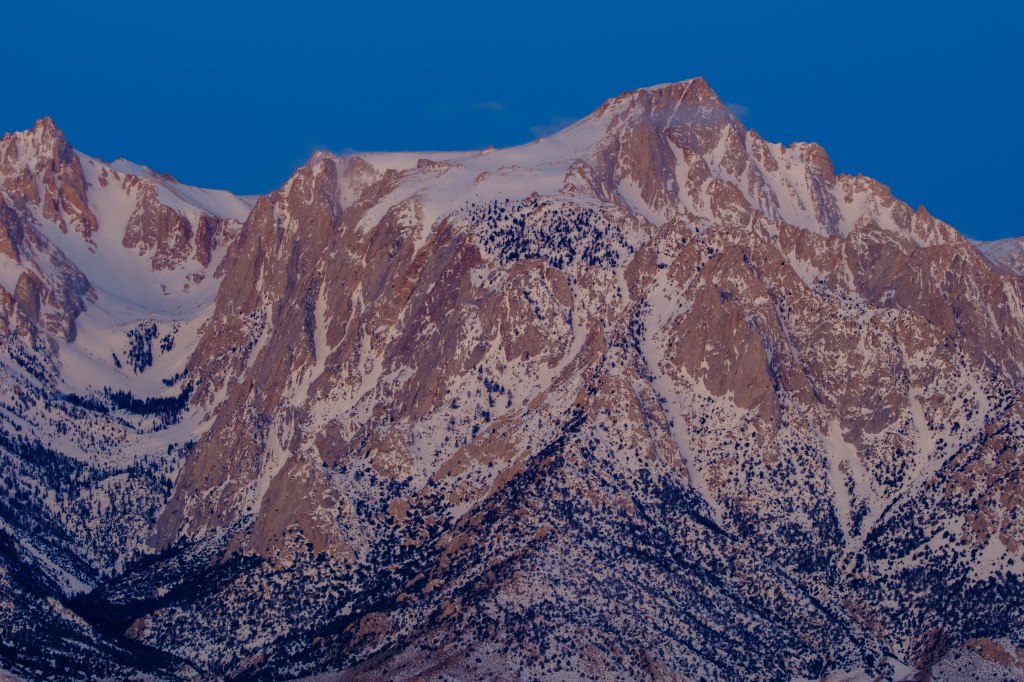
3/7/23. 6:15 AM.
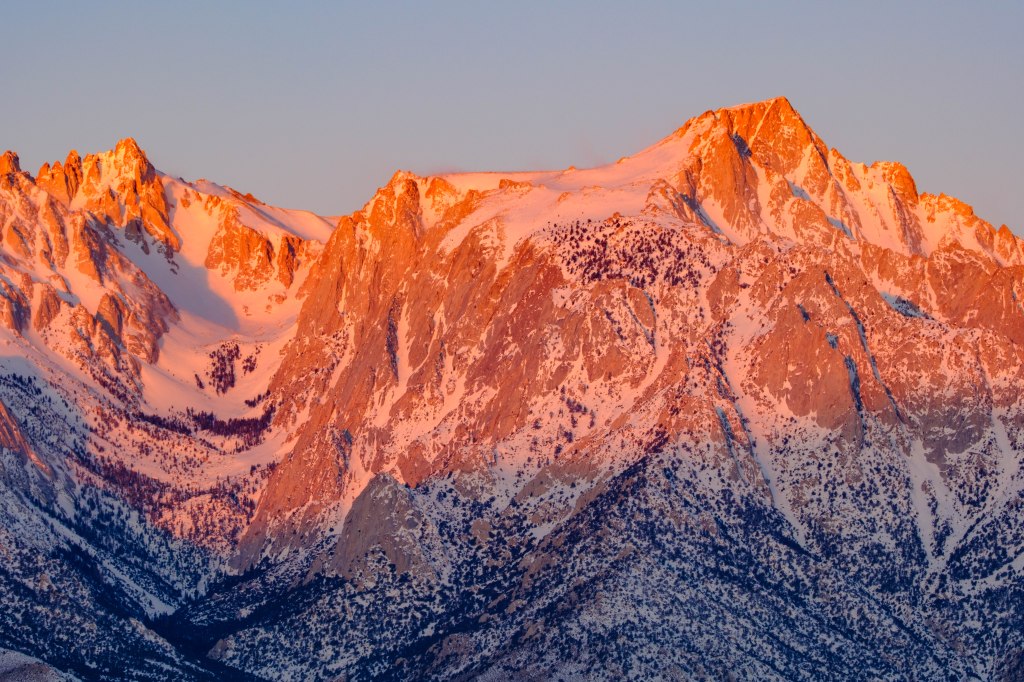
3/7/23. 6:24 AM.

A closer view of the south face of Lone Pine Peak: a 3,000 foot wall with many climbing routes.

3/7/23. 6:29 AM.

3/7/23. 6:32 AM.
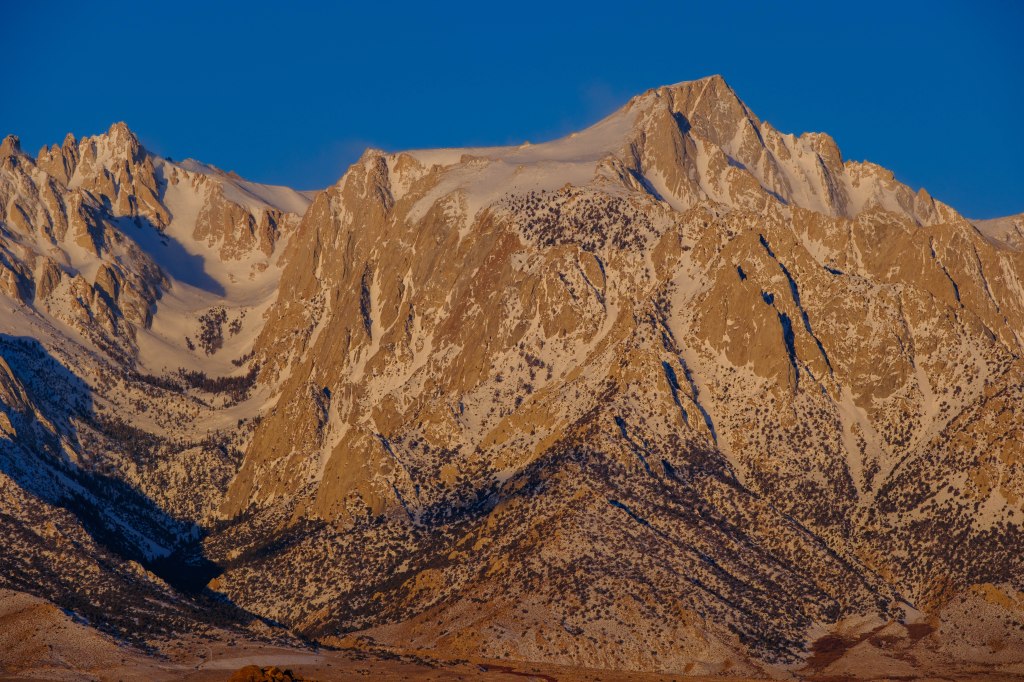
Another sunrise on 4/1/24.

4/1/24. 6:34 AM.
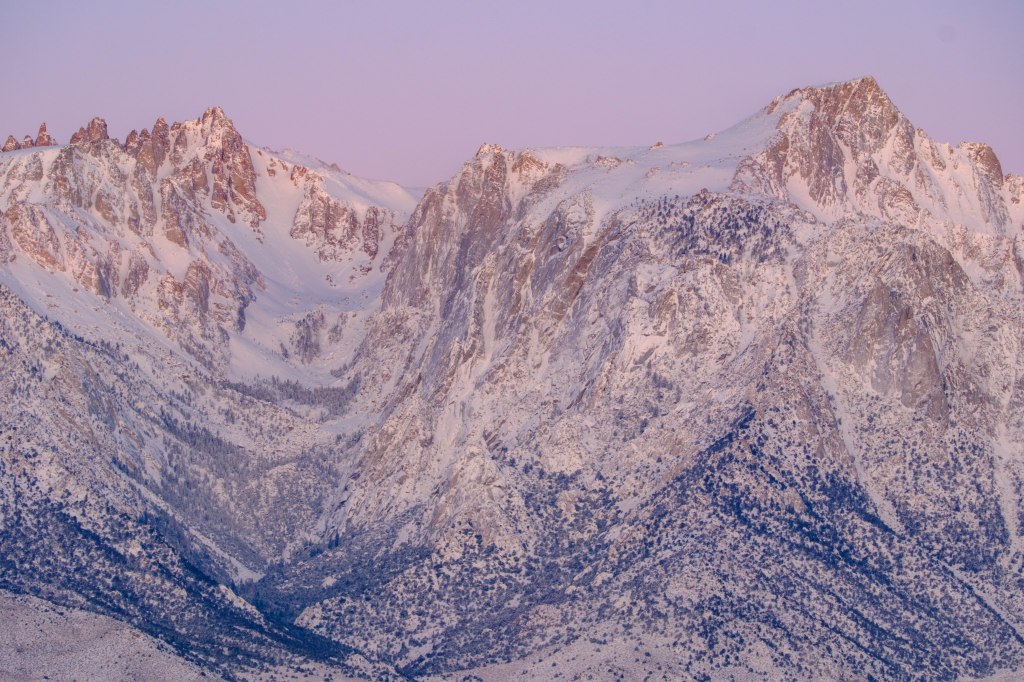
4/1/24. 6:46 AM.

4/1/24. 6:45 AM.
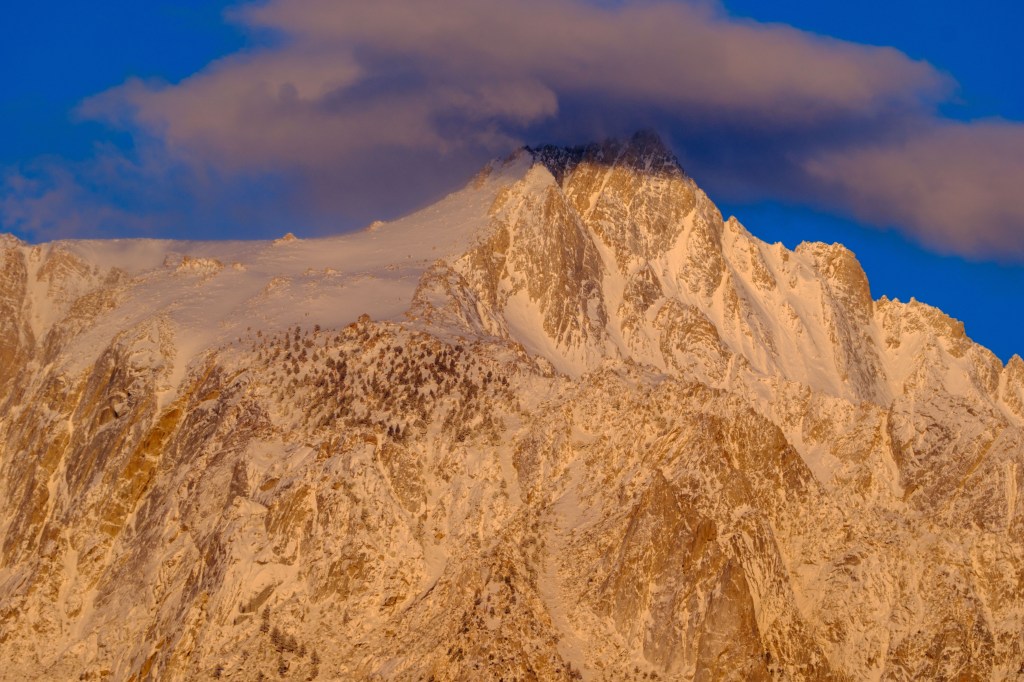
Mount Whitney

My first climb of Whitney was in 1971. I drove to Lone Pine and picked up a permit for the Mountaineer’s Route in May. My climbing partner and I saw no one on our climb and met only four people on the summit. But that ship has sailed. Because this is the tallest US summit aside from peaks in Alaska, the demand for permits has surged in the last 25 years. Most people use the trail to the top; 11 miles with 6000 feet of uphill. For hiking permits during the period May 1 to November 1, people must now enter a lottery in February. There are 100 permit spots each day for people who want to try to reach the summit without camping, 60 spots for people willing to camp overnight along the trail. In 2023 there were 26,219 permit applications for about 115,000 people; 27% of the applications were granted, so about 31,000 individuals had permit spots to go up Whitney. Some of these people never went and many others failed to reach the top; it is estimated that about 10,000 people reach the summit each year.

You cannot see the trail to the summit in photos from the valley. The trail is hidden behind Lone Pine Peak and behind Whitney’s long south ridge.

3/7/23. 5:56 AM.
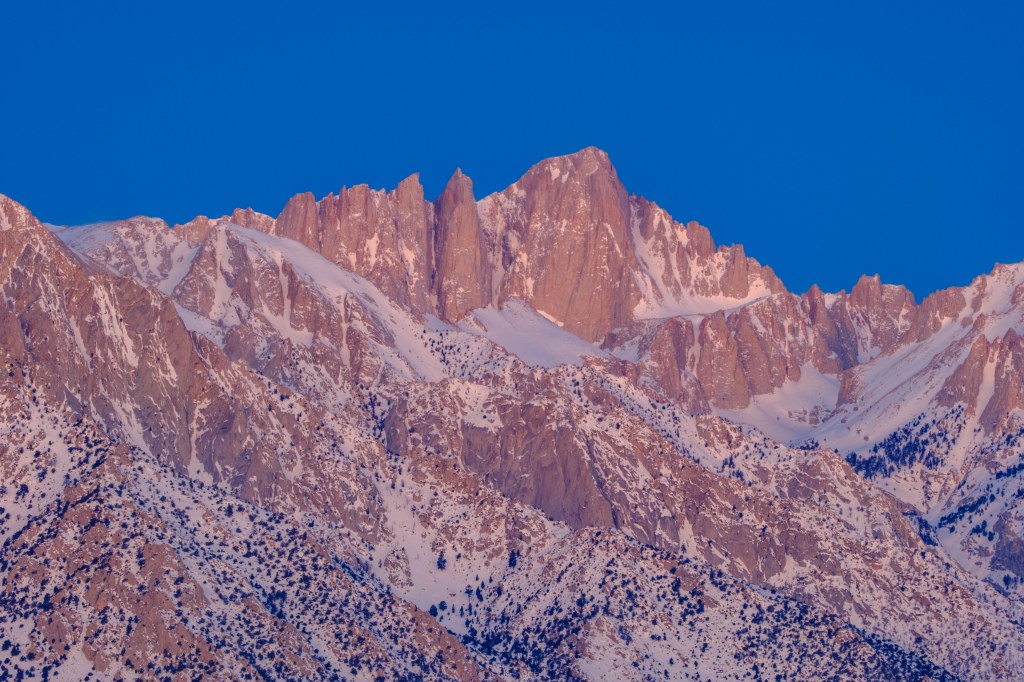
3/7/23. 6:15 AM.
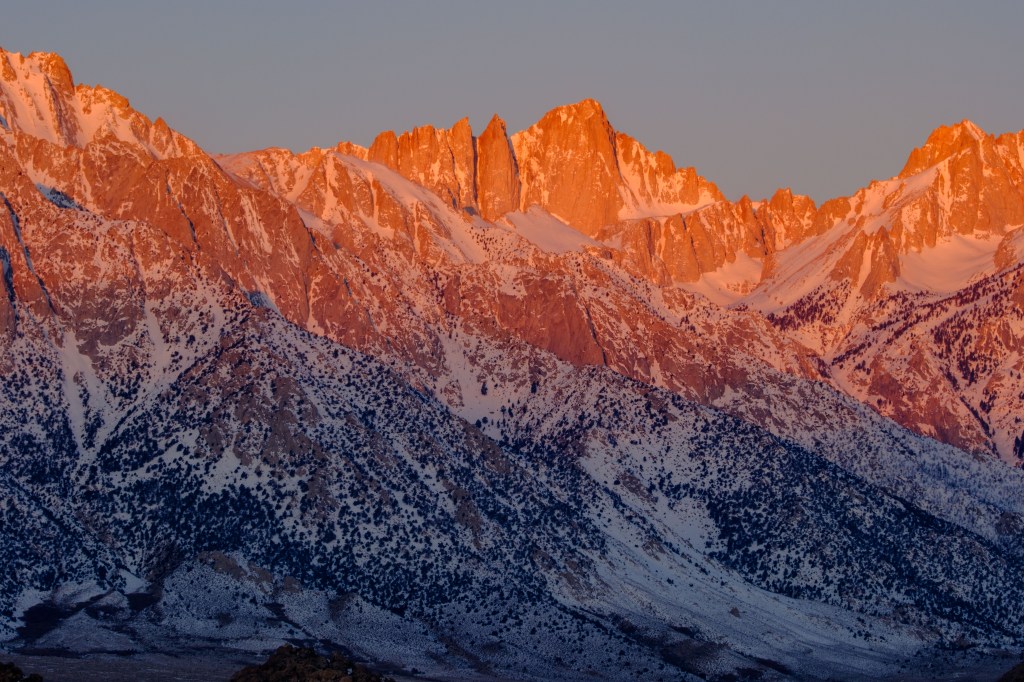
3/7/23. 6:18 AM.
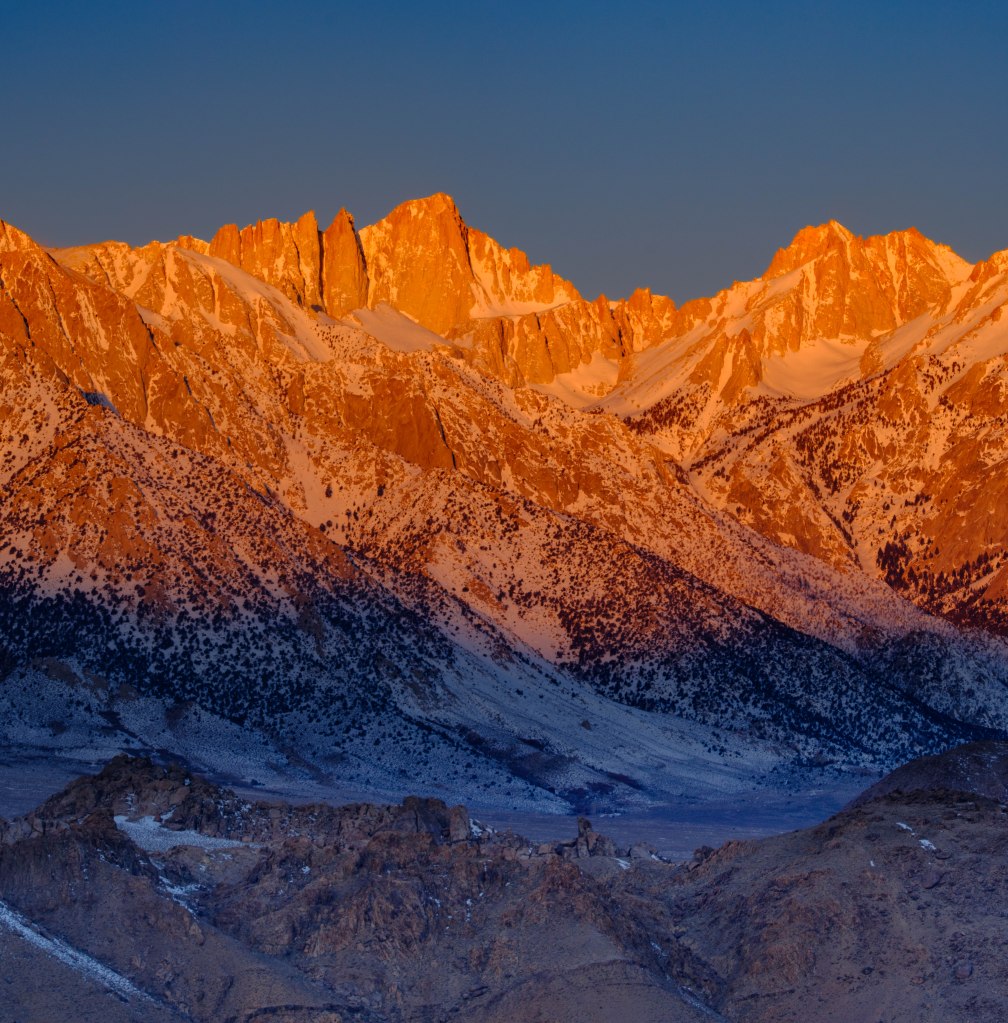
3/7/23. 6:24 AM.
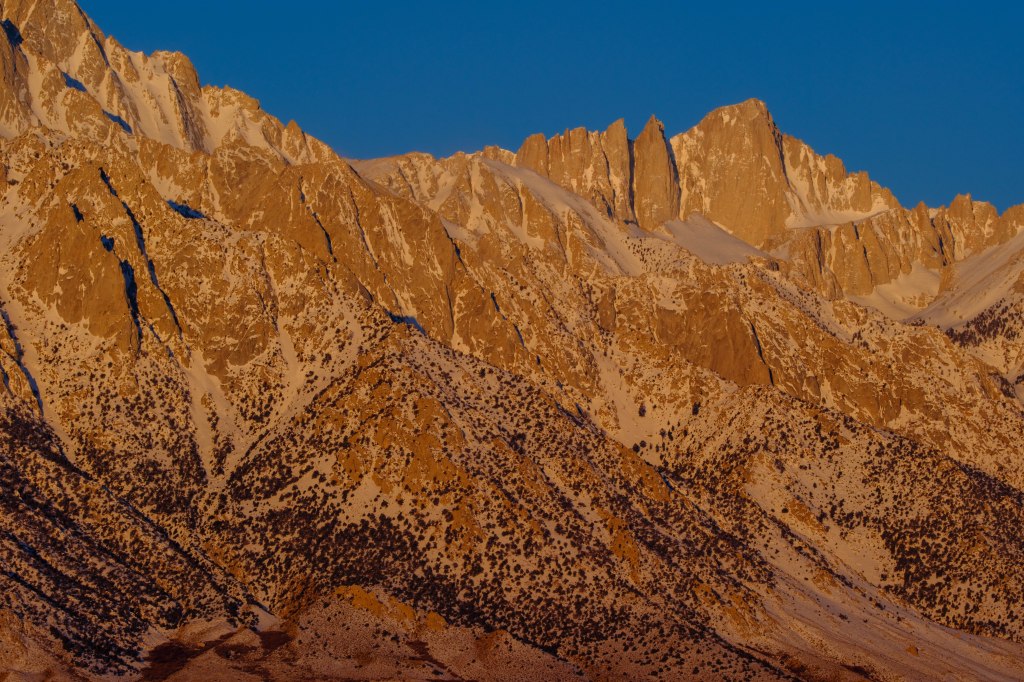
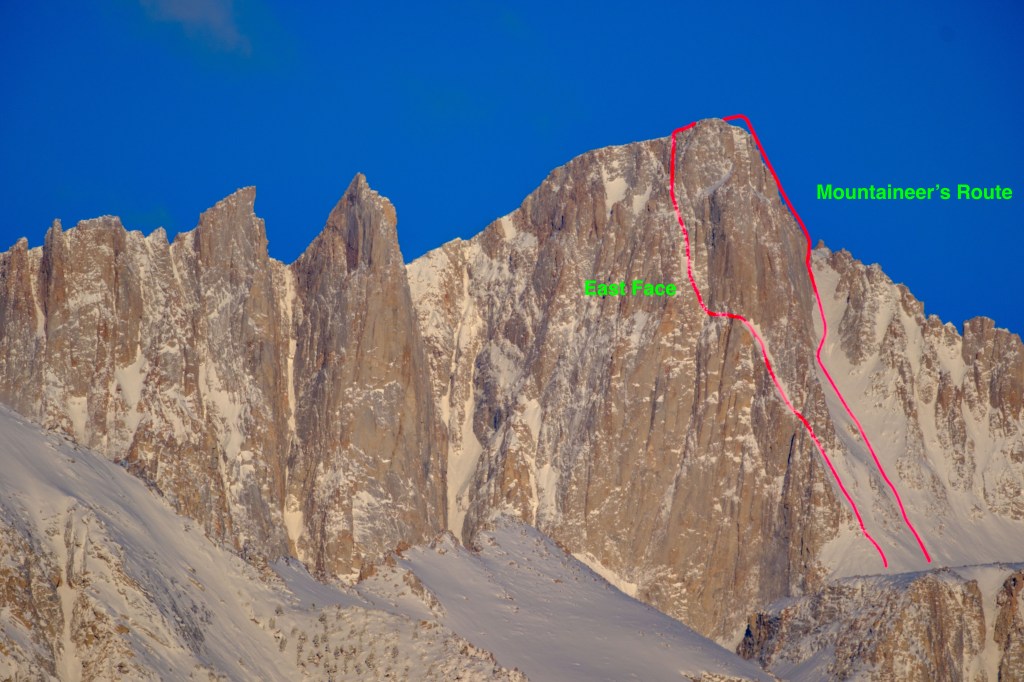
Whitney’s east face has routes popular with climbers. To the left of the summit you can see Keeler Needle (14,240 feet). Crooks Peak (14,080 feet) is further left.

3/7/23. 6:29 AM.
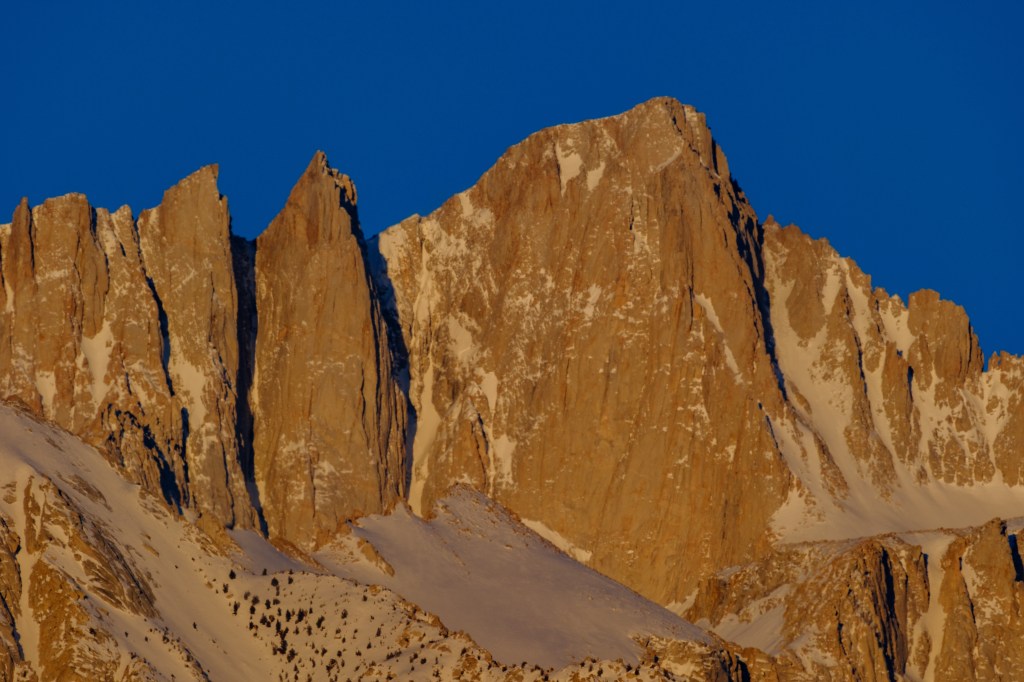
In the photo below, Crooks Peak, Keeler Needle, Mt Whitney, and Mt Russell are all taller than 14,000 feet. Lone Pine Peak on the left looks taller, because it is closer, but it is actually shorter than 13,000 feet. 

3/7/23. 6:33 AM.
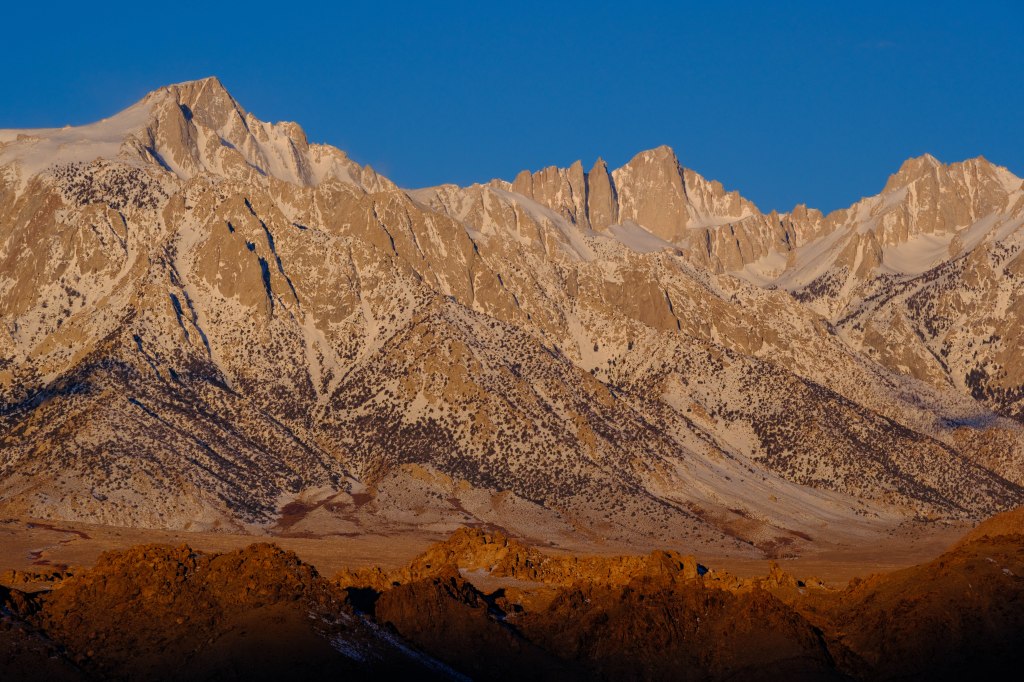
2/24/24. 6:26 AM.
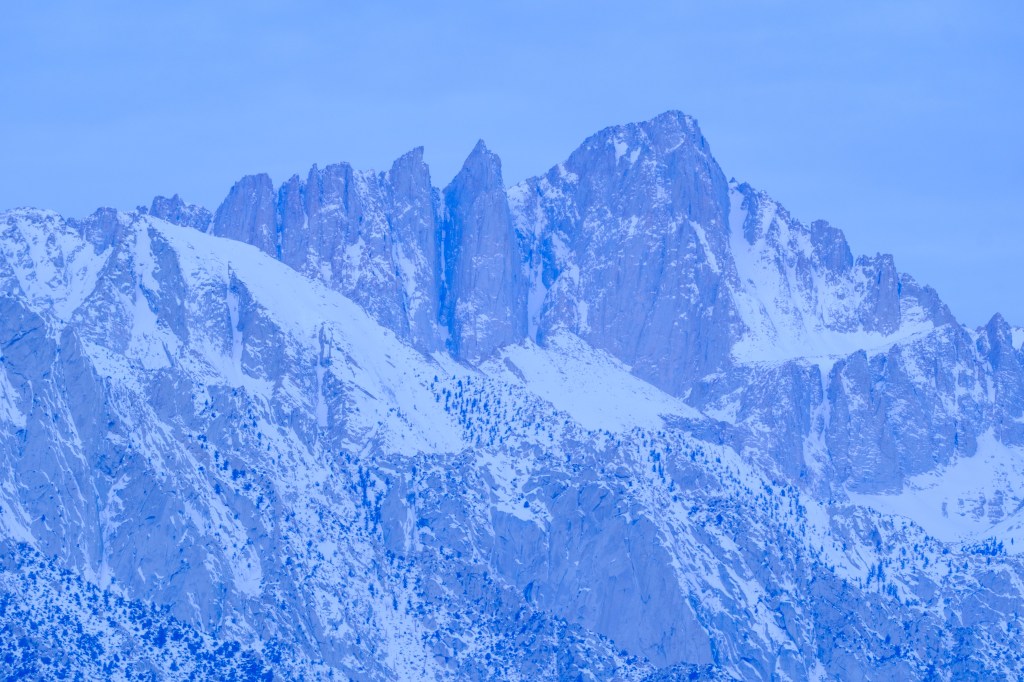
2/24/24. 6:46 AM.

Below, see how much the light changes in 1 minute, from 6:35 to 6:36 AM.

4/1/24. 6:35 AM.
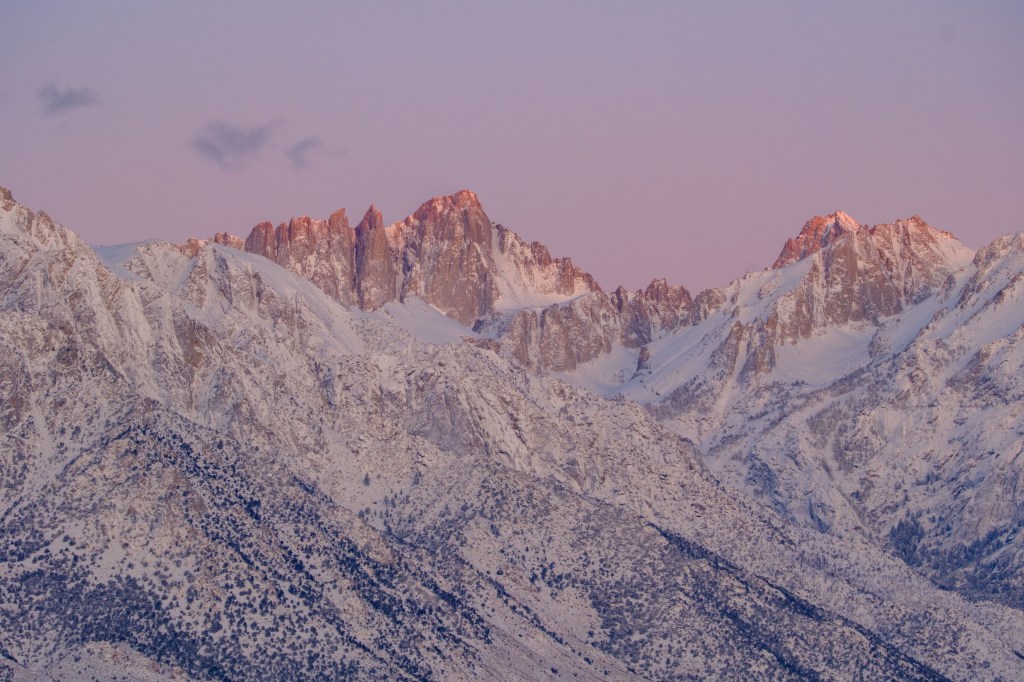
4/1/24. 6:36 AM.
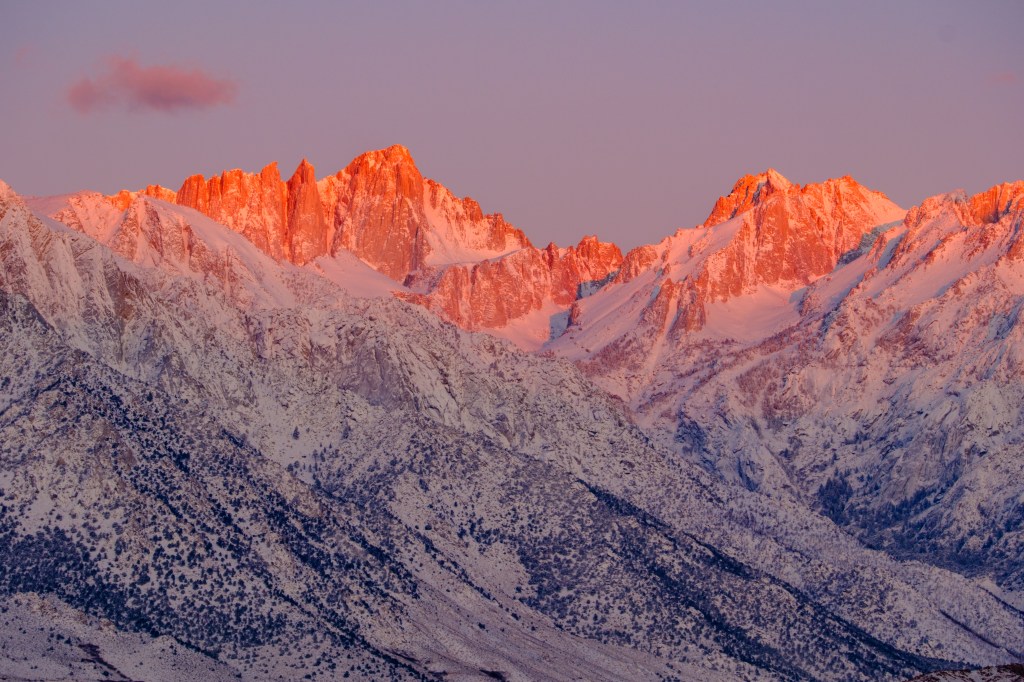
4/1/24. 6:39 AM.
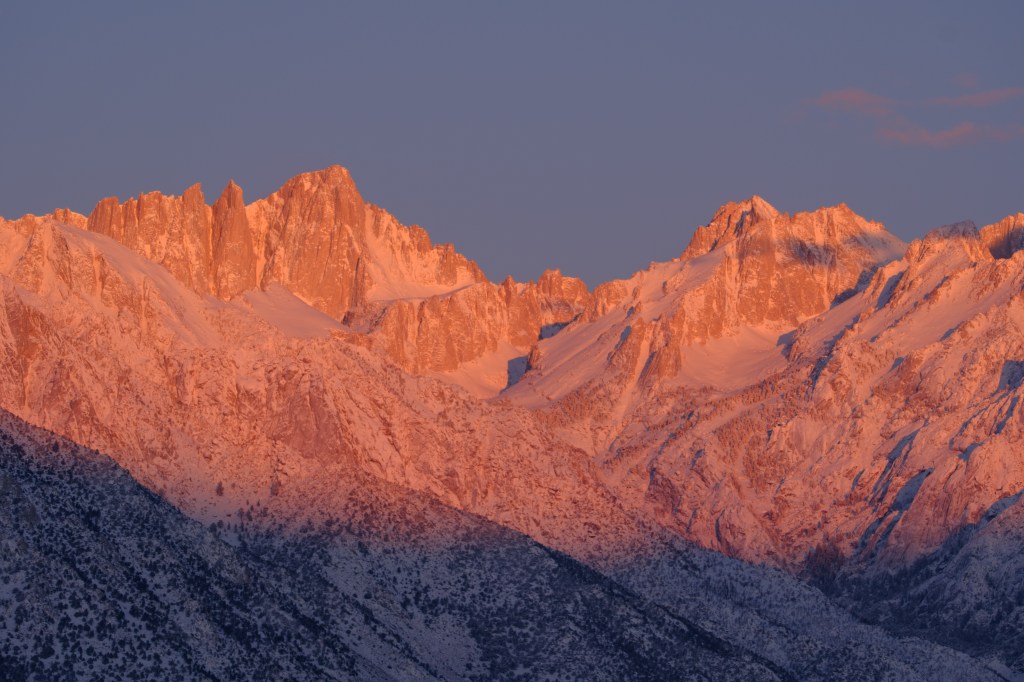
4/1/24. 6:46 AM.

4/1/24. 6:54 AM.
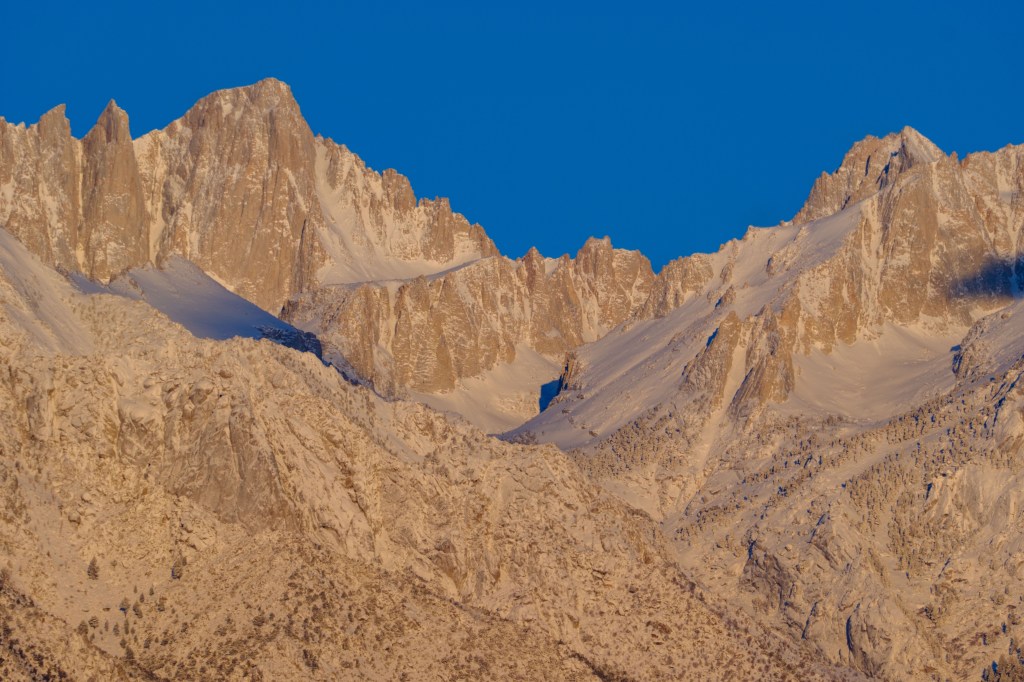
The photo below shows Crooks Peak, Keeler Needle, and Whitney’s east face. I have marked two climbing routes on the photo. In May of 1971 I climbed Whitney via the Mountaineer’s Route. That route goes up a long snow gully, then turns left and out of sight to climb icy rocks to the top. In June of ’81, I climbed the East Face Route.

4/1/24. 7:03 AM.
Peaks North of Whitney

Below, the moon sets behind Mt Carillon (13,552 feet), with Mt Russell left of the moon.

3/7/23. 5:54 AM.
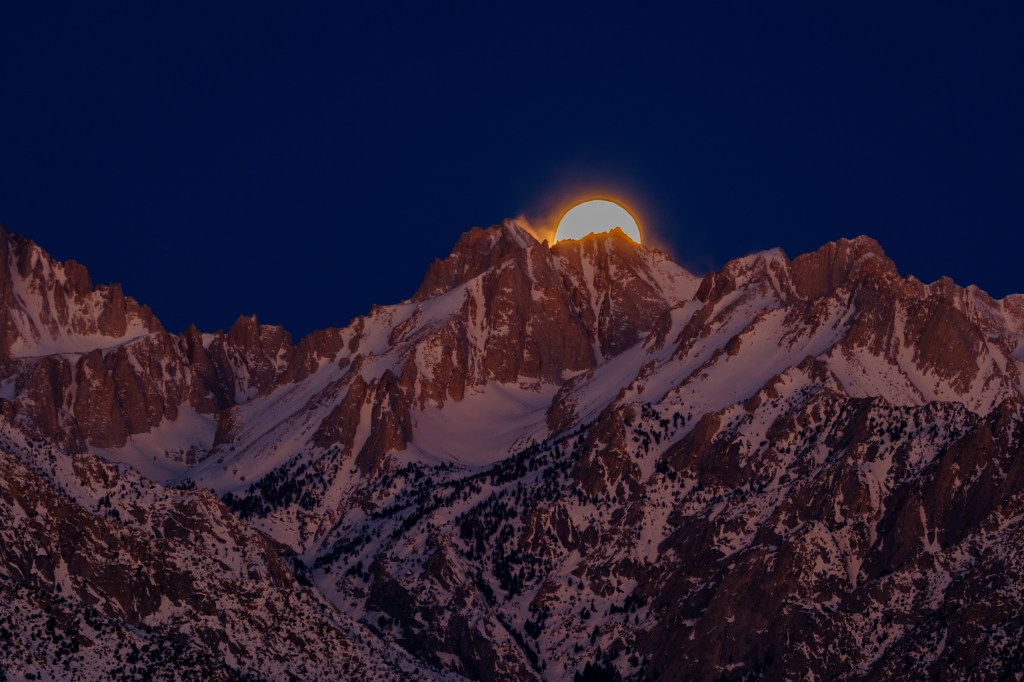
3/7/23. 6:02 AM.

Below you can see Russell, Carillon, and Tunnabora.
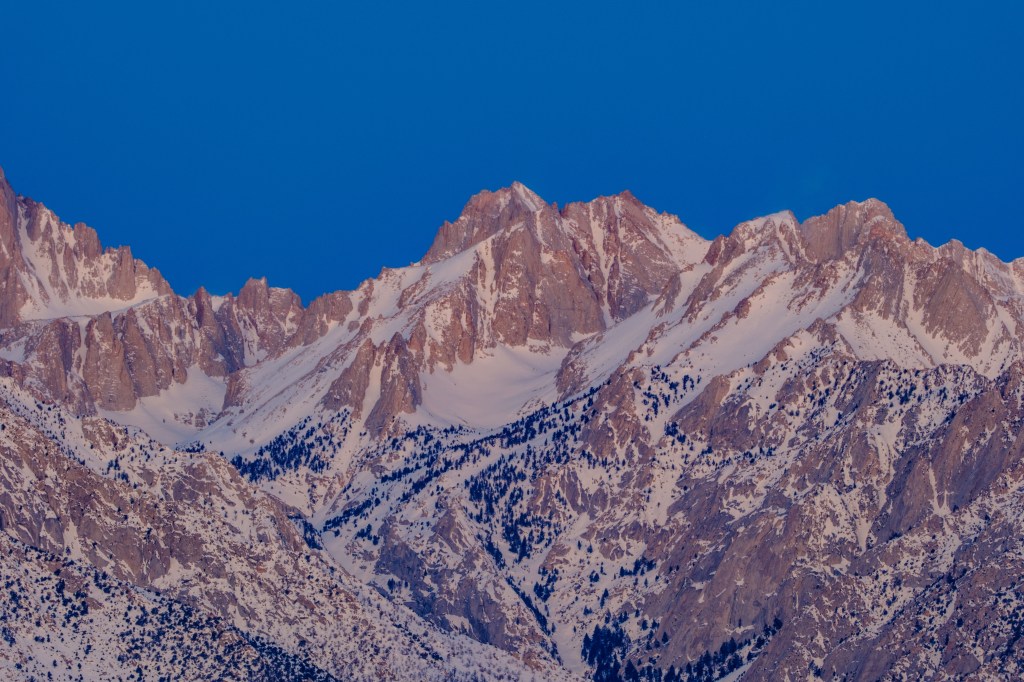
Another moonset.

2/24/24. 6:05 AM.

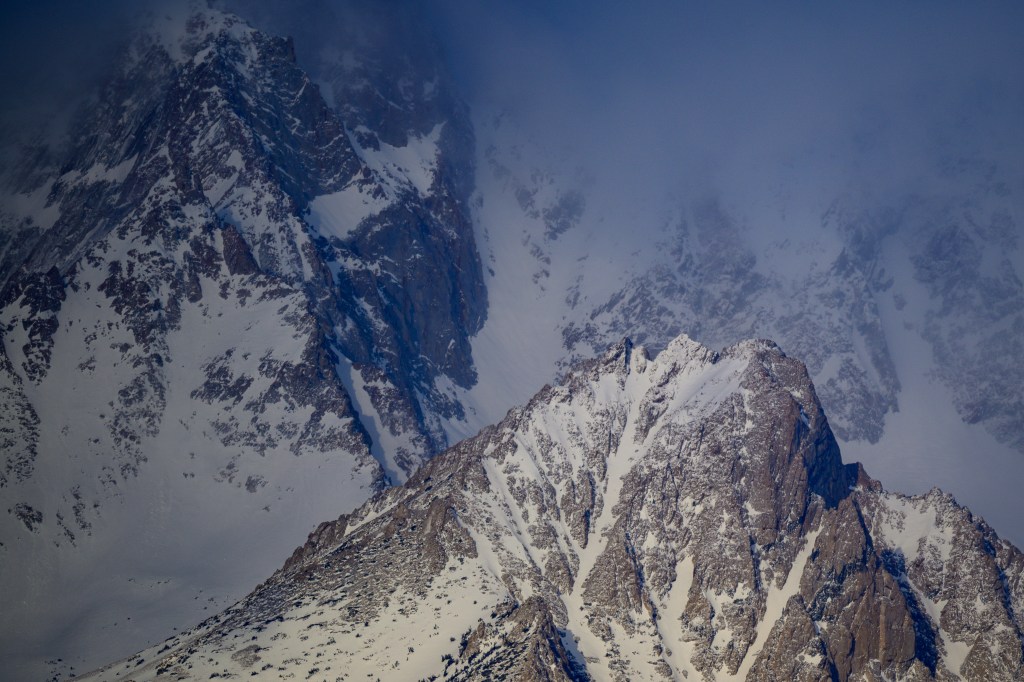
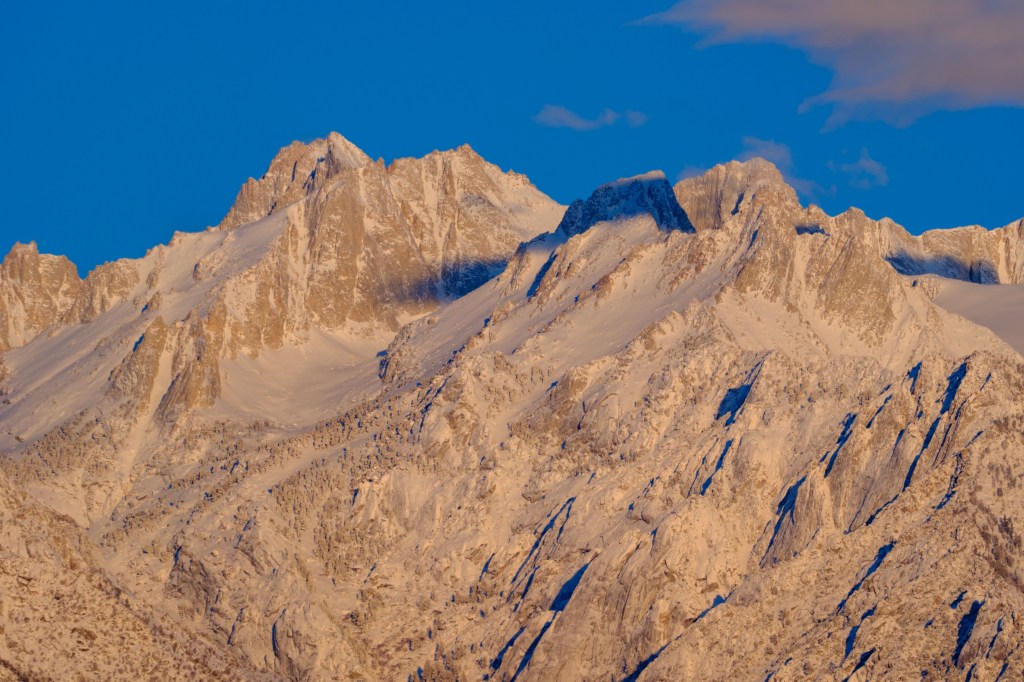
In the lower part of the photo below you can see fir trees covered in ice.

4/1/24. 6:54 AM.
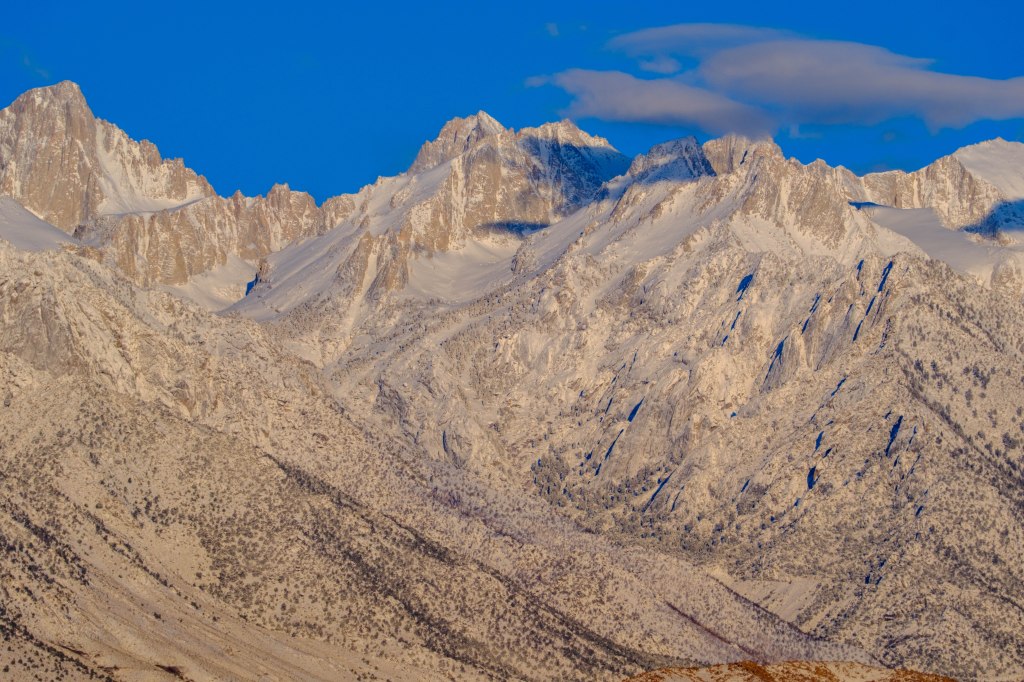
The deep canyon that slopes from lower right to upper left, in the next picture, contains Lone Pine Creek. It also contains the road to Whitney Portal, the trailhead used for the hike to the summit. You can see part of the road in the lower right of the photo.

4/1/24. 7:02 AM
Farther north is Mt Williamson (14,375), California’s second highest peak. 

4/1/24. 7:01 AM

My Climbs on Whitney

I first climbed Whitney in May of 1971, using the Mountaineer’s Route. John Muir made the first ascent of this route in 1873.

I climbed Whitney again in June of 1981, using the East Face Route. Before the climb I was lounging near my tent at Iceberg Lake, reading Wilderness and the American Mind by Roderick Nash. Another climber strolled up to me and I felt miffed that my reading was interrupted. That stranger was Bart O’Brien and soon we were discussing Nash’s book and other areas of interest that we shared. We went on to become close friends. We’ve done more than 160 climbs together on 4 continents.

In 1982, Roberta decided to climb Whitney. We did a 6-day hike, first up the trail to Consultation Lake, then over Arc Pass to Rock Creek. We used the PCT to reach Guitar Lake on Whitney’s west side. On September 12 we reached the summit before anyone else, then we descended the usual trail.

In January 1988, Leni Reeves and I climbed Whitney. Due to snow, we had to park at 6500 feet on the approach road. We took 2 days to walk and snowshoe to a camp above Consultation Lake. After a rest day, we climbed up a gully north of the switchbacks, then followed the trail to the top. A line of black clouds approached as we raced back to camp. High winds damaged our tent that night. After 4am we had to sit up and use our backs to brace the tent wall against the storm winds. At first light we packed up and hiked down to the car. We met no one else on this climb.
Cropping. And More…

I recently printed some greeting cards with bird images. A friend looked at these and asked, “Do you crop your photos?” My answer was “Yes, almost always.” What is cropping and why do I do it?

Cropping a photograph means cutting away some of the image from the edges. Most cameras produce images that are rectangular or square. If you cut off material from one or more of the 4 edges, then you have cropped the photo.

Whenever you take a picture, many factors exclude material from the final image. The camera itself eliminates part of a potential image. Camera lenses create a round image. But camera sensors are rectangular or square. So the final photograph omits parts of the round image that was created by the lens. My full-frame digital camera has a sensor that is 35.9mm x 23.9mm. A little high-school geometry reveals that 31% of the circular image is omitted from the rectangular image on the sensor.

Your decisions affect what is in or out of a photo. Most cameras held in their default position (landscape mode) record a picture that is wider than tall. If you turn the camera 90 degrees (portrait mode) this cuts potential image material from the sides and adds material to the top or bottom. If you shift your aim from side-to-side, or up and down, this affects what is captured and what is omitted. If you step toward your subject, you exclude more peripheral material from the photo. If you have a zoom lens and increase the zoom power, you reject more from the final picture. A telephoto lens takes a narrow view, excluding more. Conversely, a wide angle lens includes more.

Cropping, however, refers to excluding some of a photo that has already been taken, either by cutting away part of a negative, trimming off part of a print, or omitting pixels from the edge (or edges) of a digital image.

Why would you crop a picture? Reasons include:

1. You want to change the aspect ratio (width to height ratio) to fit the photo to a frame or a computer monitor or a TV screen. Or you think a particular ratio is more attractive. You can turn a horizontal image into a vertical image.

2. You want to trim away a distracting or unattractive part of an image. For example, you might want to cut out a nearby street sign from a shot of a bird. You might crop to remove an overly bright reflection from the surface of a pond. After a bitter divorce, you might crop your ex-spouse out of your old vacation photographs. 

3. You might crop to make a bird bigger in the image that remains.

4. You could crop to center an animal. Or to move the animal to one side.

5. You can crop to give more emphasis to the foreground. Or the background.

            In short, you might crop if you think that removing part of the image will make what remains a better photograph for some purpose. Let me show some examples.

Swainson’s Hawk and Northern Mockingbird

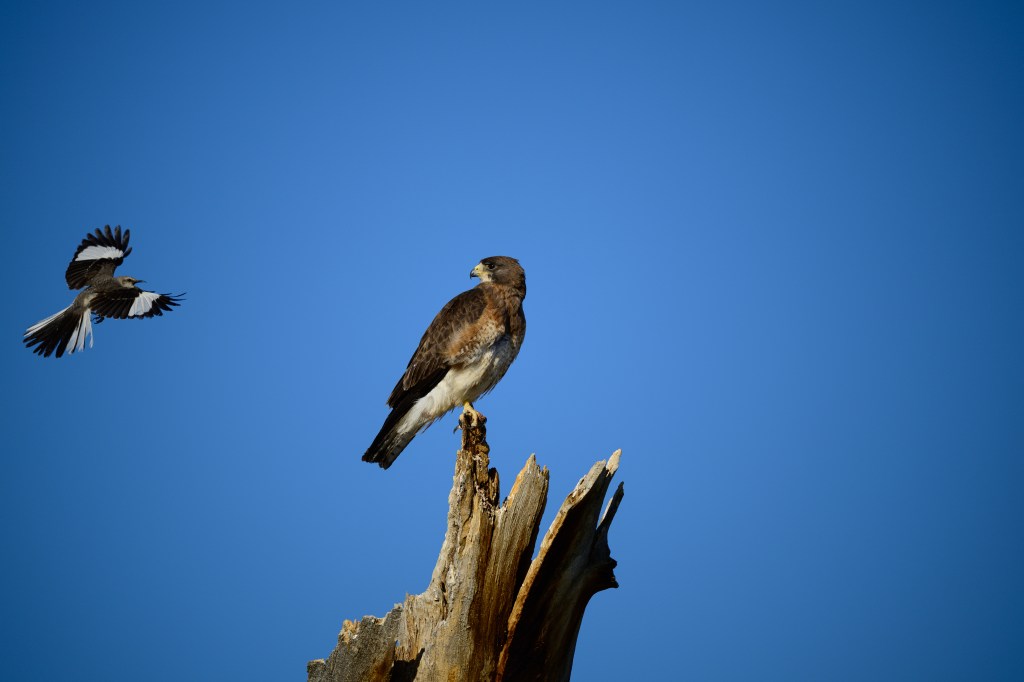
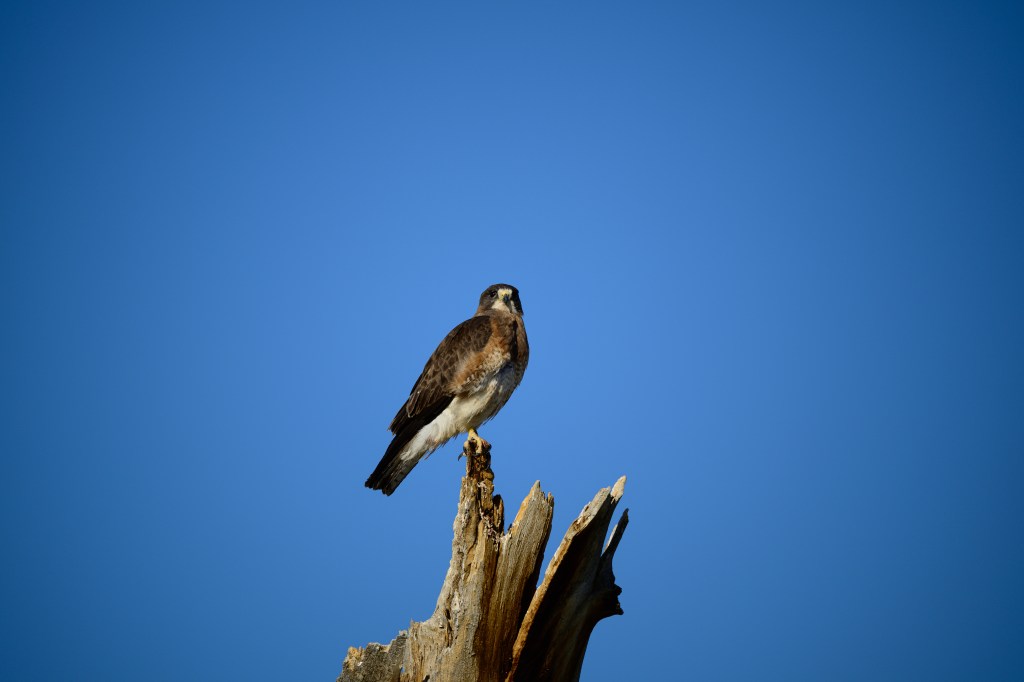
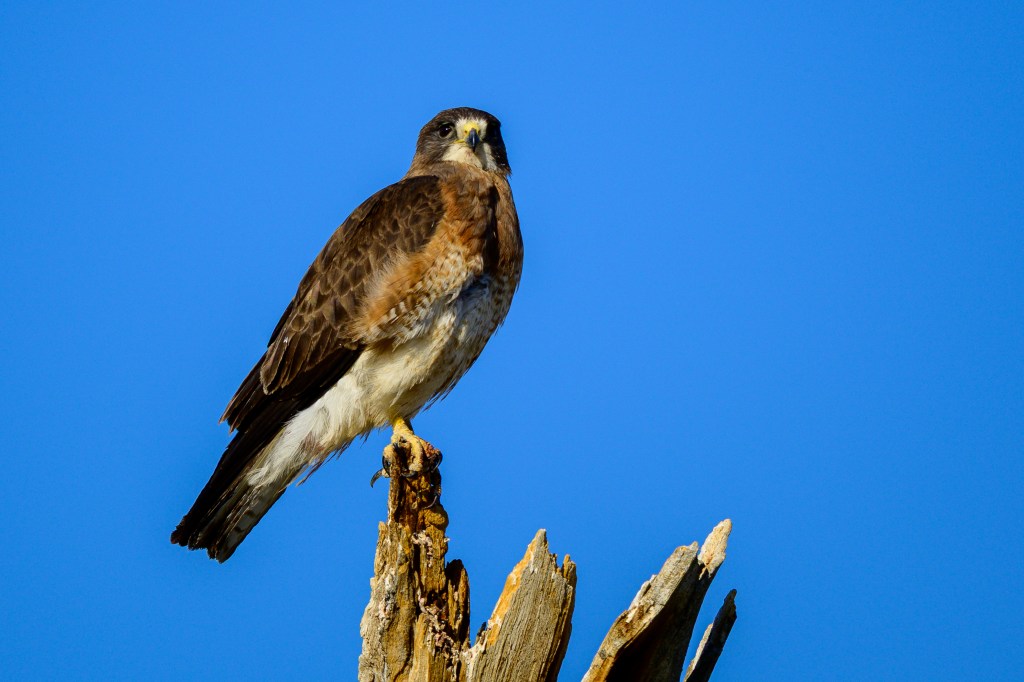
Raptors often perch on the cottonwoods along Warm Springs Road: American Kestrels, Bald Eagles, Prairie Falcons, Peregrine Falcons, and Red-tailed Hawks use this road. In 2025, a few Swainson’s Hawks moved in from South America; one of them favors a dead cottonwood. Shown below is an unedited image taken on July 19. The hawk is in the center of the image; I usually shoot with a bird near the center to be sure the camera’s autofocus is on the bird.

I edited the picture a bit, making adjustments to exposure, and cropping to move the bird to the left, center the dead tree, and remove a lot of blank, boring sky.

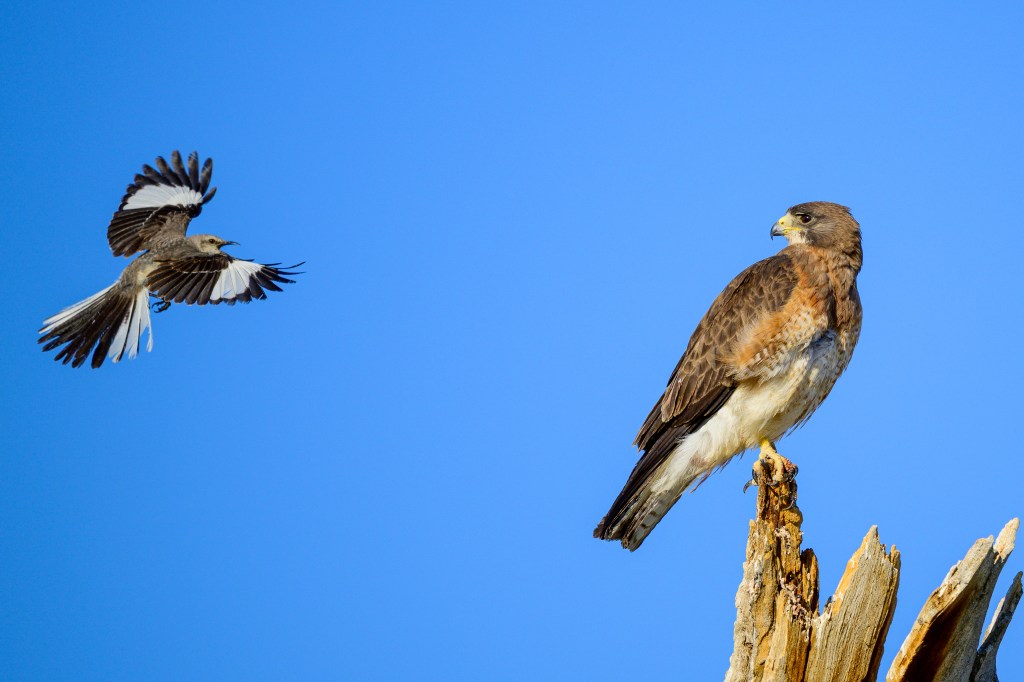
As I was shooting, a Northern Mockingbird appeared, screaming at the hawk; see below. This is a family-oriented blog, so I will not repeat what the Meadowlark was yelling. Now the picture is lopsided; all the action is on the left, while the right side is just empty blue. 

So I redid the crop, keeping the focus on the aggressive interaction, below:

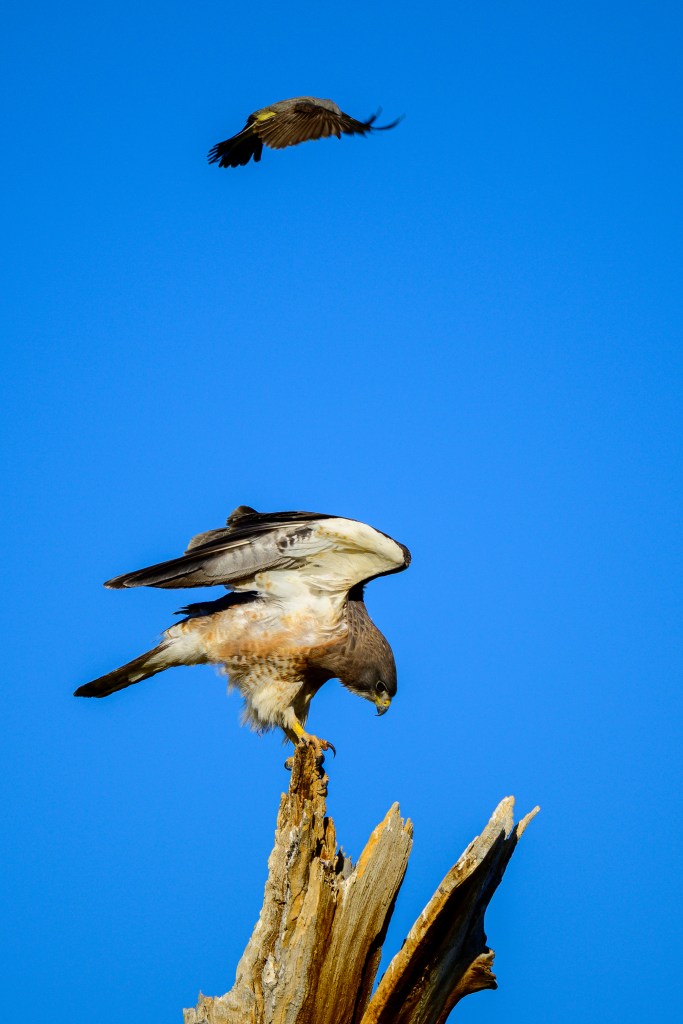
It turns out that just one month earlier, on June 19th, the same Hawk on the same tree was harassed by a Western Kingbird. In the first image, the Hawk ducks and almost takes off. In the second photo, the Kingbird can be seen rocketing past; in that picture, the camera focused on the Meadowlark, leaving the Hawk unfocused. I used cropping to change both of these photos to portrait mode.

Mountain Bluebird

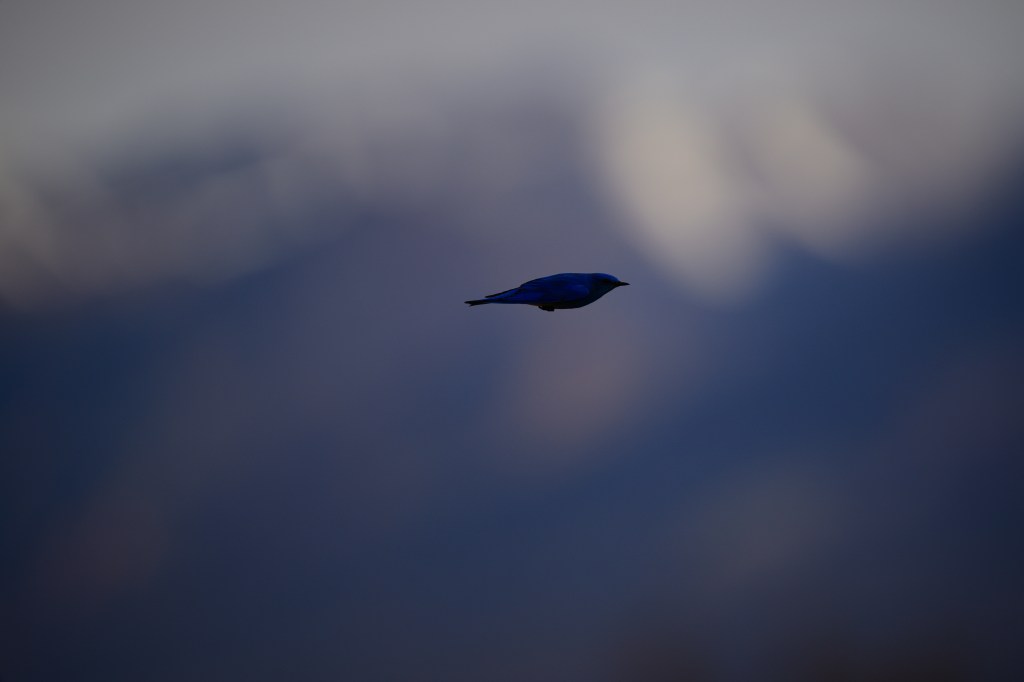
In March, a Mountain Bluebird rocketed past me on Gus Cashbaugh Lane. I tried to shoot this action and was rewarded with a few useful images. The background is blurred by my tracking of the fast bird and the narrow depth of field. Below is one of the images:

The photo above was underexposed and the bird looks pretty small. But I import my photos into Adobe Lightroom Classic on my computer. The software lets me correct some deficiencies in an image. I increased the amount of light in the photo, particularly in the darker areas. And I cropped away most of the picture to enlarge the bird. I put the bird just a bit above the photo’s center, producing the result below:

Green-tailed Towhee

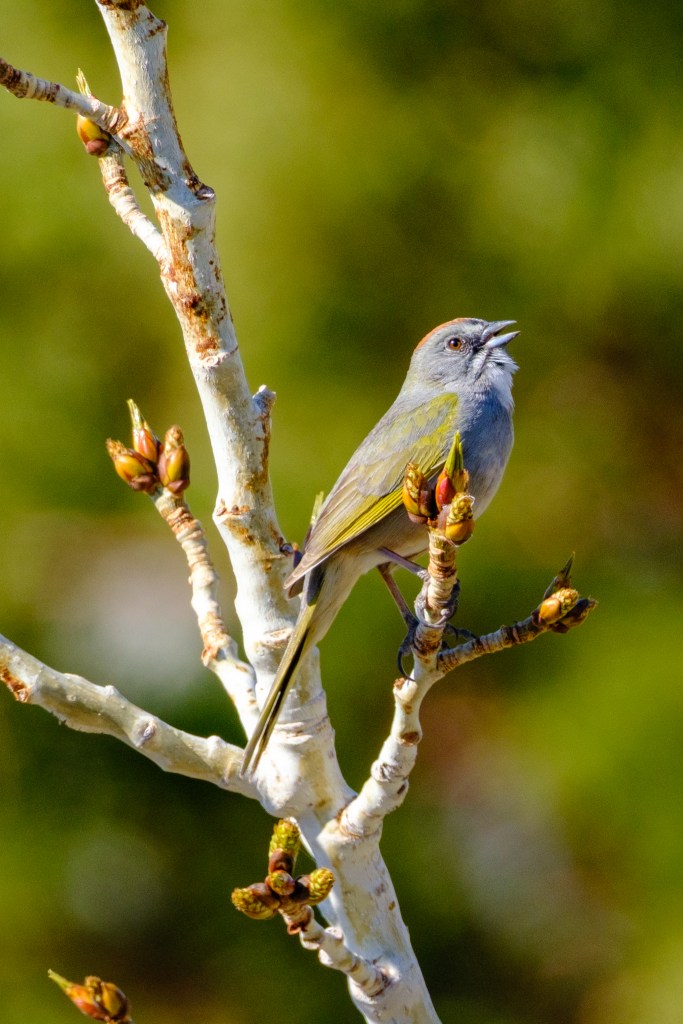
These birds live above Bishop. You can find them in the eastside canyons of the Sierra, such as Lee Vining Creek, McGee, and Convict. On a walk around Convict Lake, I shot the bird below. While I love the buds on the tree, I think the background of unfocused leaves is a bit distracting.

So I cropped away most of the background, and produced the image below for a greeting card. Now the picture is highlights the bird, the branch, and the buds.

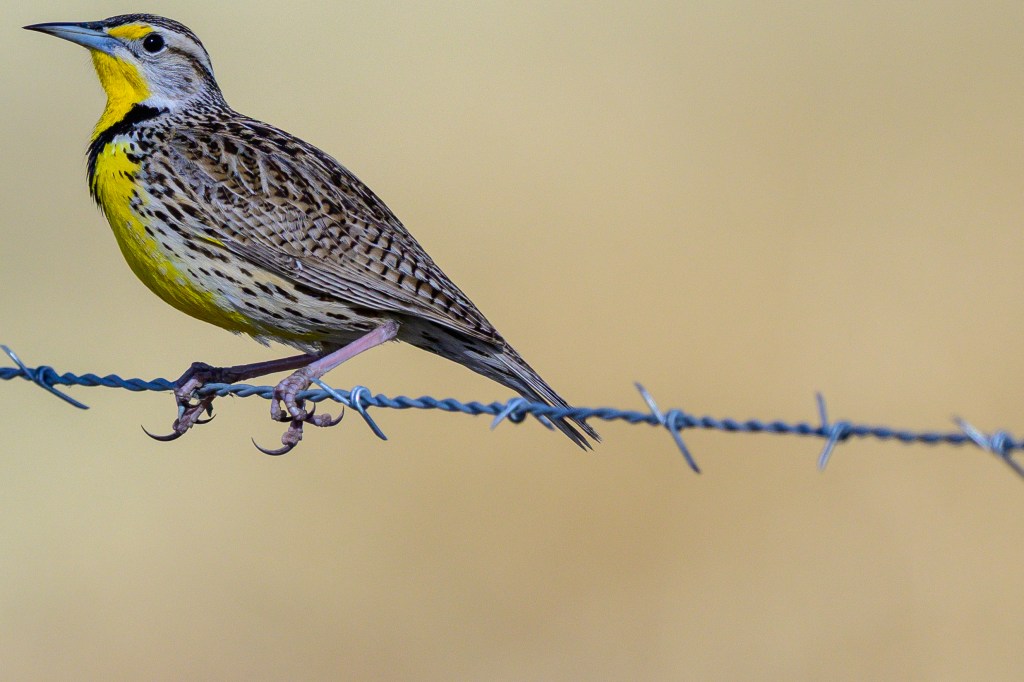
Western Meadowlark

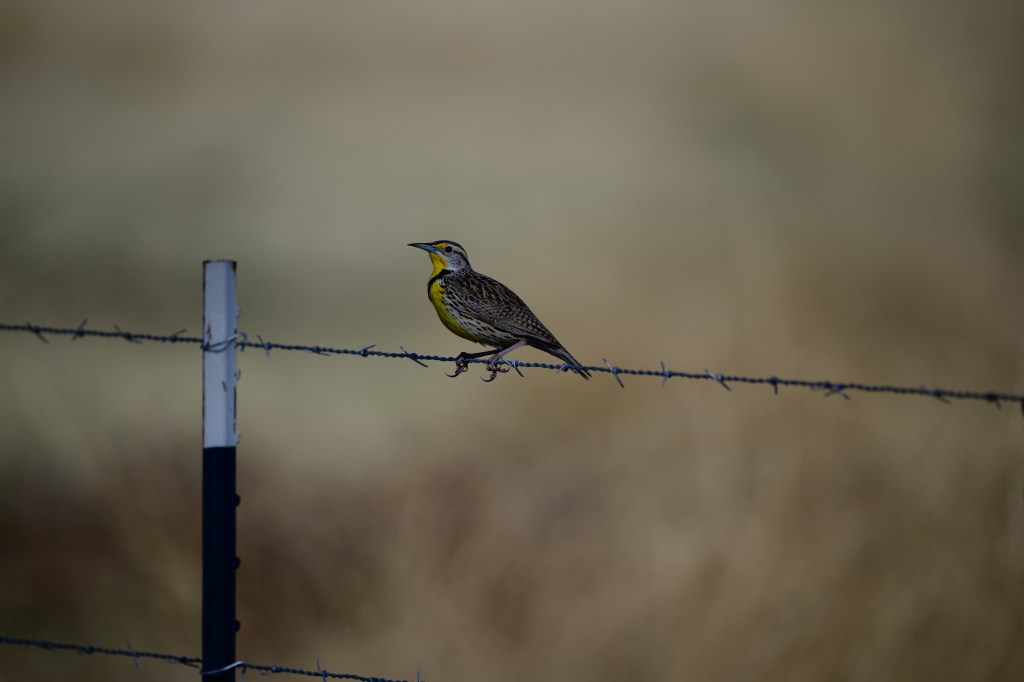
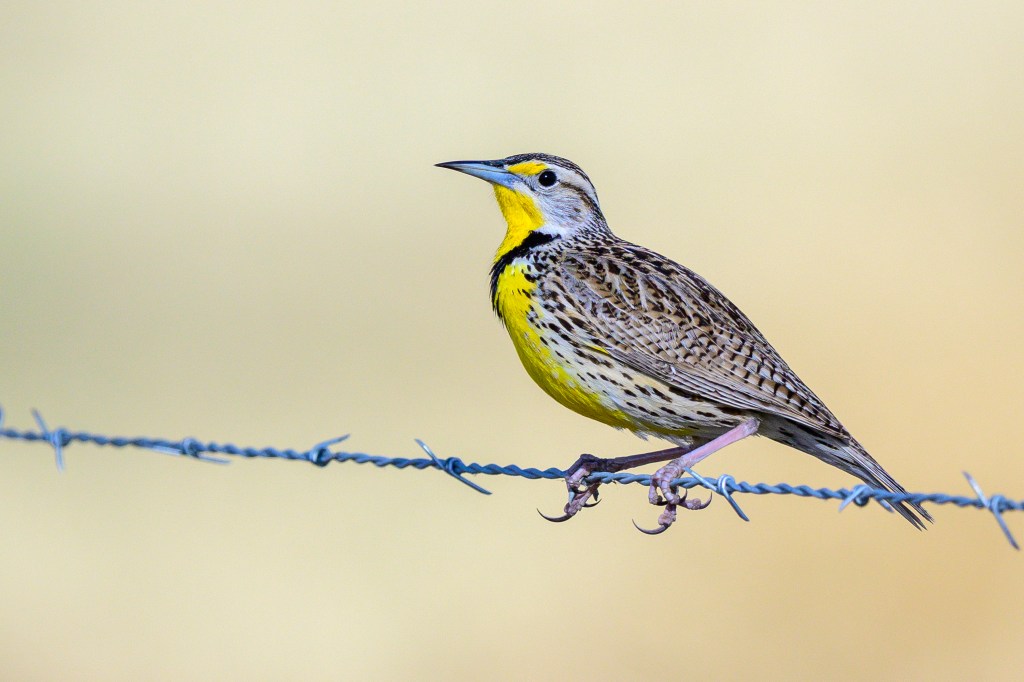
These birds love to belt out a melody. The photo below is underexposed and the bird seems small.

But cropping and some exposure adjustment reveal a lot of detail. I love the way the feet balance on the barbed wire.

Savannah Sparrow

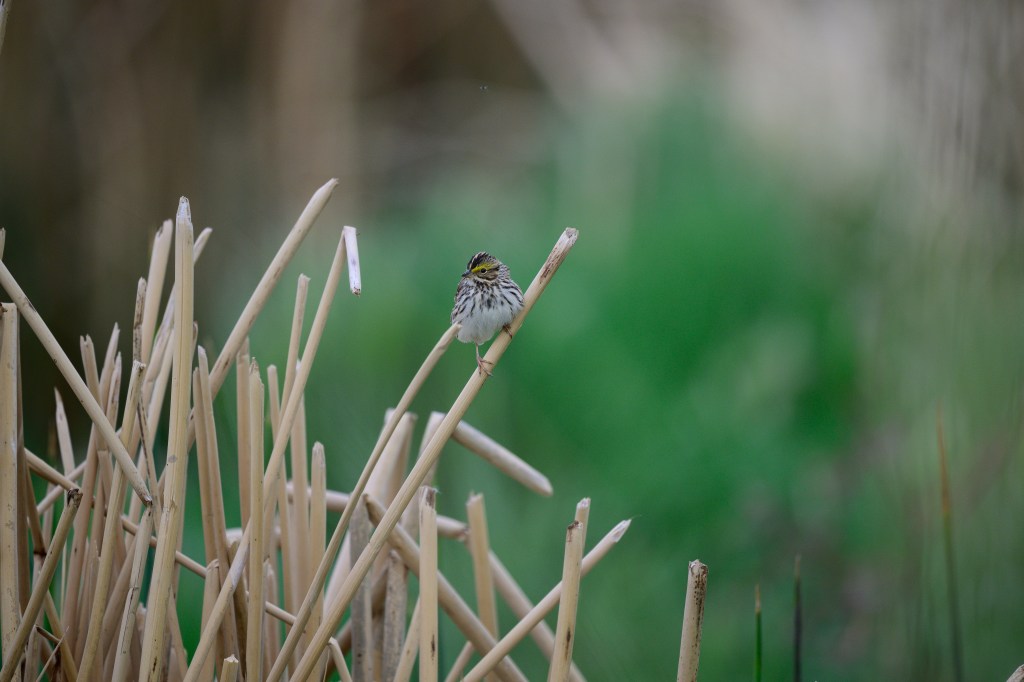
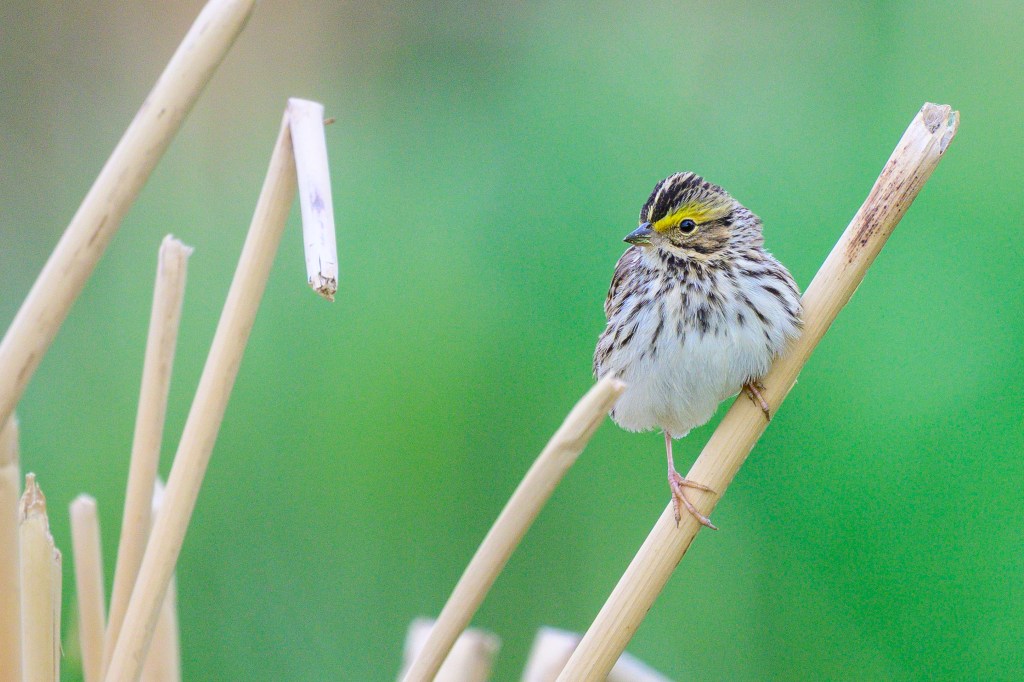
This sparrow posed on dead reeds along South Airport Road. In the unedited photo, below, he is a little underexposed and it is hard to see details. On a greeting card, using the entire image would produce a minuscule bird.

Making the image brighter and cropping brought out bird details for a card.

Northern Harriers

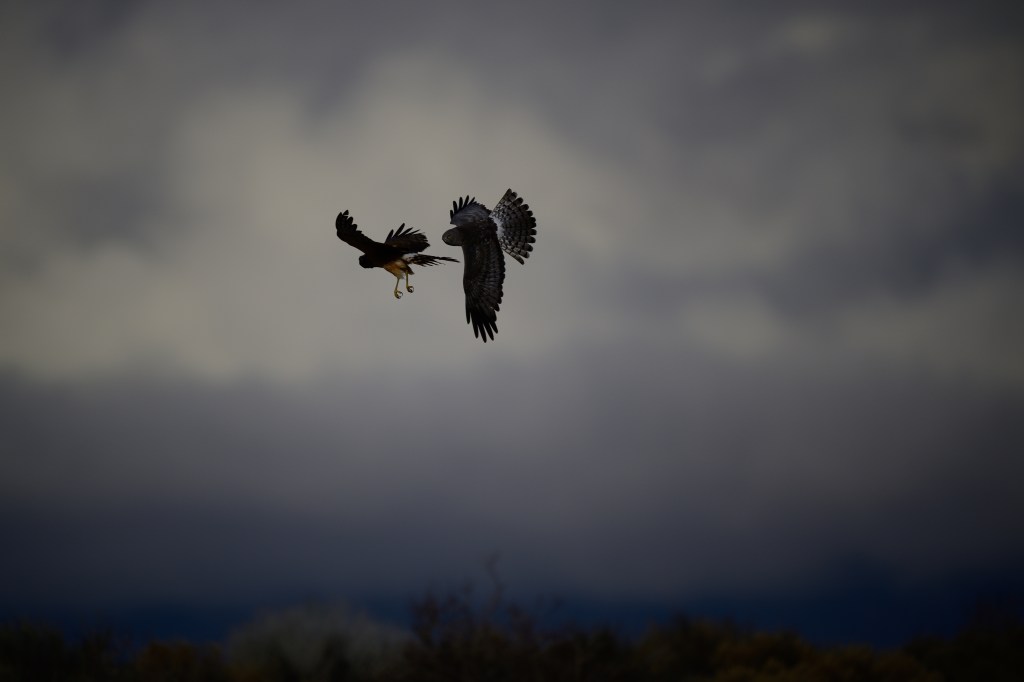
Two Northern Harriers, male and female, were hunting at the Buckley Ponds. They crisscrossed the sagebrush, searching for rodents. From time to time their flight paths intersected. I was tracking the female, getting photos like the one below.

Suddenly the male could be seen in the viewfinder. In the photo below, the brown female is on the left, the gray male on the right. This is the initial image, with no editing. The birds are underexposed because of the bright sky and bright clouds in the background.

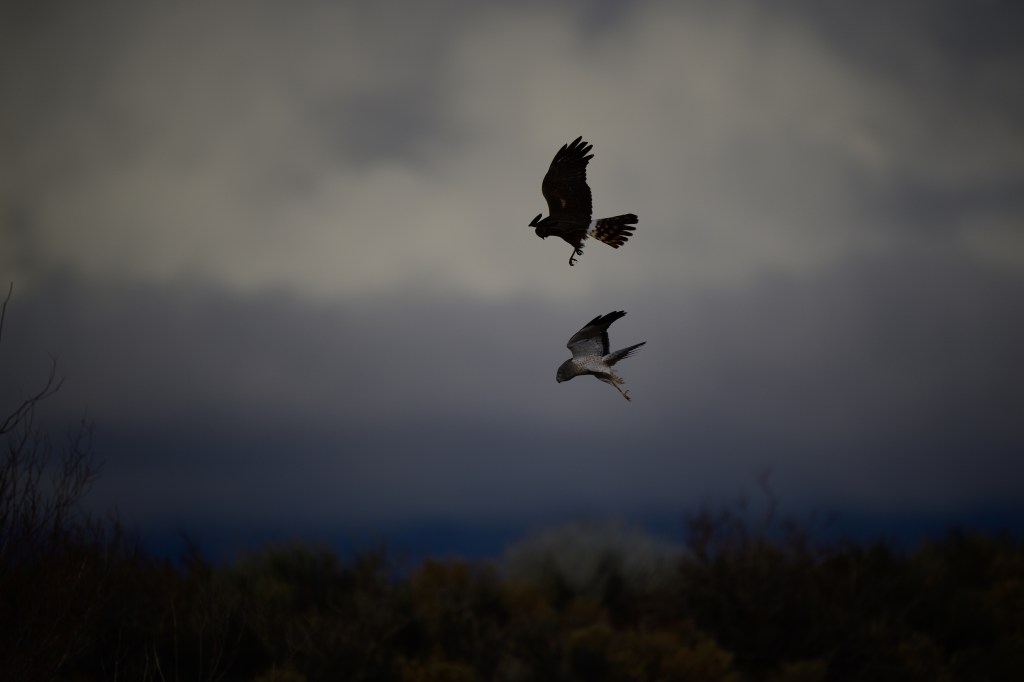
The male came to a stop and fell downward to avoid colliding with his mate. I liked the photo below because both birds are close and positioned so that you can see details of each. But you can see the photo is too dark. The camera underexposed the picture because of the bright background.

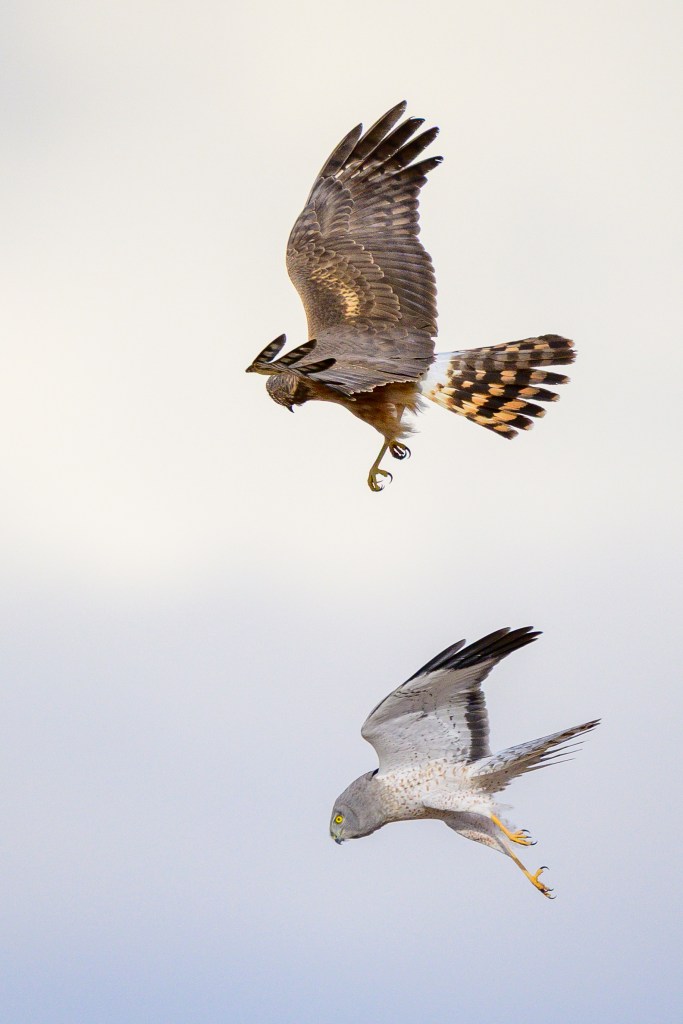
In order to get a better image for a greeting card, I took the following steps:

A. Boosted the overall brightness

B. Toned down the white areas in the birds and clouds

C. Added a little sharpening

D. Trimmed away (cropped) most of the picture, just leaving the birds.

You can see the final result below. The gray-white male is falling to the ground. These acrobatics are child’s play for a Harrier. He recovered easily in the air and jetted away. A real show-boat.

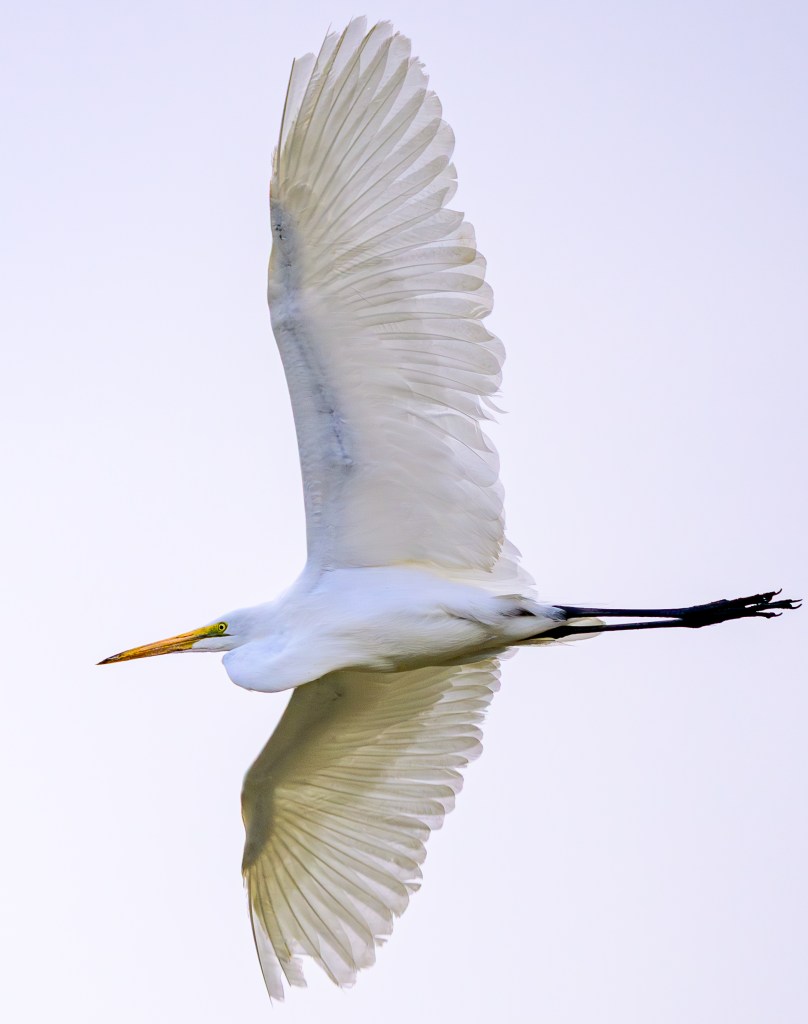
Great Egret

A Great Egret flew by on South Airport Road in May, 2025. A white ghost. By now you know the drill. Initial image, below, is too dark and bird too small.

I cropped tightly, leaving just enough space to avoid cutting part of the bird. I usually prefer to leave more room around a bird. And, if possible, show the bird in some kind of context, as I did with the Green-tailed Towhee, shown above. But here I decided to showcase the bird against a featureless white sky. For me, the most interesting features are the wing bones, which can be partly seen though the translucent feathers.

My Approach To Cropping

Now you have seen what cropping can do. Plus adjustments to exposure, shadows, etc. One of the advantages of digital photography is that an amateur with a computer can make all sorts of adjustments and repairs to a digital image. When I photograph a bird, I don’t worry much about composition. I feel I have only a few seconds to capture the image. I put the bird right in the center of the viewfinder and try to get an image that is sharply focused and properly exposed. Some degree of underexposure (too dark) is fine, as this can be easily corrected using software. An overexposed image, however, may be hopeless, as bright areas may have so many fully exposed pixels that no detail can be recovered. Because of this approach, I usually end up cropping to improve the composition of the photo after it is taken. So with a bird, I shoot first, crop later.

When I photograph landscapes, I have a different approach. I often use a tripod and a zoom lens. This allows me to carefully position the scene as I want, making decisions about what to leave in and what to leave out before I push the shutter release. In addition, I may take several images, with different compositions and framing choices. After all, the landscape is not going anywhere soon. Later, I may have little need for cropping.

Poor cropping choices may produce an image that is unappealing. For example, the cropped Mockingbird image below looks weird. Why is the bird’s head stuffed into one corner?

In many of my cropped images, shown above, the bird is off to one side and faces toward the middle of the photo. That is a common choice for a bird photo. But I don’t always make that choice. For example, the Towhee and the Great Egret, shown earlier, face the edge of the picture. In January of 2025 I photographed a juvenile Bald Eagle as it took off from a limb. I cropped the picture to have much more width than height. I feel the Eagle looks as if it is trying to escape from the picture. And I liked the way the tree branches and the Eagle all bend toward the left. I printed this image and it hangs in a frame above Roberta’s desk.

Can Cropping Fail?

If the bird’s image is small relative to the total image, cropping to enlarge the bird a great deal may produce a poor picture. There may not be enough pixels to support a detailed image of the bird, so the result looks grainy and blurred. That is why photographers use big telephoto lenses; to magnify the bird sufficiently before the light reaches the camera’s sensor.

Ethics

Can cropping be unethical? Sure, if you are not honest about what you did. For example, I could take a photo of a Snow Leopard in a zoo. And then crop out anything that might be recognized as part of a zoo, such as bars or a feeding bowl. Then it might look as if I photographed the Leopard in the mountains of Asia. That would be a lie. The ethical failure, however, would not be due to cropping; it would be due to lying. As long as I reveal that the picture was taken in a zoo, I think the cropped photo is ethical. 

I could be equally dishonest if I photographed the Snow Leopard using a telephoto lens that allowed me to omit any zoo objects from the picture, without any use of cropping. The dishonesty is not inherent in the photo; it arises if I claim the photo shows something which it does not.

Consider the previous picture of a Swainson’s Hawk being scolded by a Mockingbird. I could transfer that image to Adobe Photoshop and then remove most of the space between the two birds. If I then claimed that the Kingbird came within 6 inches of the Hawk, that would be a lie. I could be honest and reveal that I altered the photo to create a false impression of closeness; but why would anyone want to see a photo altered in this way?

Photographers can always make choices about how an image is created, either before or after taking a picture. Edward Steichen (1879-1973) was a pioneer of photography. In 1903 he took a portrait of J.P. Morgan, the banker. That photo is the most famous image of Morgan, reproduced in hundreds of books and articles. Morgan is staring right at the camera and he looks angry. His black suit merges with the dark background. His left hand grips the metal arm of a chair; but at first glance, it looks as if Morgan is holding a knife. The photo is famous for its drama. It makes Morgan look powerful and dangerous. This is achieved by leaving much of the image in darkness, underexposed or underdeveloped. Use Google to search for

edward steichen photo of JP Morgan

Then scroll down until you see the Wikipedia reference to this. (Some of the other websites crop away part of the chair arm.)

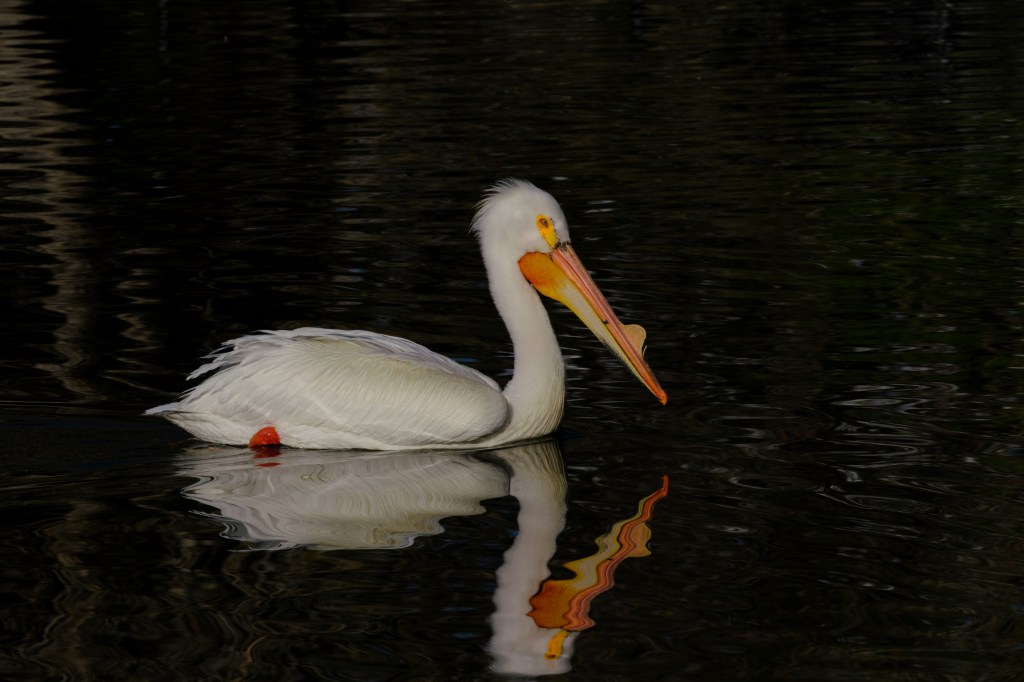
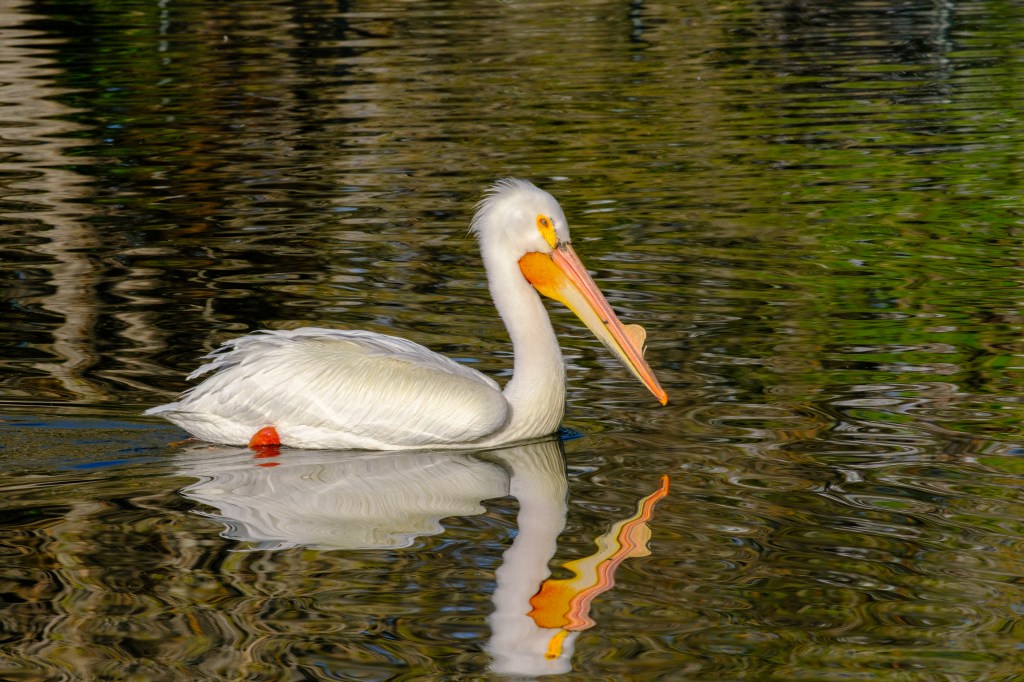
Consider a photo of an American White Pelican at Bishop City Park. Here the issue is not cropping, but exposure. The initial image from the camera shows a lot of feather detail and the reflected bill. Our attention is on the bird because the water looks almost black.

The next picture shows what happens when I hit Lightroom’s “Auto” button to change the exposure. The water is now brighter with a lot of detail, which draws attention away from the bird. This second image looks more like what I saw at 8am in April, when the Park was well lit. Which image is “best?” For what purpose?

Final Comments

Professional photographers and enthusiasts typically catalog and process their digital pictures using software on a home computer. Software choices include Capture One, Topaz, Affinity, Luminar, Snapseed, and more. The dominant applications are Adobe Photoshop and Adobe Lightroom. Photoshop was released in 1990; it is so well-known that the name became a verb, as in “she photoshopped that picture.” It is still popular among photographers and graphic artists. Lightroom appeared in 2017 and is more specifically aimed at photographers.

While the ability to process your own pictures is a gift, it requires a time commitment. On most mornings, Roberta and I go for a one-hour walk. I spend 5 minutes of that walk photographing birds. After a typical walk, I will have about 400  images. When I get home, I import the pictures into Lightroom Classic on my computer.  Next I examine each photo. If an image is blurry, or boring, or otherwise useless, I delete it. If I have six images of a sparrow that look similar, I remove five. I do this quickly; in half an hour, just 100 images remain. Now I go back through the pictures, making adjustments. I may increase the overall brightness, darken areas that are too bright, bring out details in shadowed areas, and use commands that sharpen the picture. I almost always crop each image; I trim away unwanted parts and decide where to place the bird in the photo. I keep removing images that are substandard or repetitive. I whittle the results to 40 pictures. Then I electronically label the photos so that I can find them later; a typical label might say “bird, Bishop, Buckley Ponds, Great Blue Heron”. Finally, I rename the photos to something that indicates the location and time they were taken; “Ponds2025Feb.” I use a storage system based on location, such as Buckley Ponds or Mono Lake. In all, a one hour walk will usually mean one hour at my desk.

An Astronomical Endnote

Professional astronomers were early adopters of digital photography. They bought or built electronic light sensors that cost a small fortune. The expense could be justified because it increased the usefulness of big telescopes that were already, um, astronomical in price. 

The world’s biggest camera started taking photographs in 2025 at the Vera C. Rubin Observatory in Chile. The camera weighs over 3 tons and has 3,200 megapixels. Earlier I mentioned that the camera I use for birds has a round lens barrel, the rectangular sensor of my camera ignores about 31% of the light that is collected by the lens. But astronomers do not want to waste a third of the photons that are collected by Rubin’s 8.4 meter primary mirror. Instead, the camera captures a nearly circular image using a grid of 189 square CCD sensors. Despite costing 168 million bucks, you cannot use this camera to photograph a bird. It won’t even take a selfie.

Mount Humphreys

            The Owens Valley is about 100 miles long and 10 miles wide. This long trench is oriented north to south. Bishop lies roughly in the center. The Sierra Nevada forms the west wall of this ditch, the Inyo and White Mountains form the east side. The Sierra Nevada has 12 summits higher than 14,000 feet. These high summits are 15 to 60 miles south of Bishop. From Bishop we can see only one summit higher than 14,000 feet: White Mountain Peak (14,252) in the White Mountains, to the northeast. West of Bishop is Mount Humphreys (13,992 ft), the highest Sierra Nevada summit below 14,000 feet in elevation.

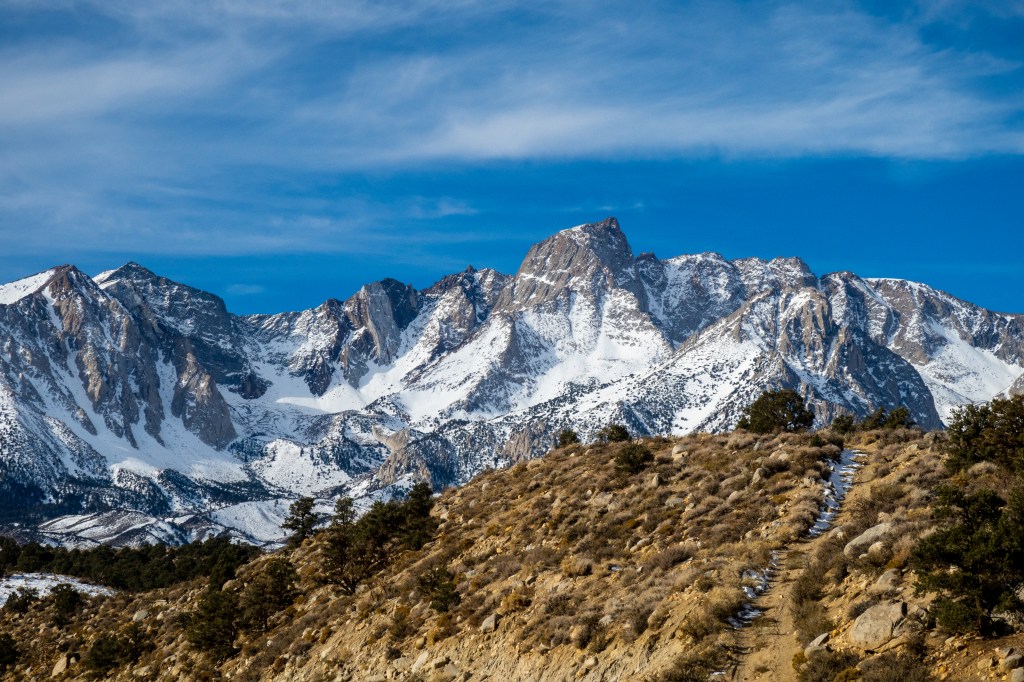
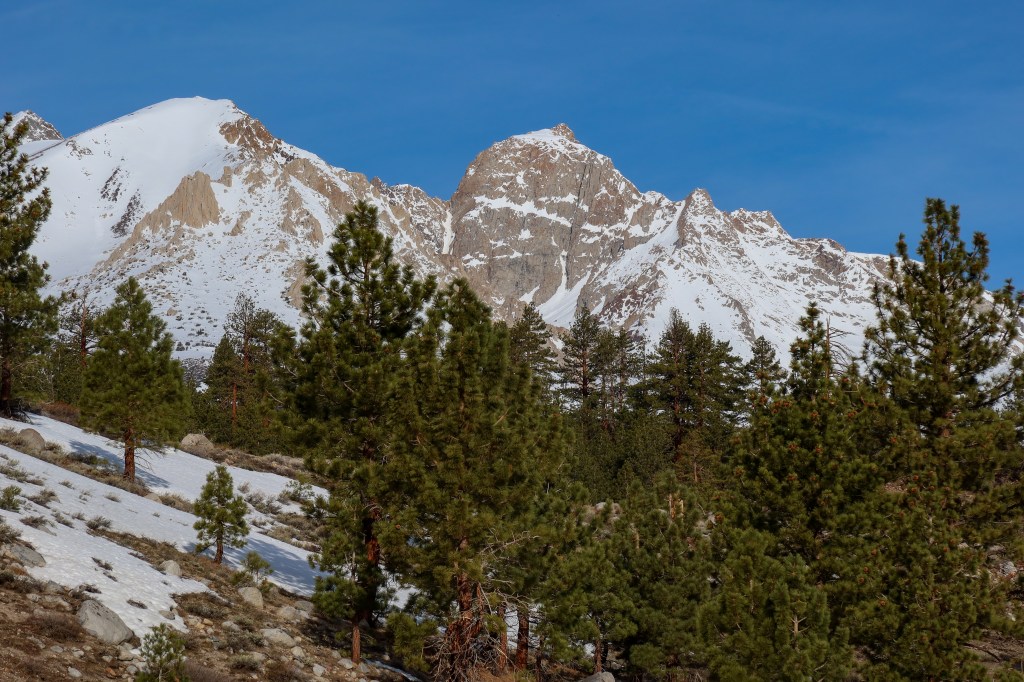
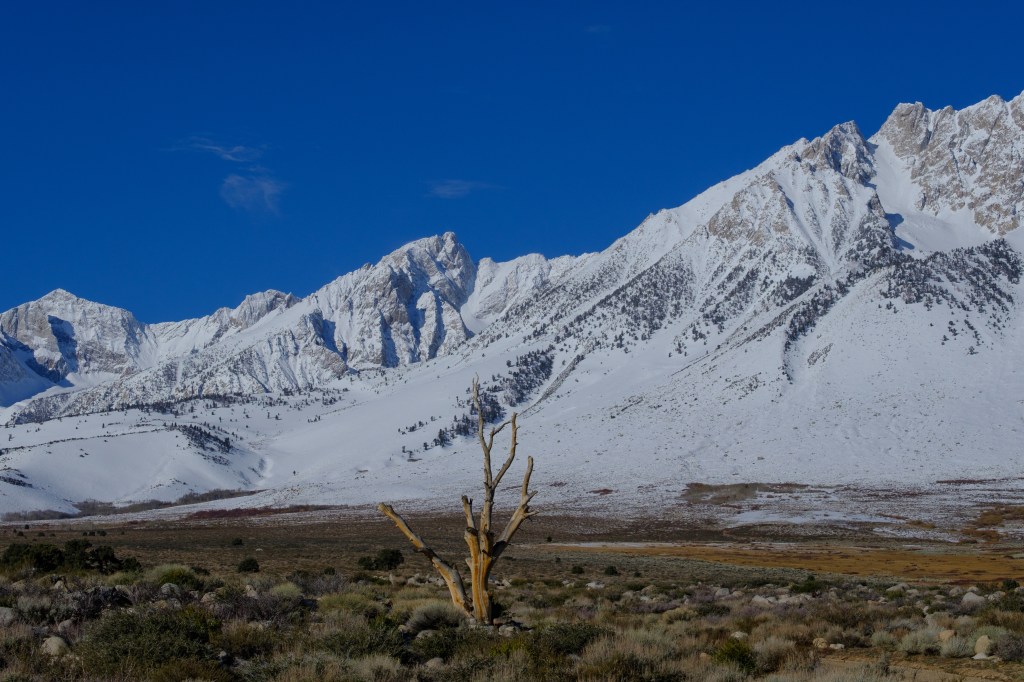
            I photographed mountains long before I started bird photography. On my bird walks, I continue to collect mountain images. One of the fun things about our walks is that the mountain scenery is always there, even if no birds appear. For this blog, I decided to focus (a pun!) on Mount Humphreys. I selected pictures that show how the appearance of this mountain is changed by snow, clouds, light conditions, and my vantage point. Photo locations range from 5 to 20 miles east of Humphreys’s summit.

Mountain Panorama from Bishop

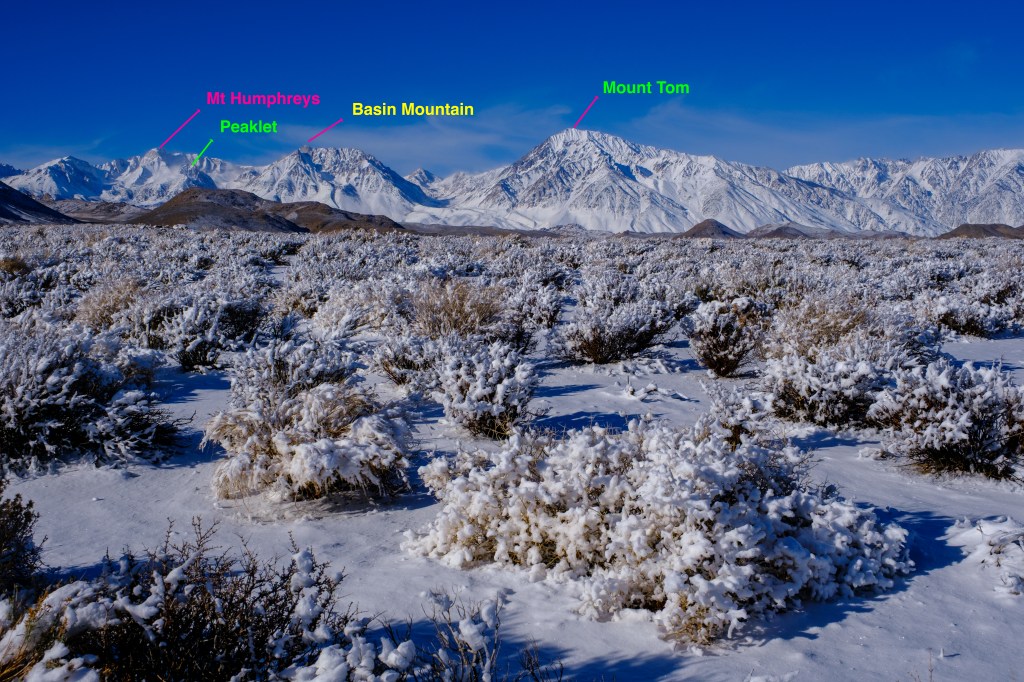
            In the photo below, December snow covers sagebrush near Bishop. Mount Humphreys is in the left side of the picture. Basin Mountain (13,187 feet) and Mount Tom (13,658 feet) are lower summits, but they seem taller than Humphreys because they are closer to Bishop. I also labeled “Peaklet” (12,160 feet), a lesser summit that appears in many of my photos because it lies in front of Humphreys. Bishop’s elevation is 4000 feet, so the top of Humphreys is nearly two miles above us.

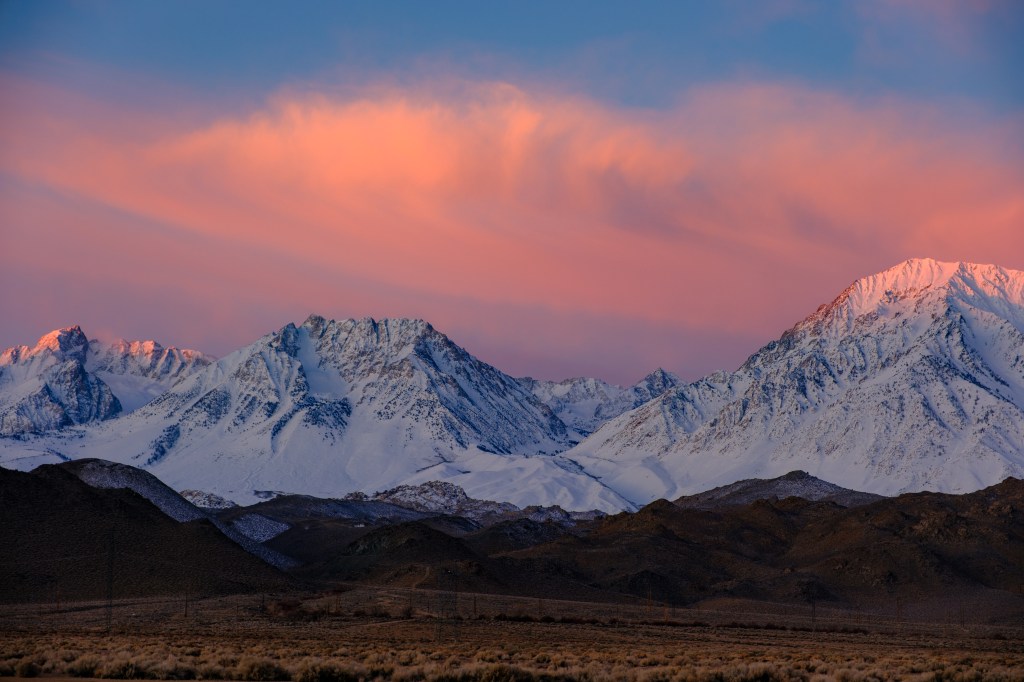
In January, dawn light (7am) touches the top of Humphreys on the left and Mount Tom on the right. Basin Mountain, left of center, is still in shadow because it is lower.

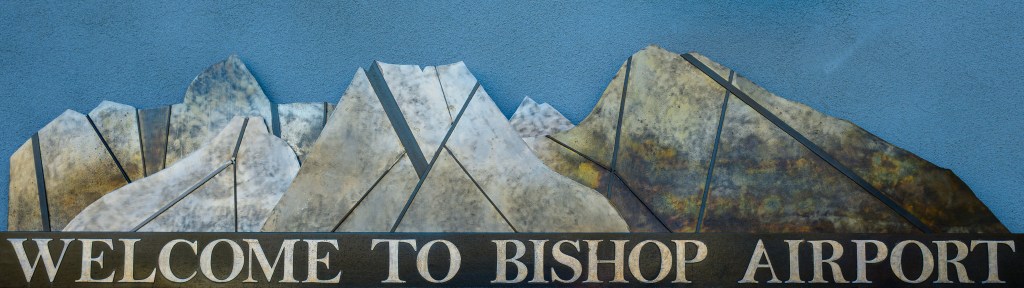
Welder Jon Vandehoven created a metal sculpture for the Bishop Airport, showing the three summits on the Bishop horizon. Even “Peaklet” appears in his design. His rendition seems a bit abstract at first, but he captures many details that you can see in my pictures.

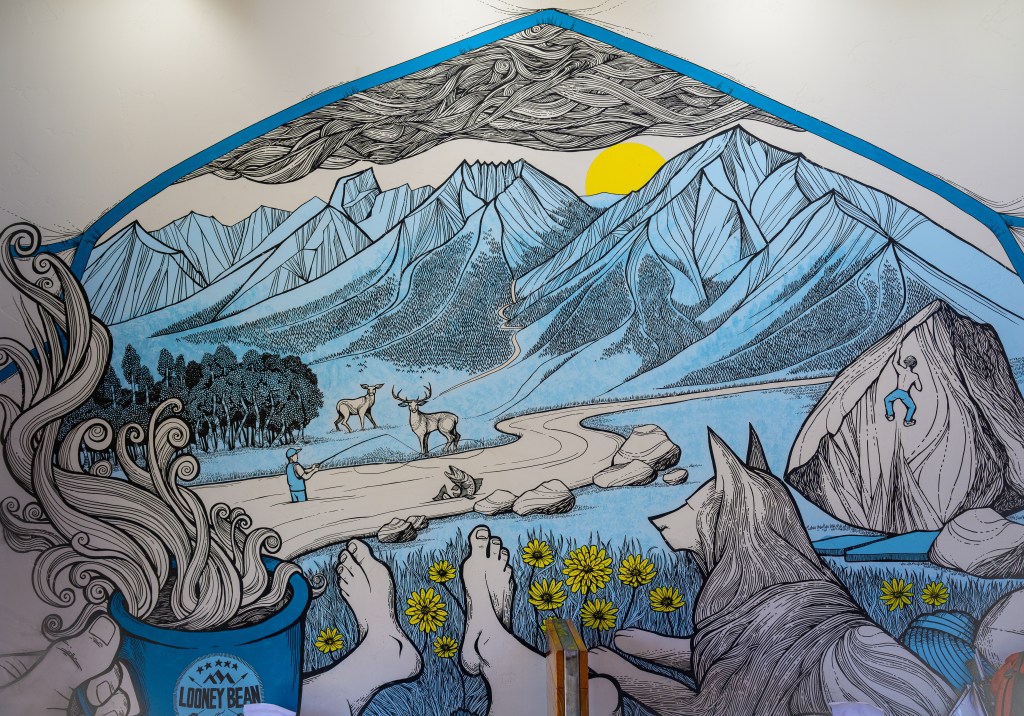
Artist David Titus imagined how these peaks look from the door of a tent; this fun painting covers a wall in Looney Bean of Bishop, a local coffee house.

Several years ago, the Bishop Chamber of Commerce had a contest for a short description of our town. The winning slogan was “Small Town with a Big Backyard.” Good choice.

            Mount Humphreys was named for Andrew A. Humphreys, a Union General during the Civil War. He later became chief engineer of the United States Army. His many achievements in war and engineering are described in a Wikipedia article: https://en.wikipedia.org/wiki/Andrew_A._Humphreys. Three summits bear his name; the peak above Bishop, the highest mountain in Arizona, and a third in Yellowstone. He had no personal connection with any of these mountains. His name is entangled with the politics of military base titles. During World War I the Army established Camp A. A. Andrews in Virginia. Later, Congressman Howard A. Smith of Virginia, a pro-segregation Democrat, resented having a military base in his district named for a Union officer; he had the name changed to Fort Belvoir in 1935, honoring the large Belvoir slave planation that existed earlier on the same land.

            Mount Humphreys was first climbed in 1904 by James and Edward Hutchinson, two brothers from San Francisco. This was a difficult and notable climb for that era.

I will group subsequent pictures according to the location from which they were taken and the approximate distance from Humphreys’s summit. I will give a date for each photo, but omit the year.

The Pipelines, 5 miles

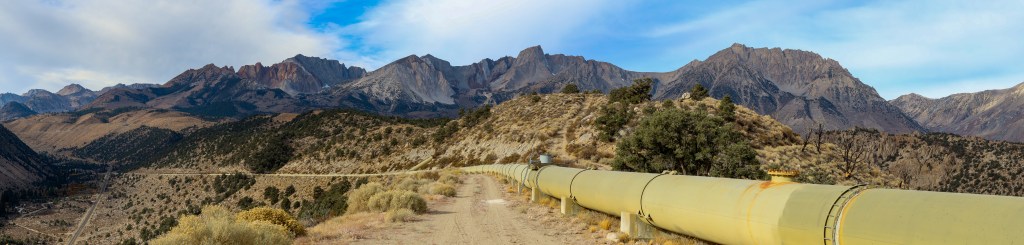
            Water that drains from Mount Humphreys will eventually reach Los Angeles via the LA Aqueduct. Aside, of course, for a dribble that sustains Bishop. Los Angeles Department of Water and Power doesn’t care how that water gets to the valley; their intakes collect from all the streams. But Southern California Edison does care; they built large pipelines to move water from the slopes of Mount Humphreys into Bishop Creek, where it flows through power stations to create the juice that lights our town. The first set of photos was taken from roads near those pipelines. The shot below is from early November. Humphreys is just right of center. The pipeline is about six feet high.

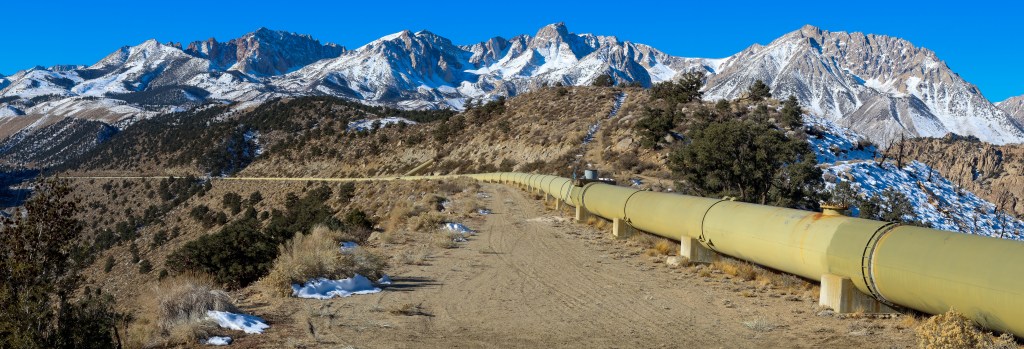
The second picture shows the same view in late November, after the first snow.

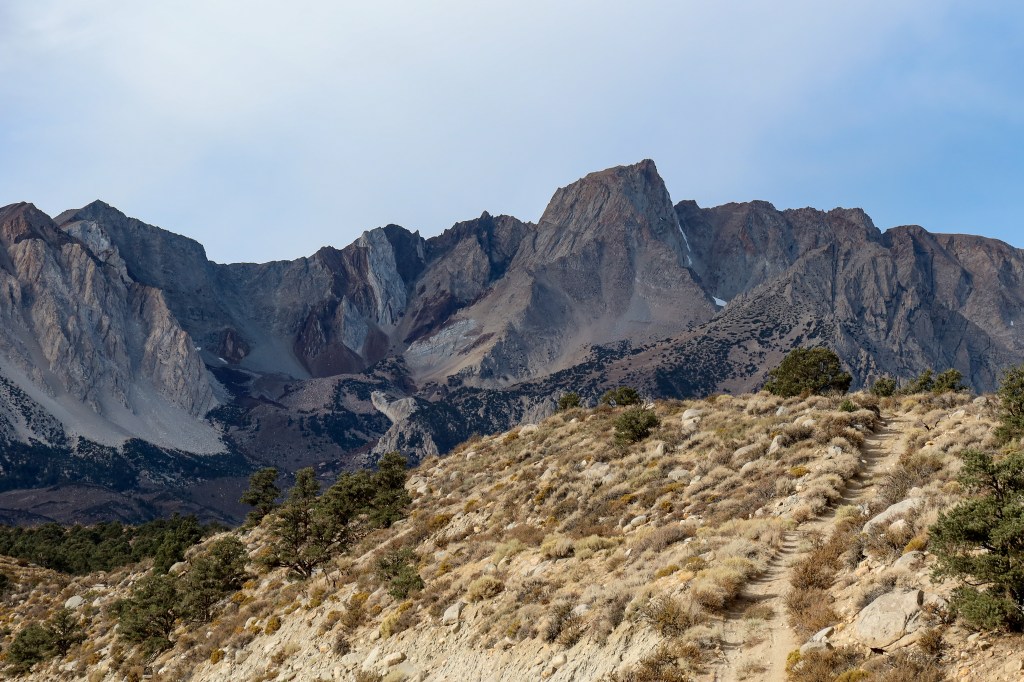
The next photo shows more detail of Humphreys before any snowfall. To the left of Humphreys, a massive tower of gray sedimentary rock reaches the skyline, sandwiched between layers of red rock. In some photos you can see the sedimentary layers have been upended ninety degrees. The Sierra is mostly granite, but throughout the range are slabs of layered rock that have been twisted by colossal forces.

Below is the same view, with snow.

The next photo was taken further north from a higher spot. The red towers of the Piute Crags are on the left. Gray Mount Emerson is above them. In the center is Mount Locke. Humphreys is further right. From this vantage, Peaklet, on the far right, reaches the skyline.

The April view below is centered on the gray sedimentary tower.

The last photo in this group was taken further south. Mount Humphreys is right of center and looks quite different from this angle.

Buttermilk Road, 5 miles

The sagebrush flat in the foreground is at 7500 feet on the Buttermilk Road. A view in April. Humphreys near the center, Basin Mountain on the far right. Peak on the far left is Checkered Demon.

Ed Powers Road, 12 miles

In winter, Roberta and I visited nearby Ed Powers Road to photograph the sunrise on Humphreys. I used a tripod for shots in low light. The first photo (7:03 am, January 3) shows, from left to right, Mount Emerson, Mount Locke, Checkered Demon, Humphreys and Basin.

At 7:08, there is more light on Humphreys. Peaklet is now in the light.

The 3rd image was at 7:13 am.

We returned on January 12. The first photo shows Peaklet at 6:53 am.

The sky turns pink at 7 am.

At 7:05 the light has almost reached Peaklet.

(Full disclosure: For years I thought Ed Powers was an early Bishop settler. I finally realized that the name refers to Southern California Edison, which operates the power plants near Bishop. So I am not always the sharpest tool in the shed.)

Riata Road, 13 miles

At 7:10 am in November, Humphreys was in clouds. The details on Peaklet were especially clear.

Barlow Lane, 15 miles

Two March photos at 8:52 am.

Conservation Open Space Area (COSA), 16 miles

The COSA is right downtown. In March I took shots of Humphreys and Peaklet.

Bishop Creek Canal, 18 miles

In June, dramatic clouds cast a shadow on Humphreys’s summit.

In September one year, wildfire smoke created a strange sky color in the next two photos. 

Morning clouds cast a shadow, but Peaklet remained in the spotlight below.

In November, cottonwoods were still yellow

December light below.

Fresh snow and clouds on Dec 31, 9:17 am.

May 30, at 6:05 am, created yellow-golden light.

On June 30, at 5:37 am, the light was red. Foreground still in shadow.

Dixon Lane, 18 miles

Both photos below were taken in late April. The clouds and vantage point make Humphreys and Peaklet look mysterious and draw our attention to features that we might otherwise overlook.

Airport Road South, 19 miles.

Three more images are affected by clouds. The first photo was taken in June.

The next two photos were from late March.

Buckley Ponds, 20 miles.

The Buckley Ponds are about 20 miles from Humphreys. It is amazing that a modern camera can capture so much detail through 20 miles of air. All these photos were taken without a tripod.

Below are the Ponds in late March at 9 am.

Next are the Ponds in early November. The birds in the water are American Coots; they hang here in winter. Several trees in this photo are now gone, ravaged by fire and beavers.

The next two images were taken using a wide-angle lens. I was just a little north of the Ponds on the Rawson Canal. Humphreys is visible, but the foreground and the sky dominate the pictures.

The next photo was shot in August at 6:37, as clouds built up.

In late September I shot two pictures using my Nikon Z8 full-frame camera. The level of detail is outstanding.

On the day after Christmas, at 8:48 am, a wispy band of cloud hovers above the peak.

Humphreys with Birds

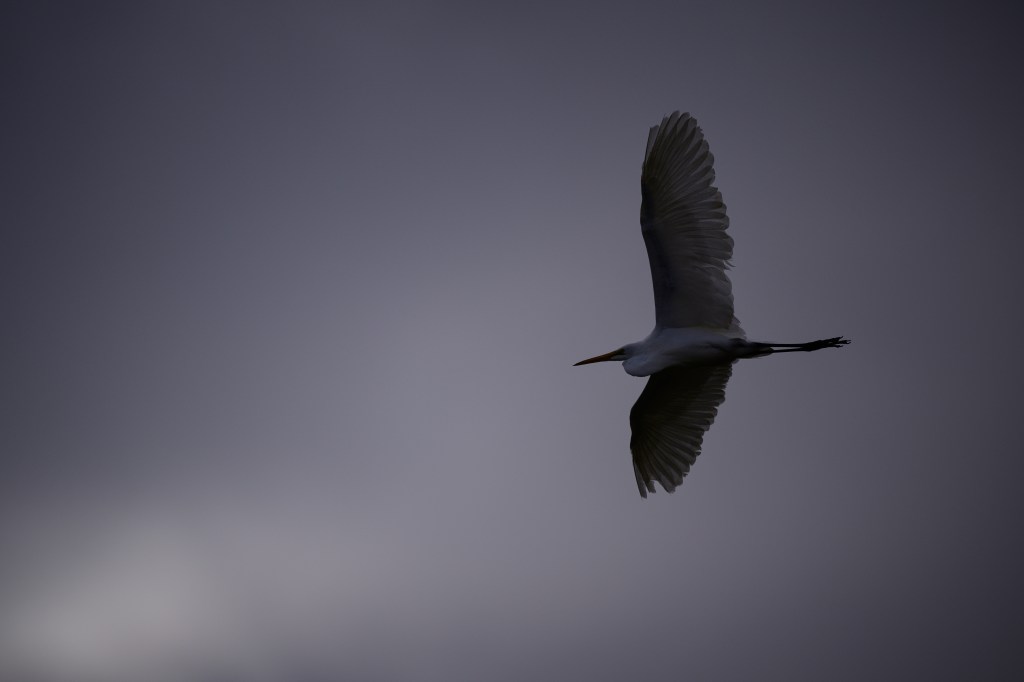
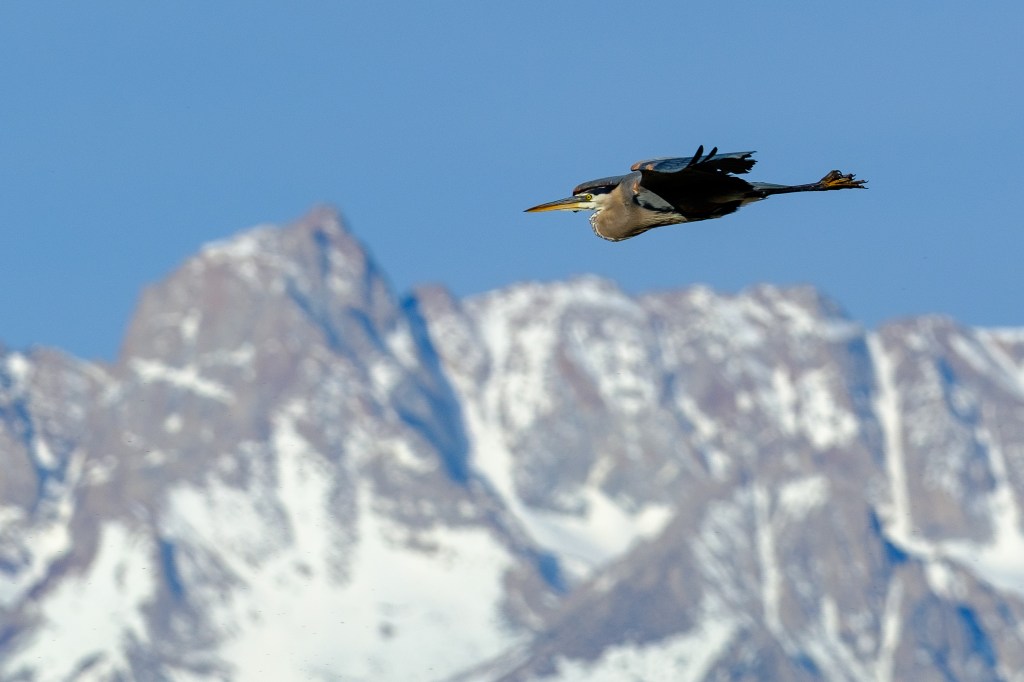
When I track a flying bird, the background sometimes includes distant peaks. In these pictures, the bird is perhaps a 100 yards away, while Humphreys is about 20 miles off. First, a Great Blue Heron flies near the Bishop Creek Canal.

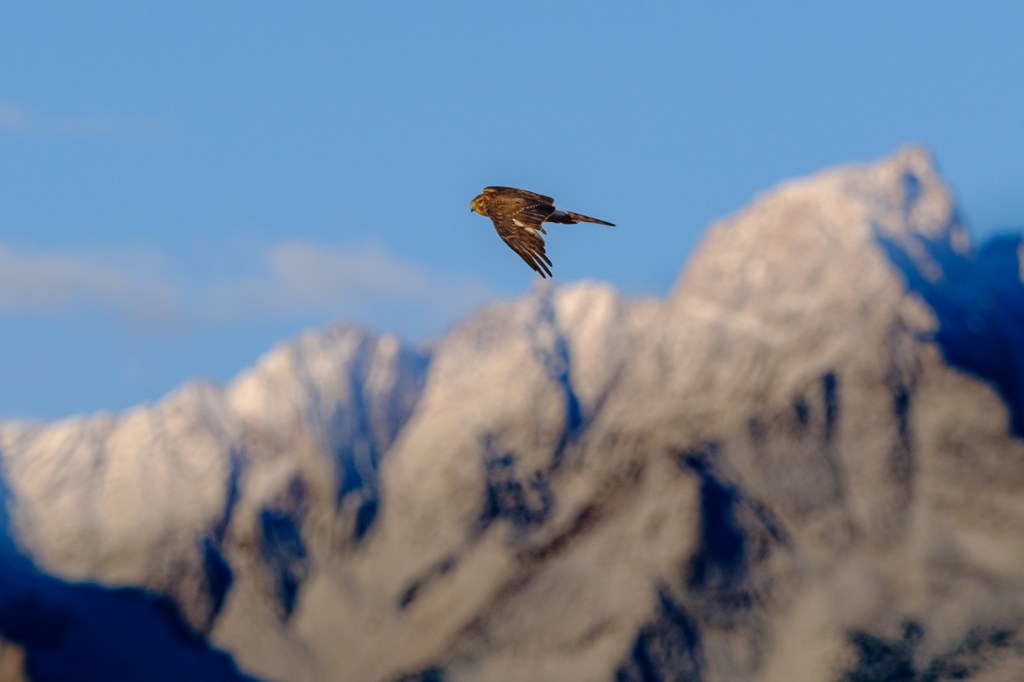
The next shot shows a female Northern Harrier at the Ponds.

And the last shows a Great Blue Heron at the Ponds.

The West Side

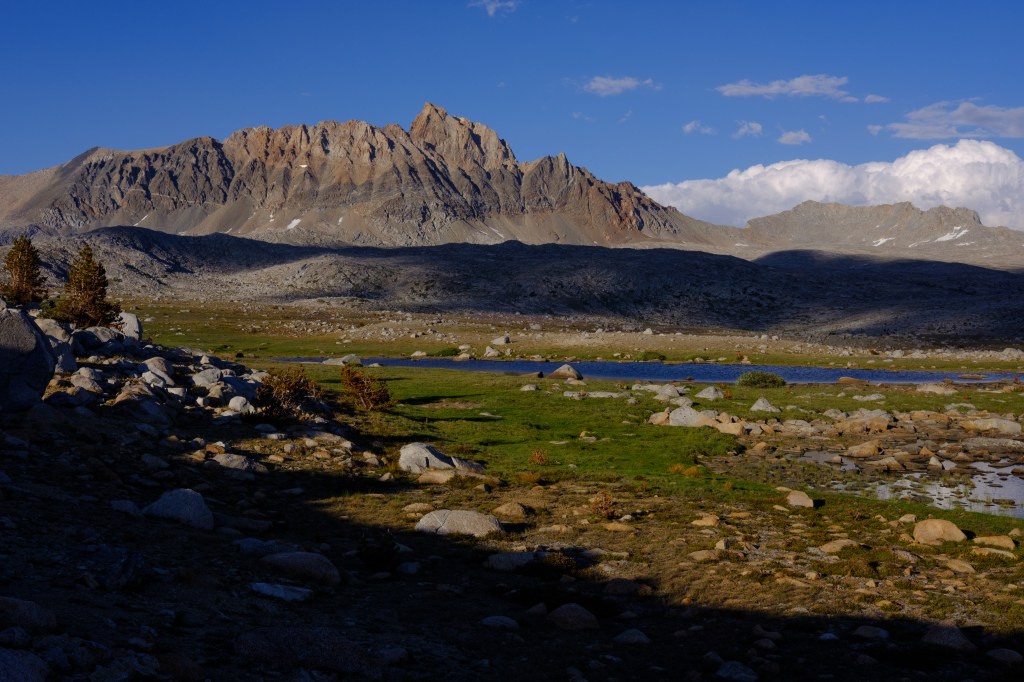
To see the west side of Mount Humphreys, it is easiest to hike over Piute Pass and drop into Humphreys Basin, a tableland of lakes, rocks, and meadows. The first photo shows Humphreys near the center, at 7 pm.

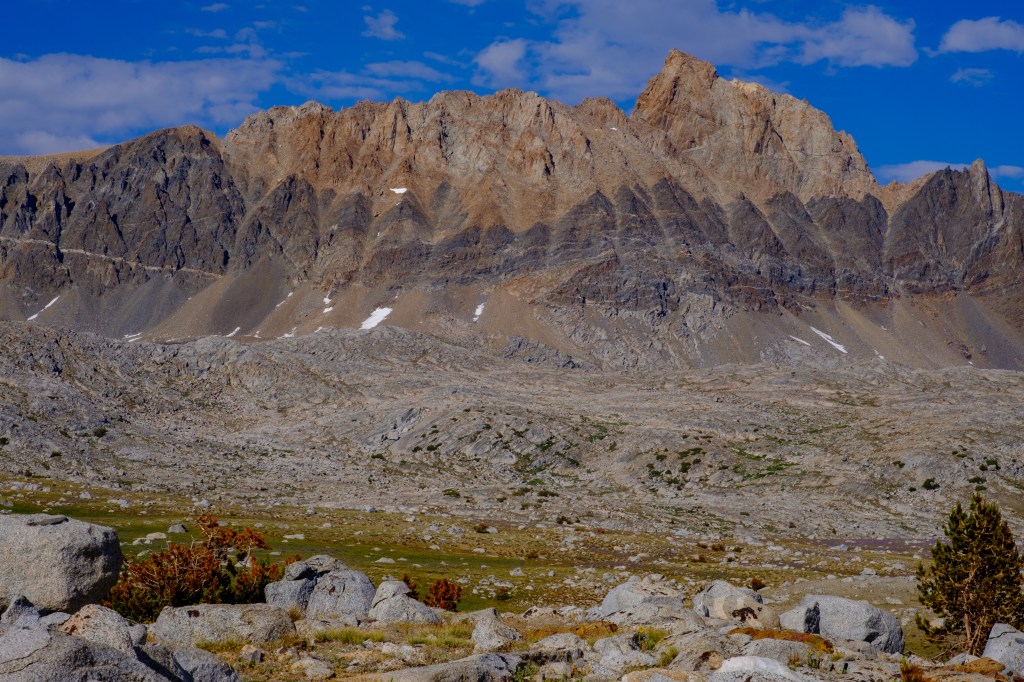
A band of old, dark metamorphic rock, much of it loose, extends horizontally across the middle of the photo below. On the far right, partly hidden by a pine tree, is a purple field of lupine.

I climbed Humphreys in 1988 with my friend David Harden. We climbed the Southeast Buttress and then followed the south ridge to the top. Our ascent route is marked in green. Then we descended the Northwest Face and the Southwest Slope, following the red line. A fun day.

The last photo shows detail of the Northwest Face; this is the usual way up. We descended this face in 1988.

An anecdote: David and I downclimbed Humphreys without using a rope. As you can see in the previous photo, some cliffs near the top are steep. I got stuck part way down and asked David to help me find placements for my feet; he is a much better rock climber than I am. David wisecracked “Cummings, for someone who does so much climbing, you’d think you would be better at it.” I told this to Roberta; she thought David’s quip was harsh. I thought it was pretty funny. And true.

Mt Kenya — Joy and Sorrow

            I first climbed in Africa in 1984; a failed attempt on Mt Kenya (in Kenya) and a successful climb of the Western Breach route on Kilimanjaro (in Tanzania), the highest summit (19,340 ft) in Africa. In July 1990 I returned to Mt. Kenya with my friend, Bart O’Brien. This post uses digitized slides from that trip. The photos of me were, obviously, taken by Bart.

Safari photos

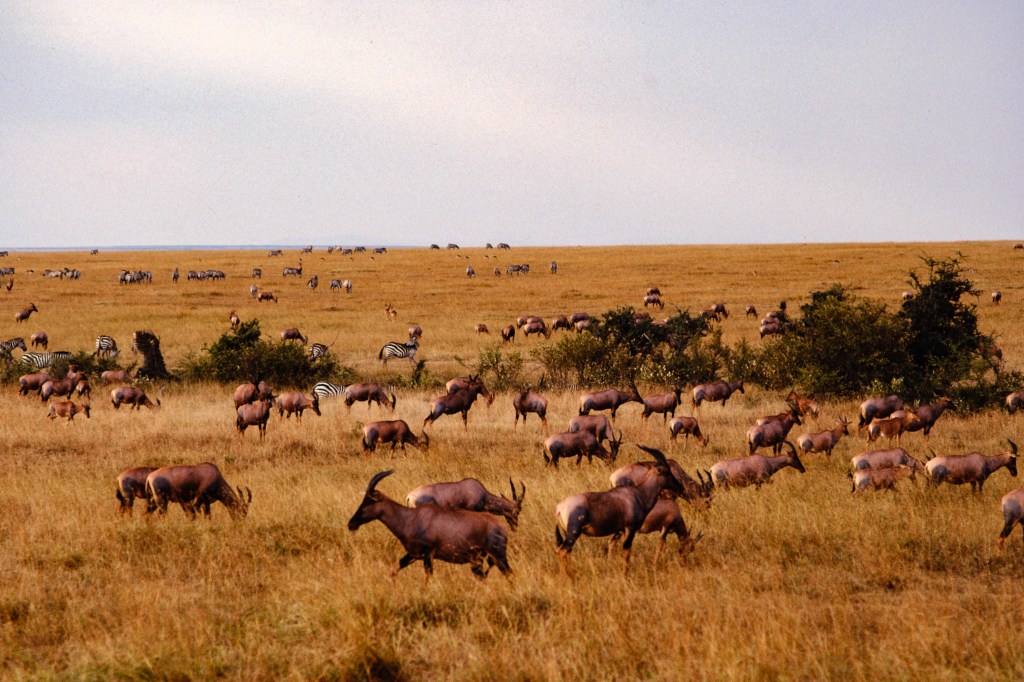
            First we spent a week visiting some of Kenya’s game parks. The photo below shows Zebras and Hartebeests on the Serengeti.

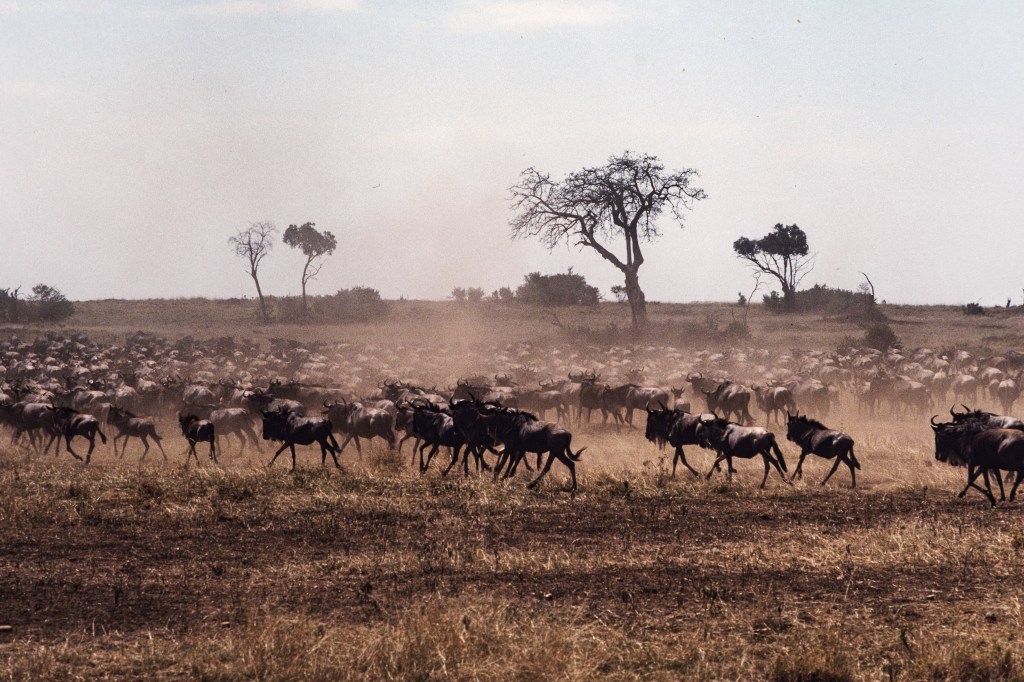
Wildebeests below.

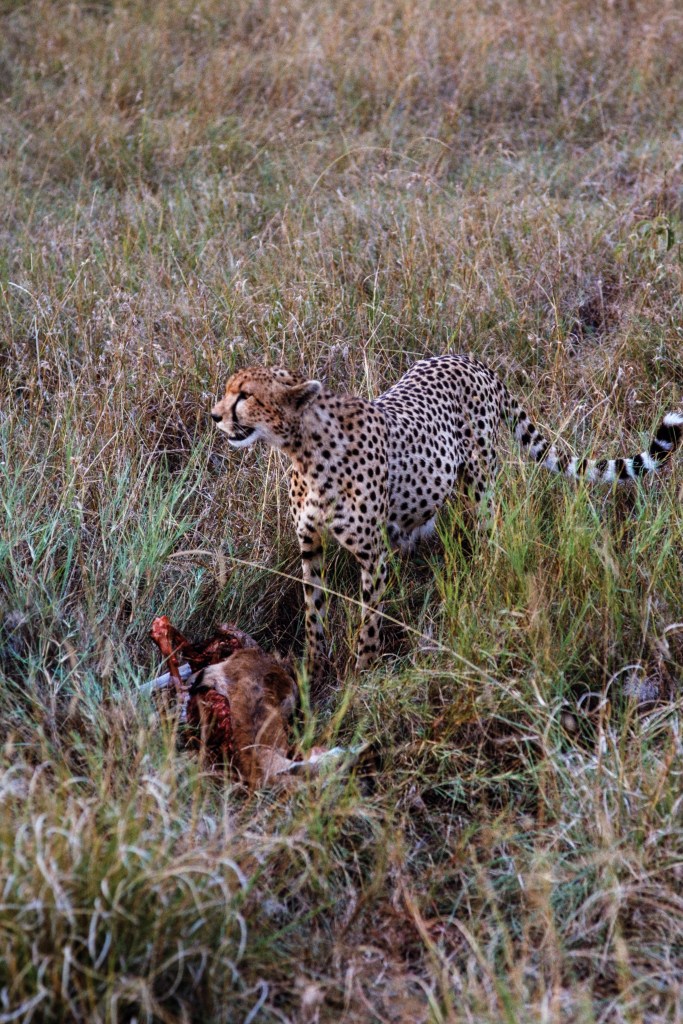
 Cheetah eating a gazelle.

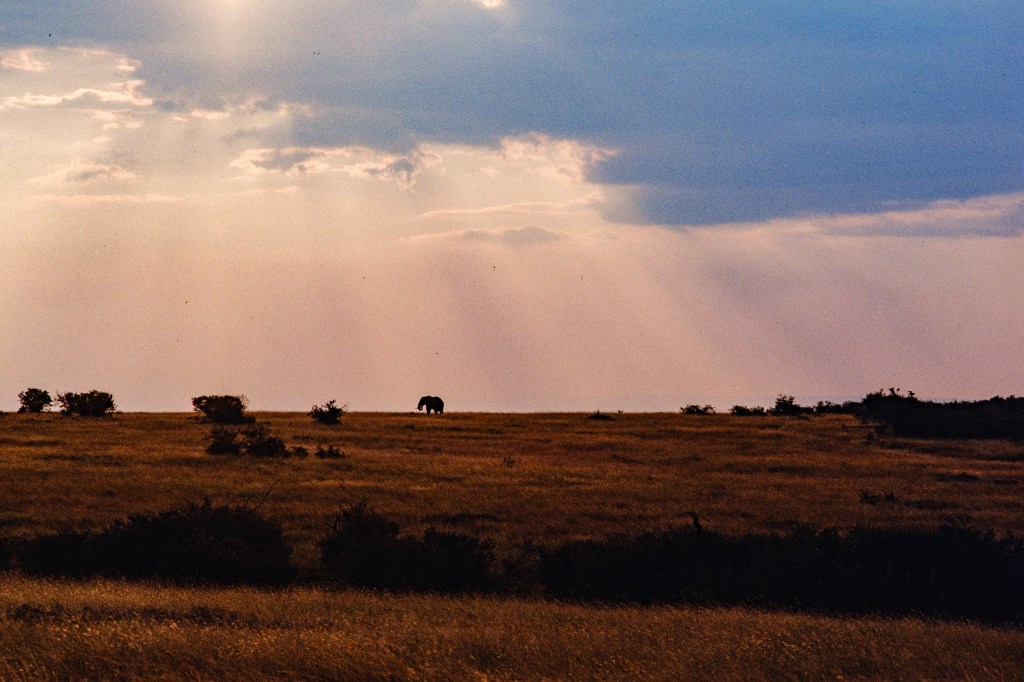
Lone Elephant.

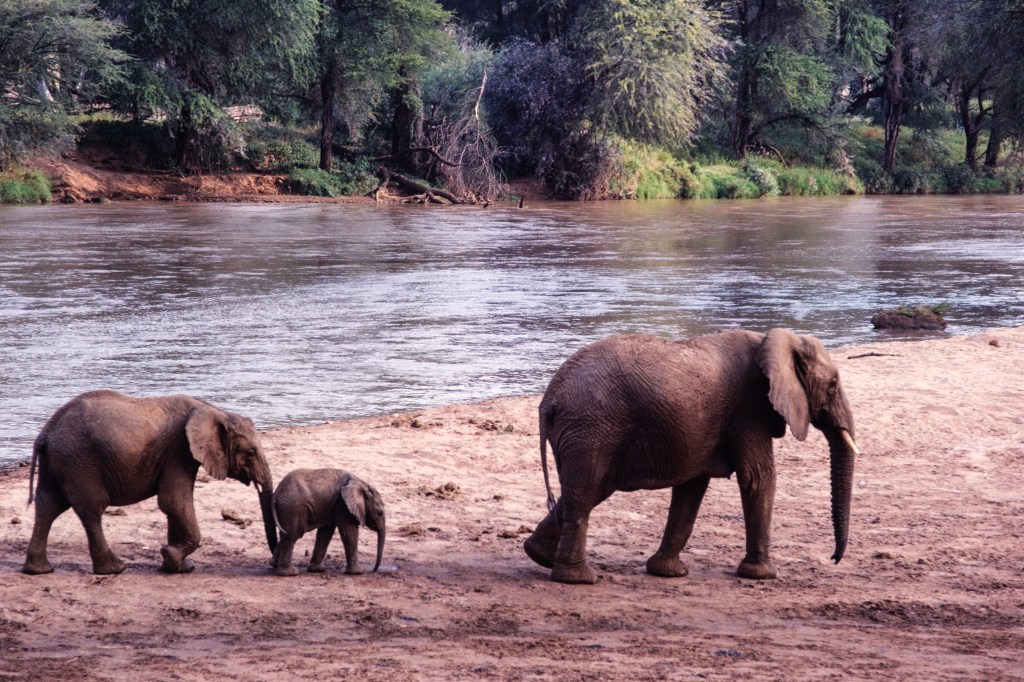
Elephant family.

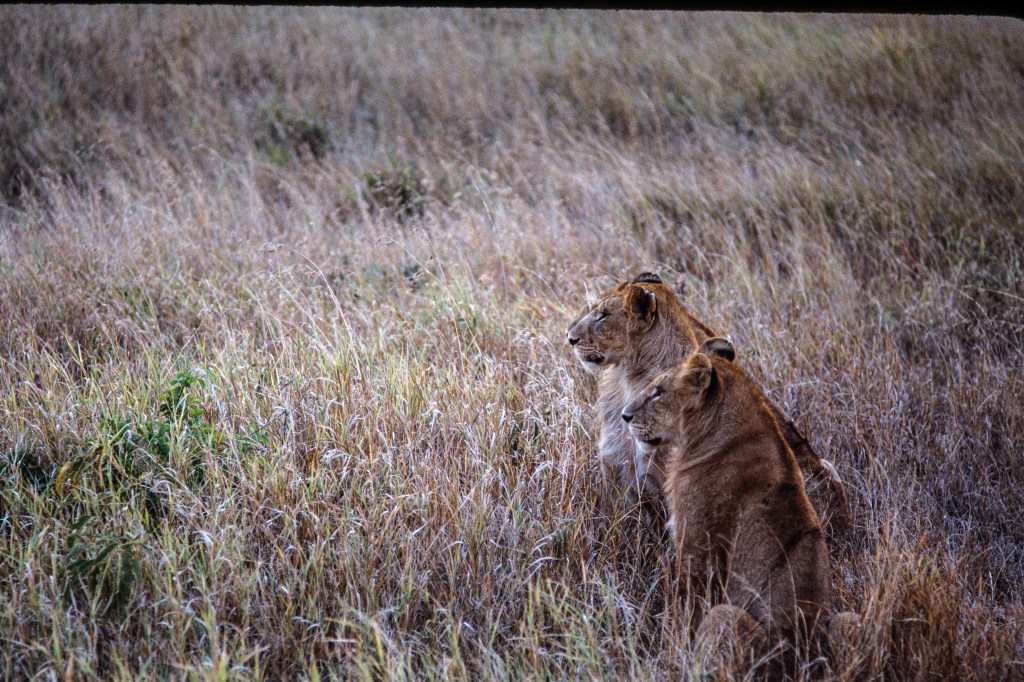
Lion King; not the musical.

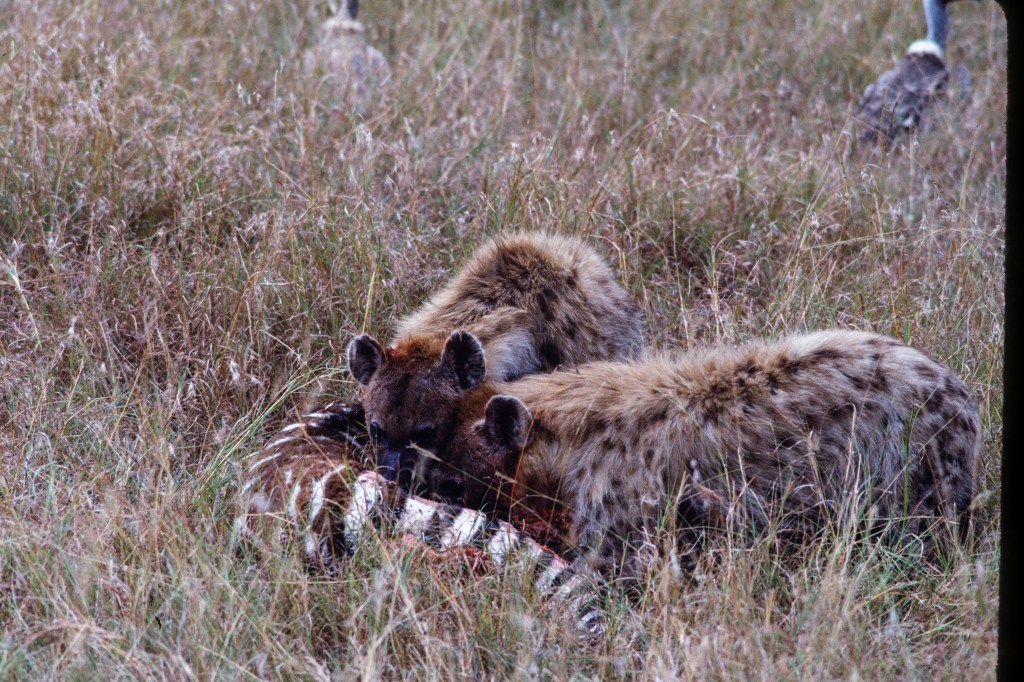
Hyenas eating a Zebra-burger.

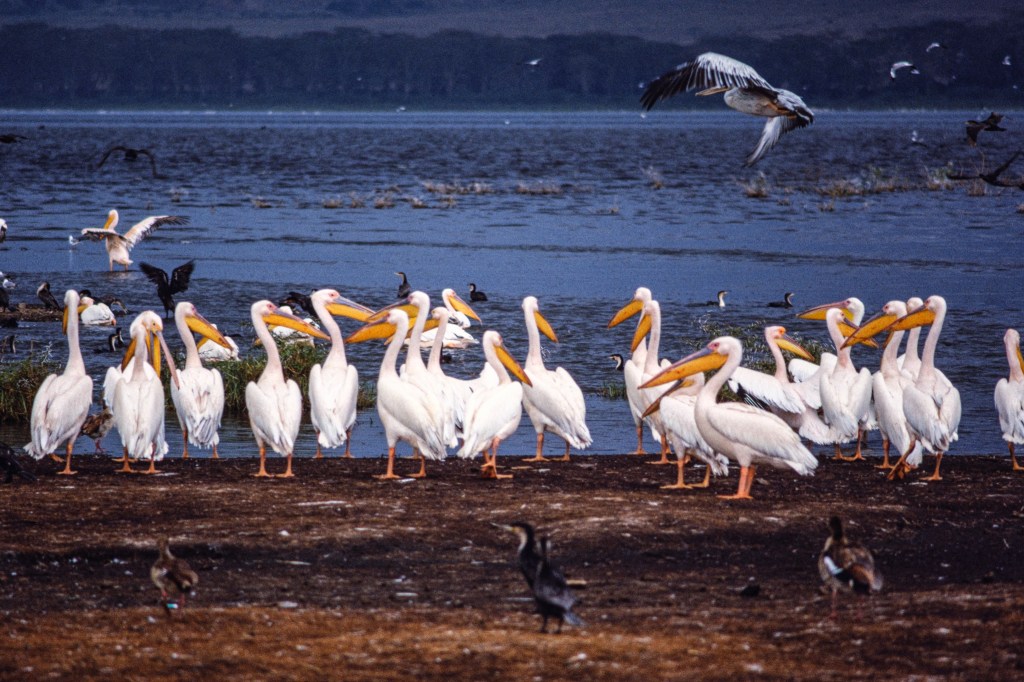
Great White Pelicans.

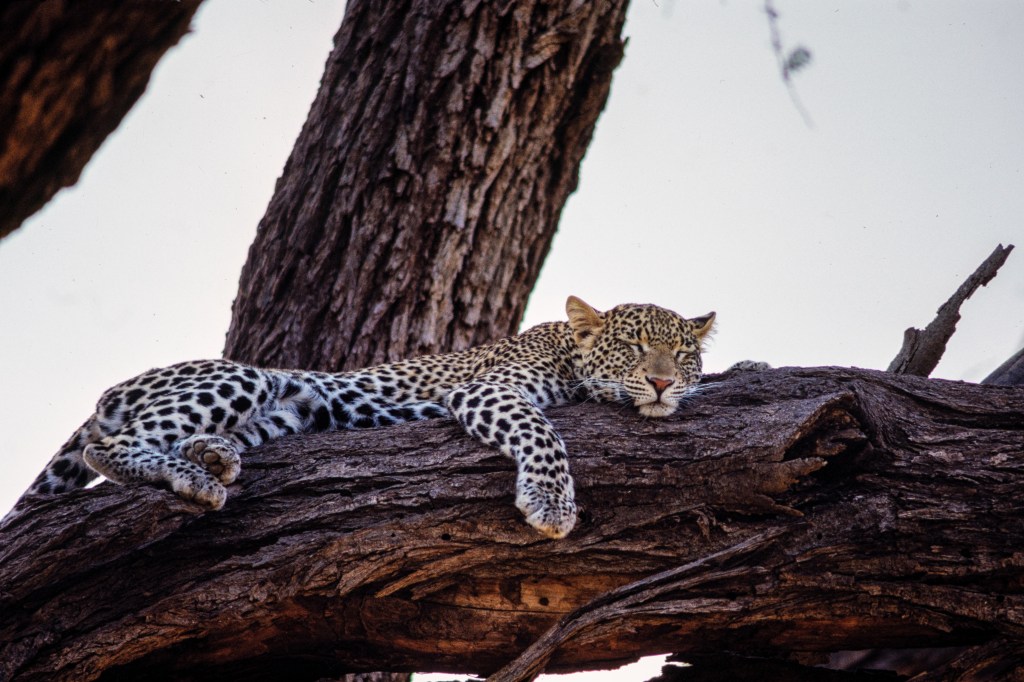
Leopard.

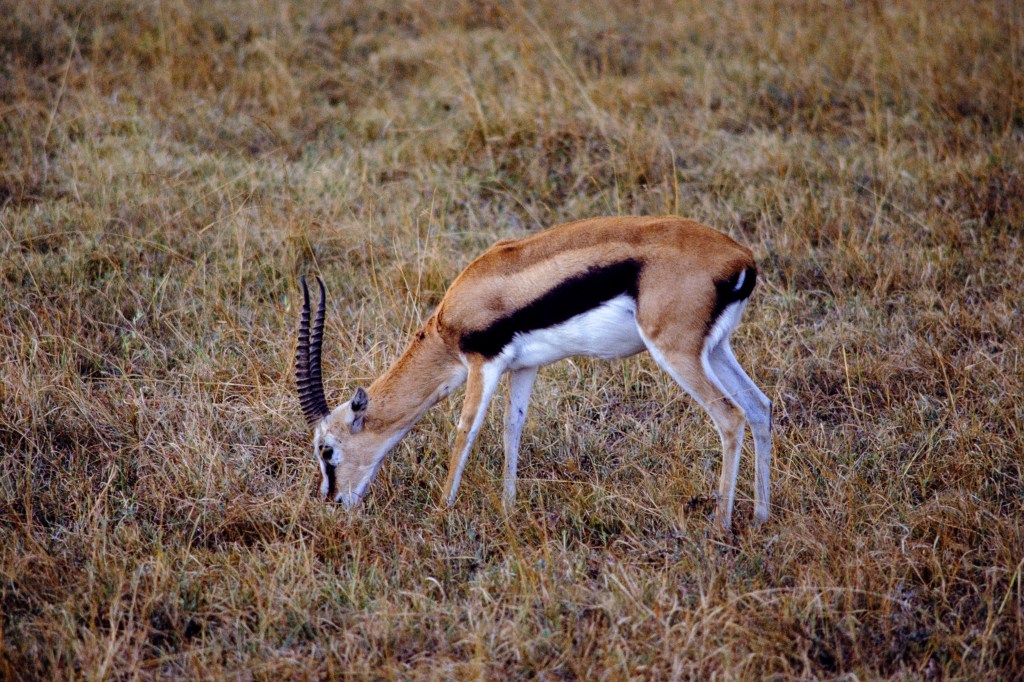
Thompson’s Gazelle.

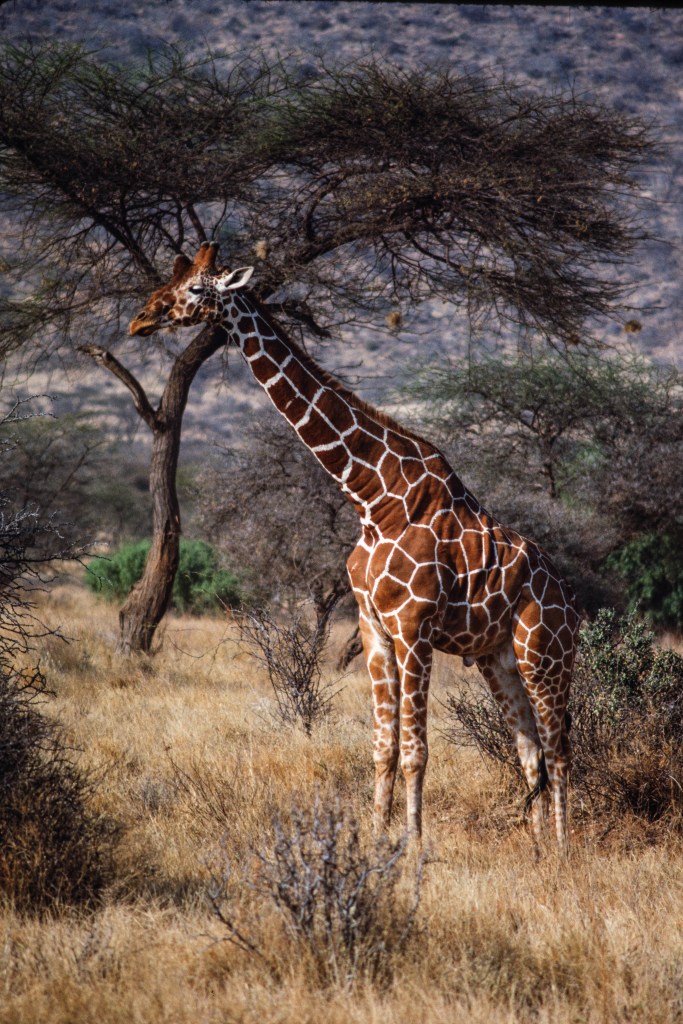
Reticulated Giraffe.

Approach to Mt. Kenya

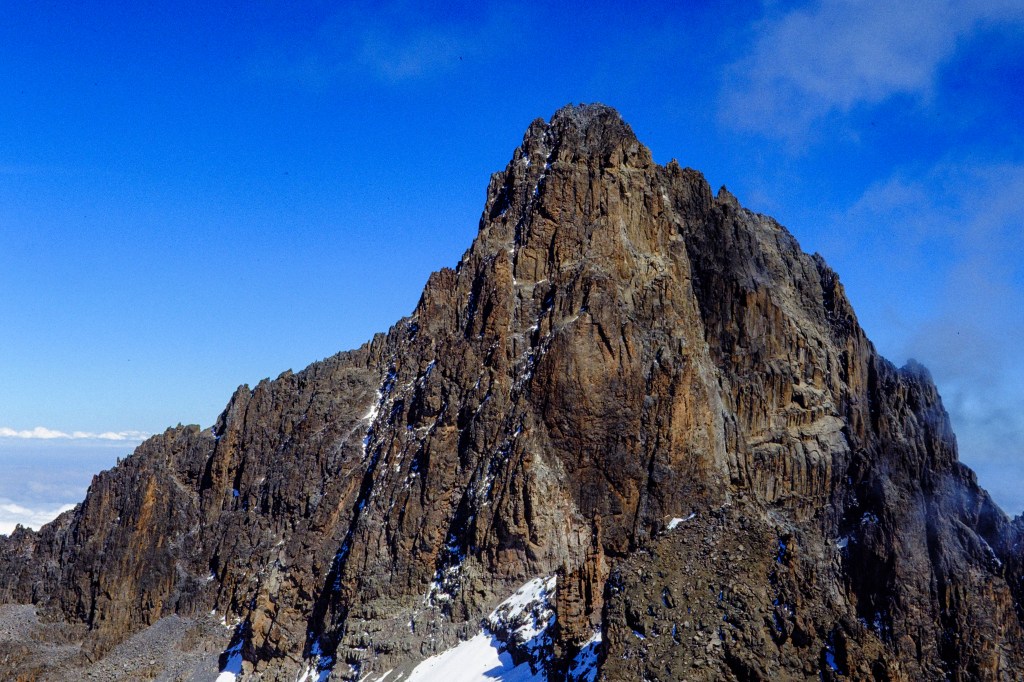
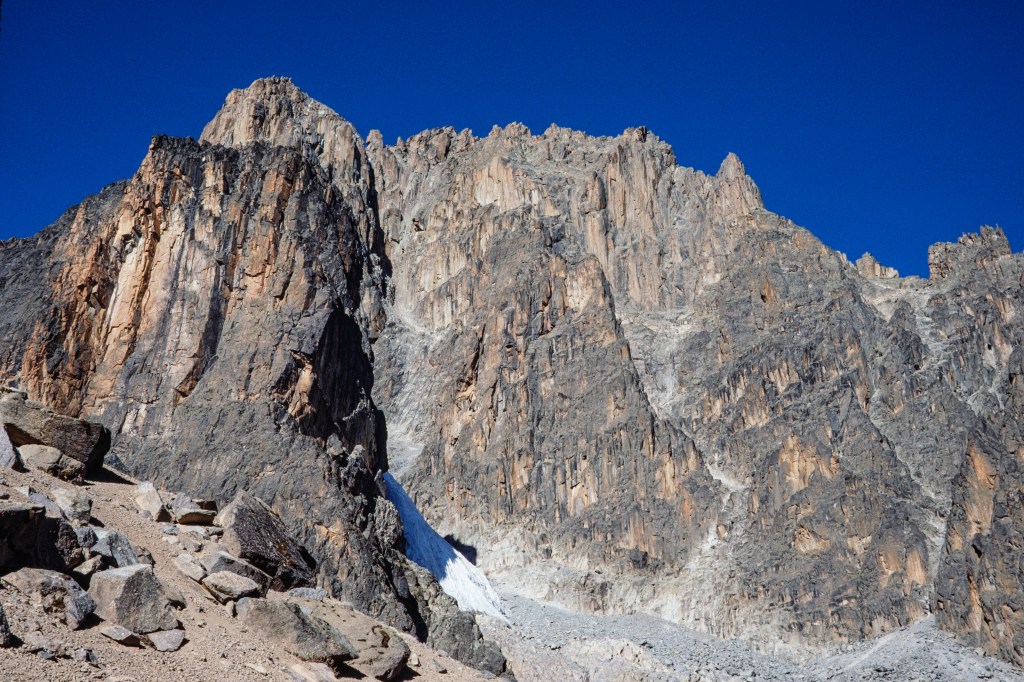
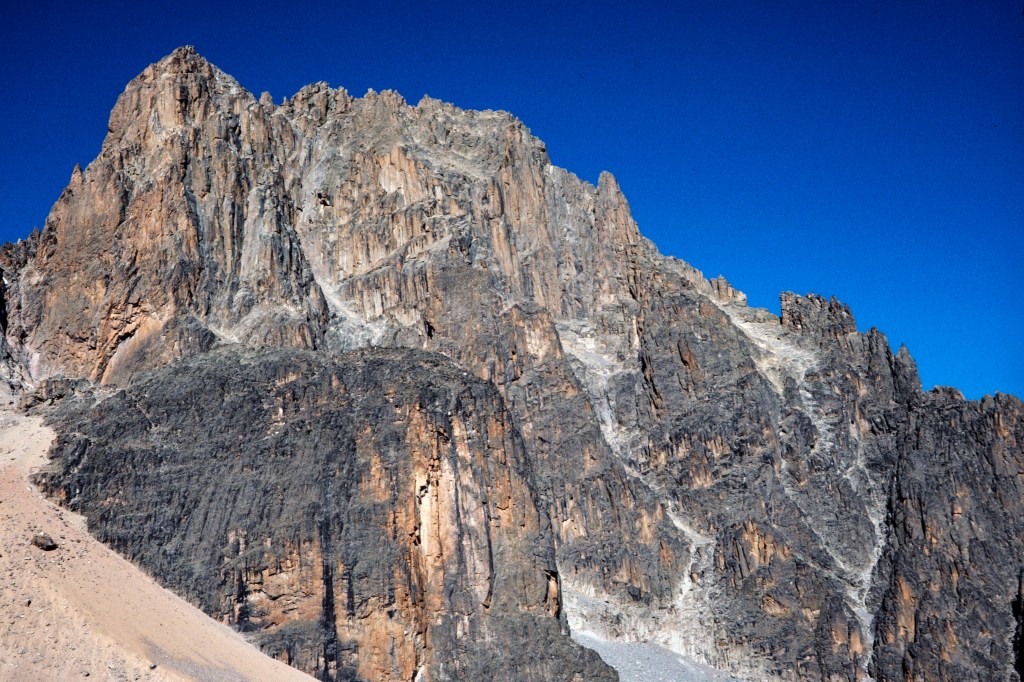
           Mt Kenya had a volcanic origin. Later it was covered by ice which severely eroded the rock; what remains is the interior plug of the original volcano. This created steep towers of hard rock with a rough texture; ideal for climbing. Most visitors to Mt Kenya hike up Pt. Lenana (16,355 feet), a peak which only requires walking; perhaps 10,000 ascents per year. The main summit of Mt Kenya, Batian (17,057 feet), involves roped climbing and has about 50 ascents per year. Batian was first climbed in 1899 by Halford Mackinder (English geologist), and two professional guides, Cesar Ollier and Josef Brocherel. The West Ridge, rated 5.8 in difficulty, was first climbed in 1930 by Eric Shipton and Bill Tilman. Both men were English coffee growers who later left Africa and became famous explorers of peaks in Asia and elsewhere. (I met Shipton in 1975 in Portland, Oregon, when he showed slides of trips to Tibet and Everest in the 1930s.)

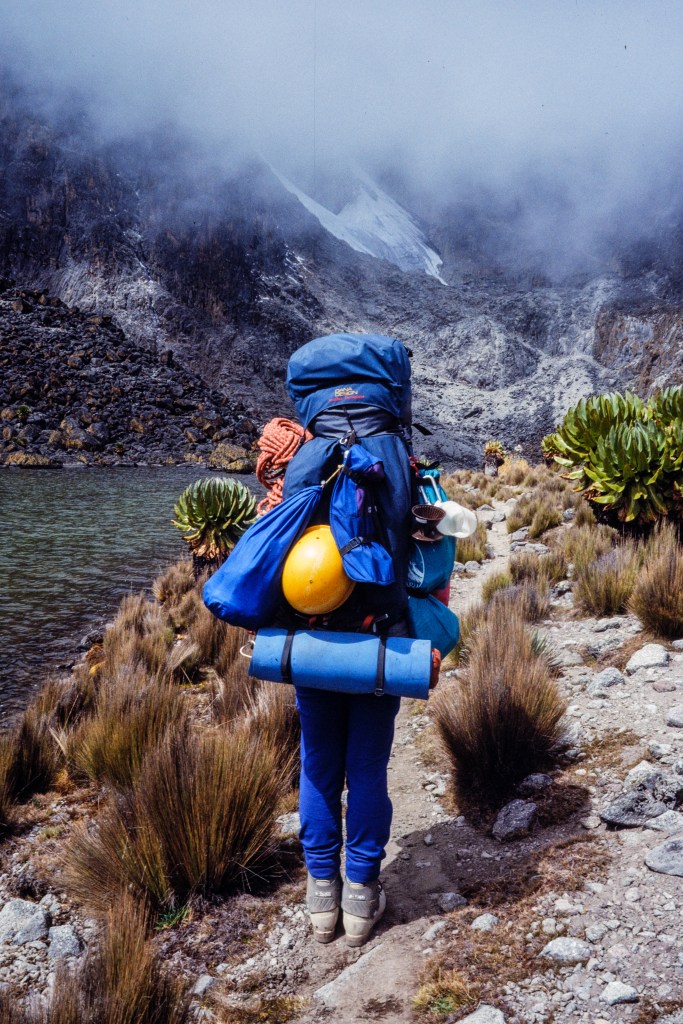
            Bart and I planned to spend 2+ weeks in the park; our main goal was to climb Mt Kenya’s West Ridge. We hired 3 porters to help carry our gear to climbing routes on the north side of the peak. Over two days we hiked the Sirimon Route to a tarn near the Kami Hut, at 14,600 feet, arriving on July 19. The porters left us here.

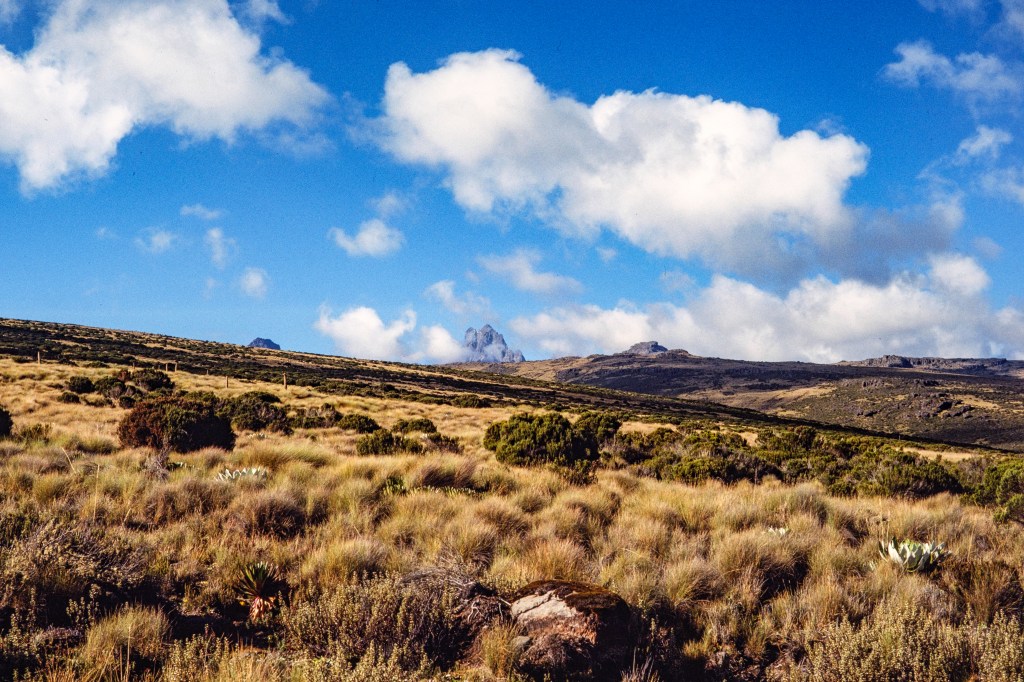
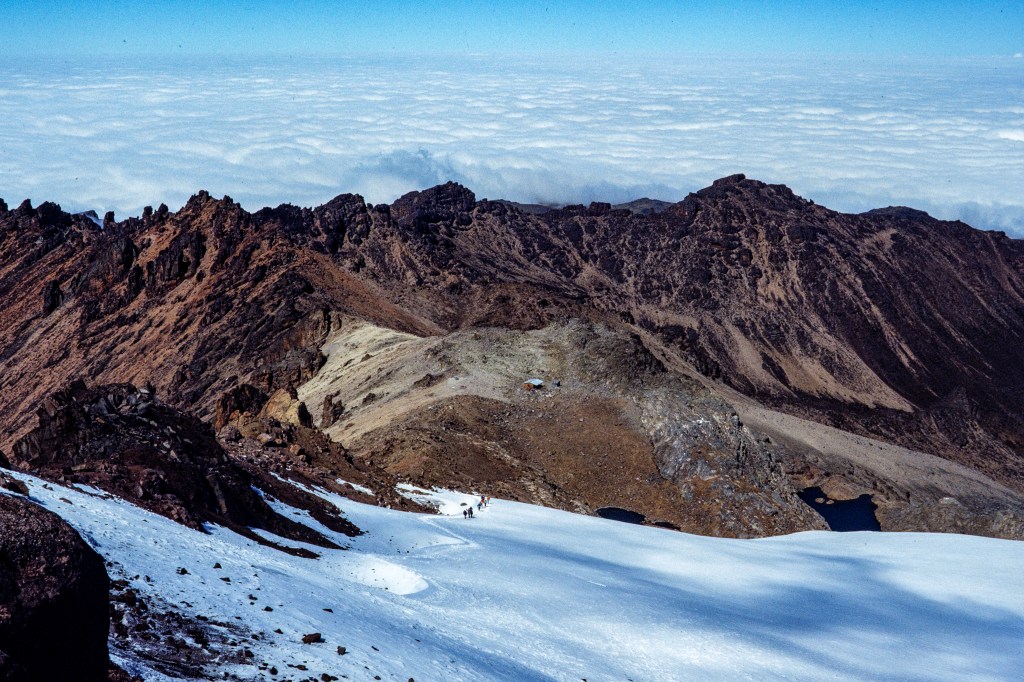
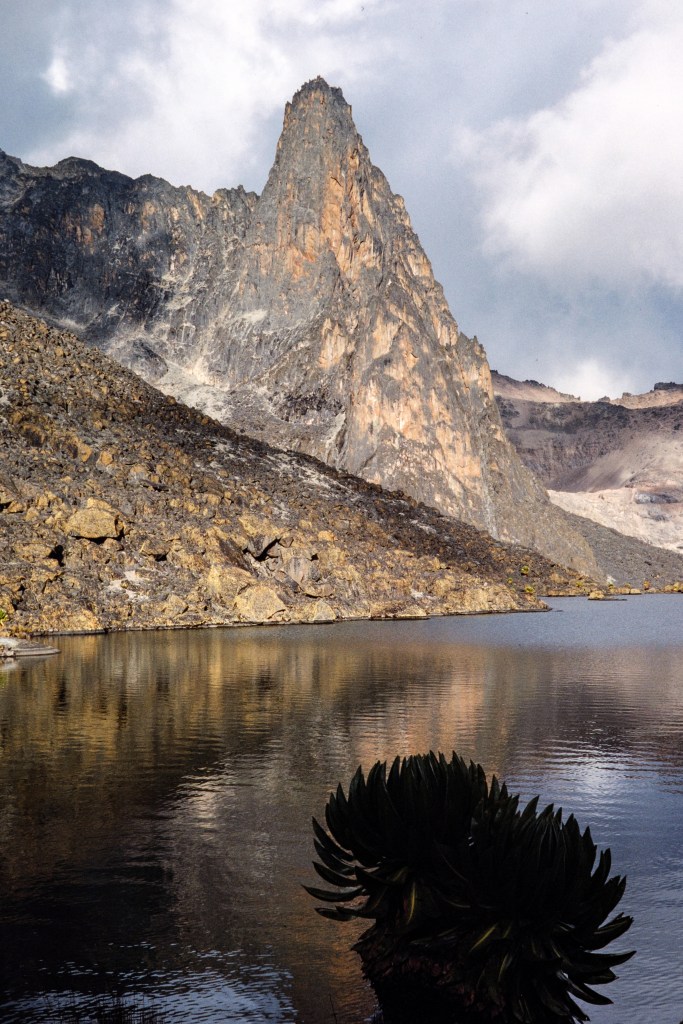
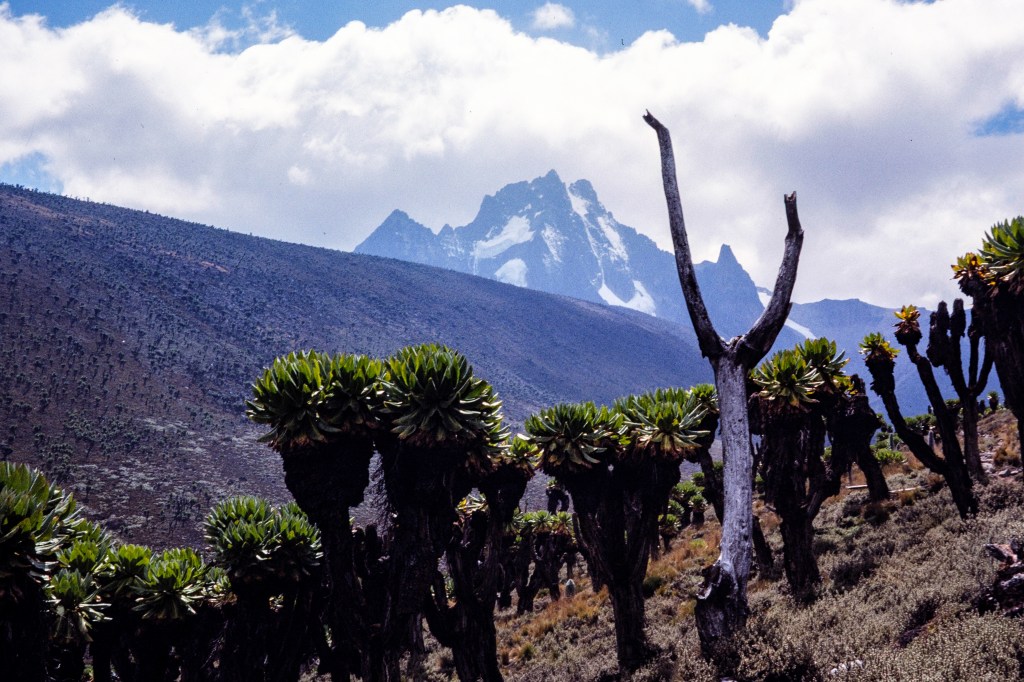
Mt Kenya’s main summit in the distance,

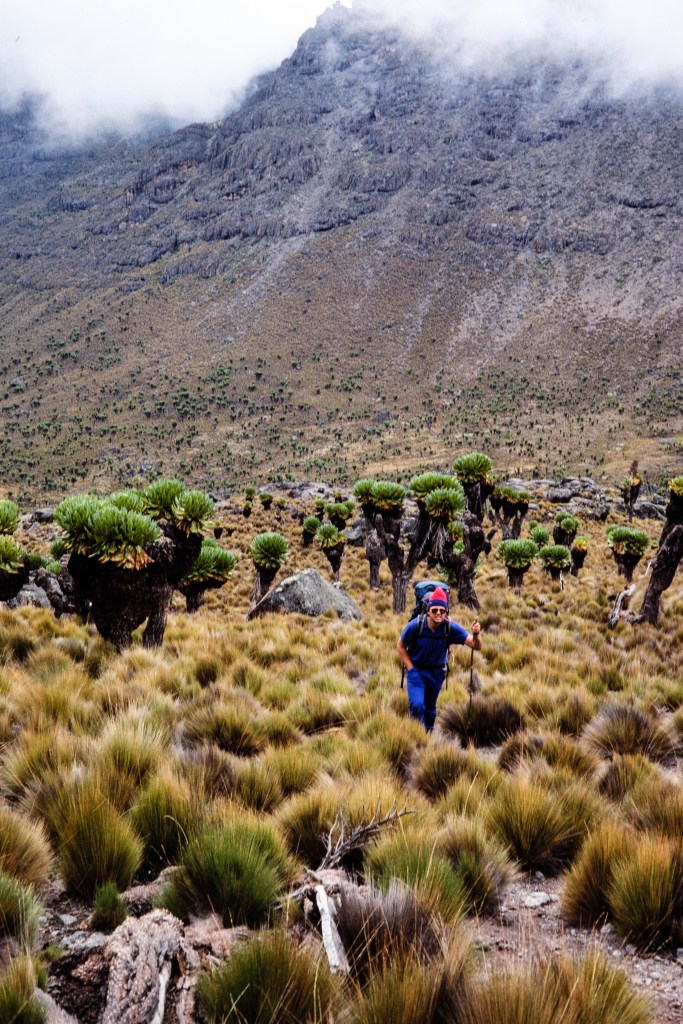
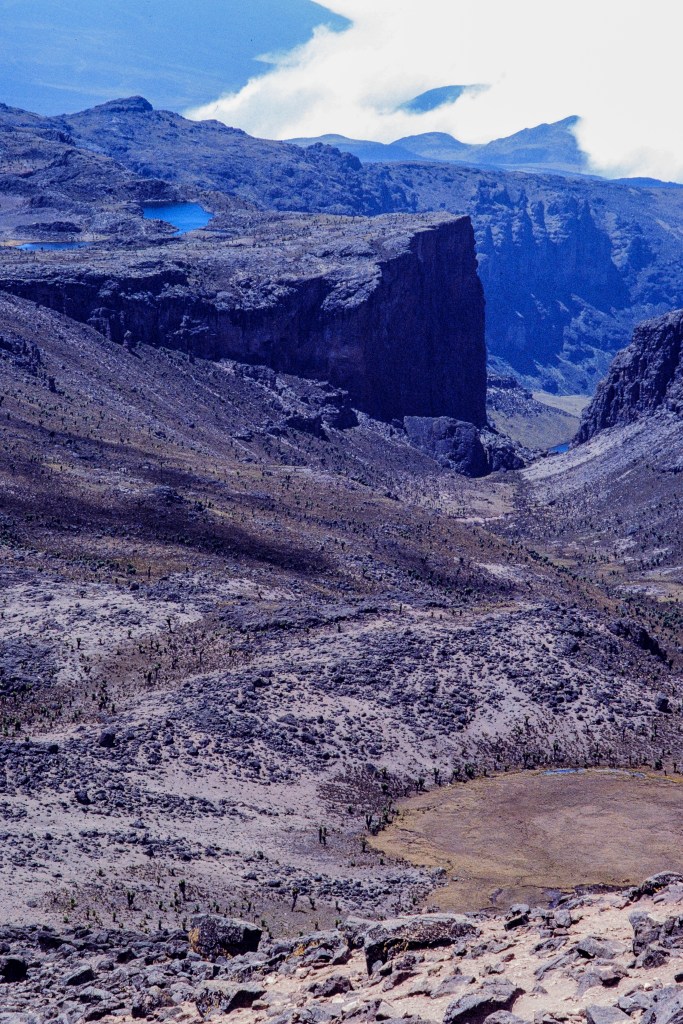
The porters enter the Mackinder Valley

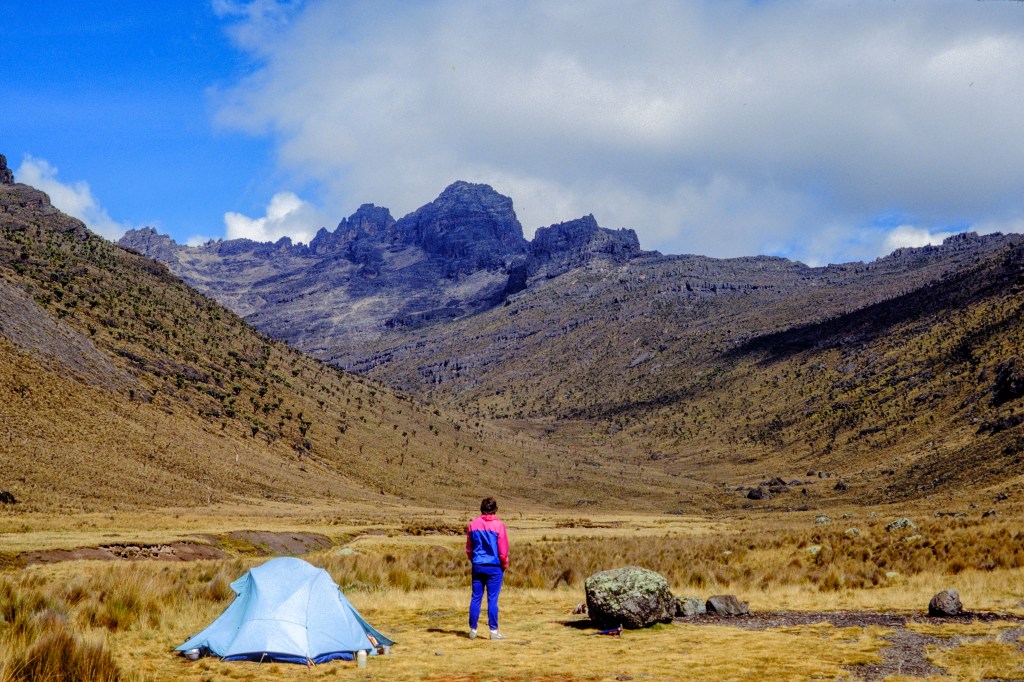
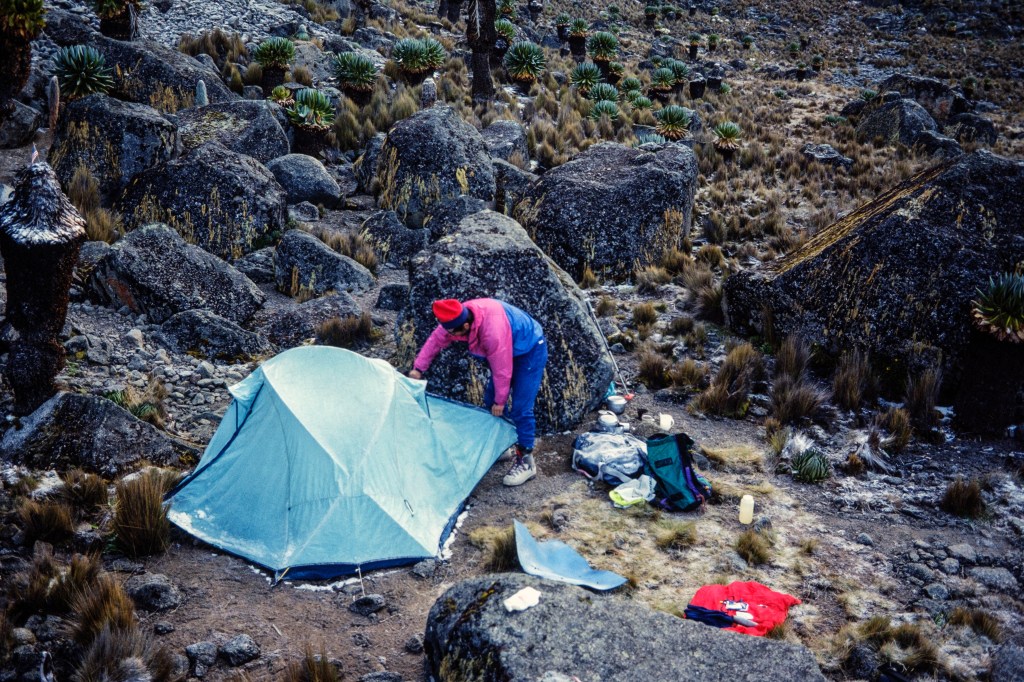
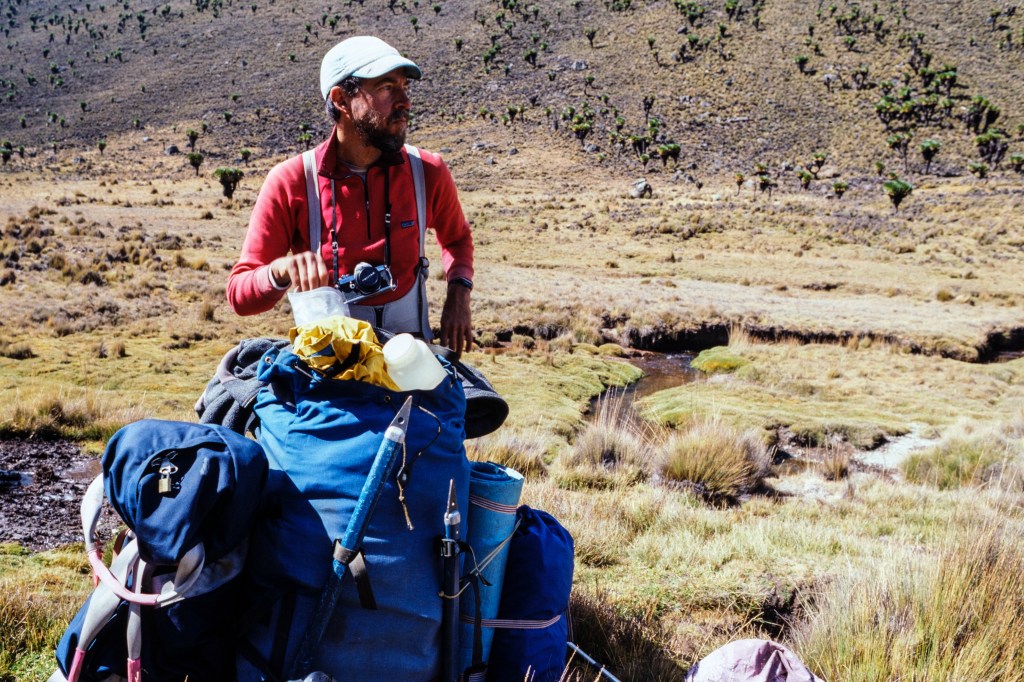
Bart near our tent in Mackinder Valley.

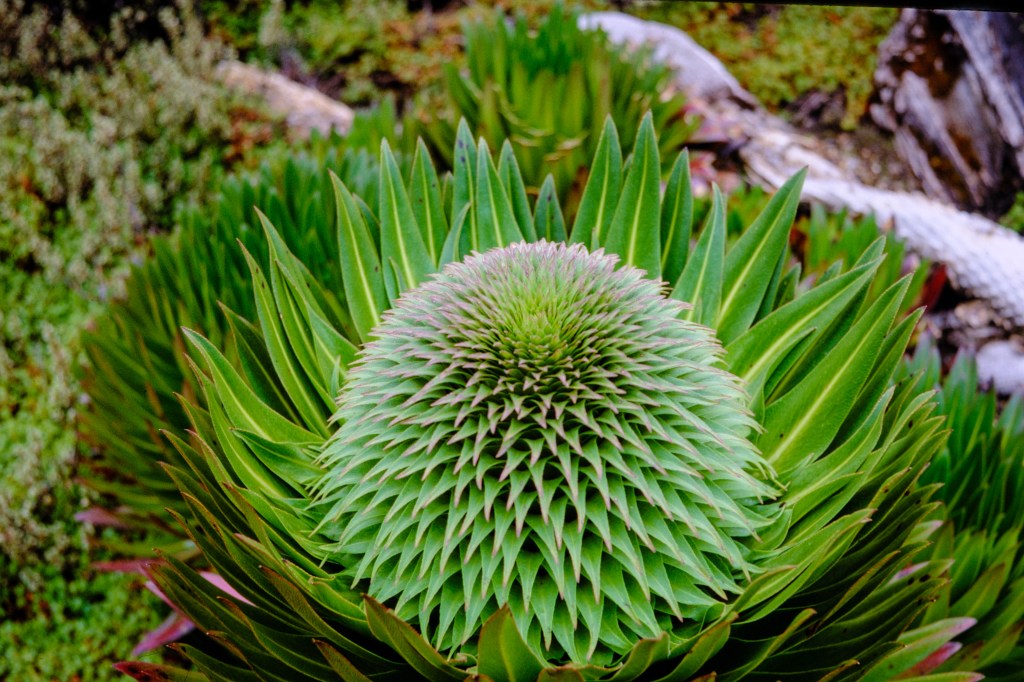
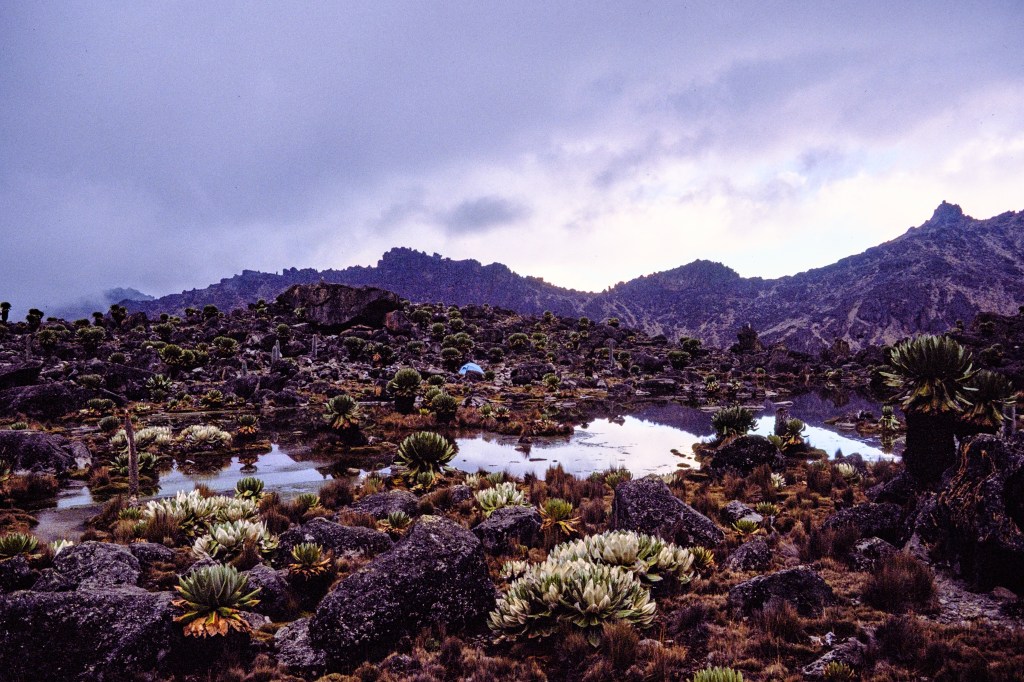
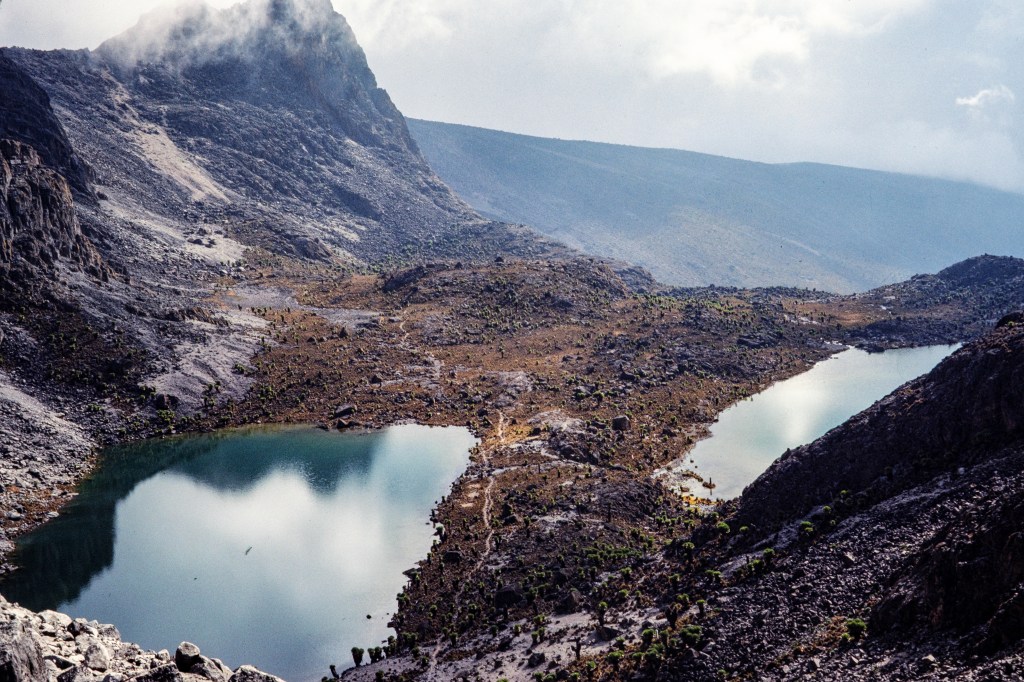
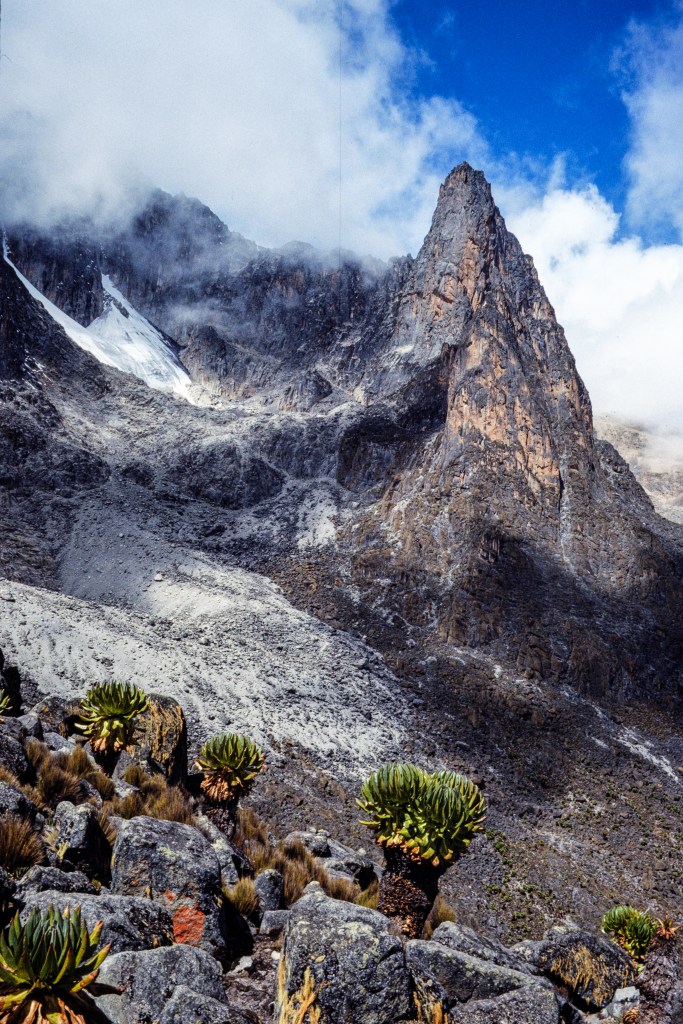
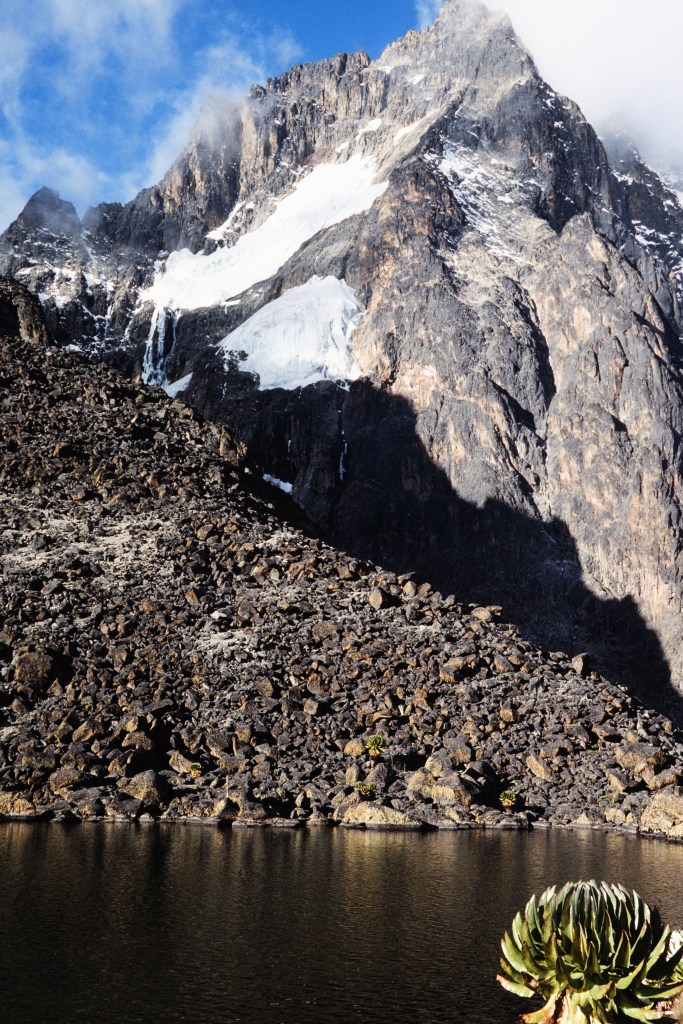
Lobelia, a lovely plant.

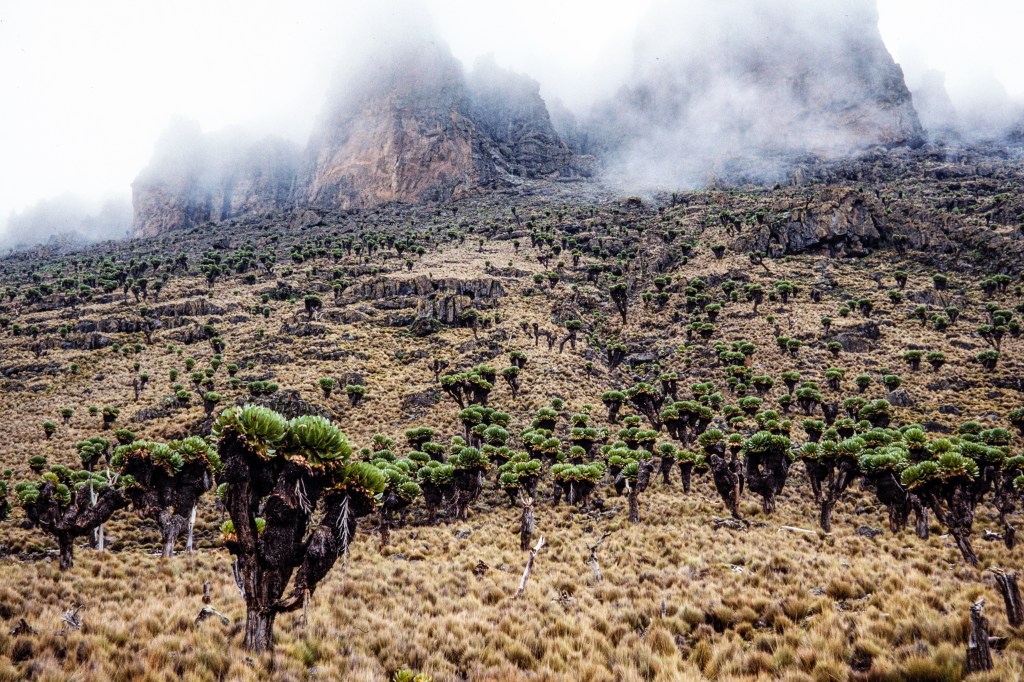
A forest of Giant Groundsel.

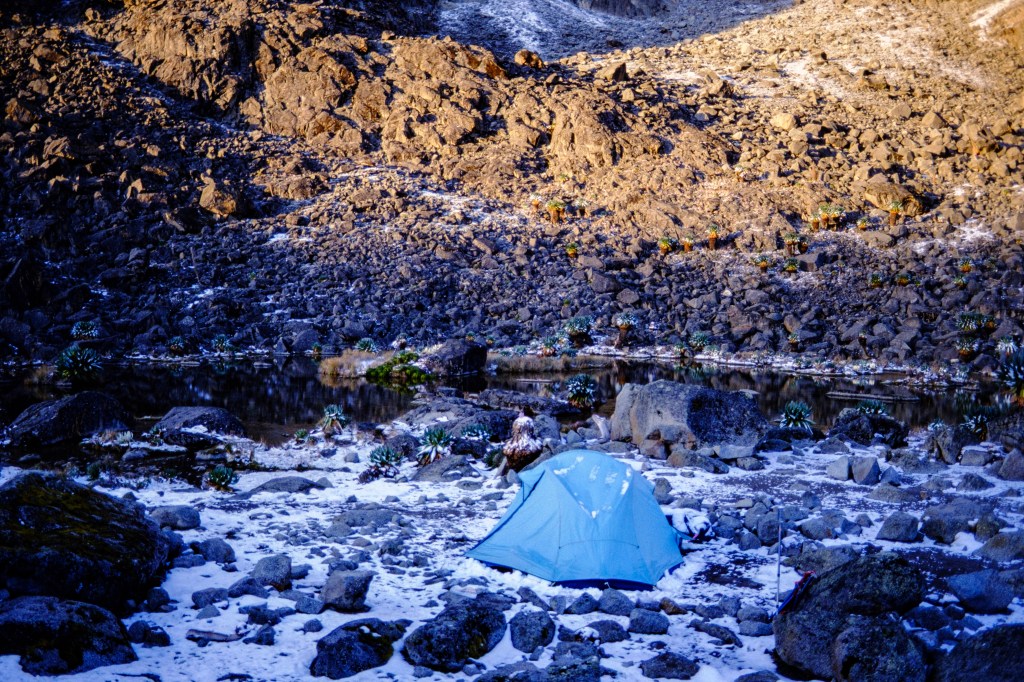
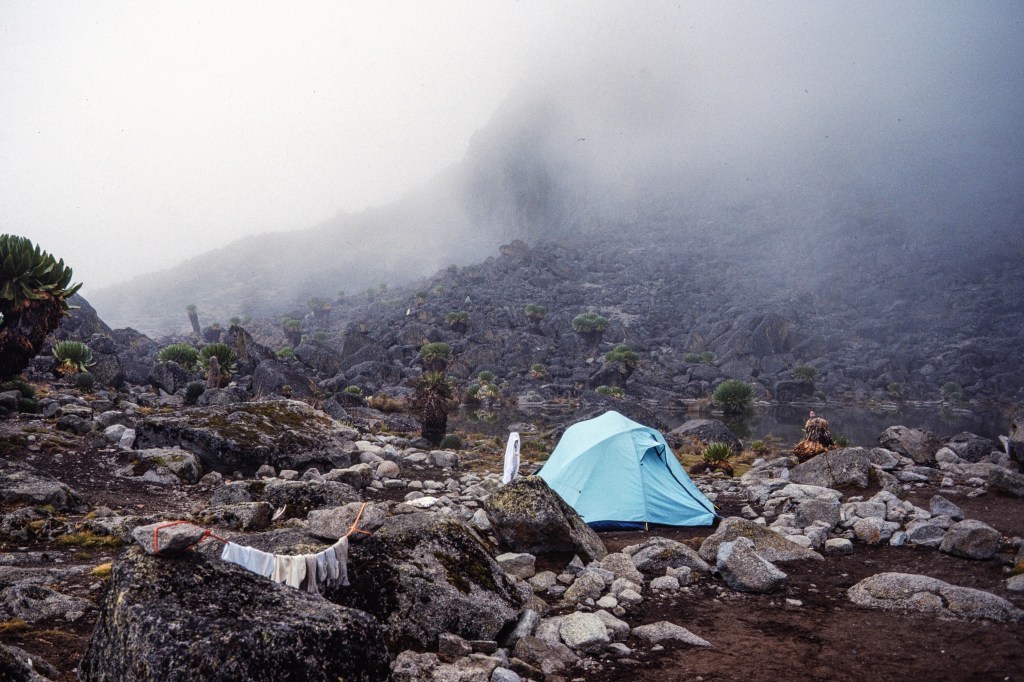
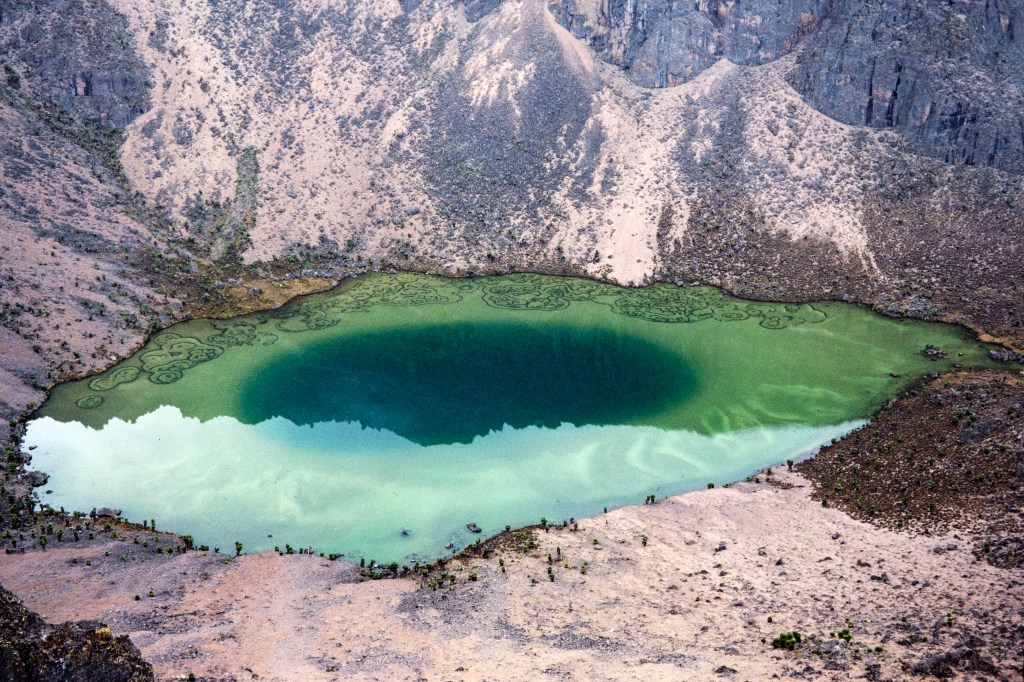
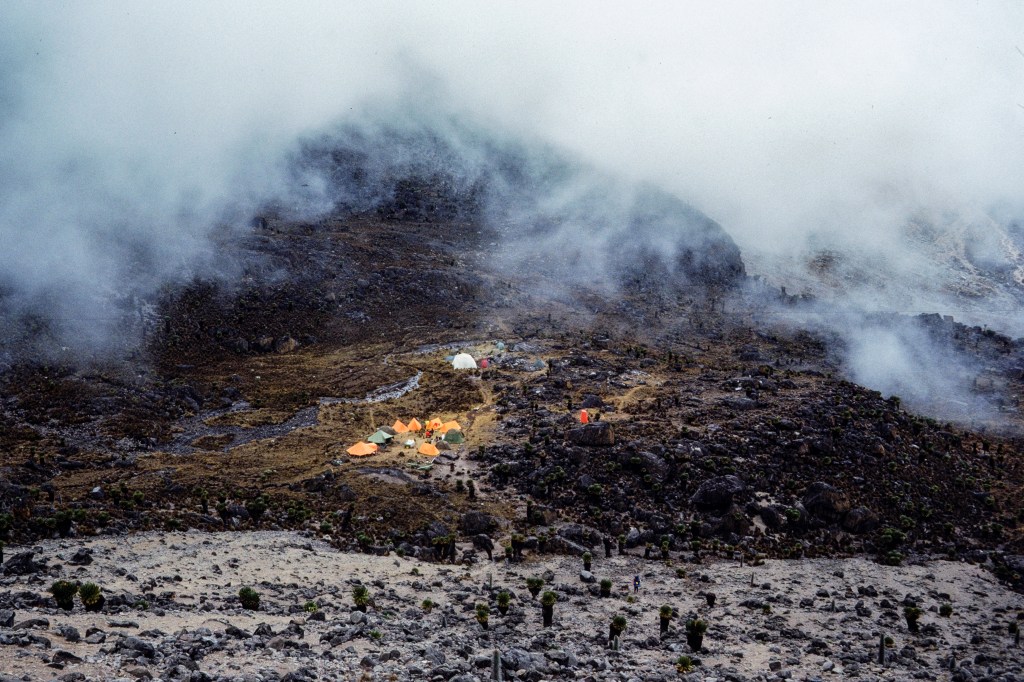
Kami Tarn, 14,600 ft. Our blue tent is near center of photo.

 Fresh snow.

Initial climbs

           The Kami Tarn was our home for 8 nights. On July 21 we climbed Pt. Peter (15,607).

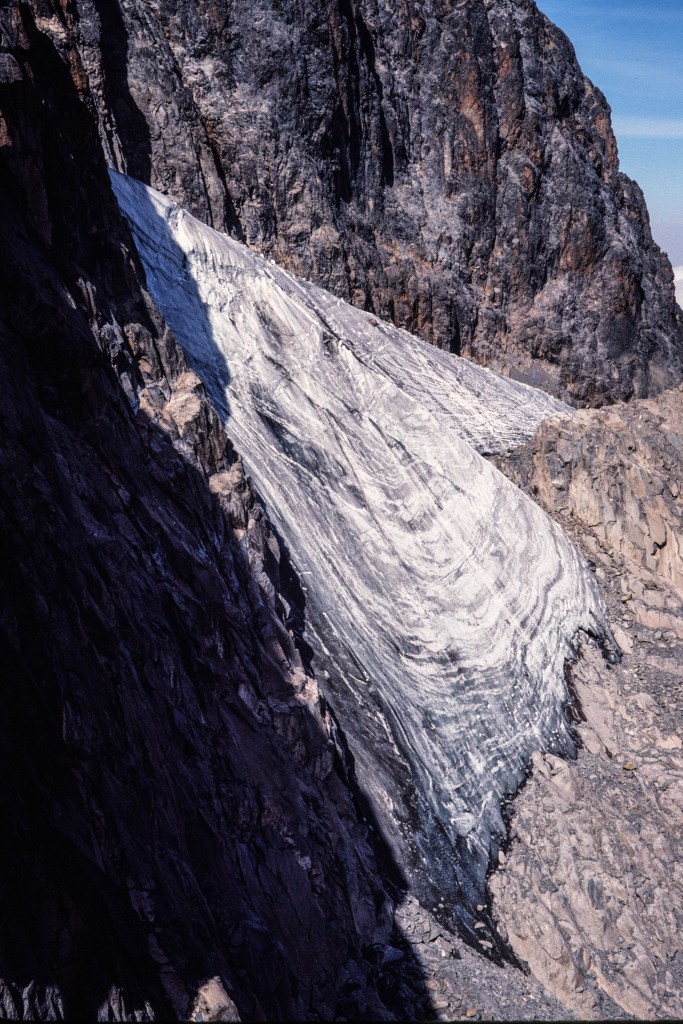
Josef Glacier from Pt. Peter.

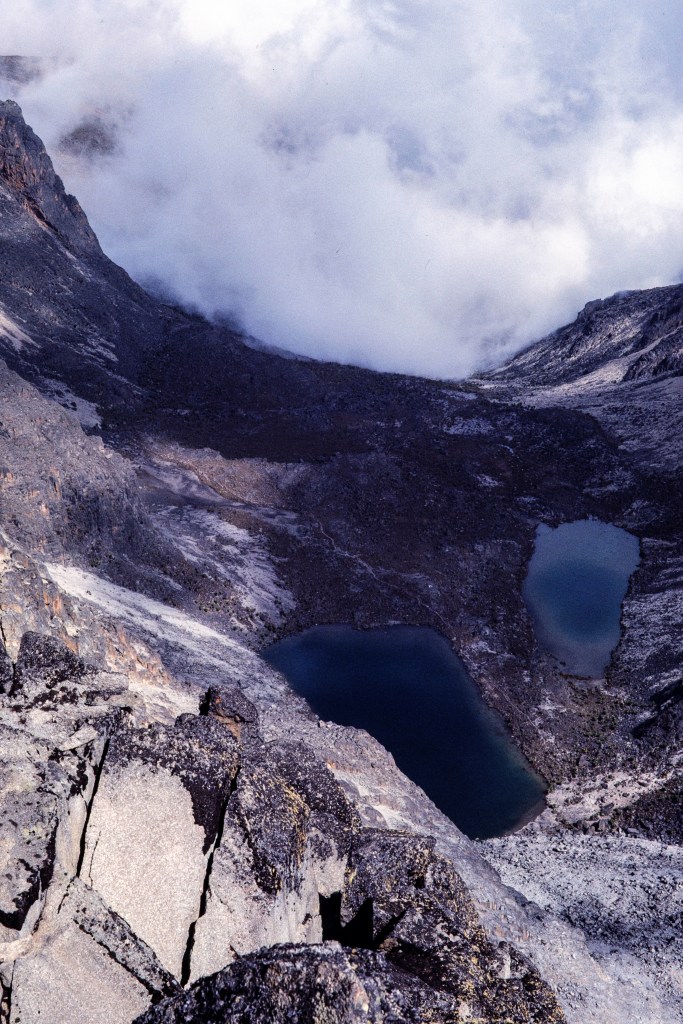
Oblong Tarn and Hausberg Tarn.

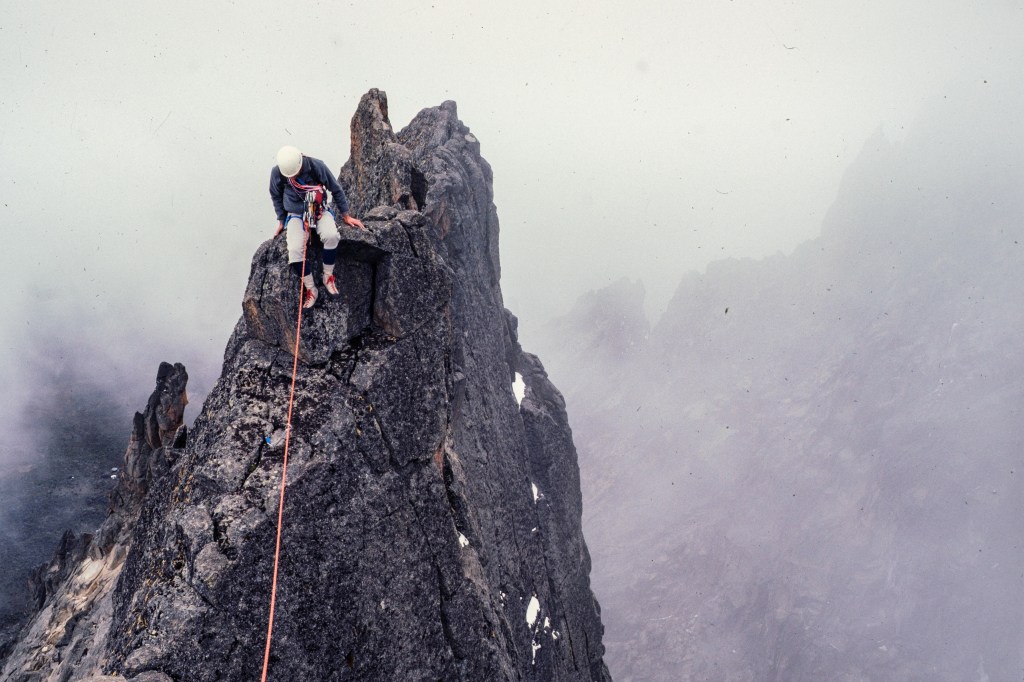
Bart uses a rappel to descend.

The next day we climbed Pt Dutton (16,207), shown below.

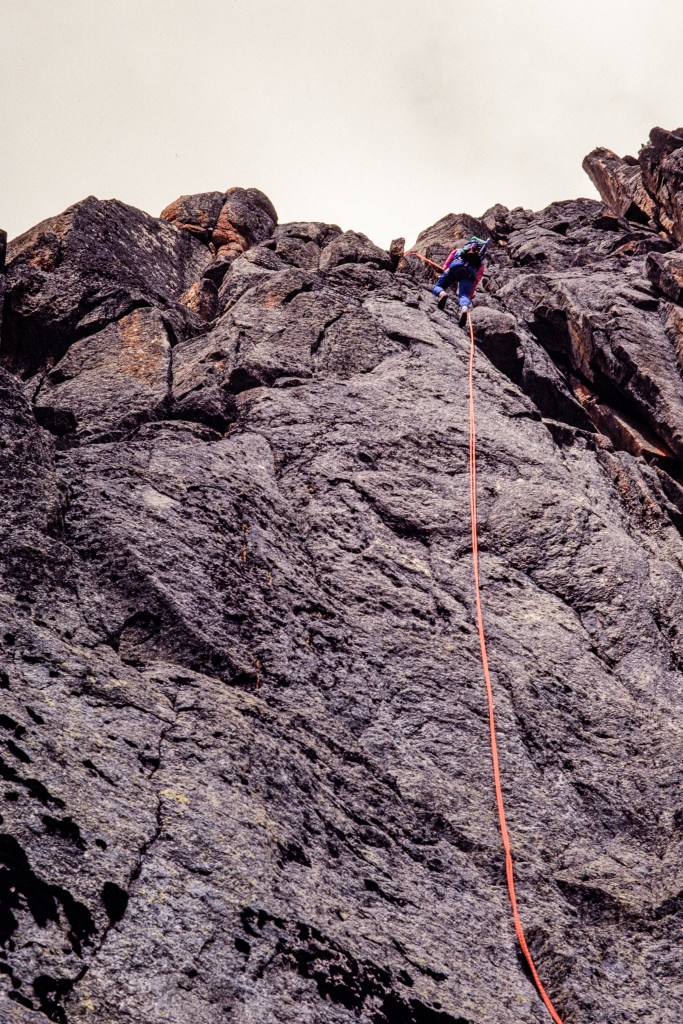
Bart leads up.

Peter follows. Kami Tarn and our tent, a blue dot, are in upper right.

Peter contemplates his fate. Note how rope runs through an anchor set in the rock.

Laundry day.

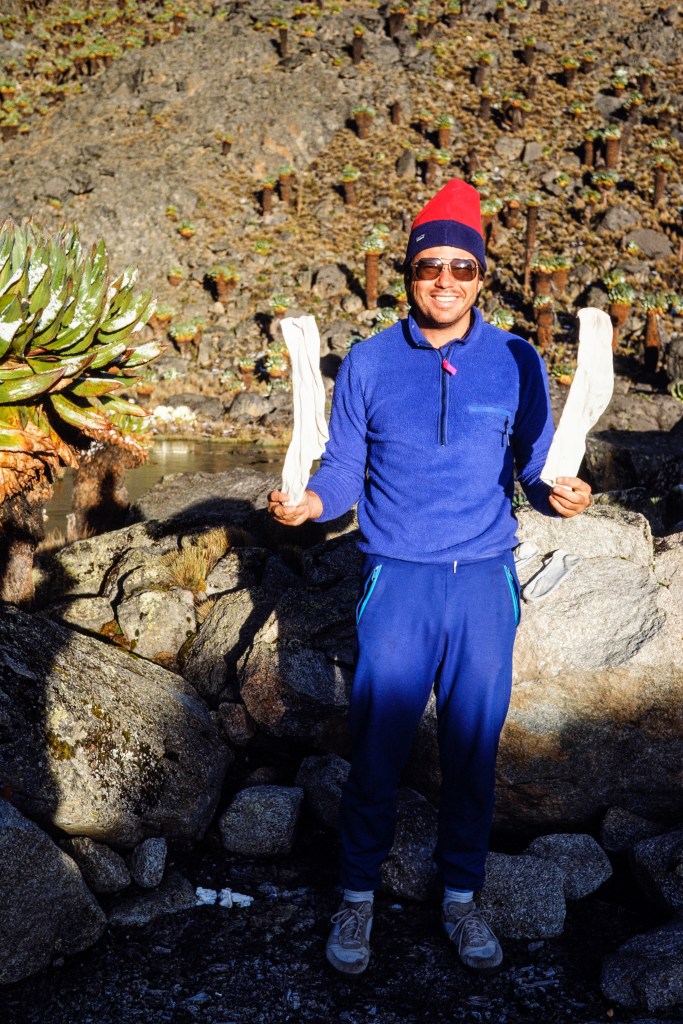
 Bart demonstrates clean, but frozen, socks.

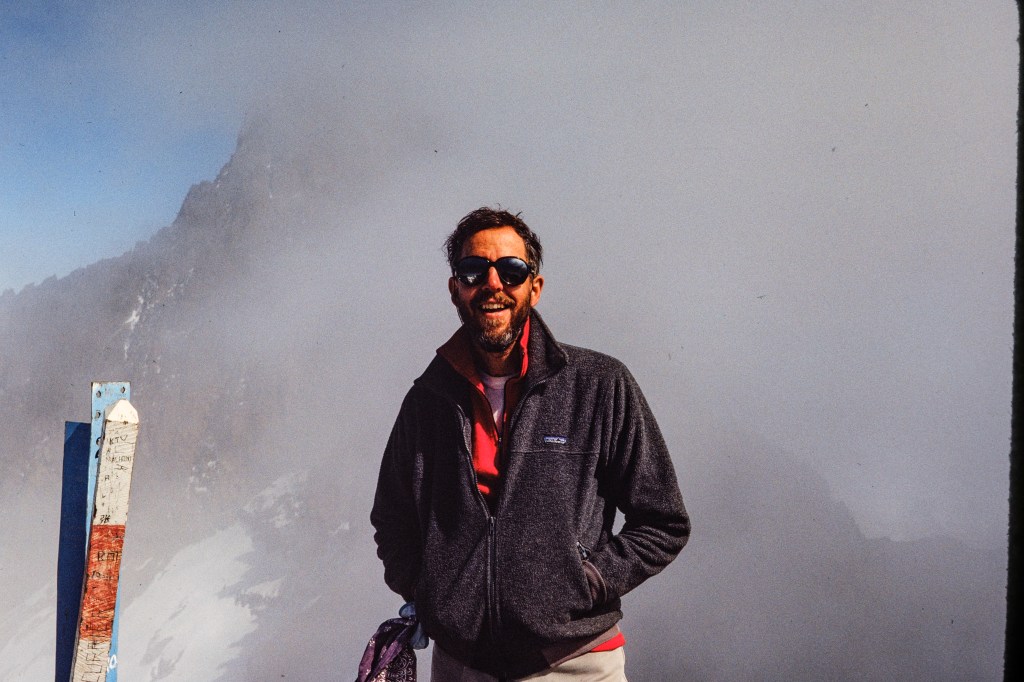
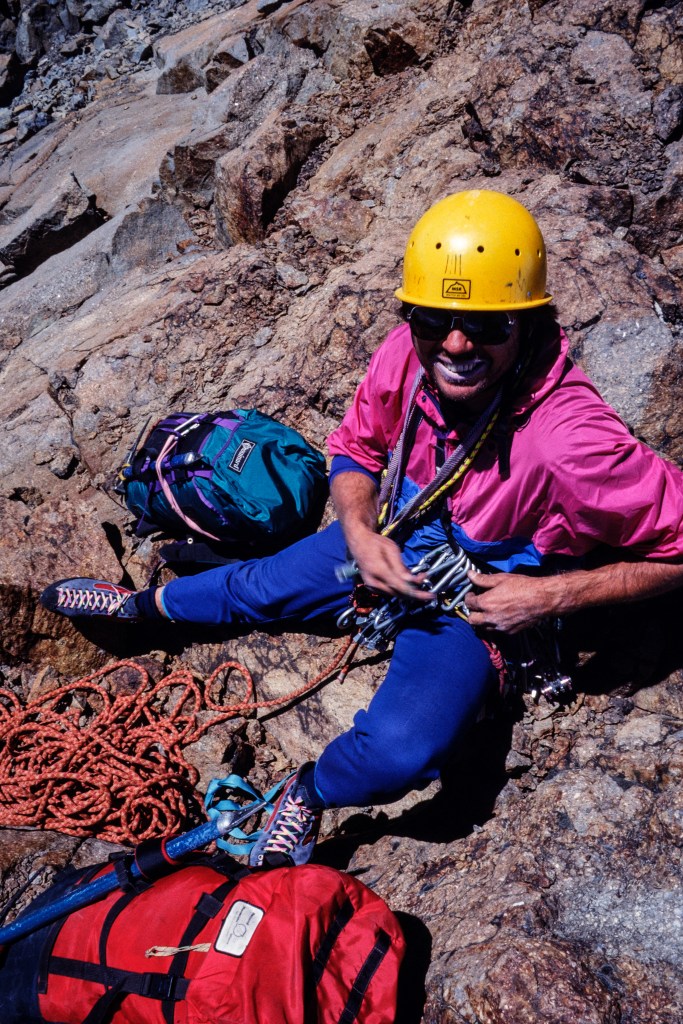
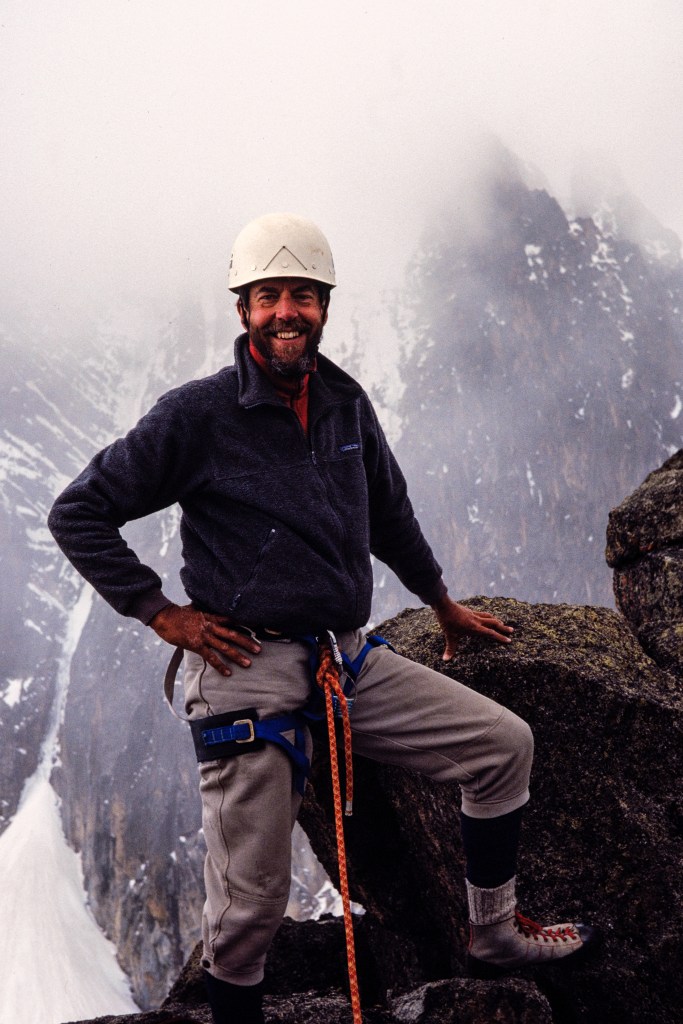
On July 23, we climbed Pt Lenana (16,355), then rested on 7/24. Below, Peter smiles on top of Lenana. Only a little gray in his beard back then.

People hiking up Pt Lenana from Austrian Hut.

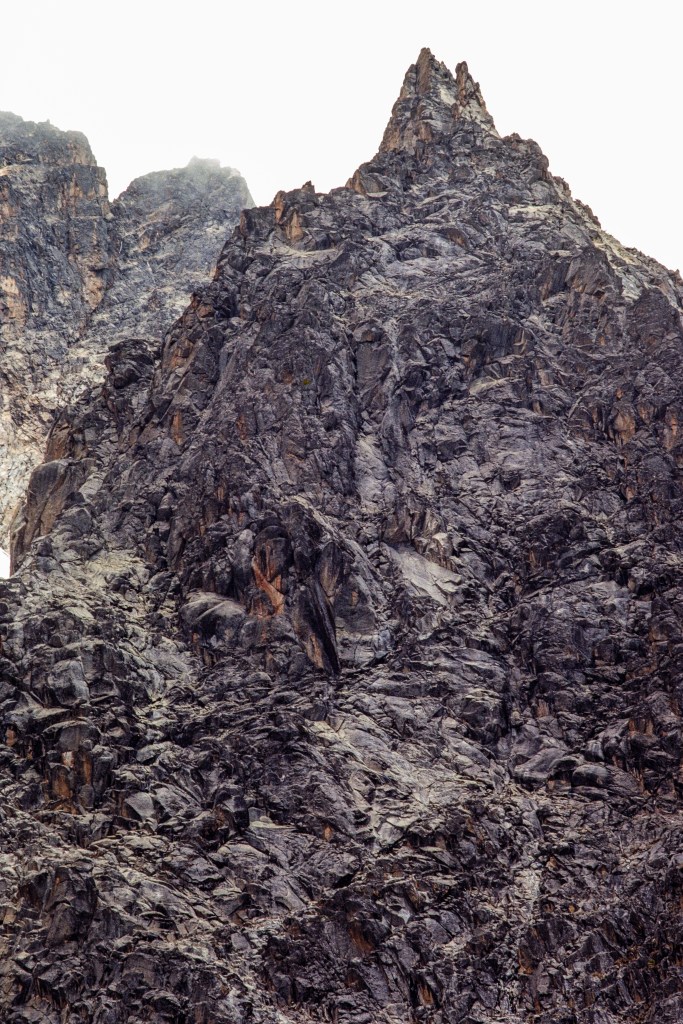
Nelion, Mt Kenya’s second highest summit (17,021 ft.) The true summit, Batian, is hidden behind Nelion.

Upper part of the Chogoria route which I hiked in 1984.

The West Ridge

            We were now acclimated and ready to attempt the summit, Batian, via the West Ridge. We sorted gear, each preparing a small pack with extra clothing, sleeping pads, bivouac sacs, some food, 1 quart of water, climbing gear. No sleeping bags. The plan was to go light and fast, sleeping one night on the climb.

A glossary of some climbing terms used in this blog:

Roped climbing: About two centuries ago, ropes were introduced for climbing. Imagine two guys on a ledge. (Guys invented this sorry scheme.) Each ties himself to one end of a rope. The leader starts up. If the leader falls, he lands on the ledge; the rope offers him no help. If he falls past the ledge, he pulls off the second climber and both die. Imagine the leader climbs up 100 feet. He stops, tries to find a strong position, and pulls the rope up to assist the second climber. If the second climber falls, the leader tries to keep a grip on the rope. This wretched method was used for a century.

            The old method of roped climbing produced many disasters. Edward Whymper (English) made the first ascent of the Matterhorn in 1865. On the descent, the 7 climbers were roped together. Douglas Haddow slipped, he pulled Michel Croz off the rock, and their combined weight pulled off Charles Haddon and Francis Douglas. Whymper and the Taugwalders (father and son) would have been pulled off as well, but the rope broke above Douglas; 4 men died, 3 survived. So one man slipped and the rope killed 3 more.

Belaying. Eventually climbers invented the belay. When the leader climbs, the second anchors himself to the rock with rope, pitons, other devices, and strong webbing. If the leader falls, the second will probably live thanks to his anchor. When the leader has climbed 100 feet to the next ledge, he stops and anchors himself to the rock. Then the second climber removes his anchor and comes up. This arrangement is called “belaying.” If the second falls, he may get banged up, but he should not fall far if the leader holds the rope.

Anchors. Climbers realized that anchors could be used between the climber and the belayer. The leader climbs while the belayer pays out rope. The leader may spot a crack after 20 feet. She puts an anchor in that crack, attaches a carabiner (snaplink) with webbing, and runs the rope through the carabiner. Now she climbs up 10 feet more. If she falls, the belayer holds the rope and the leader only drops 10 feet below the last anchor. Remarkably, this works. I’ve fallen more than once and I’m still alive. Placing anchors is a skill; they must be strong, placed quickly, and easily removed by the second climber.

Rappels. To get down some cliffs, climbers set up an anchor, attach nylon webbing, and slide half the rope through the webbing. If the rope is 150 feet long, the two 75-foot halves hang down from the anchor. The climber, using a metal device, slides down the rope. A lot can go wrong. You can slide off the end of the rope, you can detach from the rope, the anchor can fail, the rope can be cut, and more. But if you do this right, rappelling provides a fast descent.

Verglas. Clear ice on rock, hard to see, very slippery. Same thing as “black ice” on the highway; black, because you see the asphalt through the invisible ice.

July 24

            Rest and get ready. Bart frets a bit about the route. He is the better climber, so he will lead, place all the anchors. The responsibility for finding the route rests on him. My job is to follow as fast as I can, be cheerful, quickly remove each anchor, and return the gear to him in neat order when I get to his belay station.

July 25

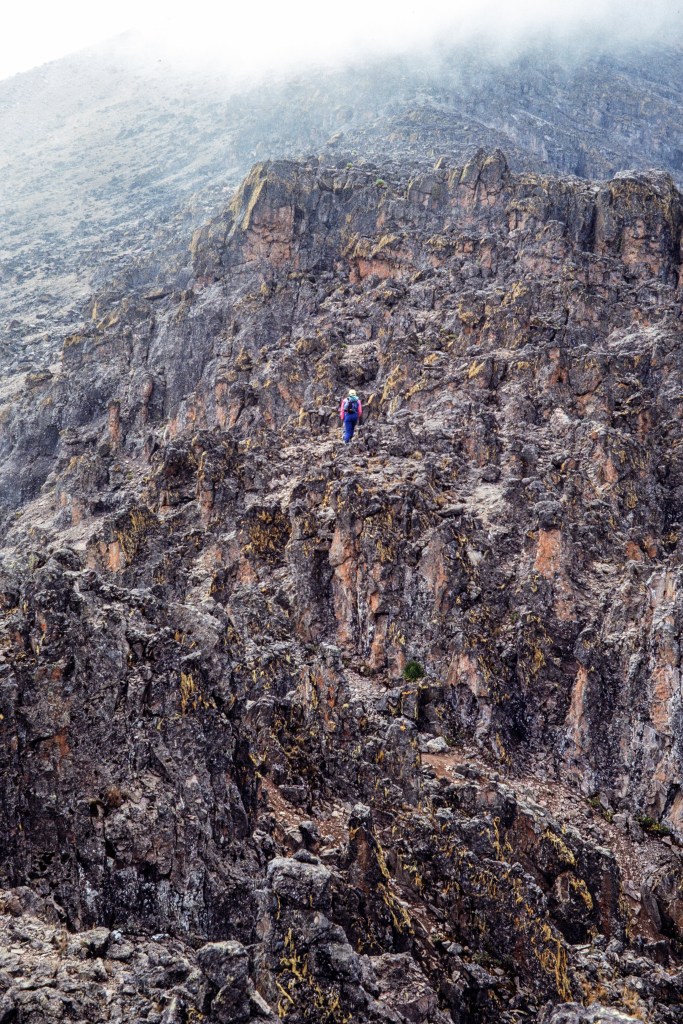
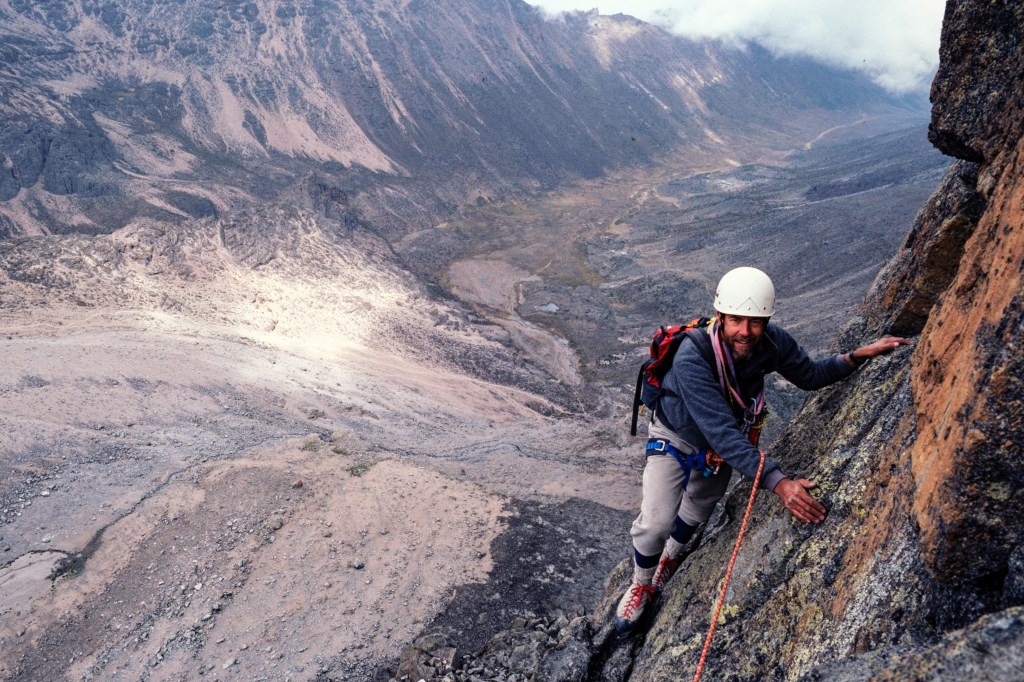
            Breakfast 5am, on the go at 6. Fast hiking, then scrambling. At 7:50 we are at the notch between Pt Dutton and the Petit Gendarme. We climb about 100 feet – there is a lot of air below and we rope up. We are now on the West Ridge. We reach the top of the Petit Gendarme at 9am. Then climb and rappel down into a deep notch. Long traverses put us below the Grand Gendarme; really steep as we head up to a large ledge, around 11am.  

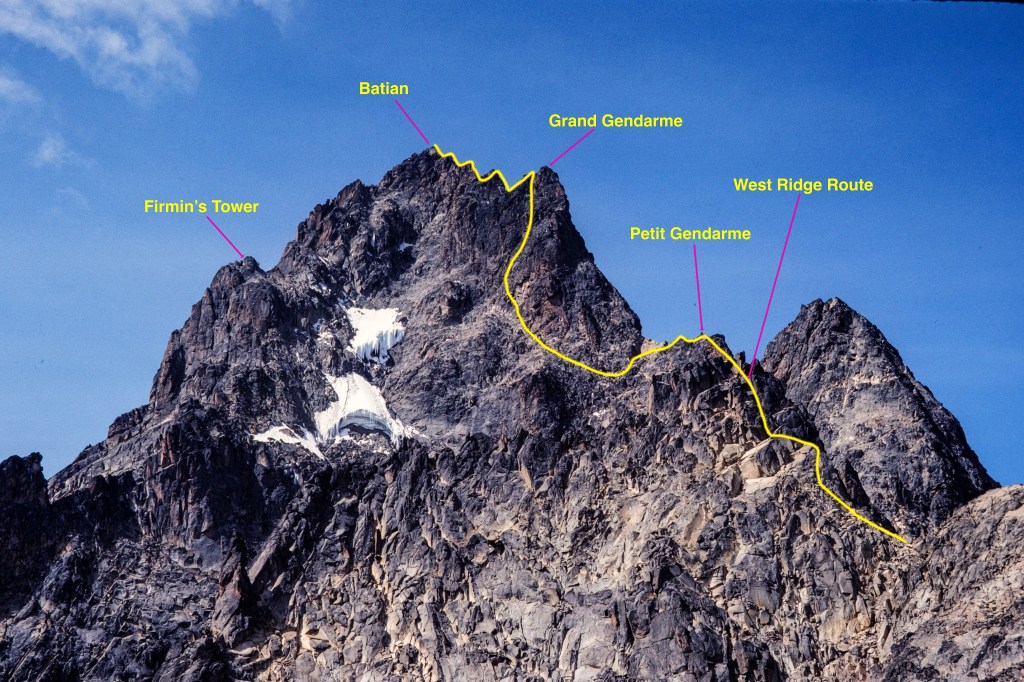
Photo below shows the West Ridge Route from the Northwest.

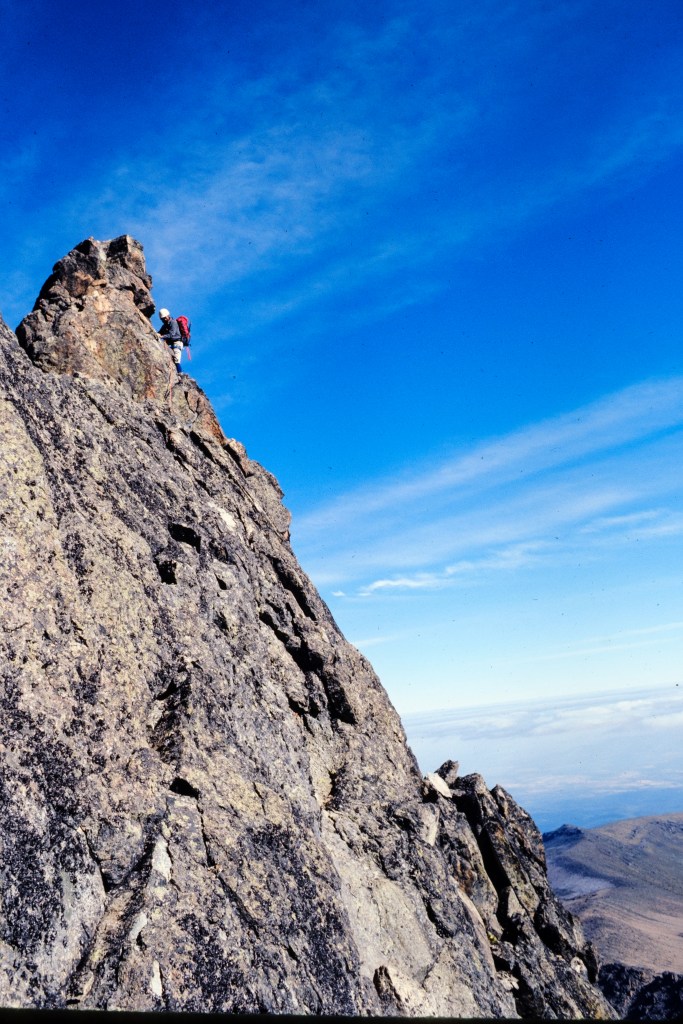
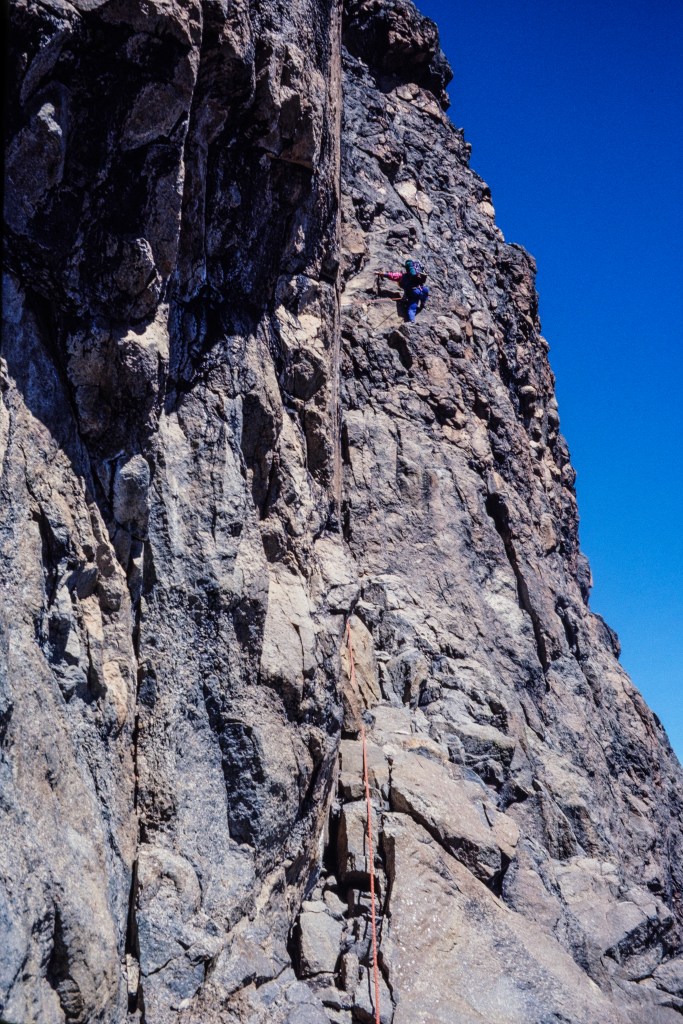
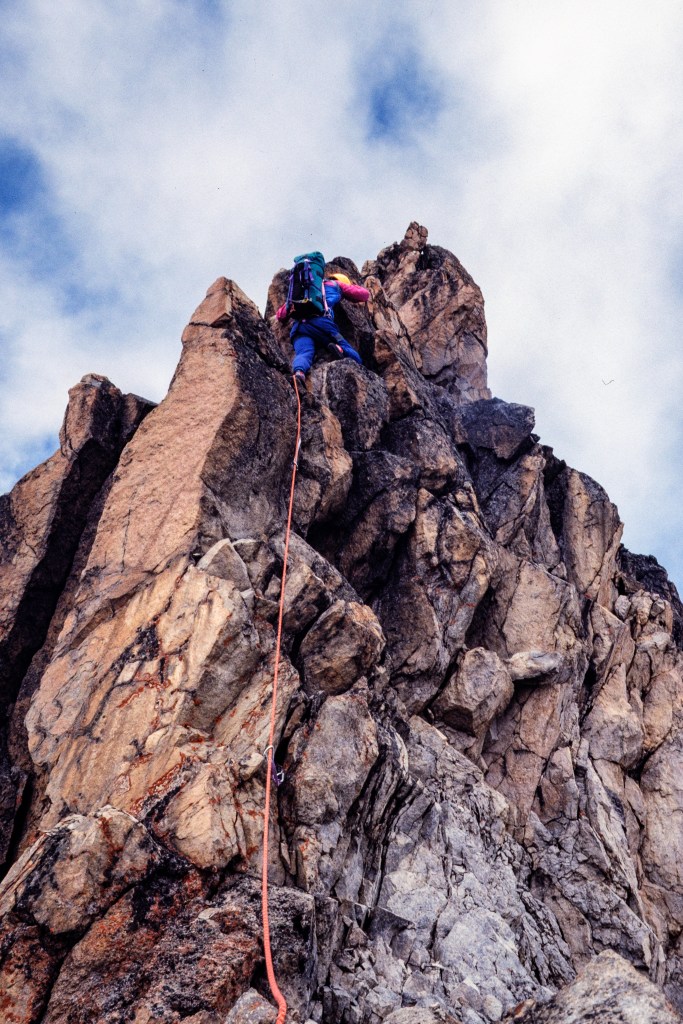
In photo below, the Petit Gendarme is above Bart’s head. Grand Gendarme off to the left. We roped up soon after this photo was taken.

Looking down on Pt. Dutton.

Peter passes summit of Petit Gendarme.

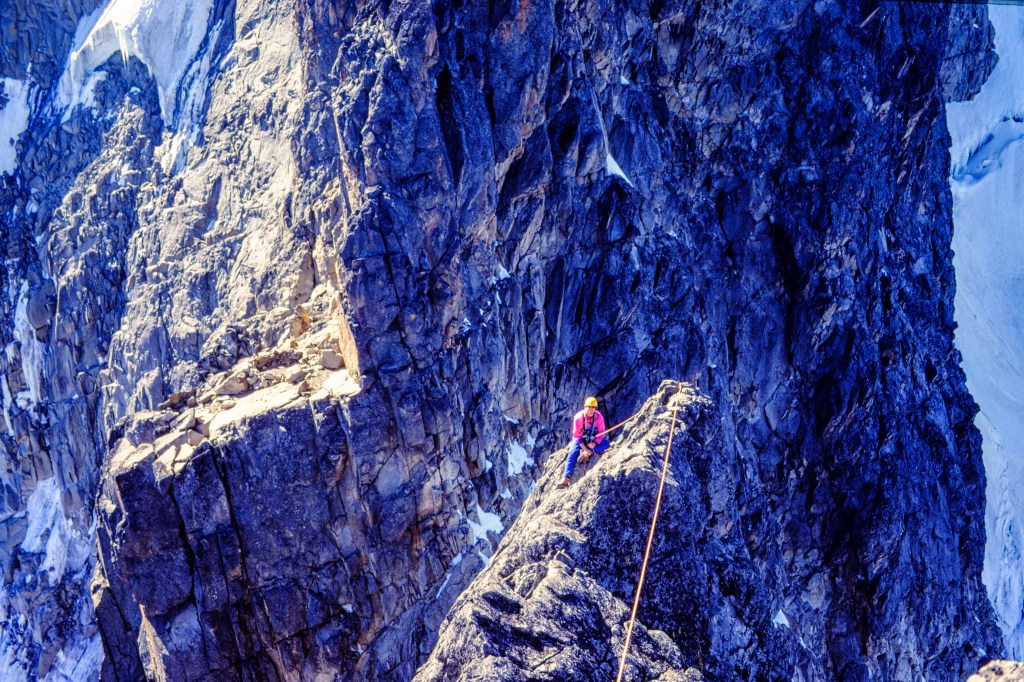
Bart belaying on ridge of Petit Gendarme. We have to descend into the space behind him, then climb to the ledge in sunlight on the left.

Photo below is a view from a distant point, showing the Petit Gendarme on the right and Grand Gendarme near the middle.

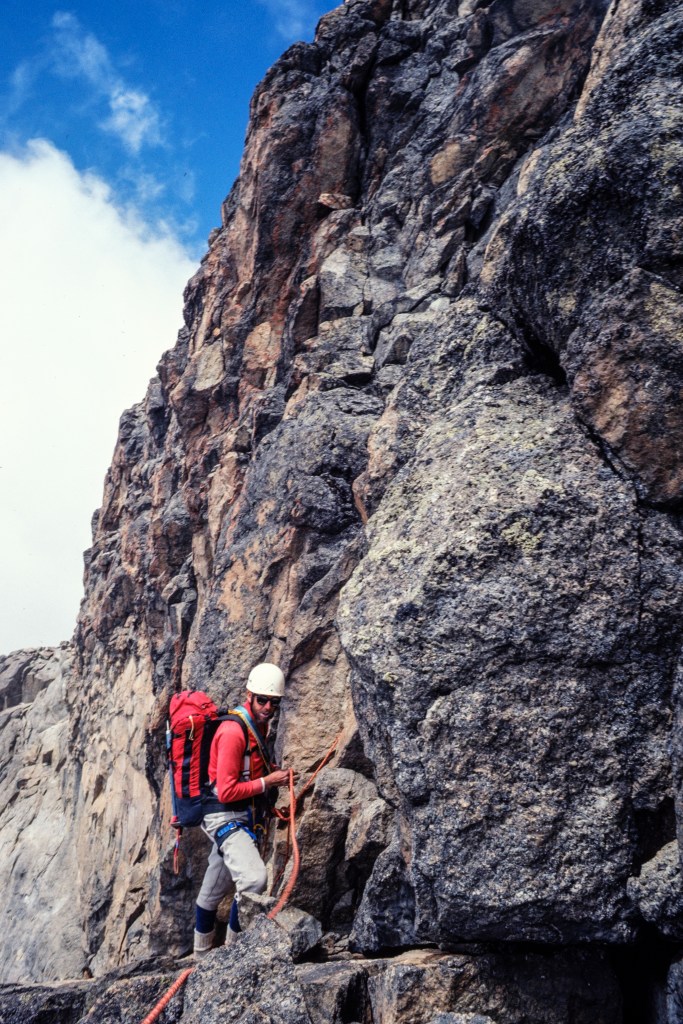
Bart follows ledges on side of Grand Gendarme.

View looking back at Petit Gendarme.

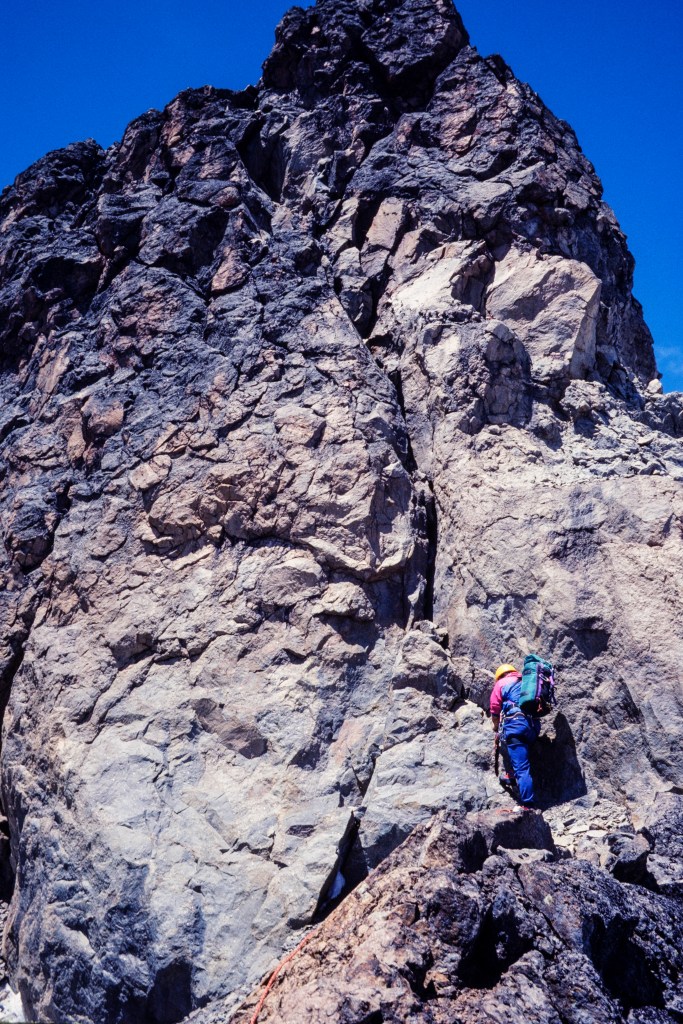
Bart climbing up the Grand Gendarme.

This distant view shows the big ledge on top of the Grand Gendarme. In the previous photo, Bart was on the wall a little to the right of this picture’s center.

A bite to eat, a sip of water.

Up to a steep wall; Bart shoots up without his pack, hauls it after him. I follow. We are now past the hardest spots, but the ridge goes on and on. It is like being in an airplane, looking down on one side or the other.

We reach Shipton’s Notch. Bart belays me.

A few more hard sections, and then easier.

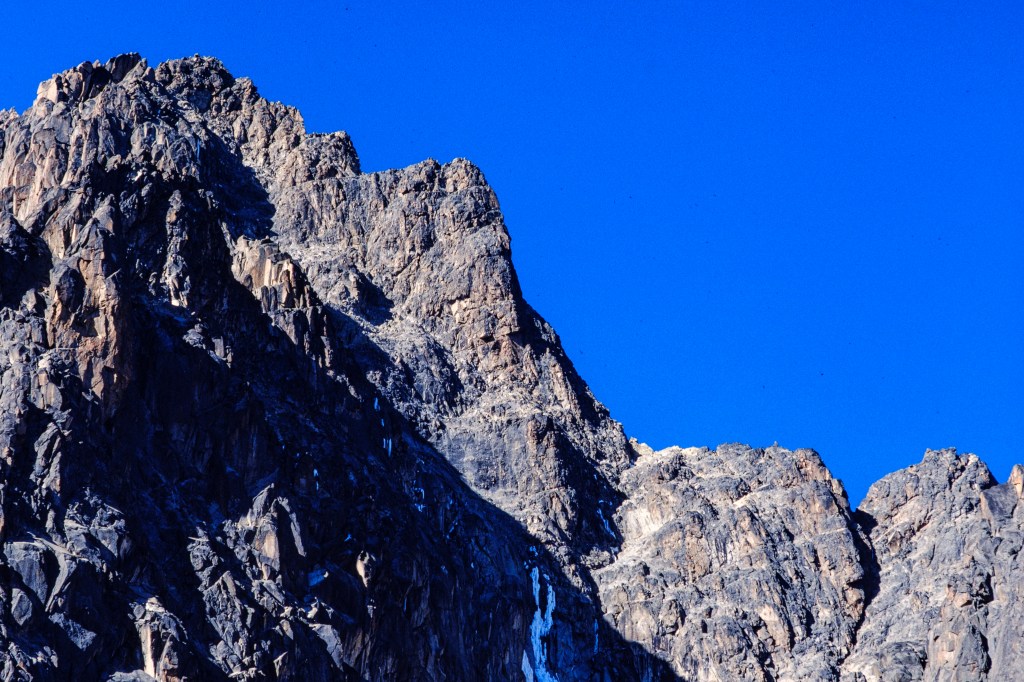
A distant view of the final section of the West Ridge. Batian on left skyline. Firman’s Tower is the pinnacle about 25% of the way from the right margin of the photo.

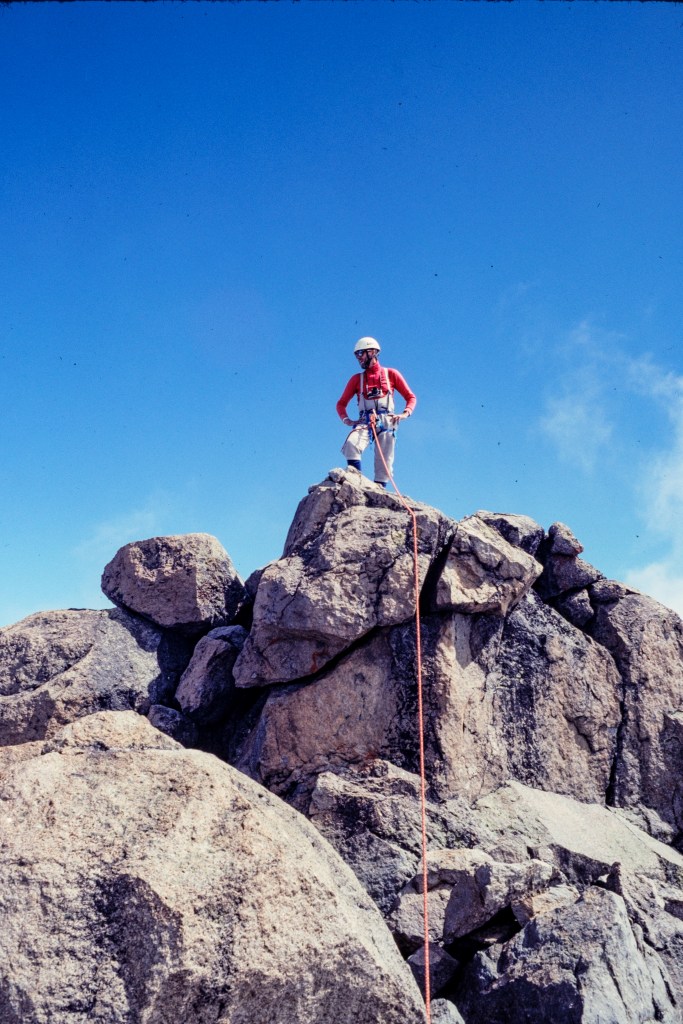
At 2:50 pm we are on top of Batian, 17,055, the summit of Mt Kenya.

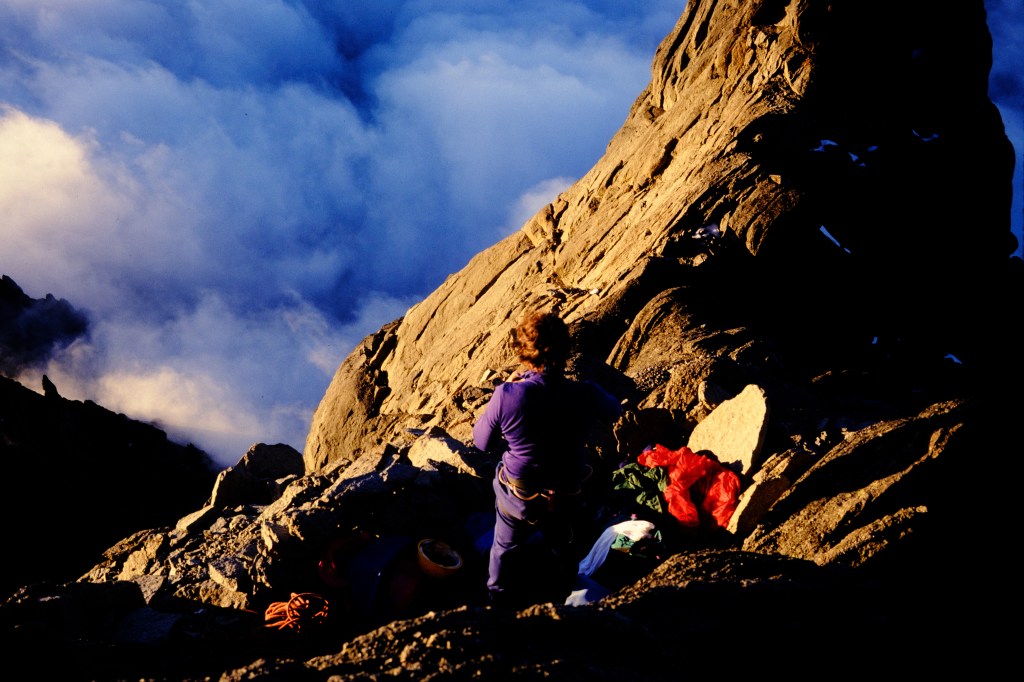
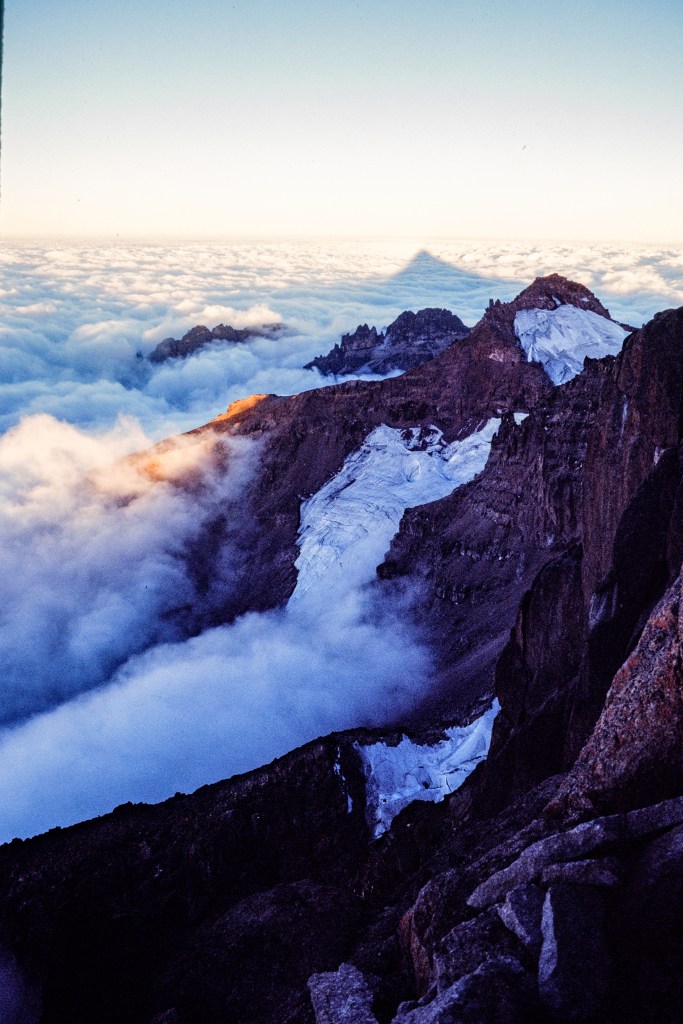
            We have been moving for 9 hours. We decide to descend the standard North Face route. Back to Shipton’s notch, then further, then downclimbing and 2 rappels. We make a mistake — we follow old rappel anchors down, but they lead nowhere. We have to climb back up. We are tired and want to rest. But no whining or cursing. Back up two hundred feet, on to the North Ridge, 2 more rappels, and we find flat spots near Firmin’s Tower. We each have a small ledge with a rock wall to keep us from the void. It is 6:40 pm. The shadow of the peak falls on the clouds below. By 7 it is dark. The temperature plunges.

Bart gets ready for a cold night.

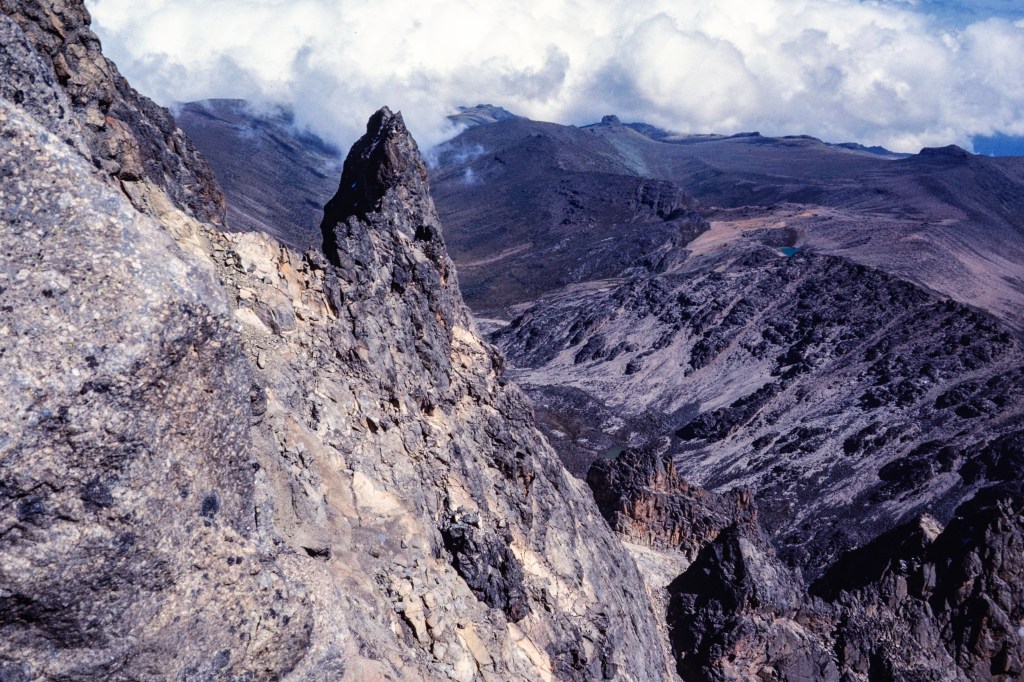
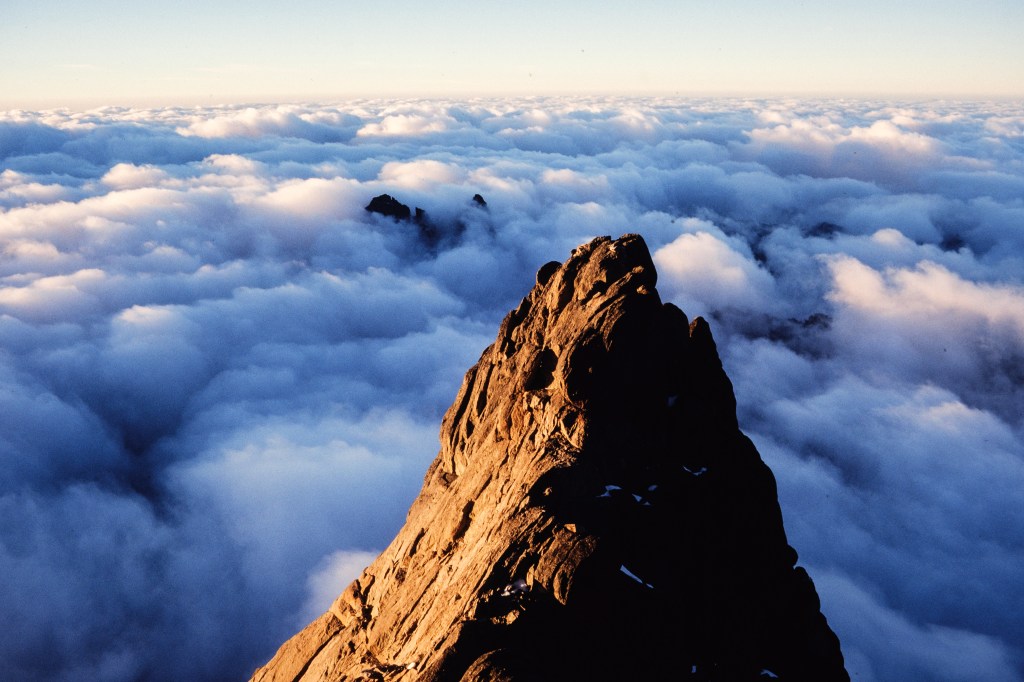
Top of Firman’s Tower.

Shadow of the summit on top of clouds.

July 26

            The equatorial night was 11 hours; I slept 4 hours. I shivered from 3am to dawn. Finally, the sun warms us. I finished all my water the previous day. Bart saved a pint, but it froze in his bivy sack; he cannot drink the ice. Below, Bart sits up as the sun reaches him.

We start down at 7:45am. First, 6 rappels.

Concentrate; no more mistakes. Scramble down an amphitheater. Two more rappels, then climb down a gully, then 2 more rappels. At 10:30 we are walking. Water flows from the Krapf glacier. We drink and drink and drink. By noon we are in camp. Rest. We are so happy. 12 hours of sleep. July 27 is a rest day.

Around the mountain

July 28

            We move camp. No porters now. But we are fit and 11 days of food are gone. Bart’s load is 100 lb., mine is 75. In 4 hours we hike to the south side of the mountain, set up camp. Nearby is a group of 12 friendly British climbers; medical students and registrars from St. Mary’s Hospital in London.

Bart with 100 pounds of gear.

Hausberg tarn on left, Oblong tarn on right. Trail in middle.

Emerald Tarn.

Darwin Glacier, Pt. John.

West Ridge on left skyline. Tyndall Glacier, Tyndall Tarn.

The British camp, with dining tent, outhouse, etc.

Our pathetic little camp. Bart shakes fresh snow off the tent fly.

Final climbs and hikes

July 28-31

            Rain, mist, snow. Dayhikes, scrambles up peaks named for Shipton and Tilman. The Brits invite us to dinner. We exchange stories and get to know them.

Batian seen on left, Nelion in cloud on right. Gates of the Mist in between. Diamond Glacier and Diamond Couloir below the Gates.

Climbers in the Diamond Couloir.

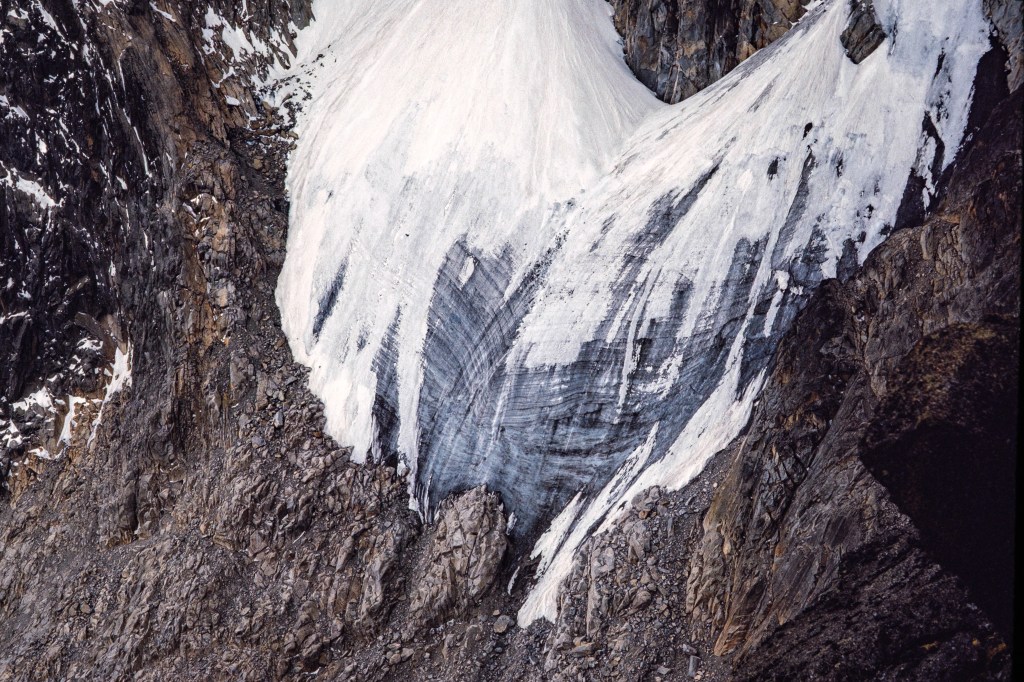
Tyndall Glacier.

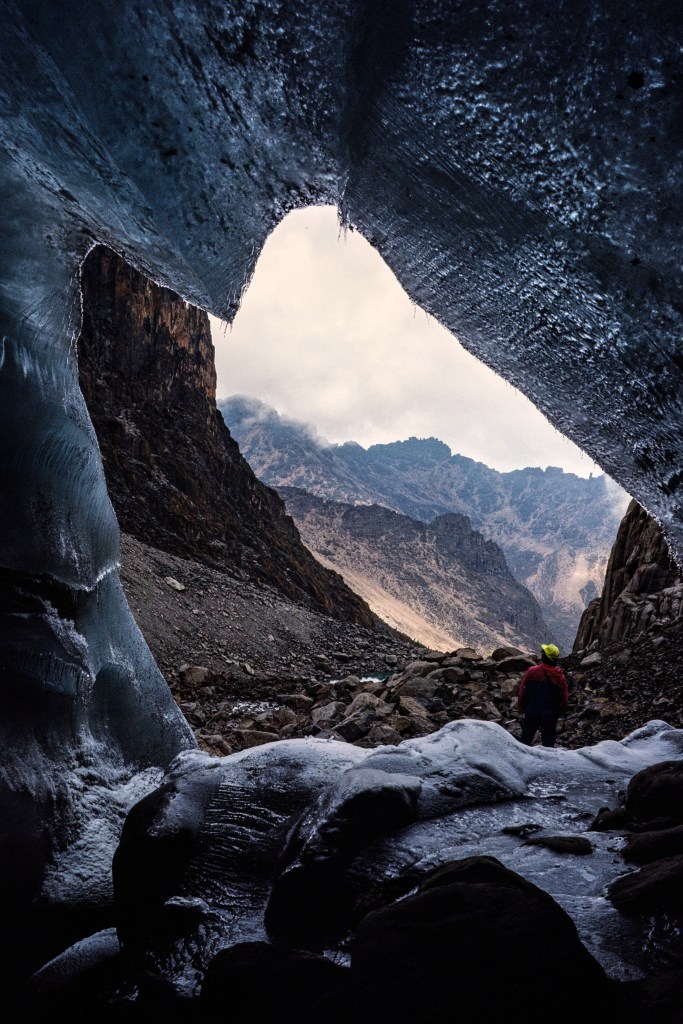
Ice cave.

We climbed Shipton Peak and Tilman Peak in mist.

Tragedy

Aug 1

            Four of the Brits hiked around the mountain on July 30, then climbed the North Face route to sleep on ledges above Firmin’s Tower. On July 31 they headed to the summit. Bill was leading, roped to Elunid. He slipped, yelled “Oh my God,” and flew downward. Elunid was not anchored, so the rope yanked her after Bill. Jim and Jed searched the area; they found blood, but no bodies. They descended. Now the Brits want us to help find Bill and Looney. We gather gear, quickly hike around the peak. Bart and I opt to climb the Krapf Rognon (15,748), a rock hulk, and use binoculars to view locations further east of the searched area. Our guess was right. We spot the broken bodies in a giant gulley. I cry for a while. We scramble down and tell others at the Kami Hut. John Omirah, a climbing ranger for the park, is in charge. (He played the role of a tracker in the movie, Gorillas in the Mist. Sigourney Weaver played Diane Fossey.) He says porters will remove the bodies the next day. Bart and I hike back to camp.

The North side, with West Ridge on skyline. The Krapf Rognon is the bulky rock blob in the lower left of photo.

The bodies.

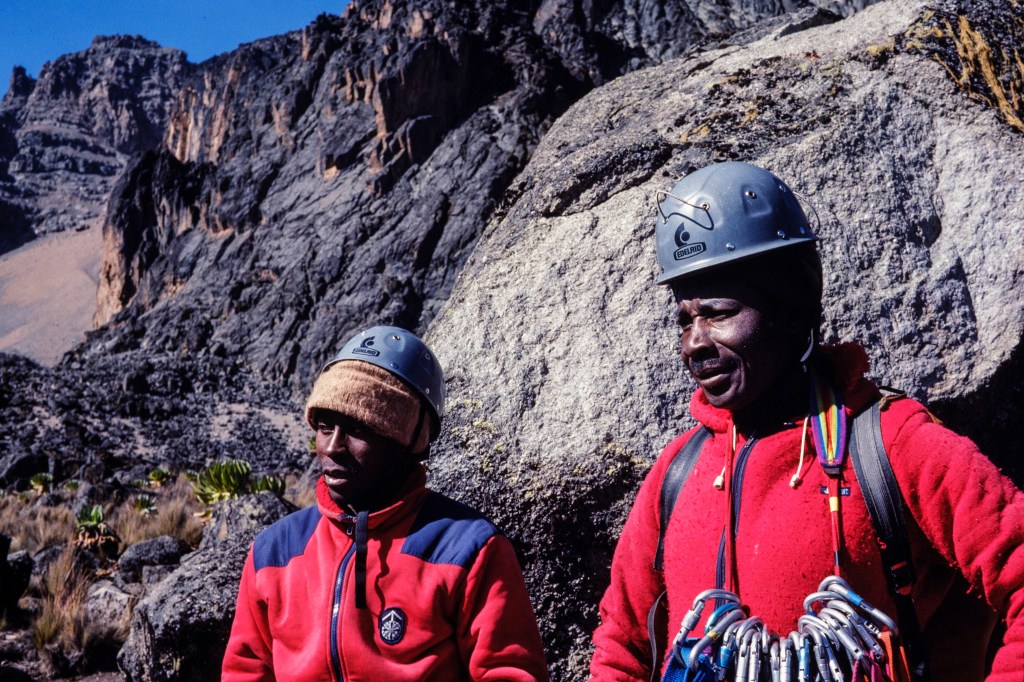
Park rangers. John Omirah on the right with helmet.

Aug 2

            We sleep in, but John Omirah wakes us. The bodies lie above a 100 foot cliff and porters cannot reach them. Can we help? At 7:30 we leave and by 9 we are at Kami Hut. We collect some ropes and reach the base of the gully by 11:30. Bart leads up and places an anchor. Omirah and I enter the gully — steep, loose, dangerous. I’ve never seen humans pulverized like this. We drop the bodies below the cliff, where they can be retrieved. By 2:30 we are done. All of us are shaken. A cup of tea at Kami Hut, then 2 hours back to our tent.

            What can we say about these senseless deaths? One strategy is to find mistakes. The recent rain and mist made verglas likely, especially in the morning. Bill probably slipped on ice that he never saw. There were no anchors, so once Bill fell, Elunid was doomed. Bart and I climbed through this area on July 25, using belays and anchors. You will be safe if you just avoid mistakes.

            This blame-the-victim approach is common. An annual report, Accidents in North American Mountaineering, is published by the American Alpine Club. This is a ghoulish litany of deaths in the previous year. Accounts are followed by a list of mistakes that were made. When I started climbing, I began to realize that some “mistakes” were irrelevant. For example, a solo hiker would stumble off a cliff and die; the analysis criticized the hiker for being alone. But 1) had there been a companion, the hiker would still have died and 2) are we supposed to never go alone? Over the years, the reports became more thoughtful. Less “that would never happen to me” and more “but for the Grace of God…” Often the dead were doing what many climbers would do. And ran out of luck.

            Another way to think about climbing deaths is to acknowledge that climbing is insanely dangerous – it is all a mistake. Climbing, like any sport, has no useful objective; put a ball in a hoop, run fastest to the tape, reach the summit. Sport is for amusement, challenge, diversion. When you step into the batter’s box or the starting blocks, your risk of death is minimal. That isn’t true for climbing. Some climbing magazines have obituary columns; most of those listed are young. I’ve done over a 1000 climbs. Friends died on expeditions with me and on domestic peaks. I’ve stepped over frozen bodies. I’ve seen climbers die. I’ve narrowly missed death several times. Why did I accept these risks? Was it an addiction – foolish, but irresistible? A type of gambling in which the bet limit is your life?

            Edward Whymper wrote, “Climb if you will, but remember that courage and strength are nought without prudence, and that a momentary negligence may destroy the happiness of a lifetime. Do nothing in haste; look well to each step; and from the beginning think what may be the end.” Poetic advice, but illusory. If you climb, haste is often necessary and unbroken prudence is a fantasy. Want prudence? — stay home. I don’t believe life should be risk-free or that the person who lives longest wins. But the chances many climbers take, myself included, seem hard to justify.

            While we were on Mt Kenya we came across several metal plaques, affixed to rocks, commemorating dead climbers. They are the alpine equivalent of the white crosses that mark fatal crash sites on highways.

Last climb and hike out.

Aug 3

            I want to stay in camp, but I know Bart wants to climb Pt John (16,020). We make quick work of this peak in a mild snow storm. We are smiling on top. Rappel off and back to camp. I later learn that Bart did the climb because he thought I wanted to go. Dinner with the Brits.

Pt. John.

Peter hangs on and smiles for the camera.

Darwin Glacier.

Peter on top. Diamond Couloir behind his right elbow.

View of the Diamond Couloir.

Aug 4

            A long slog with heavy loads gets us off the mountain via the Naro Moro route. Reach Nairobi the next day. Below, Peter eats food off of his heavy load.

Final view of the south side of Mt Kenya. Batian in center, with west ridge on left. Diamond Glacier and Nelion just right of center. Pt. John in the Y of the dead Groundsel limbs.

            The West Ridge of Mt Kenya is one of my favorite climbs; 30 hours of exciting effort. But the meaningless deaths cast a shadow on this memory.

Anecdote from my 1984 trip: 

            Brad Neiman and I shouldered giant packs (about 90 lb. each: 10 days of food plus camping and climbing gear) and began a 3-day walk to reach the peak via the Chogoria route; a scenic path which we had to ourselves. We staggered along in the forest and found a sleeping Cape Buffalo that was 25 feet away. He stood up and looked grumpy. This animal weighs 1500 lb. Wikipedia says: “One of the “big five” African game, it is known as “the Black Death” or “the widow-maker,” and is widely regarded as a very dangerous animal. According to some estimates, it gores and kills over 200 people every year…” Brad was a little ahead of me; with just a few steps he vanished into the jungle. I stupidly stood there and lifted my camera to take a picture. Brilliant! The buffalo charged; I turned and waddled away, knowing that I would be gored and trampled in two seconds. But after 100 feet, I was still alive; I looked back and saw the buffalo had stopped — I circled past the buffalo and joined Brad.

Mount Waddington — The worst night, the best day

I’ve photographed birds for 5 years. Previously, for decades, I spent time as a mountain climber/photographer. I’ve done over a thousand climbs and I spent years shooting Kodachrome slides on five continents. This article is about Mt. Waddington, my favorite climb.
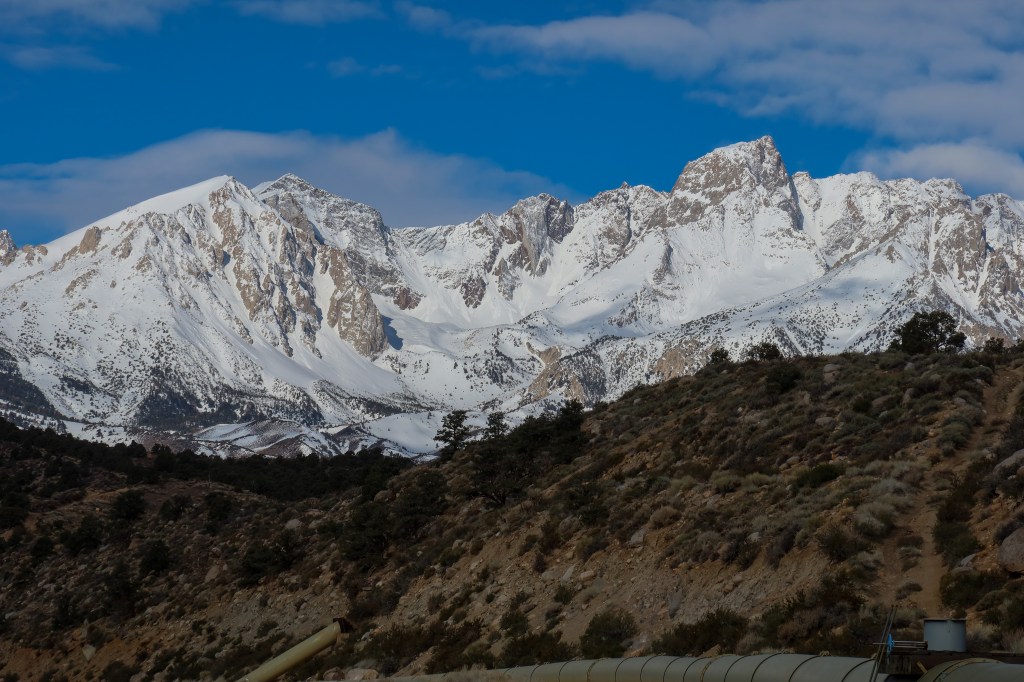
            Mt. Waddington is in the British Columbia Coast Range, between the Klinaklini and Homathko Rivers. Bad weather and the remote location conceal the peak; it was not discovered until 1925. At 13,186 ft, it is higher than any peak in the better-known Canadian Rockies. For a decade, climbers from the US and Canada attempted to reach the summit. The peak was known to climbers during this competitive era and it is featured in books about the history of climbing in North America. Two US climbers, Fritz Weissner and Bill House, reached the top in 1936. Many climbers today are unaware of this isolated area. This is a region of dangerous rivers, dense forests, giant glaciers, and grizzly bears.

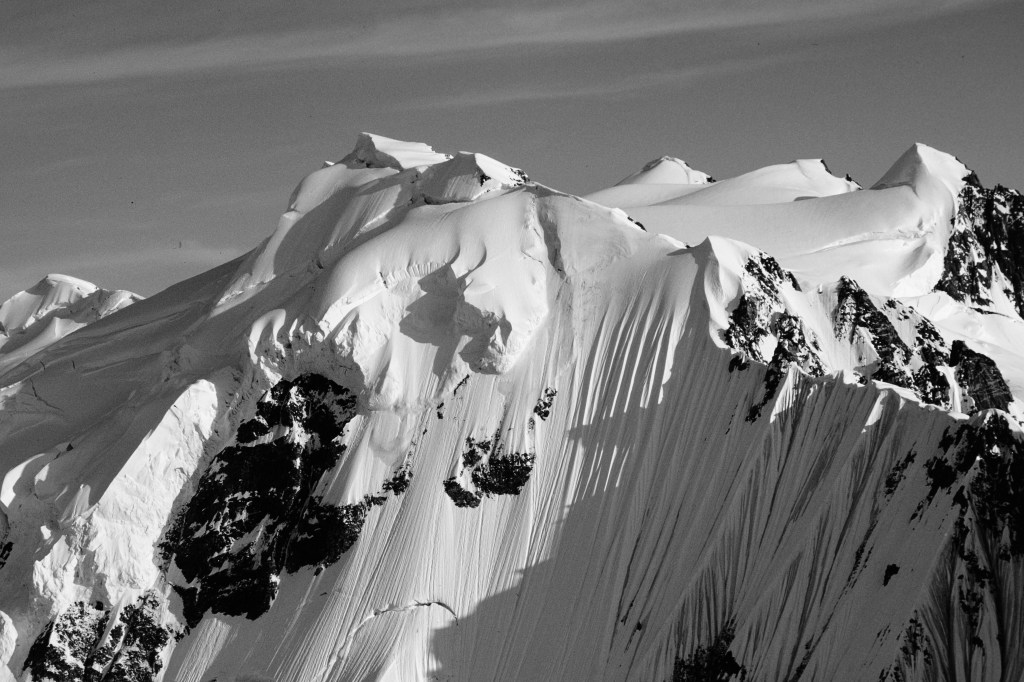
Waddington rises 7000 feet above the Tiedemann Glacier


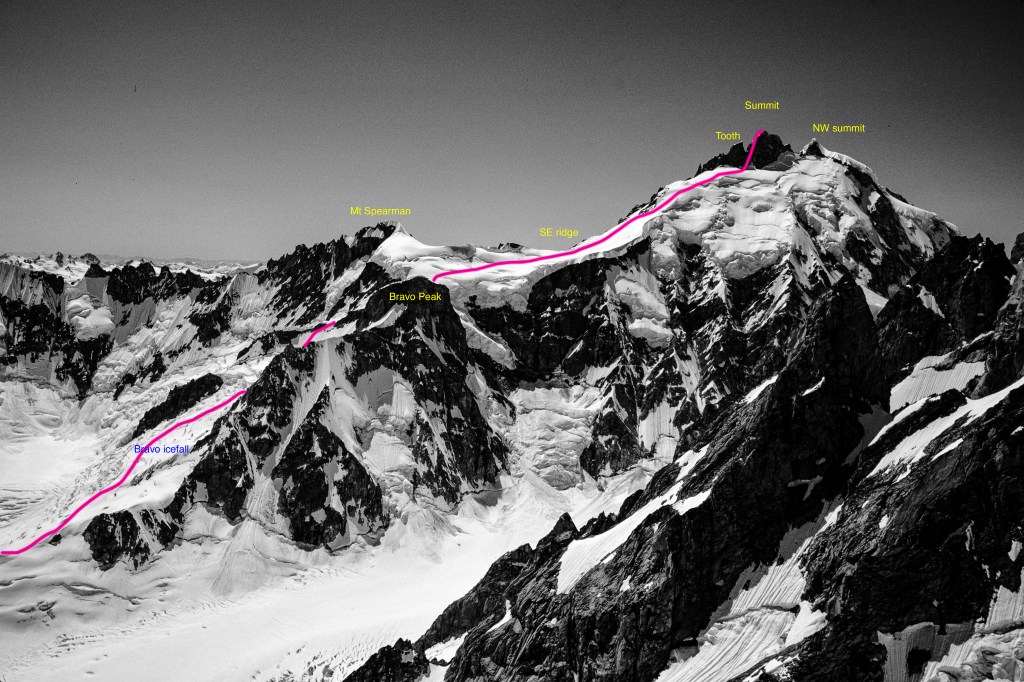
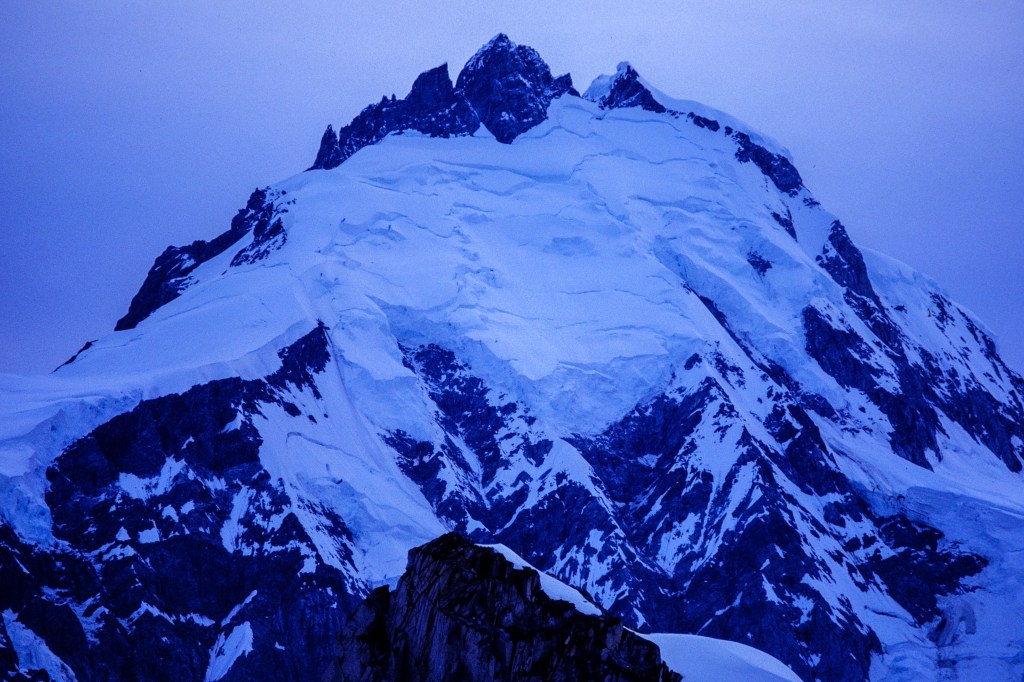
The usual route to the top is marked.
View of our route from where the helicopter landed.
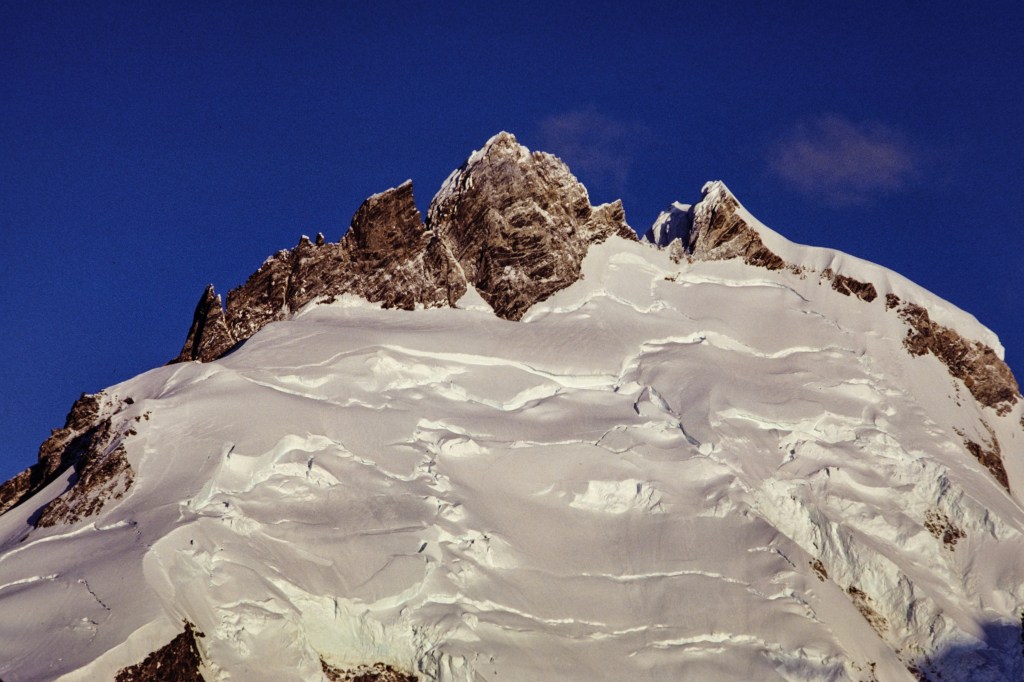
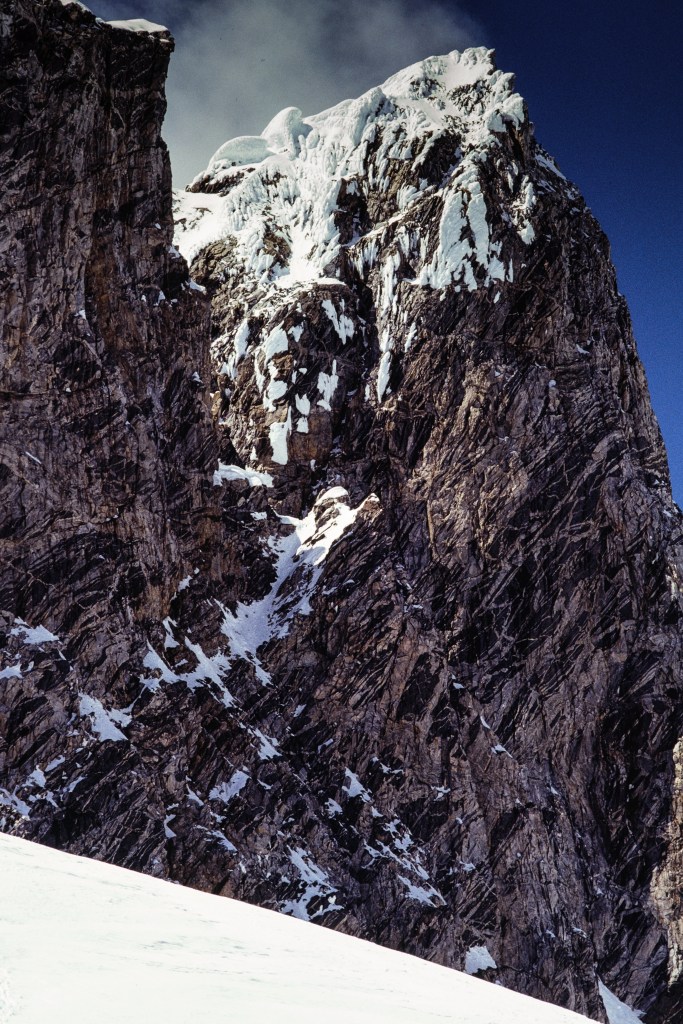
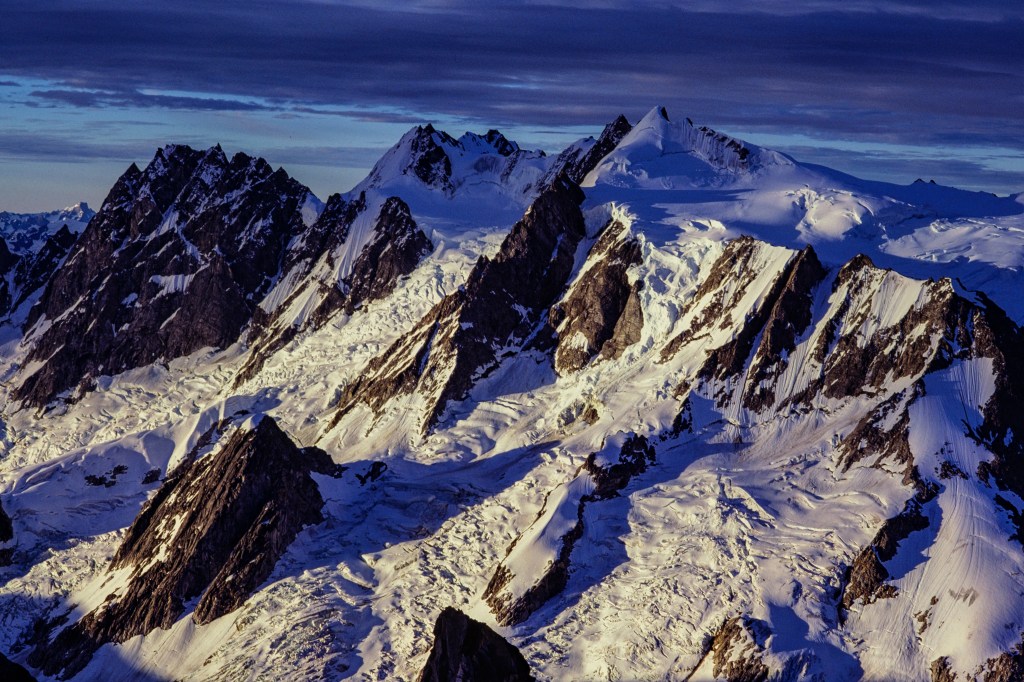
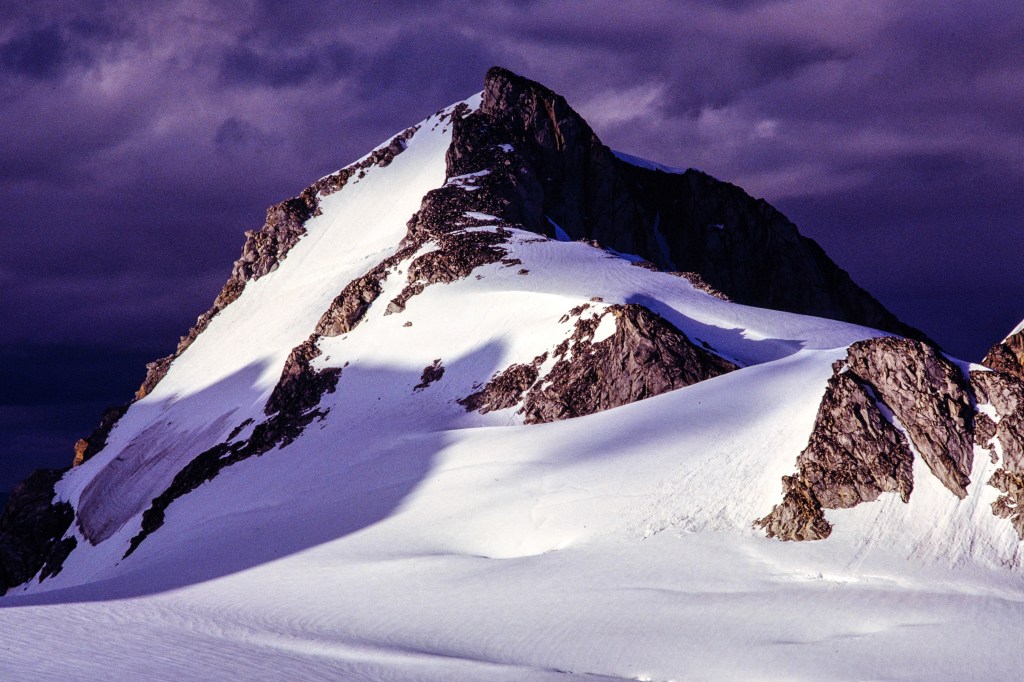
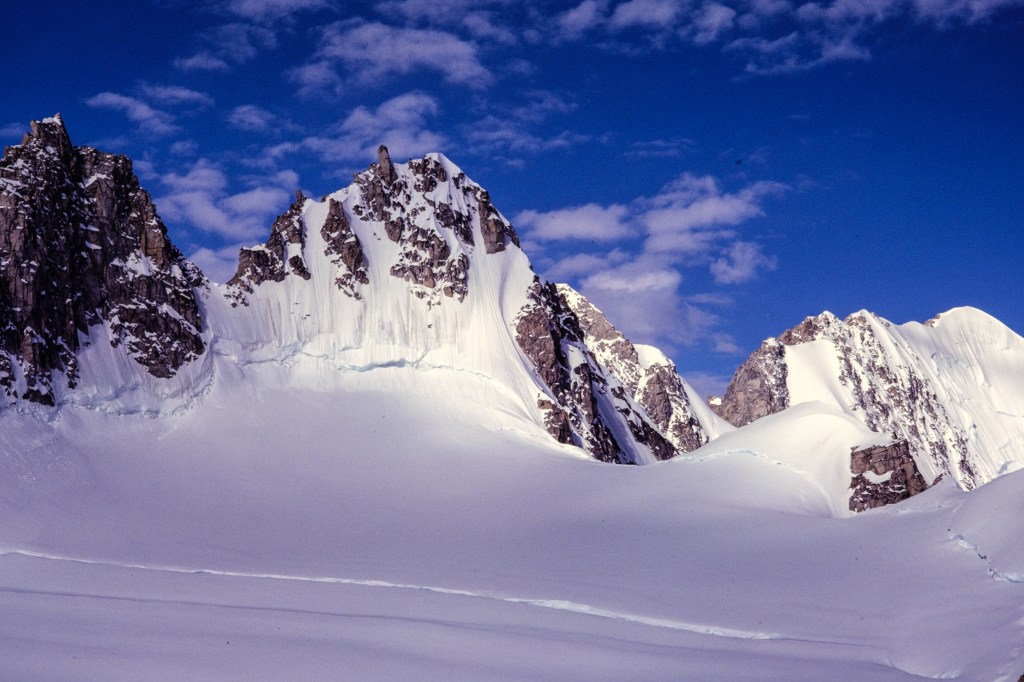
The upper part of the mountain. Central summit tower is about 1000 feet tall.

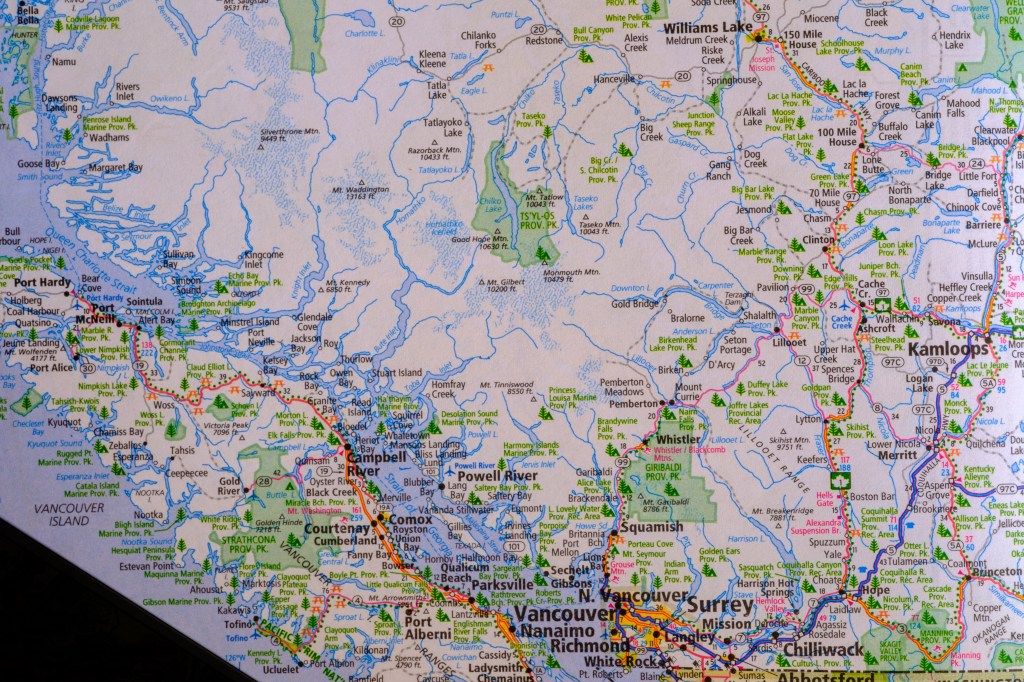
The map below shows Waddington is about 100 miles northwest of Vancouver. To get there in 1980, you had to drive about 500 miles; first east on Highway 1, then north to Williams Lake, then west on gravel road to Tatla Lake, past towns with Russian-style churches, then south to the helicopter service owned by Mike King.

Our 1980 attempt

       I learned of Waddington when I started climbing in 1967. By July 1980, I had 100 climbs under my belt, including Denali and big peaks in Peru and Asia. Chris LaRocca (then a college student) and I decided to tackle Waddington. We flew by helicopter to the Tiedemann Glacier at the base of our route. As the chopper circled to land, I saw a world of rock and ice; stunning, but intimidating. No plants, little color, no life. This was before satellite phones and personal locator beacons; if we had trouble, no one was going to help us. I considered asking the pilot to just fly us back out. But we stayed for 2 weeks.

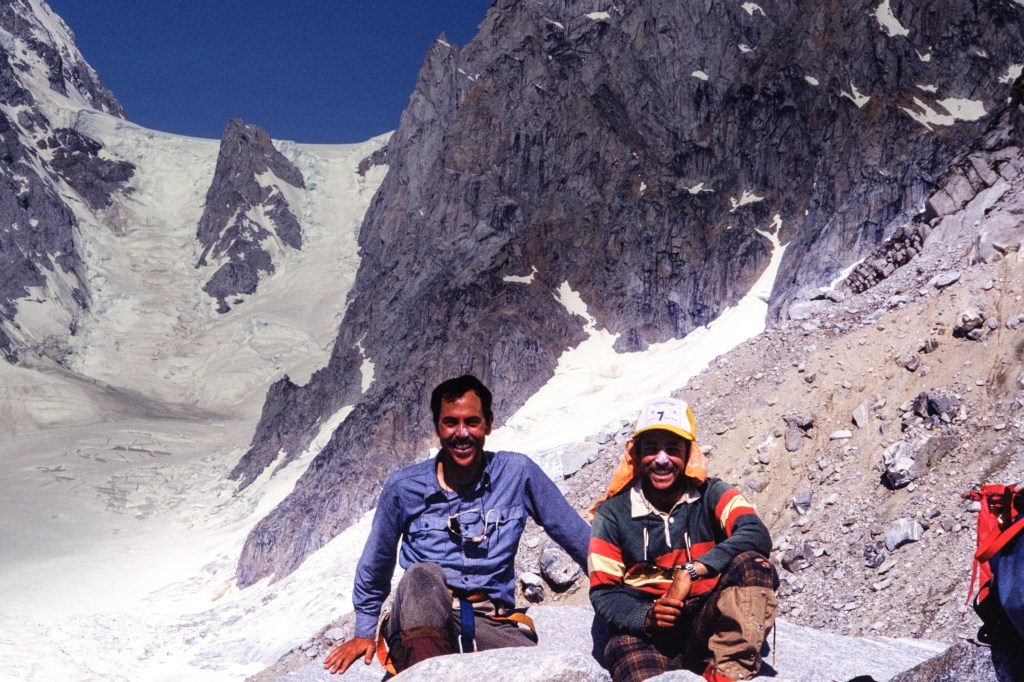
I am in the blue shirt. The other guy is Chris. We both have zinc oxide on our noses. This portrait taken at the Plummer hut, after our time on Waddington.
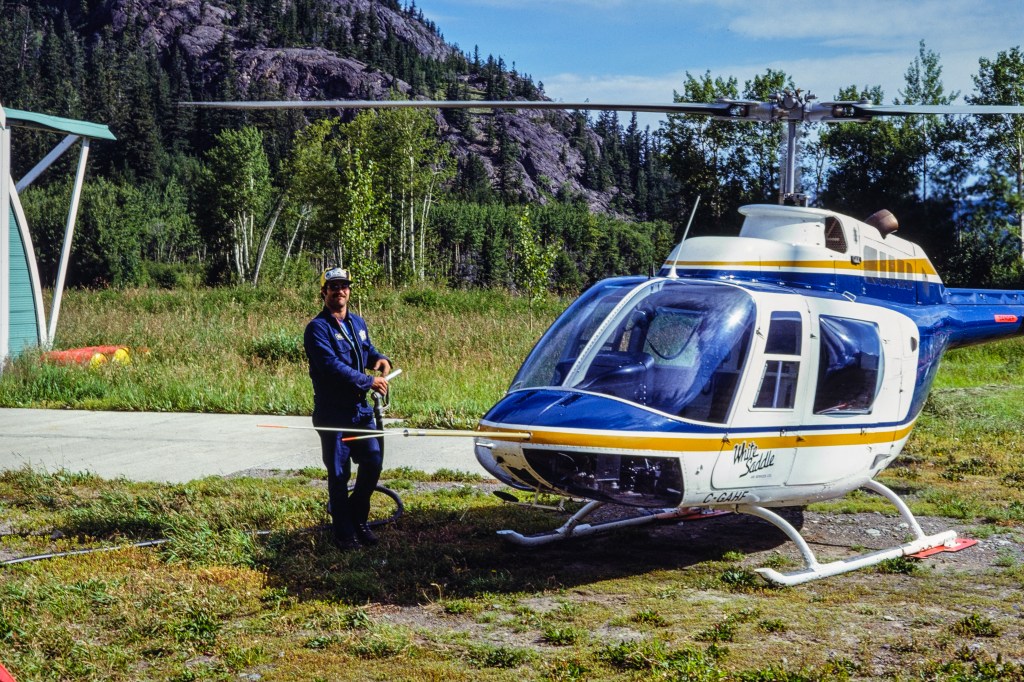
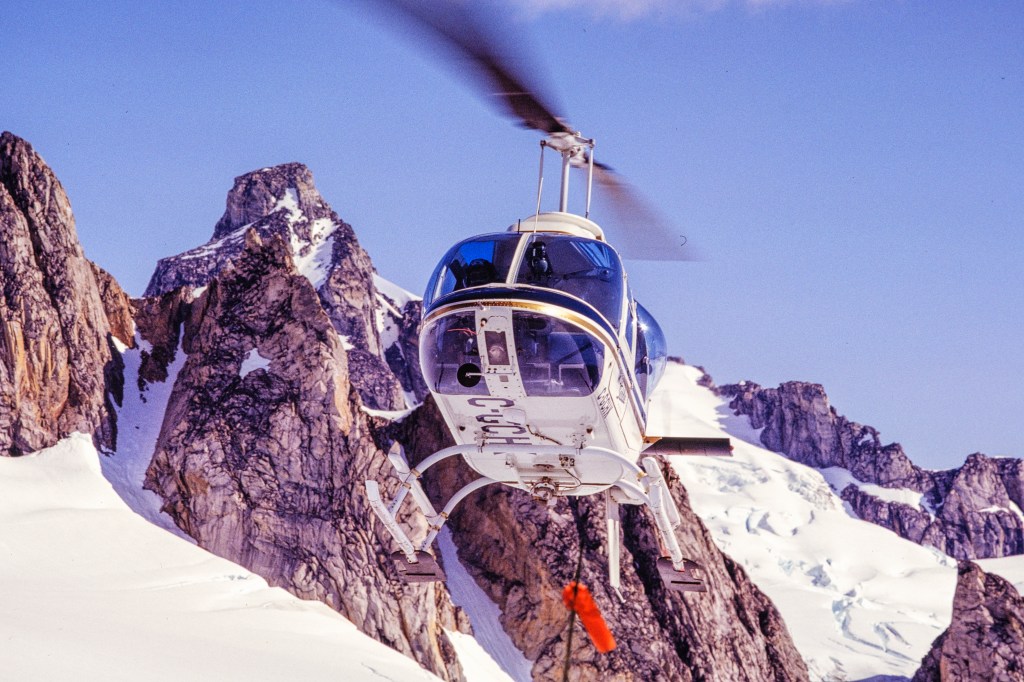
Mike King of White Saddle Helicopters
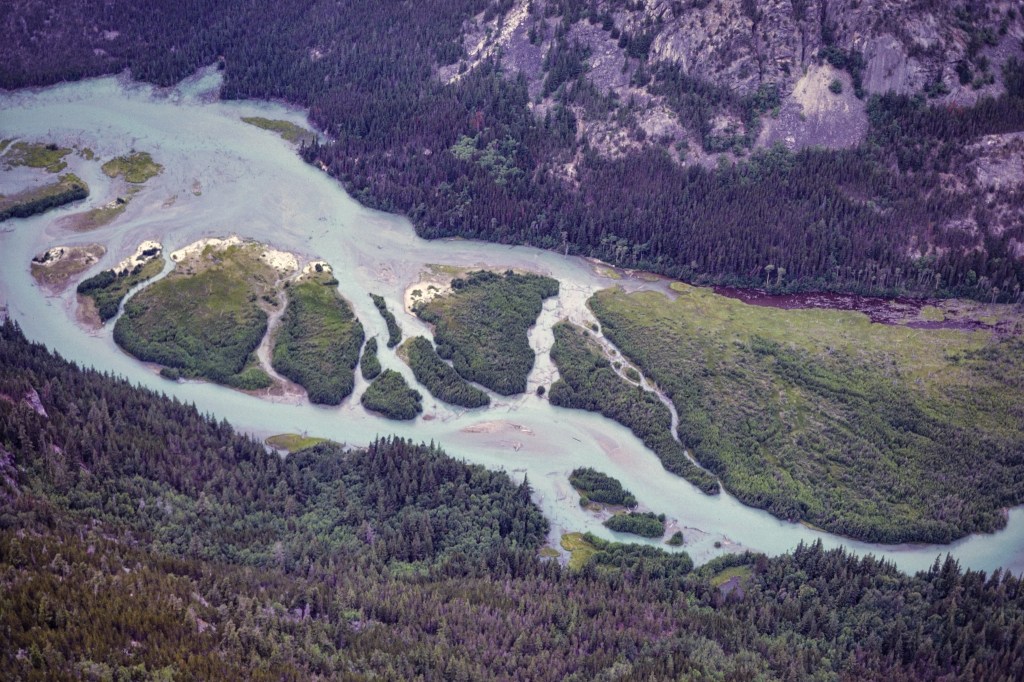
The helicopter flew over this terrain. To get there on foot would be a nightmare.
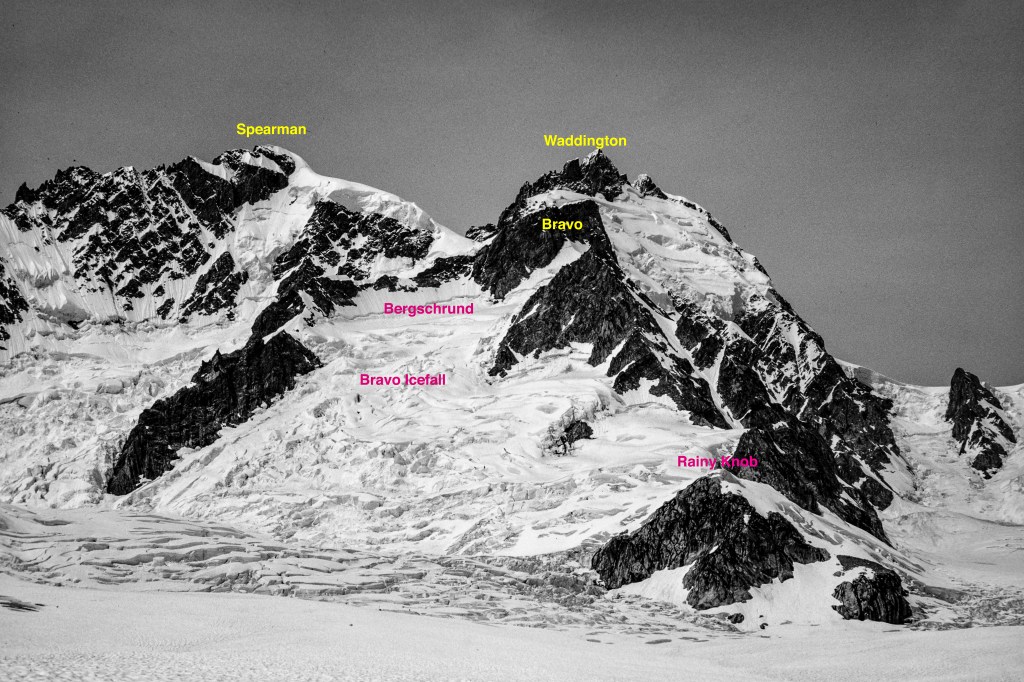
Rainy knob is the low hill of rock and ice in middle foreground. Behind it is the Bravo Icefall.
Tent, gear, and Chris, on Rainy Knob.

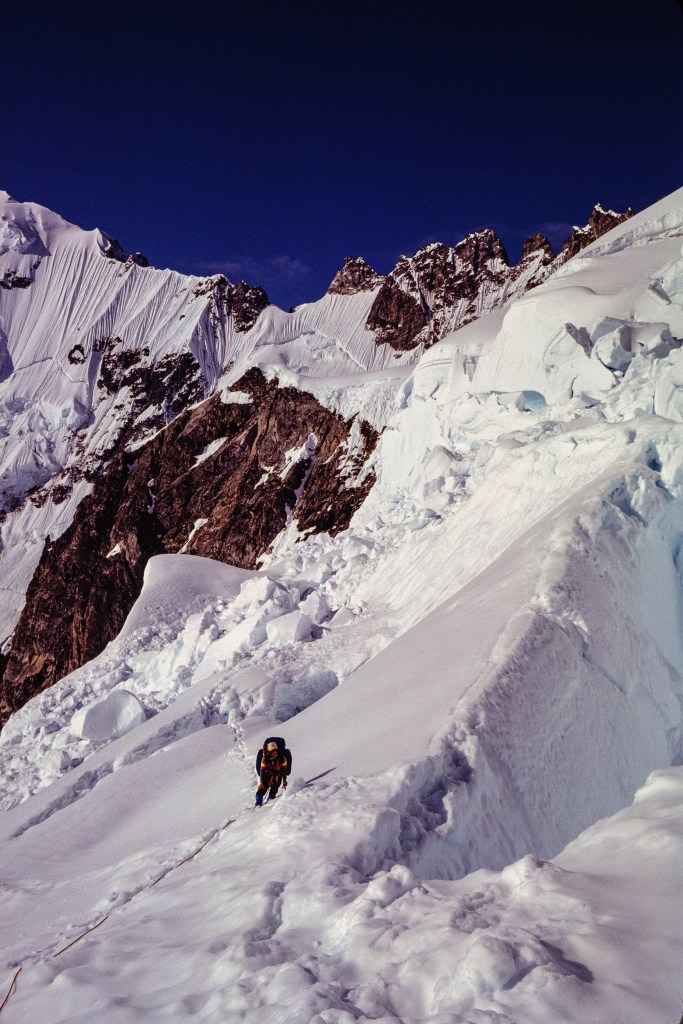
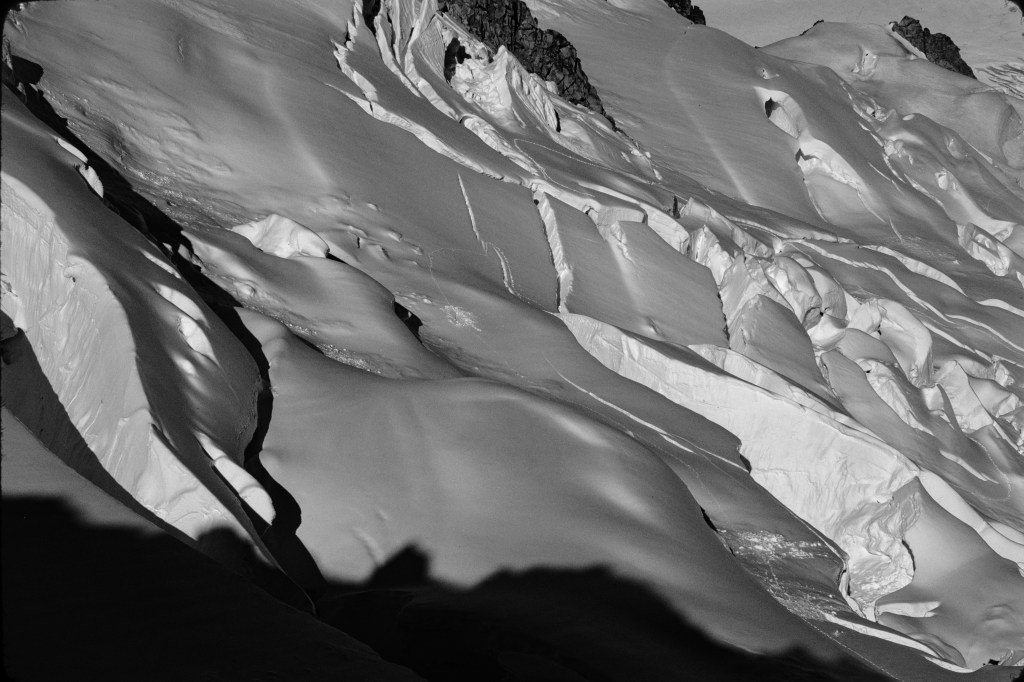
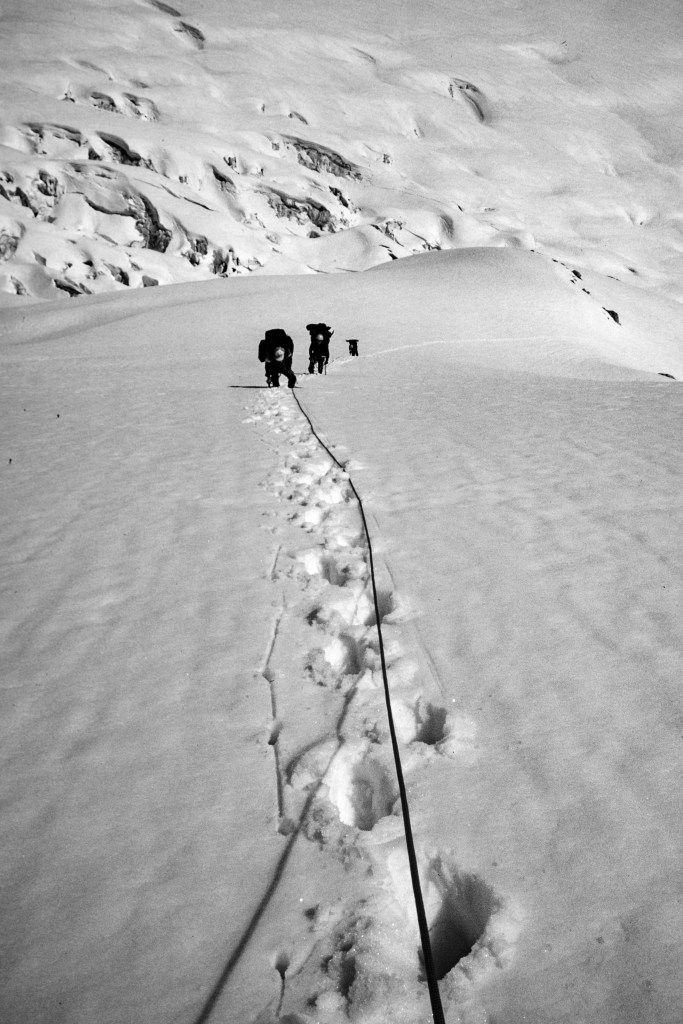
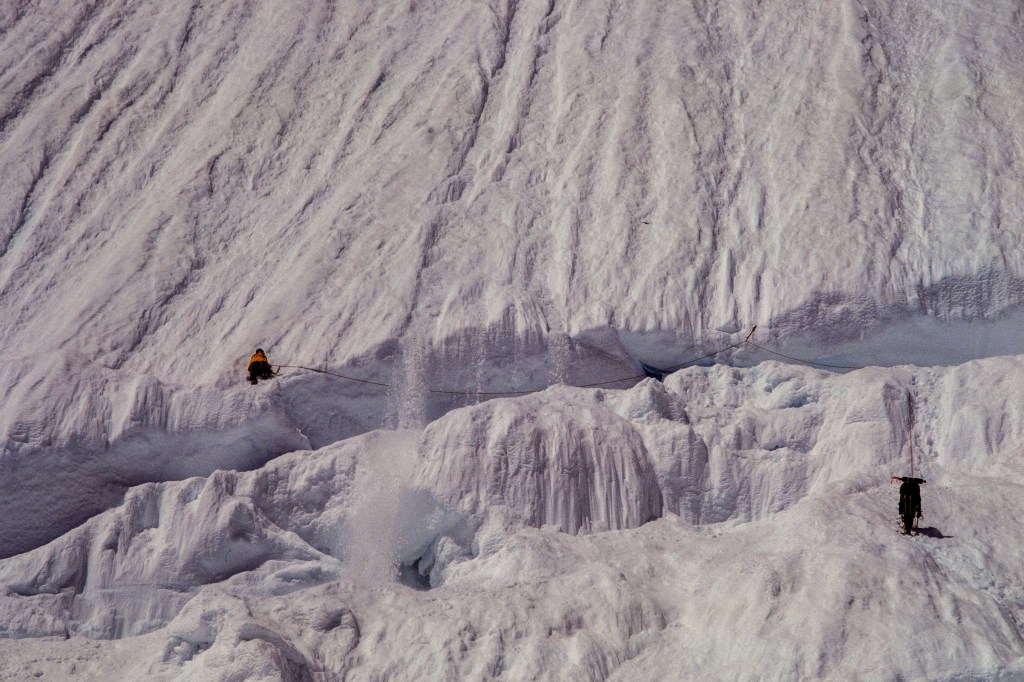
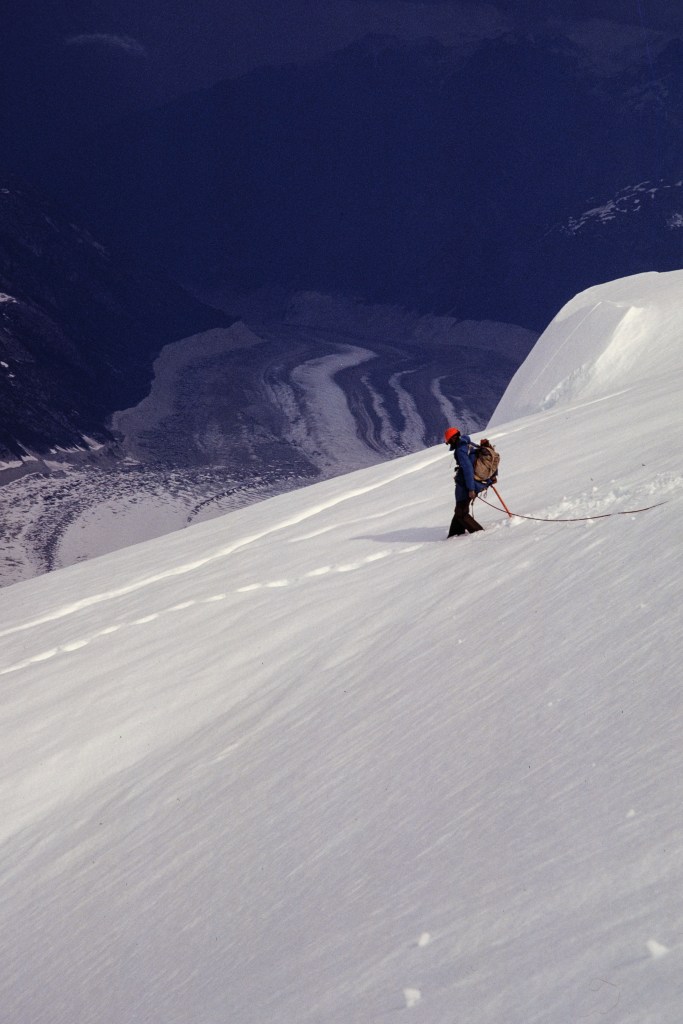
For the next two days we weaved through the crevasses and seracs of the Bravo Glacier. Four Canadians died here in 1960, crushed by falling ice.
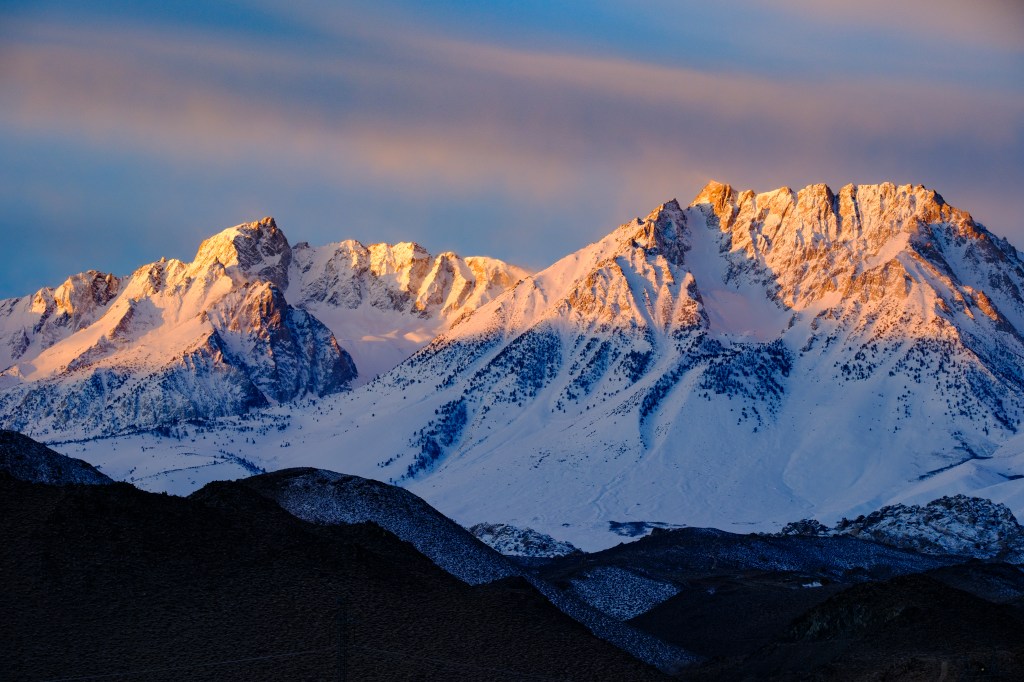
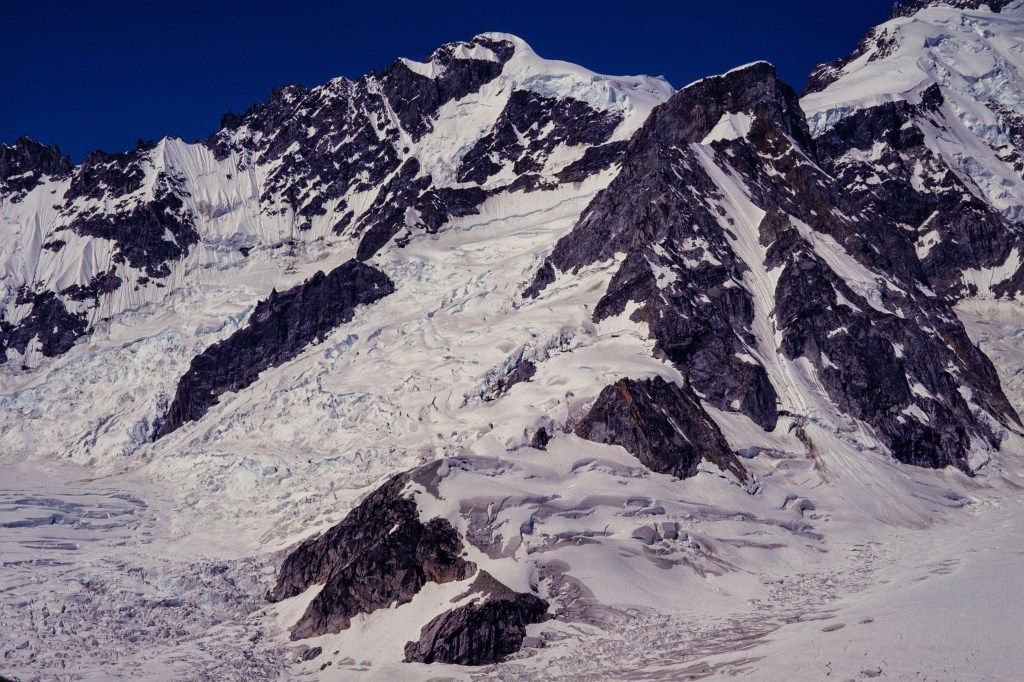
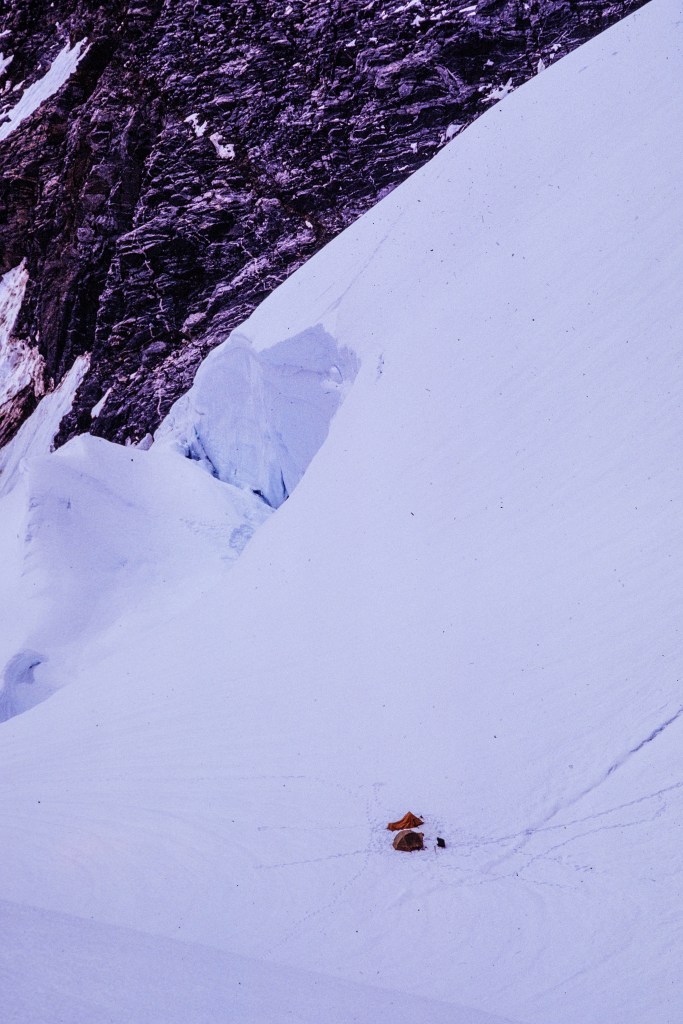
Bravo Icefall. Try to follow our track. Can you find one of our dead-ends — look in upper center
This was our high point — we gave up here in 1980.

Although we crossed the Bravo Icefall, we failed to get very far above it. We retreated, crossed the Tiedemann Glacier, and climbed up to the Plummer Hut. We managed to do three climbs from there.

We climbed this slope to the Plummer Hut, which is out of sight in upper right.
Chris carries a heavy load.
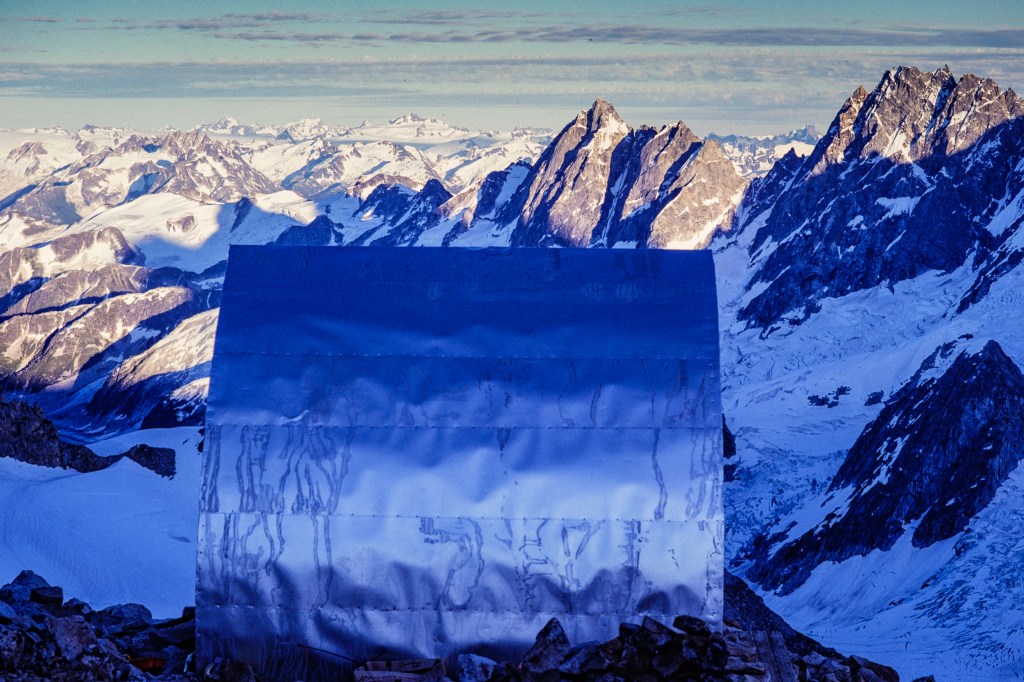
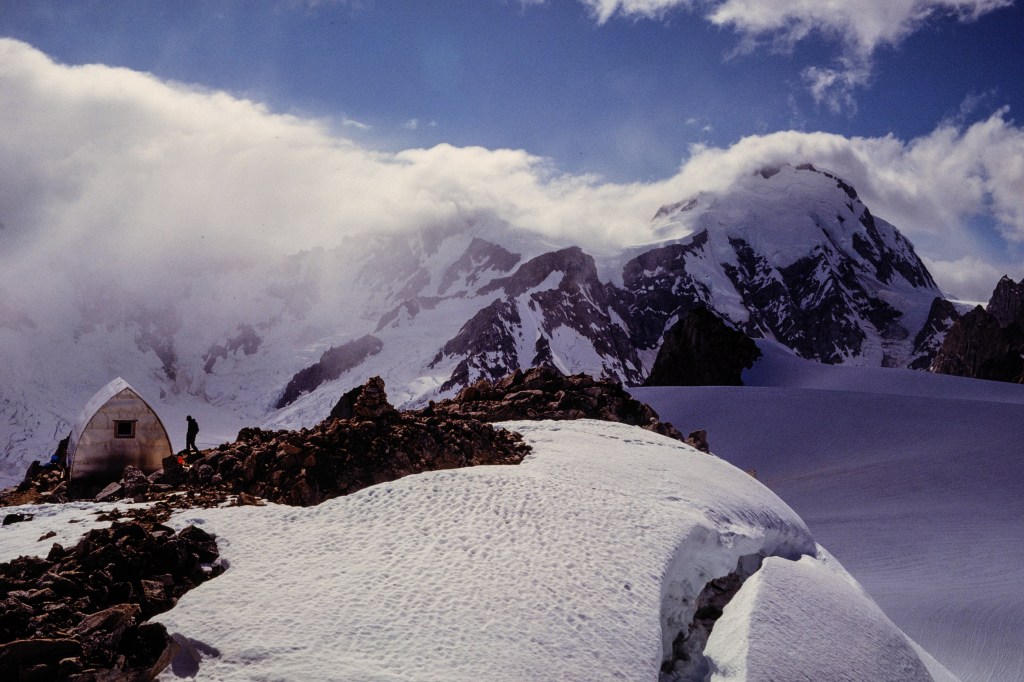
Plummer Hut, built by climbers, in the middle. We climbed Claw Peak, the rock tower on the left.
Tiedemann Glacier on left.
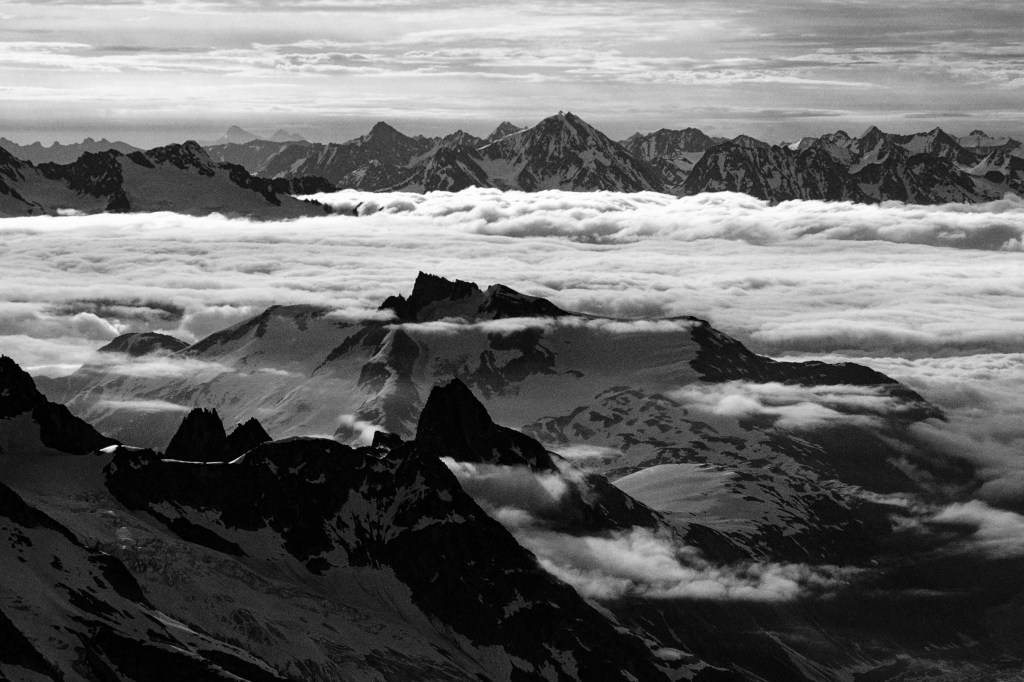
The hut and a sea of summits.
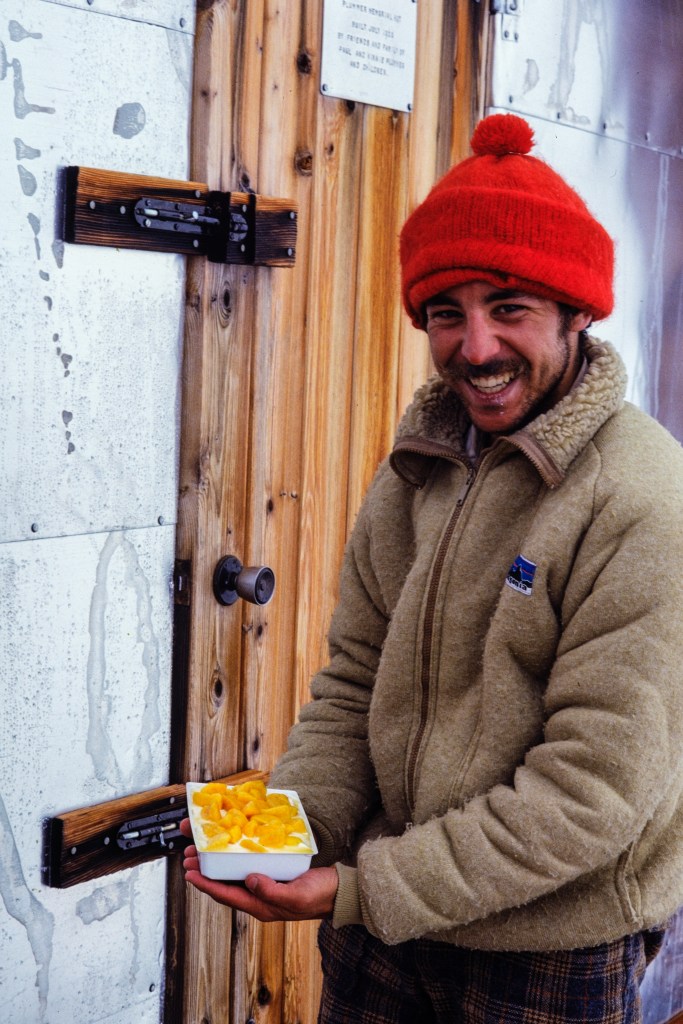
Is this cobbler? Or cheesecake? We were hungry!
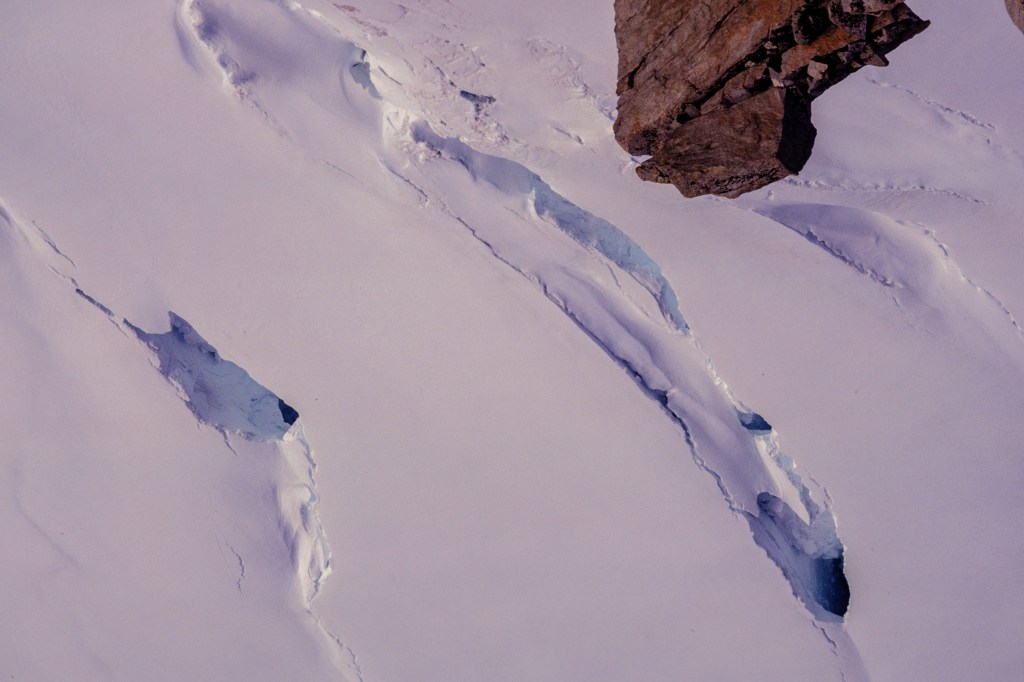
Crevasses everywhere.
Tiedemann Glacier below the hut.

Our 1981 attempt.

After our 1980 failure, we gathered more information and plotted a return in 1981. We invited Gus Benner and Joe Davidson to join us; they foolishly agreed.

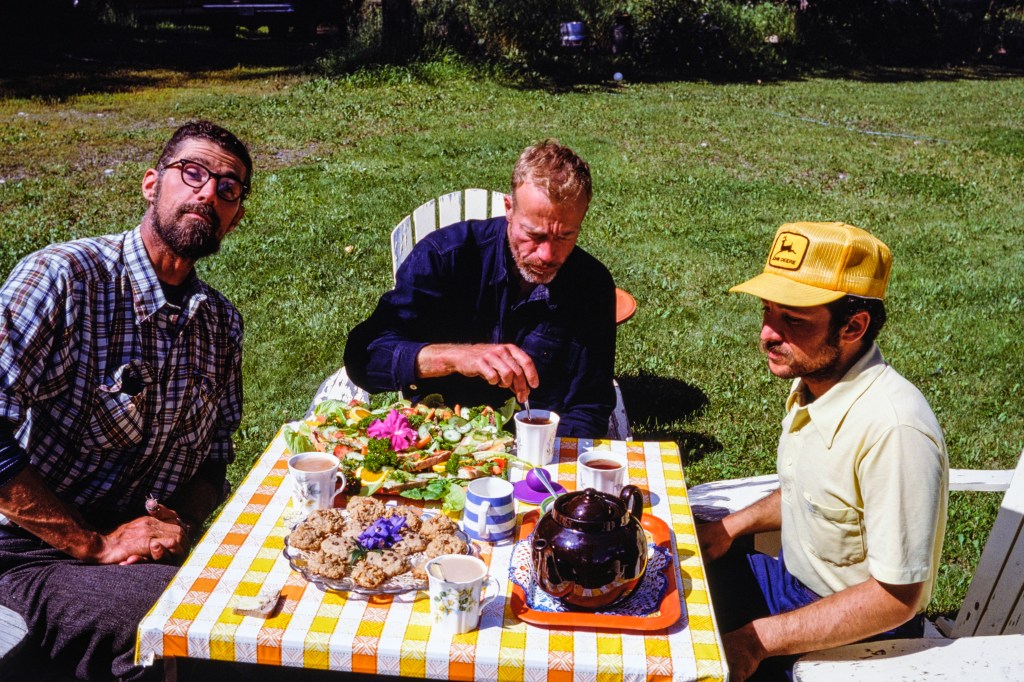
Fine dining at White Saddle Helicopters. Gus mugs for the camera on left, Joe stirs his tea, Chris seems lost in thought.
We climb up to Rainy Knob. Note how deep my footprints are.
Camp on Rainy Knob.
Telephoto view of upper part of Bravo Icefall. Long, diagonal gash in the snow near middle of photo is the bergschrund. We must cross this and climb to the ridge above.
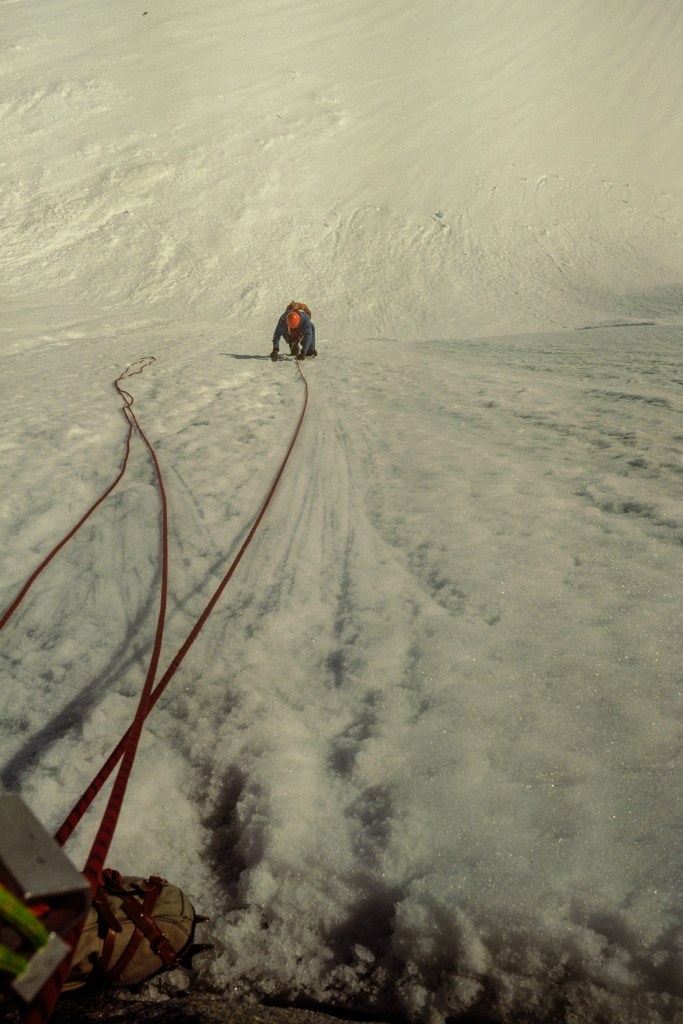
I am trying to cross the bergschrund on the left. I could see way down into the dark depths of the glacier. Gus belays me at the right.
I’m up! Note the small avalanches coming down.
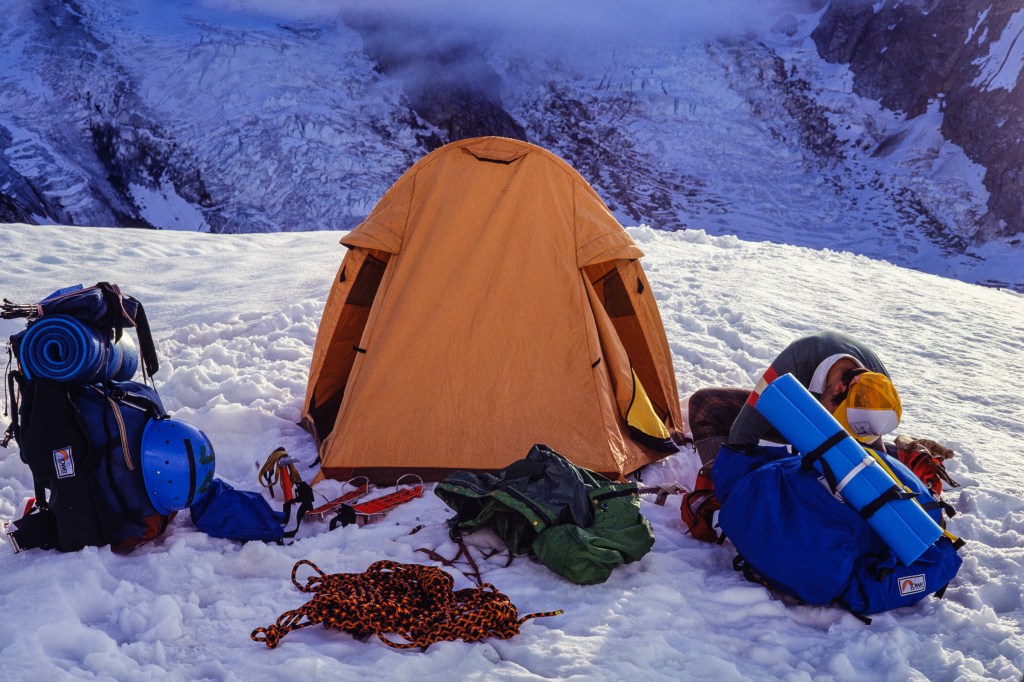
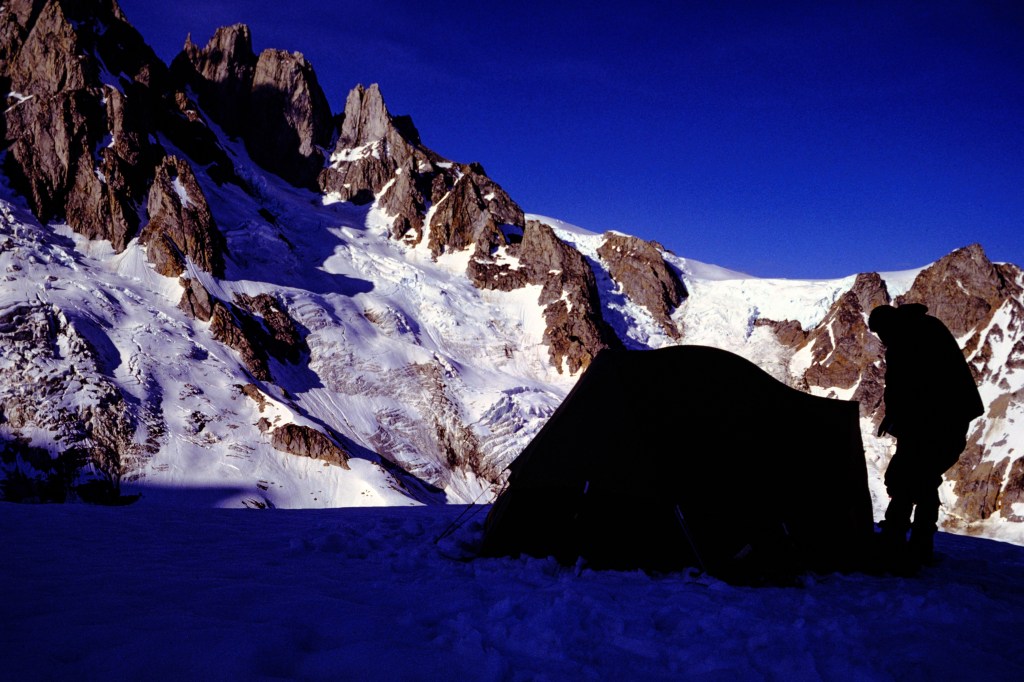
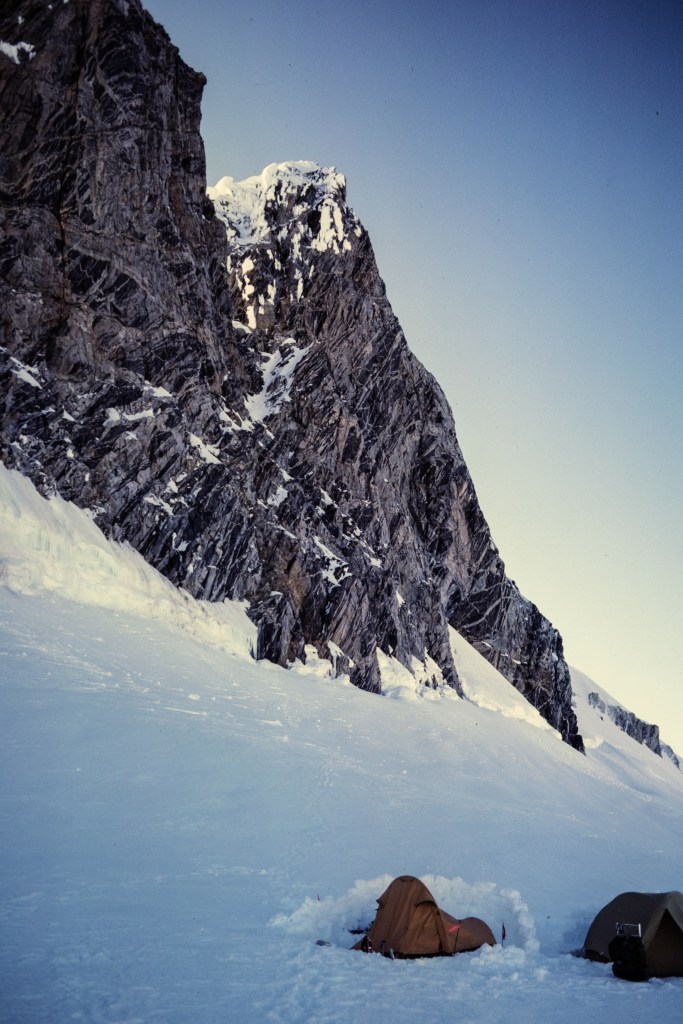
Our tents near Bravo Peak. Elevation. 9800 feet.

The Worst Night

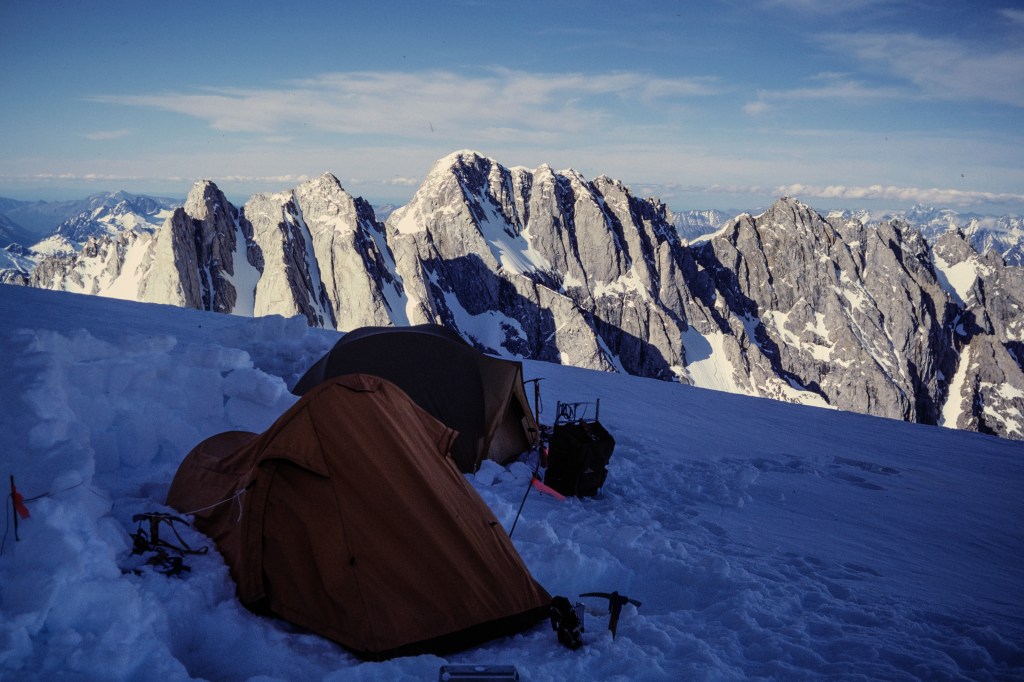
July 17-18. The worst night – pure misery. My diary notes (written July 19) describe this: “We left camp at 5:15am, hoping to make the top. The route winds up steep, crevassed snow slopes. By 10am we were at the base of the summit tower…. We climb about 700 feet of rock and ice, protecting ourselves with ice screws, nuts, and pitons…. At 5pm we made the bad decision to bivy [bivouac = sleep in the open]. Chris and I shared a small ledge. It started to snow heavily at 6pm. We and our gear were tied off to the rock. Chris sat on the pack and I sat on the rope. [In the photo below, we were sitting on the summit tower, to the right of the gap between the Tooth and the Summit.]

            “What followed was the most miserable night of my life. It snowed steadily to 9pm, then fitfully to 2am. My wool knickers were soaked and so was part of my parka. The wind was the worst, bringing unbearable chill. Leaning against the rock wall was too cold, so I sat hunched over my knees all night.

            “…Had the storm gone on full force all night, some or all of us would probably have died from hypothermia. I cannot express in words how agonizing the cold was. All night I shivered on and off, and my teeth chattered. I did exercises to stay warm and used mental games to pass the time. Whenever I checked my watch, only 15 minutes had gone by – I tried to wait longer, but the elapsed time was always just 15 minutes. Chris was the youngest and I think he suffered the most. He asked if we would die. I said ‘absolutely not’ with all the authority I could muster, but I doubt he was convinced.

            “At 4am the sun began to lighten the sky and it was clear we would survive… the sun did not really warm us until 6am and around 7 we slowly stood up and moved about. No one suggested going up. We set up the first rappel and started down about 8:30am. I was still shivering. By 2pm we were off the rock tower. For 3 more hours we slogged back to the tents in wet snow. We repeatedly sank to our crotches and set off wet avalanches. Melted snow and drank the water, then slept for 13 hours.”

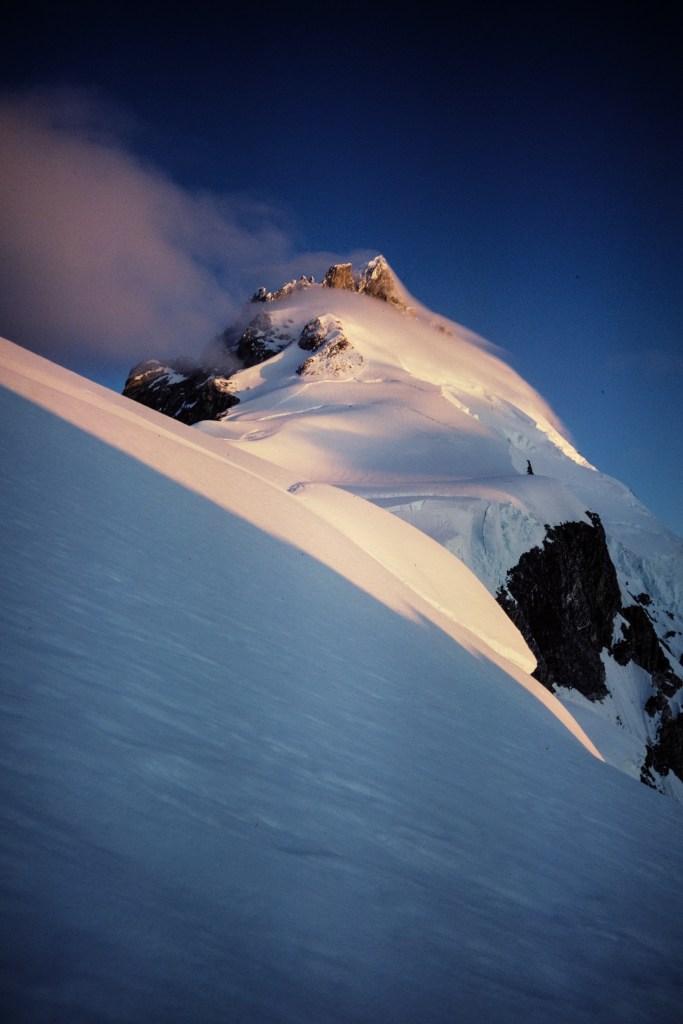
Telephoto view of the SE ridge, on left, and Tooth, Summit, and NW summit towers. Dusk.

July 19. We rested. Chris and I climbed nearby Bravo Peak. On July 20 we moved our camp to the base of the final tower, about 11,800. Because of wind, we built snow walls around our tents.

SE ridge and summit tower.
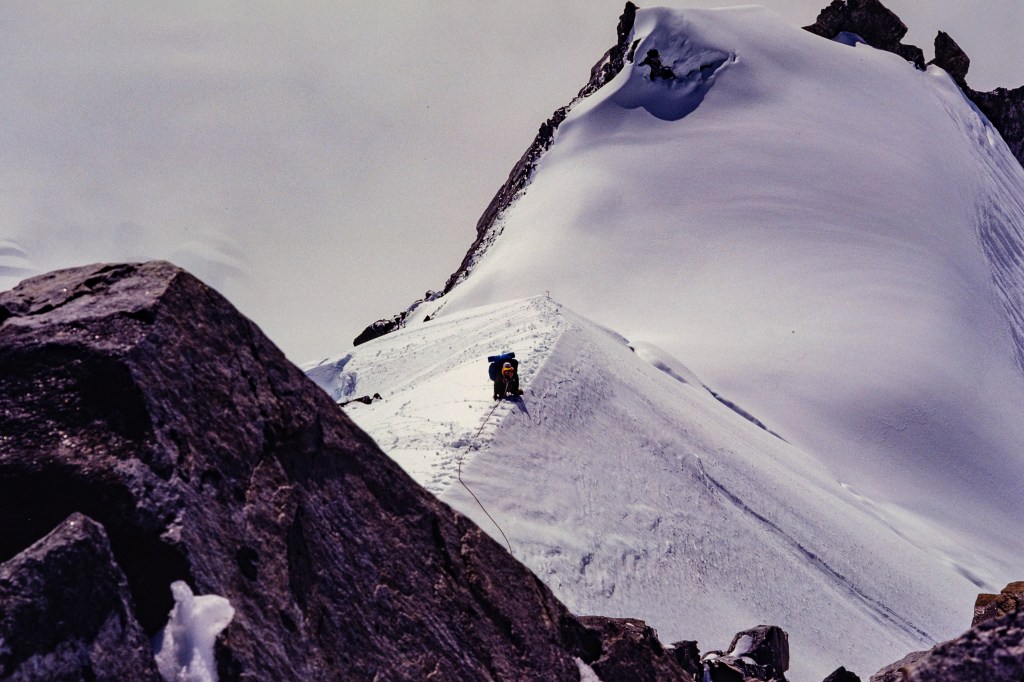
SE ridge, the Tooth, and Summit. Tracks from failed effort are visible.
Joe moving camp up the SE ridge. Bravo Peak in upper right corner of photo.
Chris moving up.
New high camp with snow walls. Route to the top lies near center of rock tower.
Mts Combatant, Tiedemann, and Asperity in background.
Mt Munday
Summit. Route goes up the snow gully in lower middle, then into the shadowed rock cleft in center.

The Best Day

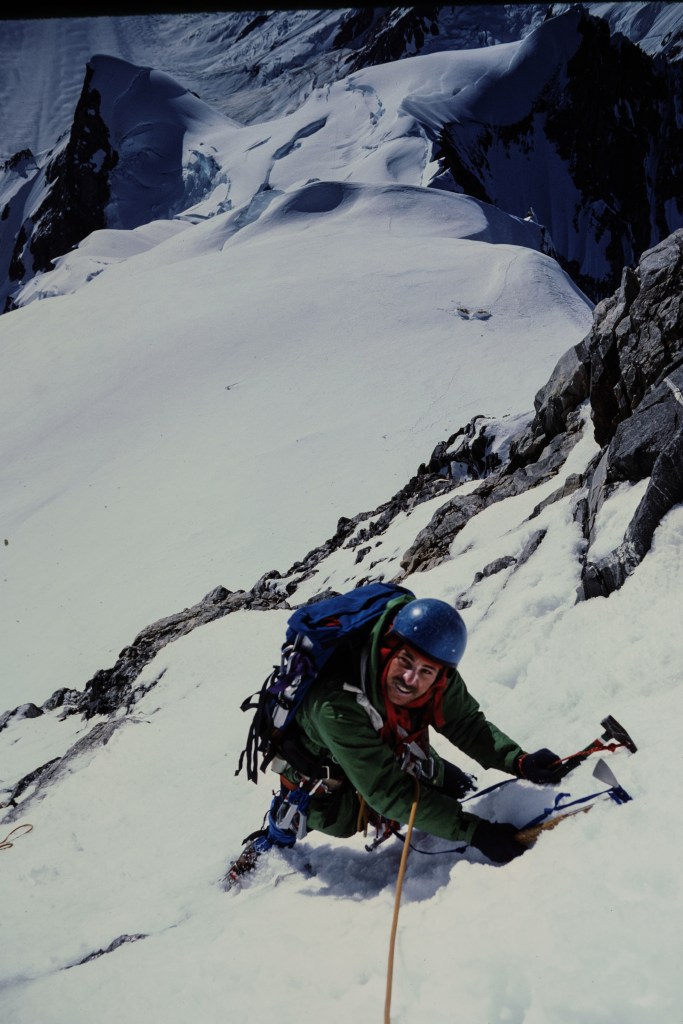
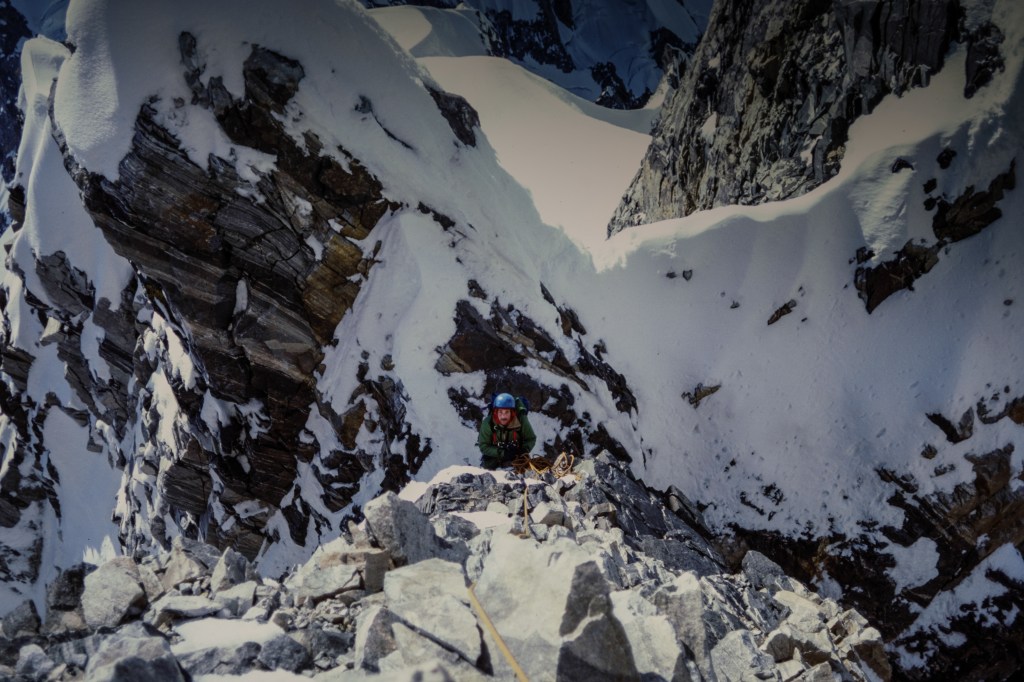
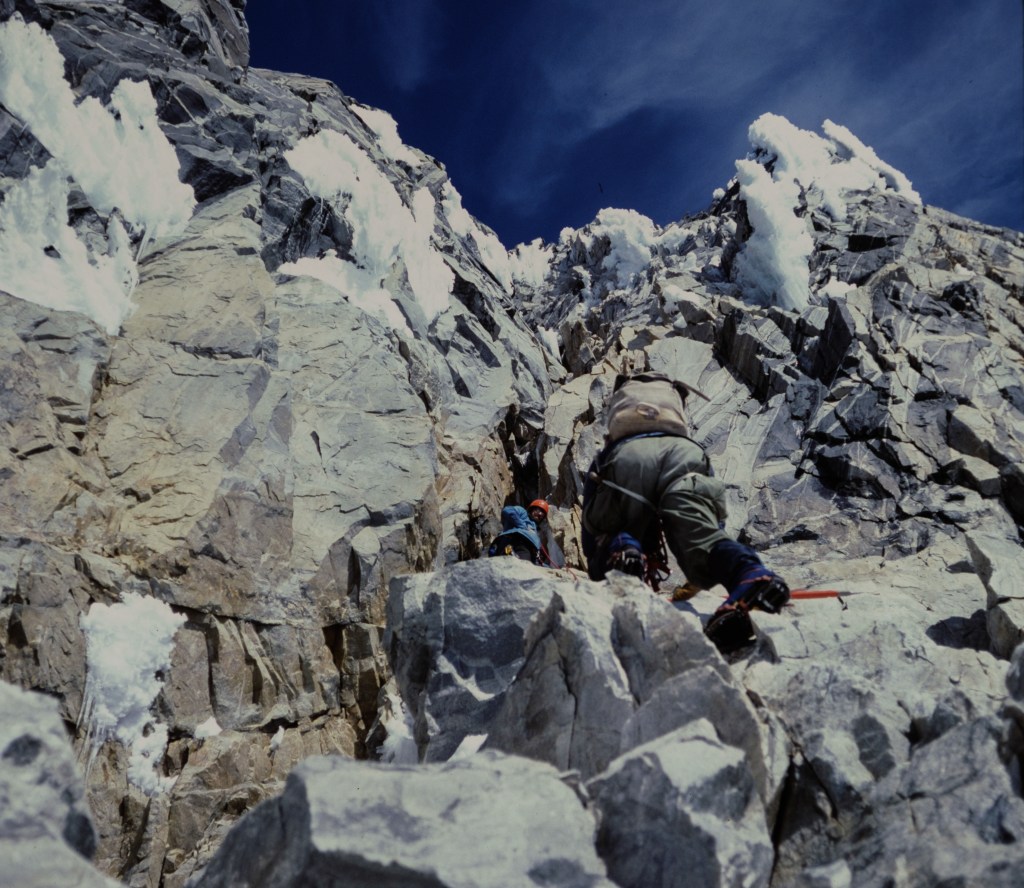
Diary entry: “July 21. Awake 2am. Ready to go by 4, but still too dark — we catnap with our boots on until 5:30. Then we start. As soon as we go my mood changes – I am excited, happy, and feel strong. Up to the notch between the main summit and the Tooth. Into a long rock gully. We are climbing on both rock and ice, wearing crampons which scrape on the rock. We protect ourselves with pitons and nuts in rock, screws in the ice. A chockstone blocks progress in the gully – we quickly overcome this by stepping up on nylon sling. Exit the gully on a ledge to left, then up and back right into the slot. Then the slope breaks back and we are on easier mixed rock and snow. I hear Gus call out – he is on top, 2pm. The top is a tiny snow tower; only two can go up at a time – are we actually standing on anything solid? Peaks stretch away for miles. Lovely sun. Then down and down and down, a mix of rappels and downclimbing with ice tools. At 9:30pm we are back at the tents. Water, food. I am smiling as I fall asleep.”

Chris. Note tents above his helmet. Bravo Peak in upper left.
Gap between Tooth and summit.
Gus and Joe. Chockstone above Gus’s orange helmet.
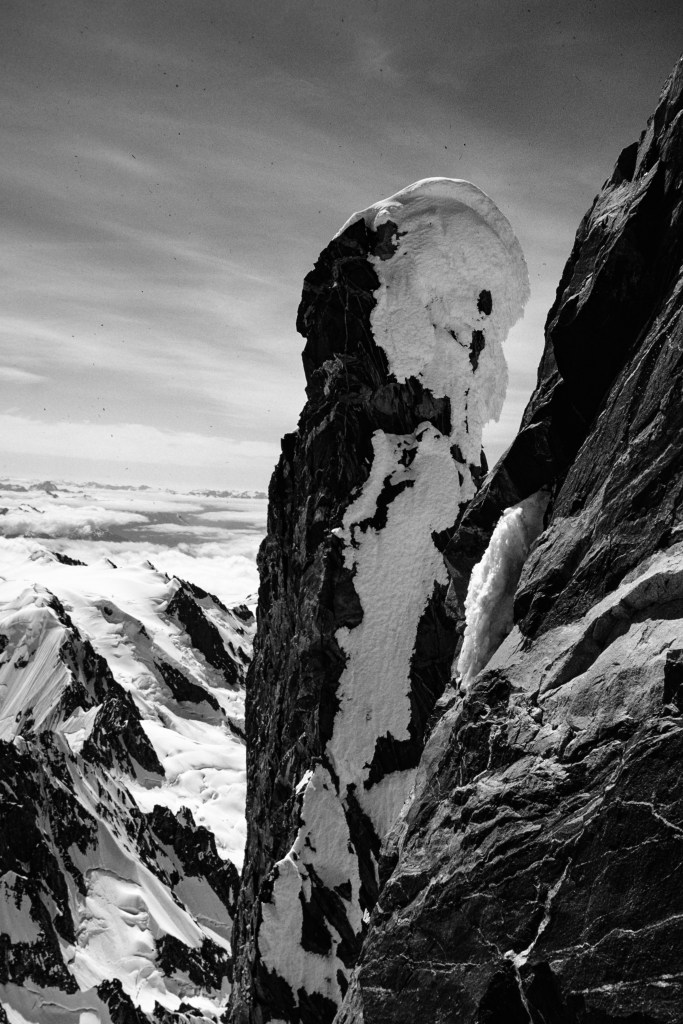
The Tooth. We are almost level with its summit.
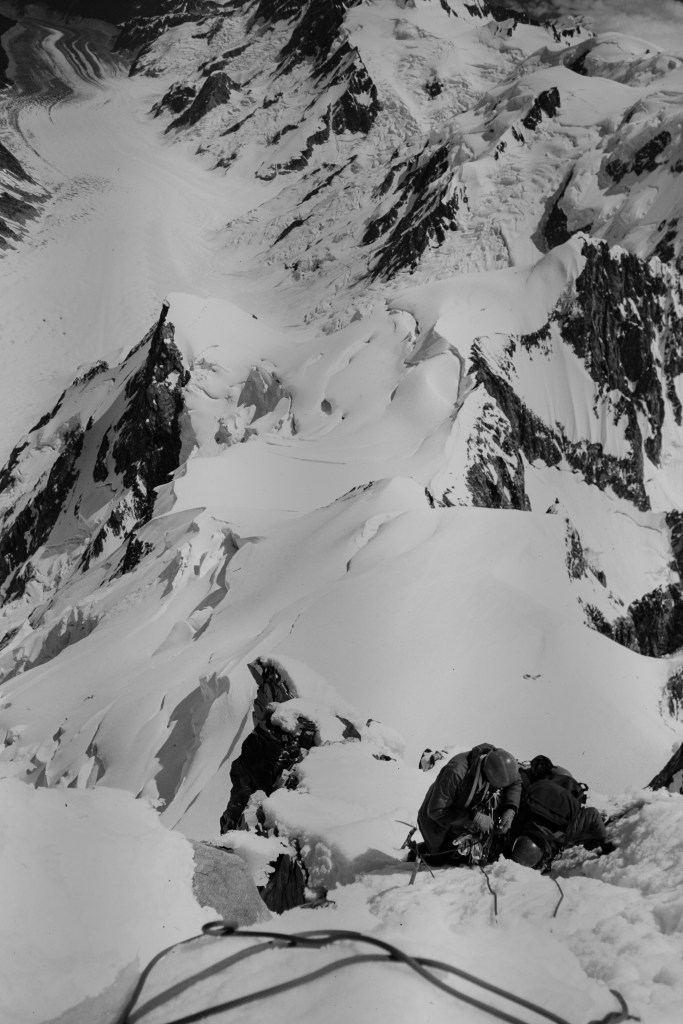
I am on top. Gus and Joe are just below, starting descent. Our tents are on snow above their heads.
Chris joins me on top. A happy fellow. The Tooth is below his right elbow.
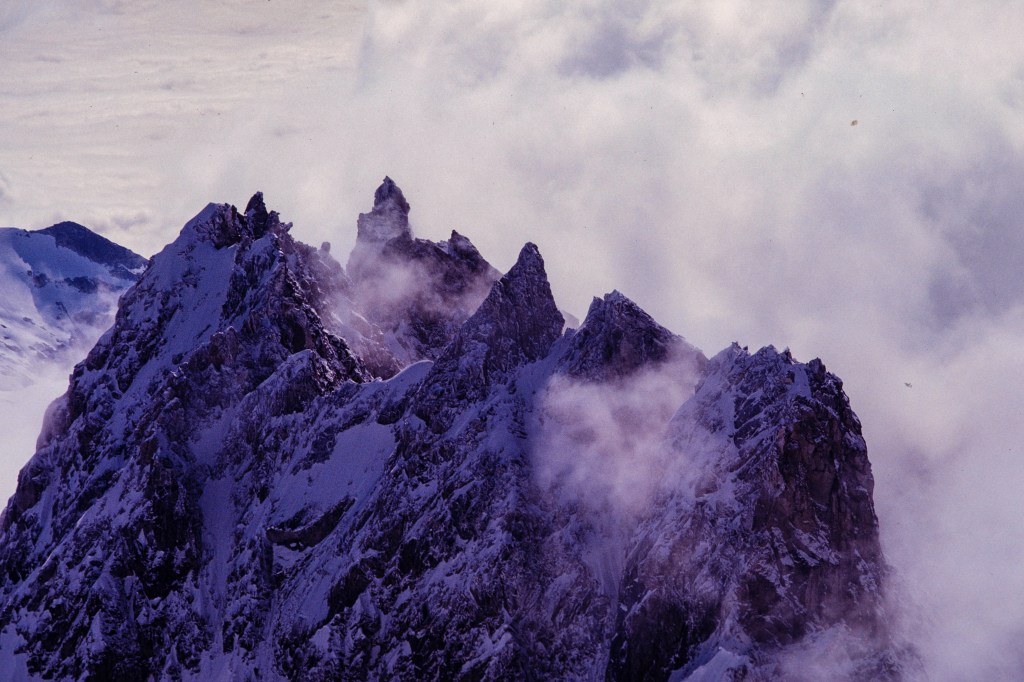
The NW summit.
Rappeling down.
Chris rappels. Note crampons on his feet.
Descending the next day.
Gus and Joe. Bravo Peak in background.
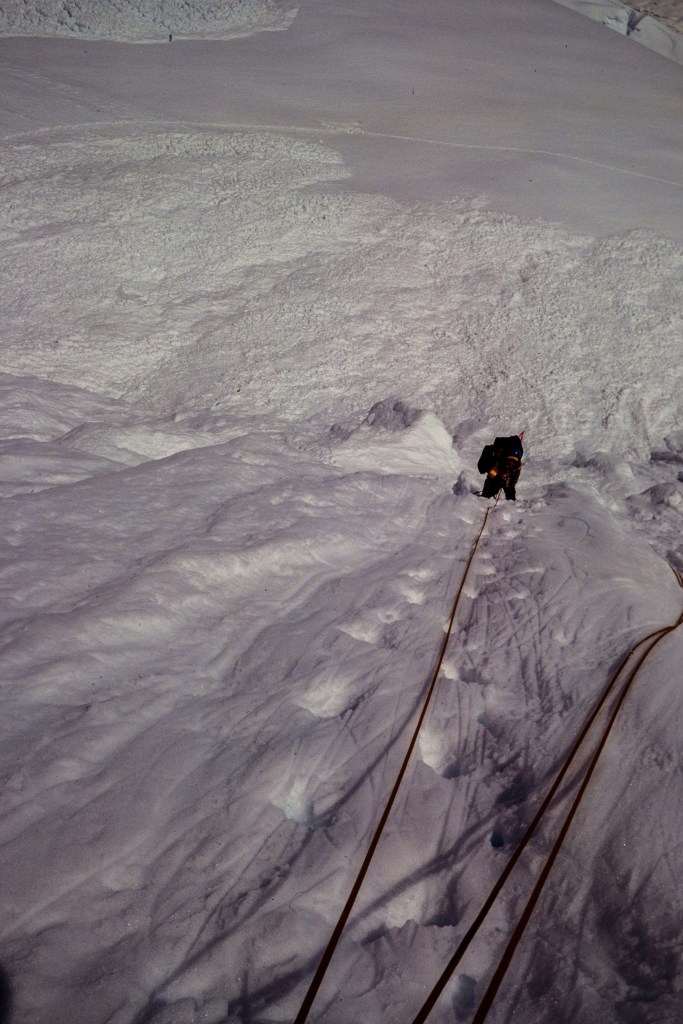
Rappel to the bergschrund. Avalanche debris below.
Crossing the bergschrund.

Aftermath

We hiked up to the Plummer Hut and climbed additional peaks (Heartstone, Dentiform, Serra III).

Gus and Joe approach the hut.
Hut on left, Bravo Peak in middle, Waddington in cloud on right.
Avalanche pours off Waddington.
Dawn view from the hut.
Summits everywhere.
Mount Heartstone.
Climbing Heartstone.
Heartstone.
Descending a slope.
Dentiform. We climbed this.
Serra III; highest point near middle. Gus and I climbed this.
Serra III from Tellot Glacier. Route goes to snow notch on left, then right up ridge.
Gus coming up Serra III. My boot is in lower left.
View from Serra III.
Our taxi arrives. Time to go home.